
You come to the park along the river, and the first thing that stops you is the skeleton of the A-Bomb Dome, its bare ribs of steel against the sky. Beyond it, paths run through lawns and trees toward a cenotaph, a flame and a monument draped in colorful paper cranes. This is a memorial to the victims of the first nuclear attack on a city, set in the center of Hiroshima, and the visit is a quiet, reflective one.
Is visiting Hiroshima Peace Memorial Park worth it?
Yes, for almost any traveler who comes to Hiroshima, and above all for those who want to understand the city rather than just pass through it. The park is dedicated to Hiroshima’s legacy as the first city in the world to suffer a nuclear attack and to the memory of the bomb’s victims. More than one million people walk its paths each year, and that number tells you this is a place people feel they need to see in person.
What sets it apart from the other sights around the city is its purpose. Elsewhere in the prefecture you find the Seto Inland Sea, wooded mountains, clear waters, shrines and the red torii gate standing in the sea at Itsukushima Shrine on Miyajima.
Those are places of scenery and pilgrimage. The Peace Memorial Park is a place of remembrance, laid out with monuments that each carry a story, and you walk it slowly, often without saying much.
The A-Bomb Dome and the adjacent park together make up the two UNESCO World Cultural Heritage sites that Hiroshima holds in its own city. That recognition reflects how the place is read today: not as a ruin to gawk at, but as a message. Visitors who come with open time tend to find the visit settles in the mind long after they have moved on to okonomiyaki for dinner or a day on Miyajima.
What to see at Hiroshima Peace Memorial Park
The park gathers its monuments along a line of lawns, trees and riverbank, so a walk through it reads like a sequence of quiet stops. Each one has its own meaning, and the order matters less than the time you give them.
The A-Bomb Dome
The Dome is the ruin of a building left standing as a frame of twisted steel and broken masonry, and it has been kept as a witness to what happened in the city. It was added to the UNESCO World Heritage List on December 7, 1996. You cannot go inside, so it is seen from the outside only, from the riverbank and the nearby paths.
Take your time circling it and looking at the details: the exposed ribs of the dome, the rough edges of the walls, the contrast with the modern city rising behind. Seen across the water, with trees in front and glass towers beyond, it makes the passage of time visible in a single frame.
The Children’s Peace Monument and the paper cranes
This monument is easy to recognize from a distance by the bright color around it. Visitors can see a continuously replenished collection of folded paper cranes, sent from around the world, displayed in glass cases and hung in strings. The crane has become a symbol of hope and of the wish for peace, and the folded paper represents the many hands that made each one.
Near the monument stands the Peace Bell, and visitors are encouraged to ring it for world peace. The sound carries across the lawns. It is a small gesture, and people pause to do it in silence before moving on.
The Memorial Cenotaph, the Peace Flame and the Memorial Mound
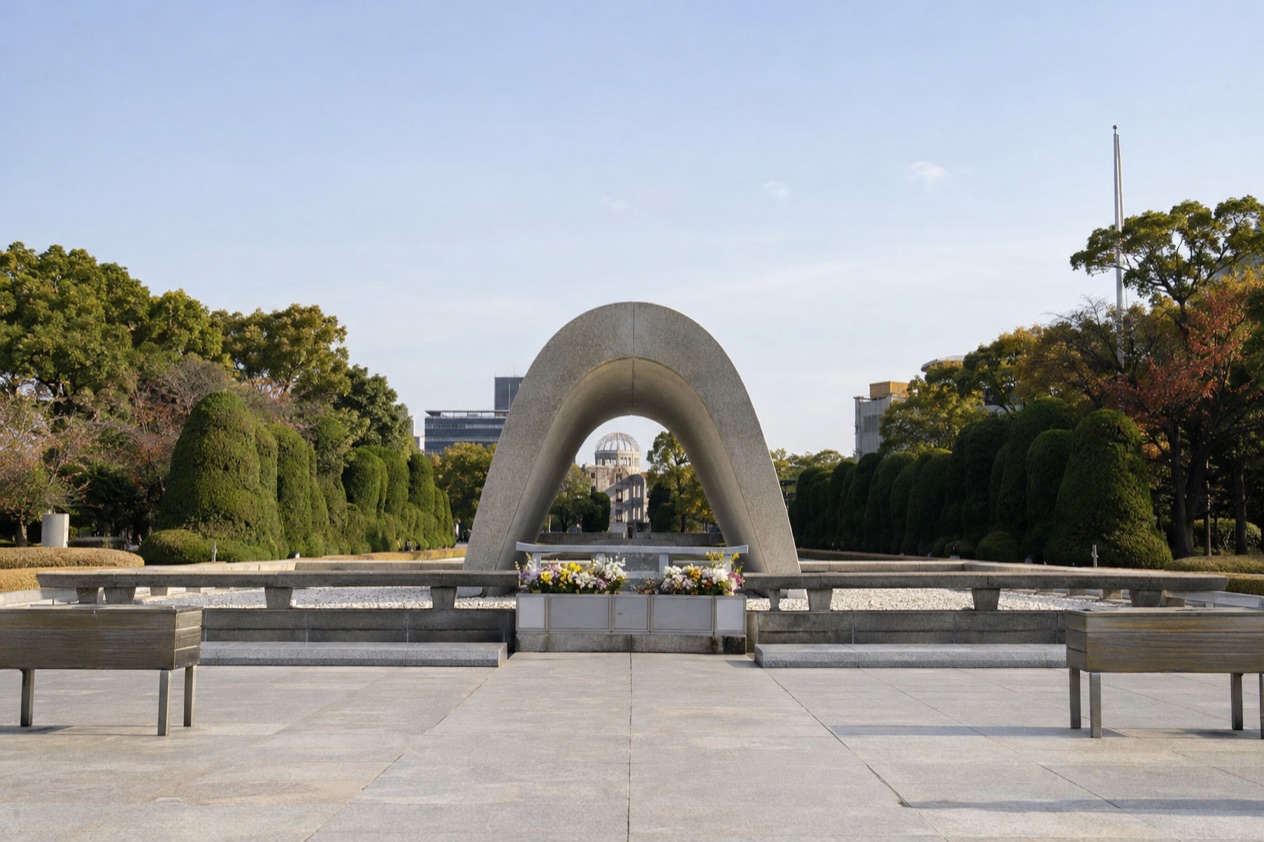
The Memorial Cenotaph is where the Hiroshima Peace Memorial Ceremony takes place each August 6. Aligned with it, the Peace Flame has burned continuously since it was lit in 1964. Standing between the two, you take in the line of the park and the Dome beyond, a composition that is deliberate and quiet.
The Atomic Bomb Memorial Mound holds the cremated ashes of 70,000 unidentified victims. It is a grassy rise, simple in form, and it asks for a few minutes of stillness. Visitors often stand a while here before walking on toward the river.
The Rest House
The first floor of the Rest House is used as a tourist information office and a souvenir shop. It is a useful place to stop for orientation and a pause between monuments, with the park all around you. Souvenirs here sit alongside maps and local information, so you can combine a practical stop with the walk.
Hours, tickets and rules
The park is an open public space in the heart of the city, and the events held in it follow their own timetable. The big ceremony of the year starts in the morning on August 6, and the Flower Festival fills the park and Peace Boulevard in early May.
| Site | Open |
|---|---|
| Peace Memorial Ceremony, in front of the Memorial Cenotaph | August 6, from 8:00 AM |
| Hiroshima Flower Festival, Peace Memorial Park and Peace Boulevard | May 3 to May 5 |
It can only be viewed from the outside. Visitors are encouraged to ring the Peace Bell near the Children’s Peace Monument for world peace.
How to get to Hiroshima Peace Memorial Park
The park sits in the center of Hiroshima, and several stops serve it. By tram you can use Hiroden Genbaku Dome-mae Station or Hiroden Chuden-mae Station. By bus there is the Hiroshima Peace Memorial Park bus stop. The Astram line has Hondori Station as well.
Genbaku Dome-mae takes its name from the Dome itself, so that stop puts you beside the first thing visitors want to see. The other stops let you enter from different sides, which is handy if you plan to walk through the park in one direction and leave from another.
To reach Hiroshima itself, the shinkansen runs to the city, taking about four hours from Tokyo and 90 minutes from Osaka. From the station in the city you continue on to the park by one of the stops above.
When to visit Hiroshima Peace Memorial Park
The date that gives the park its deepest meaning is August 6. The Peace Memorial Ceremony is held that day from 8:00 AM in front of the Memorial Cenotaph. In the evening, a Lantern Ceremony sends off the spirits of the victims on lanterns floating on the Motoyasu River. Thousands of people write peace messages on the lanterns, which are lit at sunset and carried along the river in front of the Dome.
In early spring and autumn the park is a pleasure to walk. April brings highs in the upper 60s with about nine rainy days, and October is a little warmer, with highs in the mid-70s and fewer rainy days. Both months have long hours of sun, so lawns and riverbanks are comfortable for slow walking.
Early May has its own draw: the Hiroshima Flower Festival runs from May 3 to May 5 in the park and on Peace Boulevard, which fills the space with a festive mood alongside the memorial. Summer is hot and humid. July highs reach the upper 80s, with lows in the mid-70s and heavy rain over the month, so the park in July asks for patience and a lot of water. Winter is cool, with January highs near 50 degrees and the chance of snow or sleet.
| Month | Avg high (°F) | Avg low (°F) | Precipitation (in) | Rain days | Sunshine (hours) |
|---|---|---|---|---|---|
| January | 49.8 | 35.6 | 1.82 | 5.5 | 139 |
| April | 67.6 | 50.2 | 5.55 | 8.8 | 192 |
| July | 87.6 | 75.4 | 11.02 | 10.6 | 173 |
| October | 74.7 | 58.8 | 4.30 | 6.2 | 179 |
Tips for your visit
Plan for an unhurried walk. The park rewards slow attention to the monuments, the cranes, the river and the Dome, and nothing in it asks you to rush. Wear comfortable shoes for the paths and bring something for the weather of the month you visit, a hat and water in summer or a layer in winter.
Start at the Rest House if you want a map or local information, since its first floor serves as a tourist information office and a souvenir shop. From there you can follow the line of the park from the Dome toward the cenotaph, the flame and the mound, and take time at the Children’s Peace Monument to see the cranes and ring the Peace Bell.
The park pairs well with other parts of Hiroshima. Okonomiyaki, the local version of the savory pancake, makes an obvious meal after a morning of reflection. A day trip to Miyajima Island brings a change of mood, with its deer and the floating shrine of Itsukushima, which was registered as a World Heritage Site in 1996.
On a day when you come for the August 6 ceremonies, expect a more solemn atmosphere than usual. The morning ceremony and the evening lanterns on the river are moments to observe respectfully rather than photograph at every turn.
Good to know before you go
The park is a place of mourning as well as a public green space, so voices tend to drop and conversation stays low. Dress comfortably for walking and for the season. Summer brings heat and humidity, and rain falls in every season, with winter days sometimes bringing snow or sleet. Take your time and let the park set the pace.
Sources
- Wikipedia, Hiroshima Peace Memorial Park (https://en.wikipedia.org/wiki/Hiroshima_Peace_Memorial_Park), checked October 11, 2026
- Japan National Tourism Organization, Hiroshima (https://www.japan.travel/en/destinations/chugoku/hiroshima/), checked October 11, 2026
- Visit Hiroshima, the official guide (https://visithiroshima.net/), checked October 11, 2026
- Japan Meteorological Agency (JMA), Normal values 1991-2020, monthly (https://www.data.jma.go.jp/stats/etrn/view/nml_sfc_ym.php?prec_no=67&block_no=47765), station Hiroshima, elevation 4 m, checked October 11, 2026
To plan your stay
- Best Time to Visit Hiroshima: Cherry Blossoms, Autumn Weather, Rainy Season and Festivals
- Where to Stay in Hiroshima: Peace Park, Station Area, Castle District and Miyajima Island
- Hiroshima from Osaka: Shinkansen, Local Trains and a Day at the Peace Park
- Know Before You Go to Hiroshima: Entry, Money, Getting Around and Local Etiquette