
In September, Hakone is wrapped in the smell of sulphur and wet cedar, and the clouds slide down the mountainsides as if the valleys were pouring them out. Steam still rises from the vents at Owakudani, the lake is there when the mist lifts, and the first hint of cooler air arrives in the evening. It is a month for hot springs, ropeway rides and long lunches indoors, for travelers who accept that a rainy mountain has its own mood.
What is the weather like in Hakone in September?
September is still warm at the foot of the mountain but clearly softer than August, and it is the wettest month of the year in Hakone. At Odawara, at the foot of Hakone, summer heat lingers by day while nights turn mild. Higher up, the weather is cloudier and wetter than the table suggests.
| Month | Average high (°F) | Average low (°F) | Precipitation (in) | Hours of sunshine | Daylight on the 15th |
|---|---|---|---|---|---|
| August | 87.1 | 73.4 | 6.58 | 202 | 13 h 32 min |
| September | 81.0 | 67.3 | 9.79 | 138 | 12 h 27 min |
| October | 72.0 | 57.4 | 9.40 | 131 | 11 h 21 min |
The table speaks for the foot of the mountain. That gap explains why a day can start with sun on the coast and turn into a gray, dripping afternoon around Lake Ashi or Owakudani. Rain gear belongs in the bag even when the forecast for the valley looks friendly.
Layers matter more than a heavy coat. A cotton shirt covers the warm stretches near Hakone-Yumoto, and a light sweater or thin jacket helps when you climb into the cloud on the ropeway. Fewer hours of sun than in August means the light is softer and the days are noticeably shorter, so dinner at a ryokan, an inn with set meals, arrives with the dusk well before you have run out of energy.
What to do in Hakone in September
September has no single festival that defines Hakone. What marks the month is a change of pace after the summer rush and a taste of the coming autumn.
Moon viewing season, tsukimi, falls around now in Japan, and many inns and tea shops set out rice dumplings and pampas grass in its honor.
Hakone is built on hot water. The Japan National Tourism Organization calls it world-renowned for its natural hot springs and views of Mount Fuji, and a soak is the natural answer to a gray day. Whether a bath is in an inn, a day-use facility or an open-air pool, the pleasure is the same: warm water, cool air on your face, and the sound of rain on leaves.
Lake Ashi and the Hakone Sightseeing Cruise
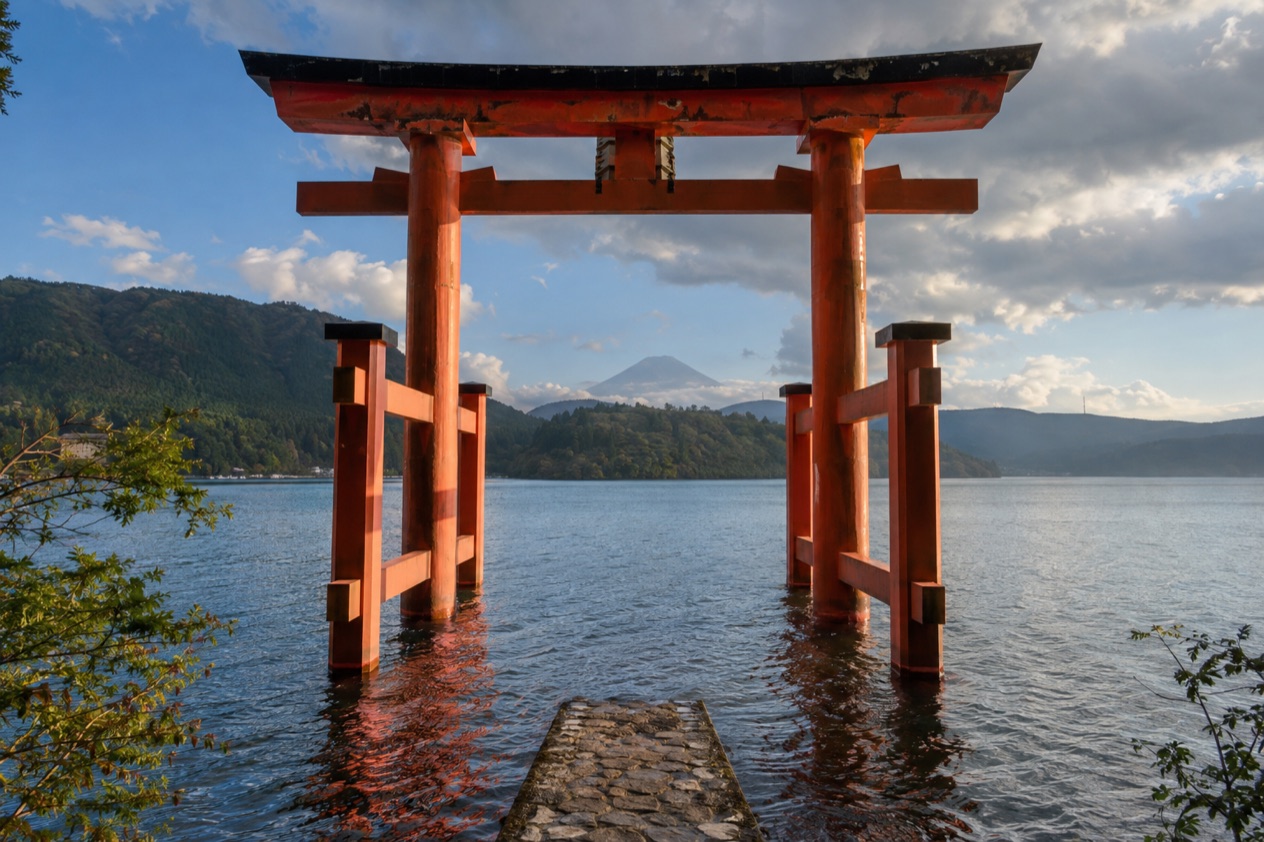
Lake Ashi is a crater lake and one of the places that gives Hakone its character. A boat on the Hakone Sightseeing Cruise lets you see the shoreline, the forested slopes and the red torii gate of the lakeside shrine from the water. In September the clouds often sit low on the hills, which gives the lake a moody, silvery look, and when they part you may see Mount Fuji in the distance.
The cruise is one of the eight forms of transport that the Hakone Freepass covers, so it fits naturally into a day of hopping between the lake, the ropeway and the mountain train. It suits travelers who like to be carried along while the scenery changes. Bring a rain jacket for the deck, since the weather on the lake can shift fast.
Owakudani and the Hakone Ropeway
The Hakone Ropeway links Sounzan and Togendai by way of Owakudani, a volcanic valley with active sulphur vents and hot springs. Cabins rise over a landscape of yellow-stained rock and drifting steam, and the smell tells you where you are before you see it. Here you can taste the black eggs, kuro-tamago, boiled in the hot springs, which are said to prolong life by seven years each.
In September the cloud can fill the valley and hide the slopes, so the vents appear and disappear in the mist, an atmospheric sight in its own right. The ropeway is also part of the Freepass. Keep a layer handy, because the air around the vents feels cooler and damper than at the lake.
Art museums and the Open-Air Museum
The Hakone Open-Air Museum, Japan’s first open-air museum, opened in 1969 and shows sculpture on its hillside grounds. Between showers you can walk among the works, and when the weather turns, the indoor galleries are close by.
The Hako Ticket Plus pairs the Digital Hakone Freepass with the Hako Ticket, which grants unlimited use of applicable art museums, hot springs and activity facilities. It is valid for 2 days or 3 days. For a rainy September trip, that mix of transport and indoor stops is a natural fit.
Hakone-Yumoto is known for its many restaurants and gift shops, and it makes a good place to sit down with a bowl of soba or a plate of local fish cakes. Wherever you eat, the cooler evenings of September make hot dishes taste better than they do in August.
A two-day itinerary for Hakone in September
Day 1 starts in Hakone-Yumoto, where the restaurants and gift shops are a gentle introduction. Spend the morning on a first soak and a browse through the shops, then take the mountain train up into the hills.
In the evening, settle into a ryokan, where dinner is served at a set hour and the inn’s own bath waits afterward. Since the sun sets earlier than in August, you will be indoors for supper with the light fading outside. If you arrive in Japan the same day, plan the ryokan for the following night so you do not miss dinner.
Day 2 belongs to the ropeway, the lake and the volcano. In the morning, ride from Sounzan over Owakudani, taste the black eggs, and look at the sulphur vents. Continue to Togendai and step aboard the Hakone Sightseeing Cruise on Lake Ashi for the shoreline and, with luck, a view of Mount Fuji.
The rain card is simple. If the weather turns, spend the day in the museums, followed by a long soak in a hot spring and an early dinner of local dishes. With the Freepass in hand, switching between transport and indoor stops costs no extra planning.
Is Hakone busy in September?
Hakone is popular year-round with visitors from Tokyo and beyond, and September does not change that. The proximity to Tokyo and the views of Mount Fuji keep the area on many itineraries, so expect to share the ropeway, the lake and the mountain train with other travelers.
What September does change is the weather that shapes each day. Rain and cloud can thin out those who come only for the view, while hot springs, museums and restaurants stay as busy as ever in any weather. The big autumn color season arrives much later, from mid-November to early December, so September is not a leaf-peeping month.
The pace is that of a mountain resort between seasons. Mornings can start slowly in the mist, and evenings revolve around the baths and the set dinners of the ryokan. Plan for a mix of indoor and outdoor stops and the days will feel unhurried even when the paths are shared.
What to pack for Hakone in September
Pack for warm valleys and cool, wet hills, and for plenty of changes between indoors and outdoors.
- A light rain jacket or compact umbrella, because the mountain side is wetter than Odawara.
- A thin sweater or fleece for the ropeway, the cruise deck and the evenings.
- Breathable short sleeves for the warm hours near the foot of the mountain.
- Shoes that can handle wet paths around Owakudani and the museum grounds.
- A small towel for the baths and for drying off after a shower.
- A bag or dry pouch to keep a phone and a Freepass safe from rain.
Good to know before you go
September is the wettest month in Hakone, so build some slack into outdoor plans and keep museums and baths as your fallback. The Hakone Freepass covers eight kinds of transport, including the mountain train, the ropeway and the cruise, and a version with an Odakyu Line return trip between your departure station and Odawara exists. Travelers staying at a traditional ryokan are advised to plan their arrival at least one day after landing in Tokyo to avoid missing dinner or being locked out at curfew.
Hakone in September vs August and October
Moving four weeks earlier brings more sun and hotter days, with far more sunshine hours than September and longer evenings. August is also drier at Odawara, but the mountain side still gets plenty of rain, and the humid summer heat of Honshu is part of the deal. If you want long, bright days and do not mind sultry air, August is the pick.
Four weeks later, October is clearly cooler, with lows well down into the fifties and shorter days. The rain stays about as heavy as in September at the foot of the mountain and heavier on the mountain side, but the air feels more comfortable for walking. The famed autumn colors have not yet arrived, since they are placed from mid-November to early December.
Those who like warm air and a lazy pace should stay with September or go earlier. Those who prefer cooler air for walking and hot baths should look to October. For museums, ryokan dinners and a soak in the rain, September serves well.
Is September a good time to visit Hakone?
Yes, for travelers who care more about hot springs, museums and moody mountain scenery than about guaranteed blue skies. September suits people who enjoy a soak with rain on the roof, a boat on a misty lake and a bowl of soba in a warm room.
It is a poorer fit for anyone who needs a clear view of Mount Fuji, a dry itinerary or the autumn colors. If that is you, look at another month.
What makes September in Hakone memorable is the steam. It rises from the vents at Owakudani, from open-air baths and from the bowls on your table, and the cooling air makes each of them more welcome than the last.
Sources
- Japan Meteorological Agency (JMA), Normal values 1991-2020, monthly (https://www.data.jma.go.jp/stats/etrn/view/nml_amd_ym.php?prec_no=46&block_no=1008), station Odawara, elevation 14 m, checked October 11, 2026
- Computed from the date and the latitude of the place (sunrise equation, solar elevation -0.833 degrees), October 11, 2026
- Japan Meteorological Agency, Emergency Warnings (https://www.jma.go.jp/jma/en/Emergency_Warning/ew_index.html), checked October 11, 2026
- Japan National Tourism Organization, safety information (https://www.japan.travel/en/japan-safe-travel-information/), checked October 11, 2026
- Japan National Tourism Organization, weather and seasons in Japan (https://www.japan.travel/en/plan/weather/), checked October 11, 2026
- Japan National Tourism Organization, summer in Japan (https://www.japan.travel/en/guide/summer-guide/), checked October 11, 2026
- Wikipedia, Climate of Japan (https://en.wikipedia.org/wiki/Climate_of_Japan), checked October 11, 2026
- Japan Meteorological Agency, maple color-change dates 2025-2026 with difference from the 1991-2020 normal (https://www.data.jma.go.jp/sakura/data/phn_014.html), checked October 11, 2026
- Japan Meteorological Agency, kaede2020.pdf (https://www.data.jma.go.jp/sakura/data/kaede2020.pdf), checked October 11, 2026
- Japan National Tourism Organization, autumn in Japan (https://www.japan.travel/en/guide/autumn-guide/), checked October 11, 2026
- Japan National Tourism Organization, spring in Japan (https://www.japan.travel/en/guide/spring-guide/), checked October 11, 2026
- Japan National Tourism Organization, Hakone (https://www.japan.travel/en/destinations/kanto/kanagawa/hakone-and-around/), checked October 11, 2026
- Hakone Tourist Information (https://www.hakonenavi.jp/international/en/), checked October 11, 2026
- Wikipedia, Hakone, Kanagawa (https://en.wikipedia.org/wiki/Hakone,_Kanagawa), checked October 11, 2026
- Wikivoyage, Hakone (https://en.wikivoyage.org/wiki/Hakone), checked October 11, 2026
- Wikipedia, Hakone Open-Air Museum (https://en.wikipedia.org/wiki/Hakone_Open-Air_Museum), checked October 11, 2026
- Wikipedia, Hakone Ropeway (https://en.wikipedia.org/wiki/Hakone_Ropeway), checked October 11, 2026
- Wikipedia, Ōwakudani (https://en.wikipedia.org/wiki/%C5%8Cwakudani), checked October 11, 2026
- Wikipedia, Lake Ashi (https://en.wikipedia.org/wiki/Lake_Ashi), checked October 11, 2026
To plan your stay
- Things to Do in Hakone: Lake Ashi, Owakudani, Open-Air Museum and Hot Springs
- Where to Stay in Hakone: Hakone-Yumoto, Lake Ashi, Sengokuhara and Ryokan Stays
- Hakone from Tokyo: Romancecar, Shinkansen, Local Trains and the Hakone Freepass
- Know Before You Go to Hakone: Getting There, the Freepass, Weather and Etiquette