
In April, steam still curls off the outdoor baths of Hakone while the air around them has a cool edge, and a soak feels like the right answer to a spring morning in the mountains. The town of Hakone-Yumoto fills with the smell of grilled snacks and sweets, boats cross Lake Ashinoko, and the hills look fresh after winter. April is a month for hot springs, lakeside walks and long dinners in a ryokan, with the weather turning gradually kinder.
What is the weather like in Hakone in April?
April in Hakone is mild and a little changeable: warm enough for sightseeing in a light jacket at the foot of the mountain, with plenty of rain on the higher slopes. At Odawara, at the foot of Hakone, the air has clearly warmed since March and the days have stretched out.
| Month | Average high (°F) | Average low (°F) | Precipitation (in) | Hours of sunshine | Daylight on the 15th |
|---|---|---|---|---|---|
| March | 57.4 | 39.9 | 6.91 | 161 | 11 h 54 min |
| April | 66.0 | 48.6 | 7.15 | 177 | 13 h 03 min |
| May | 73.0 | 56.8 | 7.17 | 182 | 14 h 00 min |
Plan for a damp day or two even when the lowland looks bright, and keep a compact umbrella or a light rain shell within reach for the lake and the hillside paths.
Afternoons are comfortable for walking in a light jacket or a simple sweater, which is what Japanese travel guidance suggests for spring in general. Nights drop to the point where you will want a layer for the walk to dinner, and a hot bath afterward feels very welcome. In March the lows are close to freezing, so April is a clear step toward spring.
The light is generous. Days are well over thirteen hours long, which leaves room for a late lake cruise or a museum visit followed by an unhurried walk before dark. With sunshine on a good share of the days, views of Mount Fuji are possible, though the mountain keeps its own schedule and may hide behind cloud.
What to do in Hakone in April
Hakone is a spa town set in the Fuji-Hakone-Izu National Park, and April suits its main pleasures: warm water, boat rides, art and a good meal. Hakone itself has plenty to fill a stay without any single bloom to chase.
The town of Hakone-Yumoto is known for its many restaurants and gift shops, and it makes a pleasant place to wander before heading up into the hills. Look for sweet buns, wooden craft goods and local snacks to pick at as you go. Sengokuhara is filled with art museums, and a rainy hour is easy to spend there.
Hot springs
Hakone is renowned for its natural hot springs, and April is a very good moment to use them. After a day outdoors in a cool breeze, the bath is the reward: you wash first at a seat with a small stool and a shower, then slip into the water, sometimes open to the sky and the trees outside.
Travelers stay in a ryokan, a traditional inn with tatami floors, a yukata (a light cotton robe) to wear around the building and a multi-course dinner served in the evening. Staying overnight turns the bath into a ritual, one soak before dinner and another before bed. A ryokan stay suits those who want a slow rhythm over a packed list of sights.
Lake Ashinoko by boat
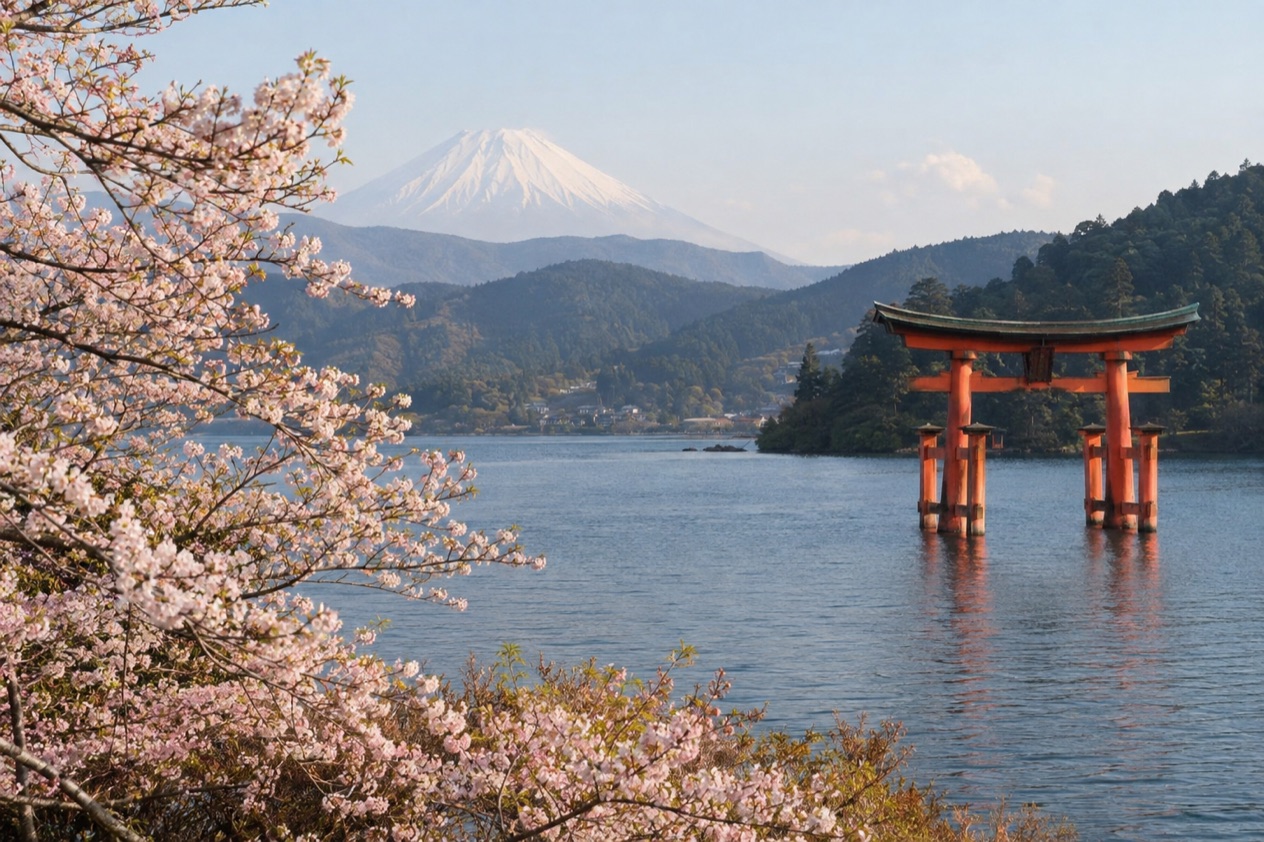
Lake Ashinoko lies at the center of the national park, and visitors can explore it by boat on the Hakone Sightseeing Cruise. From the deck you see the shoreline, the wooded slopes and, when the clouds allow, the shape of Mount Fuji beyond the water. Spring air makes standing on deck pleasant with a jacket on.
The cruise is one of the eight forms of transport covered by the Hakone Freepass, along with the Hakone Tozan Train and the Hakone Ropeway. Using them in sequence turns getting around into part of the sightseeing, with mountain railway, ropeway and boat each giving a different view of the same landscape.
Owakudani and its black eggs
Owakudani is the volcanic valley where Hakone’s geology is on show, and it is where you can taste the black eggs, cooked in the hot springs and said to prolong life. The shells turn dark, while the inside tastes like an ordinary hard-boiled egg, a little salty. Eating one is a small ritual of the Hakone trip.
The area belongs to the volcanically active landscape of the national park, so the setting feels raw compared with the lake below.
Art in the hills
Hakone has the open-air museum described as Japan’s first, where sculptures stand among lawns and trees. Spring suits it, with fresh green around the pieces and a mild day to walk between them. Sengokuhara, meanwhile, holds a cluster of art museums for the hours when you would rather be indoors.
Together they make a good rainy-day plan or a gentle counterpart to the baths and the lake. Pairing one outdoor museum visit with one indoor gallery gives the day a shape that adapts to the sky.
A two-day itinerary for Hakone in April
Day 1 starts in Hakone-Yumoto, with its restaurants and gift shops. Have a late breakfast of something warm, browse the shops and then take the Hakone Tozan Train up into the hills. By midday, settle into a noodle or tofu lunch at a small local restaurant, then continue to Sengokuhara.
Spend the afternoon among the art museums of Sengokuhara, which also double as the plan for a wet day. In the evening, check in to a ryokan, bathe, and sit down to the multi-course dinner. Arrive in good time, because dinner is served at a set hour and the doors have a curfew.
Day 2 is for the outdoors. Begin with the Hakone Sightseeing Cruise on Lake Ashinoko, where the long April daylight gives room for an unhurried morning on the water. Continue to Owakudani, taste the black eggs and walk around the volcanic valley with a layer on.
In the afternoon, visit the open-air museum and let the sculptures set the pace of a slow walk. If rain settles in, spend longer over lunch, turn to the indoor galleries and plan for a bath at the end of the day. The Hakone Freepass covers the transport for this circuit, so each leg is part of the day.
Is Hakone busy in April?
Hakone is a busy destination in April, and the end of the month tips into Golden Week. The area is extremely popular with tourists because of its closeness to Tokyo and its views of Mount Fuji, and spring brings that interest into focus.
Golden Week runs from April 29 to May 5 and contains several public holidays: Showa Day on April 29, then Constitution Memorial Day on May 3, Greenery Day on May 4 and Children’s Day on May 5. When a national holiday falls on a Sunday, the next working day becomes a holiday, and a day sitting between two holidays becomes one too. For a trip to Hakone, that means the last days of April belong to the holiday calendar.
In urban areas, shops are generally open from 10:00 a.m. to 8:00 p.m., while rural shops often close earlier, sometimes as early as 6:00 p.m. In the hills of Hakone, that is a reason to plan the end of the day around the bath and dinner. The first three weeks of the month are the stretch before the holiday week, so the pace of the area is set by the calendar as much as by the weather.
What to pack for Hakone in April
Think in layers: mild afternoons, cool nights and a mountain that gets more rain than the valley.
- A light jacket or simple sweater, for outdoor walks and cool evenings.
- A compact umbrella or rain shell, since the mountain side is wet.
- Comfortable walking shoes, for lakeside and museum grounds.
- A small towel, for the baths and the lake breeze.
- A warm layer for Owakudani and the boat deck.
- A camera with a good zoom, for Mount Fuji when it shows itself.
Good to know before you go
Golden Week begins on April 29, which brings a run of public holidays to the end of the month.
A ryokan serves dinner at a set hour and locks its doors at a curfew, so arriving in good time is wise. The Hakone Freepass Hako Ticket Plus is valid for 2 days or 3 days, and the version with the Odakyu Line ticket includes one return trip on that line between the departure station and Odawara Station.
Hakone in April vs March and May
Moving the trip earlier to March means a colder stay. Highs at Odawara are well below April’s, lows come close to freezing and the days are shorter, so a hot bath feels even better but outdoor walks take more layers. Shifting to May brings warmer air and the longest days of the three months, and the rain is about the same as in April.
May also begins with the tail of Golden Week, with Constitution Memorial Day, Greenery Day and Children’s Day on May 3, 4 and 5, so the first days of the month still belong to the holiday calendar. Travelers who prefer warmer weather may favor May. Those who like a cool morning, a long soak and a mild afternoon will find April the balanced choice, with a milder feel than March and the holiday week only at the end.
Is April a good time to visit Hakone?
Yes, April is a good time to visit Hakone for travelers who like hot springs, lakes and art, and who are happy to pack a light jacket and an umbrella. It suits couples, solo travelers and anyone who wants a ryokan stay with long evenings.
It is less suited to those who want dependable heat or dry weather on the mountain, since the slopes get a lot of rain. For them, May’s warmth may fit better.
On arrival, begin with a soak and a walk through Hakone-Yumoto, then let the weather decide whether the next day goes to the lake or to the museums. What is special about April here is the mix: the first real warmth of the year, the steam over the baths and the lake with a view of Mount Fuji waiting behind the clouds.
Sources
- Japan Meteorological Agency (JMA), Normal values 1991-2020, monthly (https://www.data.jma.go.jp/stats/etrn/view/nml_amd_ym.php?prec_no=46&block_no=1008), station Odawara, elevation 14 m, checked October 11, 2026
- Computed from the date and the latitude of the place (sunrise equation, solar elevation -0.833 degrees), October 11, 2026
- Japan Meteorological Agency, cherry blossom first-bloom dates 2021-2026 and 1991-2020 normal (https://www.data.jma.go.jp/sakura/data/sakura003_07.html), checked October 11, 2026
- Japan Meteorological Agency, cherry blossom full-bloom dates 2021-2026 and 1991-2020 normal (https://www.data.jma.go.jp/sakura/data/sakura004_07.html), checked October 11, 2026
- Japan Meteorological Agency, sakura2020.pdf (https://www.data.jma.go.jp/sakura/data/sakura2020.pdf), checked October 11, 2026
- Japan National Tourism Organization, spring in Japan (https://www.japan.travel/en/guide/spring-guide/), checked October 11, 2026
- Japan National Tourism Organization, flowers by season: cherry blossom, plum, wisteria, hydrangea, where and when (https://www.japan.travel/en/see-and-do/flowers/), checked October 11, 2026
- Wikipedia, Wisteria (https://en.wikipedia.org/wiki/Wisteria), checked October 11, 2026
- Japan National Tourism Organization, shop and attraction hours, national holidays (https://www.japan.travel/en/plan/business-hours-and-holidays/), checked October 11, 2026
- Wikipedia, Golden Week (Japan) (https://en.wikipedia.org/wiki/Golden_Week_(Japan)), checked October 11, 2026
- Wikipedia, Public holidays in Japan (https://en.wikipedia.org/wiki/Public_holidays_in_Japan), checked October 11, 2026
- Japan National Tourism Organization, Hakone (https://www.japan.travel/en/destinations/kanto/kanagawa/hakone-and-around/), checked October 11, 2026
- Hakone Tourist Information (https://www.hakonenavi.jp/international/en/), checked October 11, 2026
- Wikipedia, Hakone, Kanagawa (https://en.wikipedia.org/wiki/Hakone,_Kanagawa), checked October 11, 2026
- Wikivoyage, Hakone (https://en.wikivoyage.org/wiki/Hakone), checked October 11, 2026
To plan your stay
- Things to Do in Hakone: Lake Ashi, Owakudani, Open-Air Museum and Hot Springs
- Where to Stay in Hakone: Hakone-Yumoto, Lake Ashi, Sengokuhara and Ryokan Stays
- Hakone from Tokyo: Romancecar, Shinkansen, Local Trains and the Hakone Freepass
- Know Before You Go to Hakone: Getting There, the Freepass, Weather and Etiquette