
Steam rises from vents on a bare volcanic slope, the smell of sulfur drifts across the path, and somewhere below the ropeway cabins a lake catches the shape of Mount Fuji. Hakone is a mountain spa town where the hot water is part of the landscape, and a day here moves between a bath, a boat, a cable car and a museum. This is a visit for travelers who want hot springs and views in the same trip.
Is visiting the Hakone onsen worth it?
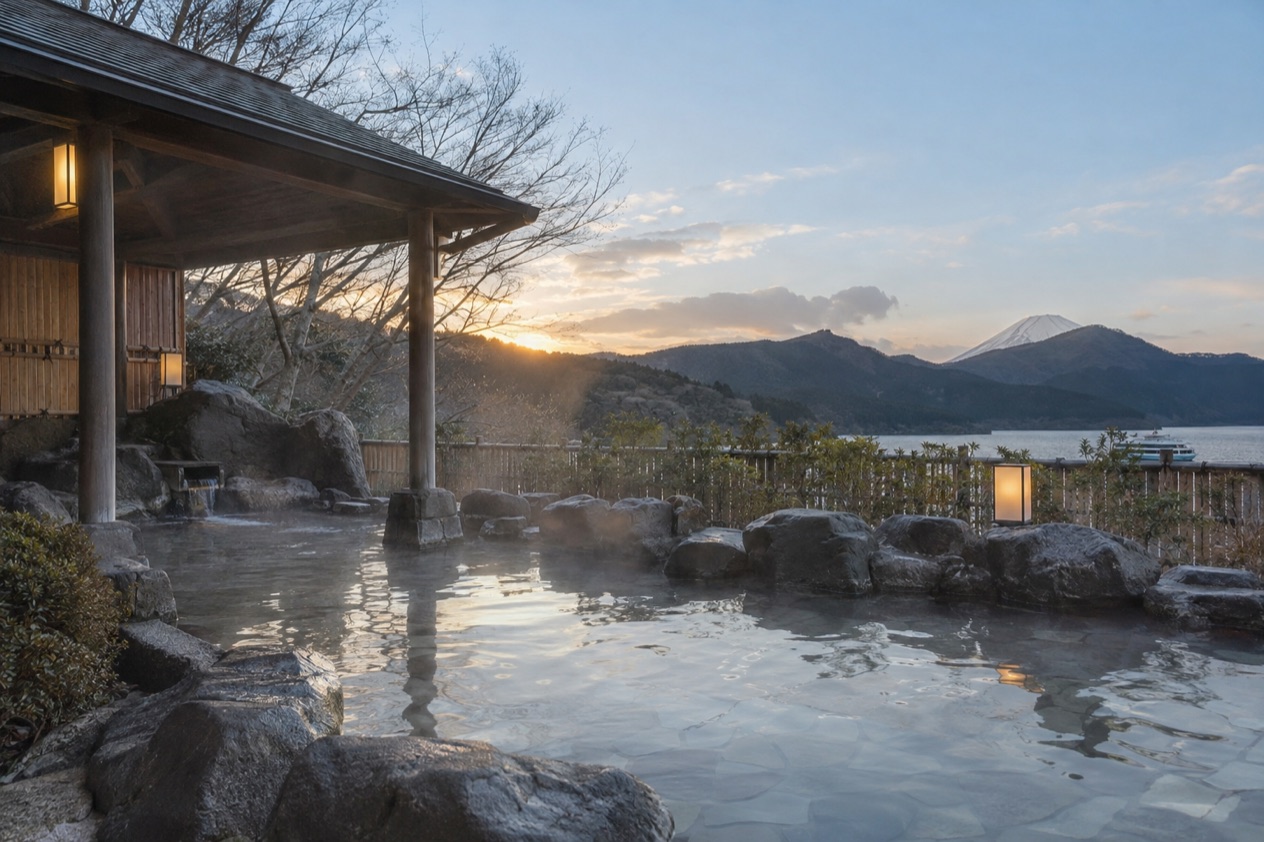
Yes, if you want a soak in volcanic water and a stretch of mountain scenery without building a whole itinerary around a single temple or castle. Hakone suits couples, friends and families who like to mix bathing with sightseeing, and it suits anyone who enjoys changing transport as part of the fun: a mountain train, a ropeway, a cruise across a lake.
Japan’s tourism board calls Hakone world-renowned for its natural hot springs, and says you can bathe in one of the country’s best. The town sits within Fuji-Hakone-Izu National Park, so the baths come with a volcanic setting: fumaroles, a crater lake shore and mountain views that include Mount Fuji.
Other spa towns offer a bath. Hakone adds the steaming valley, the lake, the shrine on the water and a cluster of art museums, all connected by one set of passes.
That variety is also the catch. Hakone is a place to sample rather than a single sight to tick off, so the visit works best when you pick a few things and let the rest go. A bath after a day of ropeways and boats is the natural rhythm, and the town has been built around exactly that.
What to see at the Hakone onsen
Owakudani and its black eggs
Owakudani is the volcanically active valley where the fumaroles of Hakone vent steam from the ground. The slopes are pale and scarred, the air smells of sulfur, and the whole place feels like the source of the hot water that feeds the baths below. A new tourist spot has opened here, with the Earth Valley observation area and a new Owakudani Station, and OWAKUDANI KITCHEN has opened at the Earth Valley viewpoint.
The local snack is the black egg, boiled in the hot springs until the shell turns dark. Japan’s tourism board says the eggs are said to prolong life, a claim visitors repeat with a smile as they peel them. Owakudani can be reached by the Hakone Ropeway from Sounzan and from the lake, which turns the approach into part of the outing.
Lake Ashi and the Fuji views
Lake Ashi sits at the center of the national park, and it is crisscrossed by sightseeing ships dressed up as pirate vessels. The lake offers views of Mount Fuji, and a crossing on the water is one of the pleasures of the Hakone loop. The Hakone Sightseeing Cruise ship Royal II has been newly renovated, while the ship Victory and Moto-Hakone Port have been remodeled and updated for an elegant cruise.
Along the shore stands Hakone Shrine, a Shinto sanctuary at the edge of the water. Its red torii gate is the image many travelers carry home, framed by trees and lake. The shrine and the cruise fit naturally into the same stretch of the day, and both are good places to look for Fuji on a clear day, though clouds sometimes decide otherwise.
Hakone-Yumoto, the gateway town
Hakone-Yumoto is the town where many visitors first step off the train, known for its many restaurants and gift shops. It is a place to browse sweets, local crafts and small eateries before heading up the mountain, or to wander when you come back down. The Romancecar limited express runs between Shinjuku and Hakone-Yumoto.
The name itself points to the hot springs: yu means hot water, and the town’s identity is tied to the baths that gave Hakone its reputation as a spa destination. Come back here in the evening and the shops and restaurants give the day a gentler ending after the volcanic landscape above.
Art museums and gardens around Sengokuhara
Sengokuhara is filled with art museums, and Hakone as a whole has a number of them, including the Hakone Open-Air Museum and the Pola Museum of Art. Japan’s tourism board describes the open-air museum as Japan’s first, with outdoor art installations set in the mountain landscape. Sculpture and hillside make a counterpoint to the volcanic scenery elsewhere.
For something greener, the Hakone Botanical Garden of Wetlands is among the sights listed for the area. Museums and gardens are the natural plan for a day when clouds sit over the mountains, since they offer a reason to stay in Hakone even without a Fuji view.
Hours, tickets and rules
For most visitors, Hakone’s tickets come down to one idea: a pass that covers the transport, and in one version the baths and museums too. The Hakone Freepass offers unlimited rides on eight different transportation means in Hakone, including the Hakone Tozan Train, the Hakone Ropeway and the Hakone Sightseeing Cruise. The Hako Ticket Plus goes further, adding the Hako Ticket for applicable art museums, hot springs and activity facilities.
| Pass | Valid for | What it includes |
|---|---|---|
| Hakone Freepass | Several days | Unlimited use of most forms of transport |
| Hakone Freepass Hako Ticket Plus | 2 days or 3 days | Digital Hakone Freepass with 8 modes of transport, plus the Hako Ticket for applicable art museums, hot springs and activity facilities |
| Hako Ticket Plus with Odakyu Line ticket | 2 days or 3 days | The Plus pass with 1 return trip on the Odakyu Line between the departure station and Odawara Station |
The Hako Ticket Plus covers hot springs only at the applicable facilities, so it helps to look at which baths are included before planning an evening. During scheduled maintenance, a replacement bus service operates on sections of the Hakone Ropeway, which can change how a ropeway day is stitched together.
How to get to the Hakone onsen
From Tokyo, Hakone is reached by the Odakyu Odawara Line from Shinjuku, a journey of 70 minutes. The Romancecar limited express runs between Shinjuku and Hakone-Yumoto, the gateway town at the start of the mountain. Hakone lies in the western part of Kanagawa Prefecture and forms part of Fuji-Hakone-Izu National Park.
Once in Hakone, the pass does the work. The Hakone Free Pass can be bought at Shinjuku Station, Odawara Station and other stations along the Odakyu Odawara Line and the Hakone Tozan Line. The version with an Odakyu Line ticket includes one return trip on the Odakyu Line between the departure station and Odawara Station.
Inside the area, the pieces link up as a loop of different vehicles: the Hakone Tozan Train, the Hakone Ropeway from Sounzan and the lake up to Owakudani, and the cruise ships on Lake Ashi. Official times for trains and buses in the Hakone area are provided by the Odakyu Hakone Group. The route search on the official Hakone website works only for transfers within Hakone or to the Odakyu Line or the Odakyu Highway Bus.
When to visit the Hakone onsen
Hot springs reward cool weather, and Hakone has a humid subtropical climate with warm summers and cool winters. Two moments carry their own atmosphere: cherry blossoms are a noted sight in April, and in autumn the silvery plumes of Miscanthus sinensis, called susuki, add to the scenery. At the New Year, the Hakone Ekiden, a collegiate relay race, runs from Tokyo to Hakone and back over two days.
The figures for the foot of the mountain come from Odawara, with the mountain side of Hakone reported separately for rain. The mountain receives much more rain than the foot in every month shown, which matters on a day of ropeways and lake views, since weather on the heights can differ from what you left behind in town. September is the wettest month in Hakone, so October follows hard on its heels.
| Month | Odawara high (°F) | Odawara low (°F) | Odawara rain (in) | Odawara sunshine (hours) | Mountain side rain (in) |
|---|---|---|---|---|---|
| January | 51.1 | 33.1 | 3.30 | 180 | 5.03 |
| April | 66.0 | 48.6 | 7.15 | 177 | 12.67 |
| July | 84.2 | 71.6 | 8.50 | 163 | 16.74 |
| October | 72.0 | 57.4 | 9.40 | 131 | 15.90 |
January is cool and the sunniest of the four, with the least rain, which suits a long bath after a day outside. April brings the cherry blossoms and mild air. July is warm and wet, and October is mild but cloudy and rainy, so a rain jacket belongs in the bag.
Tips for your visit
Plan Hakone as a series of stops rather than a checklist. A workable day links the shrine and the cruise on Lake Ashi, then the ropeway to Owakudani, with a museum or a bath at the end. If you stay overnight, the Hako Ticket Plus is built for two or three days, and the museums, baths and activity facilities it covers fill the time between the transport legs.
Pack for changing weather. The mountain side of Hakone gets noticeably more rain than the town below, so a light rain jacket and shoes that handle wet paths are sensible, and a layer helps because the air is cooler up in the mountains than at Odawara. The bath itself asks for little more than a small towel and some patience with the heat.
Combine the water with what is around it. Hakone-Yumoto has restaurants and gift shops for the start or end of the day, Sengokuhara has art museums for a gray afternoon, and Owakudani has the black eggs and a fresh observation area. Because the ropeway sometimes runs a replacement bus on sections during maintenance, it is worth looking at the official Odakyu Hakone Group times before building a tight schedule around it.
Good to know before you go
Hakone is an active volcanic area, and the Owakudani valley is where the ground steams, so the sulfur smell is part of the setting rather than a fault of the day. Cherry blossoms, autumn grass and winter sun each shift the mood, and rain on the mountain is common in several months. Keep the plan loose enough to follow the weather, and let the baths, the lake and the museums fill the gaps.
Sources
- Hakone Tourist Information (https://www.hakonenavi.jp/international/en/), checked October 11, 2026
- Wikipedia, Hakone, Kanagawa (https://en.wikipedia.org/wiki/Hakone,_Kanagawa), checked October 11, 2026
- Japan National Tourism Organization, Hakone (https://www.japan.travel/en/destinations/kanto/kanagawa/hakone-and-around/), checked October 11, 2026
- Japan Meteorological Agency (JMA), Normal values 1991-2020, monthly (https://www.data.jma.go.jp/stats/etrn/view/nml_amd_ym.php?prec_no=46&block_no=1008), station Odawara, elevation 14 m, checked October 11, 2026
To plan your stay
- Best Time to Visit Hakone: Autumn Leaves, Rainy Season, Weather by Month and Festivals
- Where to Stay in Hakone: Hakone-Yumoto, Lake Ashi, Sengokuhara and Ryokan Stays
- Hakone from Tokyo: Romancecar, Shinkansen, Local Trains and the Hakone Freepass
- Know Before You Go to Hakone: Getting There, the Freepass, Weather and Etiquette