
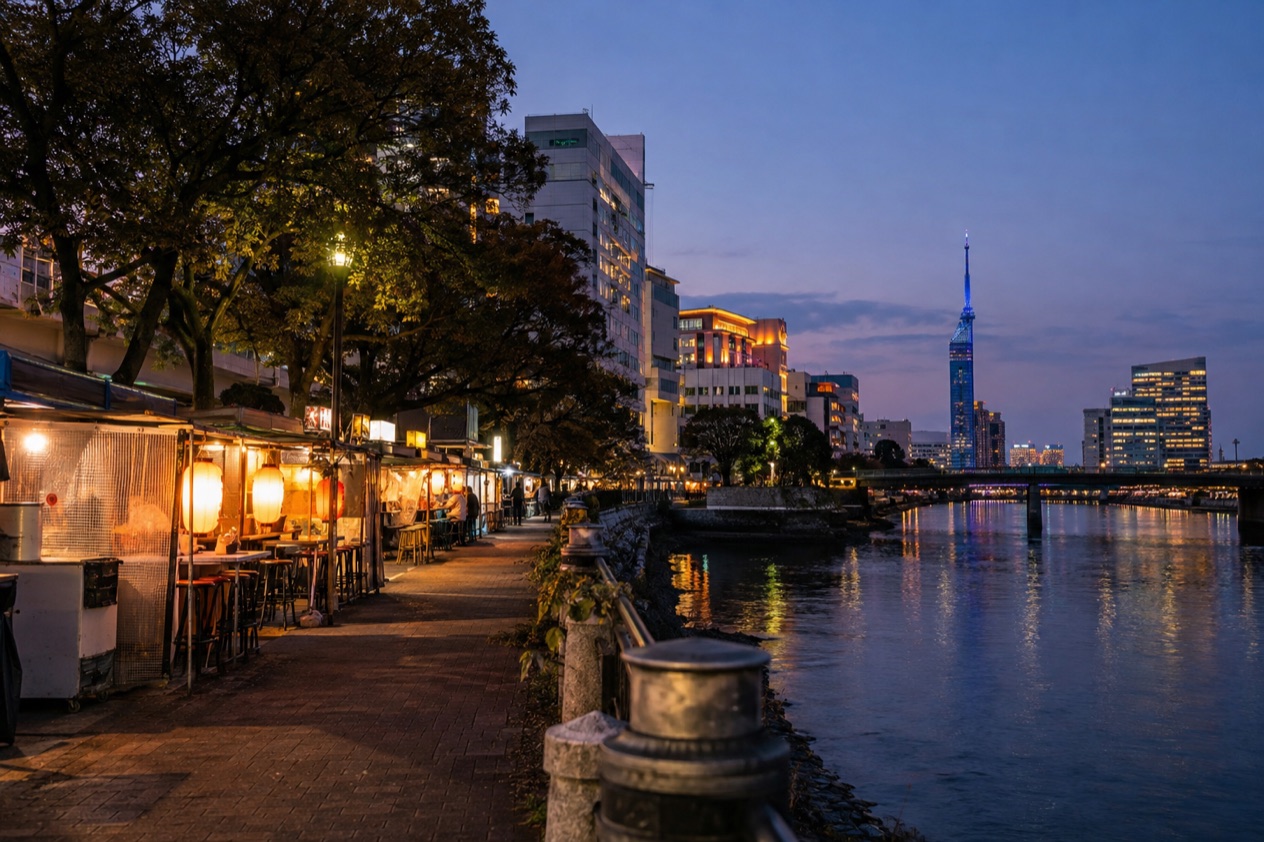
On a spring evening in Fukuoka, the yatai food stalls along the river light their lanterns and the smell of pork-bone broth drifts across the sidewalk. The year here moves from a soft, bright March to a hot and sticky midsummer, then settles into long, mild autumn days before a gray, cold-edged winter. Fukuoka is a port city on the north coast of Kyushu, and its seasons shape what you eat, what you see and which festival is in the streets.
When is the best time to visit Fukuoka?
Spring brings the cherry blossoms, which usually reach full bloom around March 31, and early May brings the Hakata Dontaku parade. Autumn is the season for strolling in comfortable temperatures, and the maple leaves in the city turn a little later, usually around December 1.
For sightseeing and food, spring and autumn both work well. Fukuoka’s yatai were chosen for The New York Times’ list of 52 places to go in 2023, and the city was picked for the Food category of Lonely Planet’s Best in Travel that same year.
Eating at an open-air stall is most comfortable when evenings are mild, so April, May, October and November suit it best. Winter has its own pleasure, because a steaming bowl of Hakata ramen or a pot of motsunabe (a hot pot of beef or pork offal) tastes better when the wind is cold.
If you want warm days and plenty of light, May and early June give long evenings before the rain gathers. Families who prefer comfort over heat will do better in spring or autumn than in July and August, when highs are very hot and the air is humid.
Travelers who care mostly about seeing a big festival may choose July for Hakata Gion Yamakasa and accept the weather that comes with it. Winter suits people who like cold, quiet city walking, with the understanding that gray days and the occasional sleet are part of the picture.
Fukuoka weather by month
Fukuoka has four distinct seasons, and the table gives the full year at a glance.
| Month | Average high (°F) | Average low (°F) | Precipitation (in) | Days with 1 mm or more of precipitation | Hours of sunshine | Daylight on the 15th |
|---|---|---|---|---|---|---|
| January | 50.4 | 39.0 | 2.93 | 9.3 | 104 | 10 h 09 min |
| February | 52.9 | 39.9 | 2.75 | 8.8 | 124 | 10 h 58 min |
| March | 59.0 | 45.0 | 4.08 | 10.1 | 161 | 11 h 55 min |
| April | 67.8 | 52.7 | 4.65 | 9.7 | 188 | 12 h 59 min |
| May | 75.9 | 61.0 | 5.26 | 8.6 | 204 | 13 h 52 min |
| June | 81.0 | 68.5 | 9.83 | 11.6 | 145 | 14 h 22 min |
| July | 88.2 | 76.3 | 11.78 | 11.0 | 172 | 14 h 11 min |
| August | 90.5 | 77.7 | 8.27 | 9.8 | 201 | 13 h 26 min |
| September | 83.5 | 70.9 | 6.89 | 9.7 | 165 | 12 h 26 min |
| October | 74.7 | 60.8 | 3.72 | 6.8 | 176 | 11 h 24 min |
| November | 64.8 | 51.1 | 3.60 | 8.5 | 137 | 10 h 27 min |
| December | 54.7 | 42.4 | 2.66 | 8.5 | 112 | 9 h 57 min |
The number of wet days changes little through the year, but the kind of rain does. In winter it comes as light showers and cold fronts, with sleet on some days in December through February and very little snow actually settling.
In June and July the rain turns heavy and steady, and the totals are far higher than in any other month. October is the driest stretch of the year by wet days, which is part of why it feels so good for walking.
What this means for packing is simple. From December through February, bring a warm coat, a scarf and layers, along with a compact umbrella. In March and April a sweater and a light jacket handle most days, and by May you can usually switch to short sleeves with something light for the evening. For June through September, pack breathable clothes and rain gear, because the humidity stays high.
Daylight matters too. Midsummer days stretch long into the evening, which leaves time for a late dinner outdoors, while in December the light fades early and the city lights up with its winter evenings sooner than you expect. Plan indoor stops, such as a museum or a long lunch, for the short winter afternoons.
What is there to do in Fukuoka in each season?
Spring: cherry blossoms and the first warm days
Spring is the season for walking, and the blossoms set the pace. The Japan Meteorological Agency records first bloom in Fukuoka around March 22 and full bloom around March 31, though from one spring to the next the dates can shift. Parks such as Ohori Park, home to one of the city’s major art galleries, are natural places to sit under the trees with a bento (a boxed meal) and watch the petals fall.
By April and May the days are warmer and longer, and a light jacket or a simple sweater is enough in the evening. This is a good time to eat at the yatai stalls, to wander the Hakata and Tenjin districts on foot, and to catch Hakata Dontaku on May 3 and 4. Sunshine is generous in these months, so sunscreen belongs in the bag by May.
The rainy season and summer
June and July are the wettest months, with the heaviest totals of the year and the humidity to match. Between showers the city still has its pleasures, and July brings Hakata Gion Yamakasa, a big summer event that fills the old merchant quarter with energy.
August is hot and often sunny, with the highest temperatures of the year. Plan outdoor sightseeing for the cooler edges of the day and leave the middle for air-conditioned stops, cold noodles and shaved ice. If heat tires you quickly, leave this month for another trip.
Autumn leaves and winter
In autumn, Japan gradually becomes milder after summer, with moderate temperatures ideal for walking, and October in Fukuoka fits that description well with its low number of wet days. Across Japan, trees show red, yellow and orange from mid-November to early December, and in the city the maples change around December 1. That makes late November and early December the time for temple and garden walks with a coat in your bag.
Winter is cold, gray and often damp, with some days of sleet but little snow lying on the ground. It is a season for hot food: ramen, motsunabe and oden, and for the soaking-hot baths of a nearby onsen town if you plan a side trip.
When is Fukuoka least crowded?
The quieter stretches of the year are the cold months of January and February and the wet weeks of June, outside the national holiday periods. Japan’s busiest travel weeks are Golden Week in late April and early May, Obon in mid-August and the New Year break, and Fukuoka shares in all three. Hakata Dontaku falls inside Golden Week, so a trip built around that parade means sharing the city with holiday visitors.
If you want more breathing room, aim for the shoulder weeks. The second half of May, once the holiday week has passed, still has warm sunny days. In autumn, early and mid-October carry mild weather without a big festival, while the leaf-viewing weeks bring more visitors to gardens and temples. In the colder months you can often eat at a favorite ramen shop without an elaborate plan, and sights feel unhurried.
Rooms and tables respond to these rhythms. A holiday week can mean fewer choices, while a gray weekday in February leaves more freedom to choose where you sleep and eat. Weighing the trade-off is easy: if cherry blossoms or a festival matter most, accept the company, and if calm matters more, take the cold months or the weeks right after a holiday.
Which months should you avoid in Fukuoka?
No month is off-limits, but June, July and August are the hardest on comfort, and winter is the dullest for outdoor sightseeing. June and July bring the rainy season with the heaviest rainfall of the year, and the air feels thick and warm even on cloudy days. Storms can disrupt plans in summer and early autumn, so keep your schedule flexible and have an indoor option ready for each day.
August has more sunshine than June or July, but the heat is the strongest of the year. Walking long distances through the city in the afternoon can wear you down, and it is better to plan around the cooler hours or to use trains and subways between stops. Visitors who handle heat well will find that the festivals and the night food scene make the month rewarding.
Winter, from December to February, is cold with short days and little sun. Sleet falls on a number of days, and snow rarely amounts to much, but the damp air makes the cold feel sharper. If you travel then, the reward is hot food and warm baths rather than sweeping views.
For blossoms, a trip in the first days of March may be early, since the usual first bloom comes around March 22. For maple leaves, a visit in mid-November may catch some color while the city itself changes later. Because bloom and leaf dates shift, treat them as a guide to the season rather than a promise for a particular week.
Festivals and events in Fukuoka through the year
Winter: New Year and Setsubun
The Japanese year begins with hatsumode, the first visit of the year to a shrine, when families line in warm coats to ring the bell, clap twice and make a wish. Shrines across Fukuoka, including the Hakata shrines tied to the city’s festivals, fill with worshippers in the first days of January. Stalls sell warm sweet sake and grilled snacks nearby, and the mood is festive but calm.
On February 3 comes Setsubun, the day that marks the turn toward spring. At shrines and in homes people throw roasted soybeans to chase away bad luck, calling out to drive demons out and invite good fortune in. It is a cheerful, noisy moment in the cold season and a good reason to visit a shrine in the middle of winter.
Spring: Hakata Dontaku
Hakata Dontaku is held on May 3 and 4 and turns the main avenues of the city into a parade route. Groups in costume dance and play music as they pass, and performers carry wooden rice paddles that they clap like castanets. Spectators line the roads, and the whole center of Fukuoka feels like one long party.
The festival falls in Golden Week, so it is a trip for those who enjoy being in the middle of a national holiday. Between watching the parade and eating at the nearby stalls, a day or two is enough to take it in. The weather in early May is usually warm and bright, which suits a day spent outdoors.
Summer and autumn: Yamakasa, Obon and the leaves
Hakata Gion Yamakasa, held in July, is a big summer event and the most dramatic in Fukuoka’s calendar. Teams of men in short happi coats and loincloths carry heavy floats at speed through the streets of old Hakata, with Kushida Shrine at the center of the celebration. Decorated floats stand in the city in the days before, and the sound of shouting teams and splashing water carries through the neighborhood.
In mid-August comes Obon, when families return to their home towns to honor their ancestors, and people travel across the country. Cities feel different, with some local shops closed for the break and others busier than usual. It is also the hottest time of the year, so expect heat as part of the festival atmosphere.
Autumn is quieter in festivals but rich in color. From mid-November to early December the leaves turn, and in Fukuoka itself the maples change around December 1. Gardens and temple grounds make good places for a slow walk, with a bowl of warm noodles afterward.
Sources
- Japan Meteorological Agency (JMA), Normal values 1991-2020, monthly (https://www.data.jma.go.jp/stats/etrn/view/nml_sfc_ym.php?prec_no=82&block_no=47807), station Fukuoka, elevation 2 m, checked October 11, 2026
- Computed from the date and the latitude of the place (sunrise equation, solar elevation -0.833 degrees), October 11, 2026
- Japan National Tourism Organization, Fukuoka (https://www.japan.travel/en/destinations/kyushu/fukuoka/fukuoka-city/), checked October 11, 2026
- Fukuoka City official tourist guide (https://yokanavi.com/en/), checked October 11, 2026
- Wikipedia, Fukuoka (https://en.wikipedia.org/wiki/Fukuoka), checked October 11, 2026
- Wikivoyage, Fukuoka (https://en.wikivoyage.org/wiki/Fukuoka), checked October 11, 2026
- Japan National Tourism Organization, autumn in Japan (https://www.japan.travel/en/guide/autumn-guide/), checked October 11, 2026
- Japan National Tourism Organization, spring in Japan (https://www.japan.travel/en/guide/spring-guide/), checked October 11, 2026
- Japan Meteorological Agency, cherry blossom first-bloom dates 2021-2026 and 1991-2020 normal (https://www.data.jma.go.jp/sakura/data/sakura003_07.html), checked October 11, 2026
- Japan Meteorological Agency, cherry blossom full-bloom dates 2021-2026 and 1991-2020 normal (https://www.data.jma.go.jp/sakura/data/sakura004_07.html), checked October 11, 2026
- Japan Meteorological Agency, maple color-change dates 2025-2026 with difference from the 1991-2020 normal (https://www.data.jma.go.jp/sakura/data/phn_014.html), checked October 11, 2026