
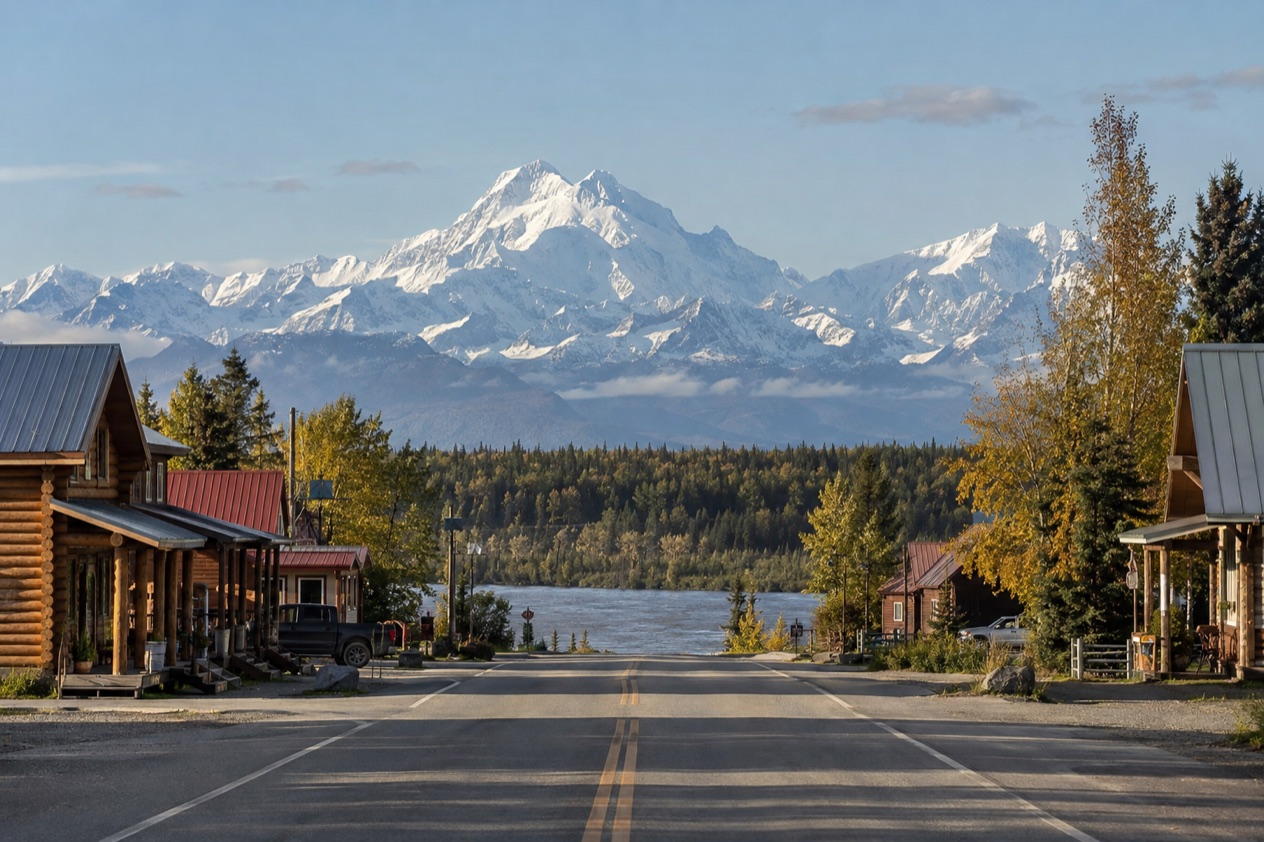
A small-town evening in Talkeetna has a particular sound: a floatplane lifting off in the distance, the clack of a screen door at the general store, and live music drifting from a porch. The town sits where three glacier-fed rivers meet, with the biggest mountain in North America as its backdrop whenever the clouds allow. It suits travelers who want a slow, slightly eccentric Alaska base with mountain flights, river trips and a train ride into the backcountry close at hand.
Where is Talkeetna and what is it like?
Talkeetna sits at the base of Denali, halfway between Anchorage and Denali National Park in the Matanuska-Susitna Valley of Southcentral Alaska. It is a small river town at the meeting point of the Chulitna, Susitna and Talkeetna Rivers, all fed by glaciers. The setting is the first thing you notice: broad braided water, spruce and birch forest, and a long line of mountains on the horizon that sometimes shows its tallest summit and sometimes keeps it behind cloud.
The town is a surprise on paper. Talkeetna is not legally a town or a city but a historic district, full of older buildings and vacation homes, with no local government other than a cat mayor who lives in the general store.
That odd detail says a lot about the mood. The place feels like a village that grew up around the railroad, the river and the mountaineers, and it has kept a cheerful, slightly irreverent character. Nothing here feels like a resort.
Talkeetna is closer to Denali itself than the entrance to the national park is, and it is where expeditions to climb the mountain begin. That gives the town a double life.
Climbers pass through with heavy gear, while visitors come for flightseeing, rafting and a pleasant stretch of time in a place with real personality. The Talkeetna Chamber of Commerce says its work is to preserve the town’s heritage and support its economic and cultural landscape, and you can feel that care in the way the old center has been kept.
The place suits people who like small towns with character, mountain scenery and a loose schedule. It may not suit travelers who want a long list of big attractions, a resort with a pool, or a lot of nightlife. Talkeetna is about atmosphere, views and the doors it opens onto the surrounding wilderness.
What is there to do in Talkeetna?
Talkeetna’s draw is that it combines a mountain, three rivers and a railroad in a very small place. Denali National Park has a bus system and a single road, while Talkeetna offers a more hands-on feel, with air taxis, river boats and a train that you can flag down in the backcountry. The main reasons to come fall into four groups.
Flightseeing and the view of Denali
Talkeetna Airport is home to several air taxi companies that run flightseeing trips and support mountain climbers. That is the essence of the town: the same airstrip that serves expeditions also serves visitors who simply want to see the Alaska Range from above. Denali stands at 20,310 feet, and from the air the scale of the surrounding glaciers and ridges becomes clearer than it can from any road.
A clear day is never guaranteed. Mountain weather decides what you see, and the summit can stay hidden even when the town below is bright. Treat a view of Denali as a chance, and enjoy the rivers, forest and neighboring peaks if the top stays in cloud. A flight suits anyone who wants to see the mountain close up, and the town’s air taxi companies are the starting point.
Rafting, kayaking and fishing on the rivers
Rafting and kayaking trips leave daily from Talkeetna, and the glacier-fed rivers give them their character: wide, cold and a milky gray-green. The Susitna is navigable for 85 miles upstream from its mouth to Talkeetna, which tells you how large the river is by the time it reaches town.
The Susitna is also one of Southcentral Alaska’s premier sport fishing streams, with significant runs of Chinook and Coho salmon, plus grayling, burbot and rainbow trout. Much of the river lies in roadless country, and access is usually by power boat or floatplane. That is part of the appeal for anglers, and it means the river feels remote even though the town is close.
The Hurricane Turn Train
The summer Hurricane Turn runs from Talkeetna to Hurricane, with stops at Chase, Curry, Sherman, Gold Creek, Twin Bridges and Chulitna. It operates Thursday through Monday from mid-May to mid-September. What sets it apart is flagstop service: passengers can get on or off anywhere along the backcountry route between Talkeetna and Hurricane, a rare arrangement that reflects how people in the roadless area have long used the line.
The summer train offers Adventure Class only, with non-smoking cars and wheelchair access. No food or drink is sold onboard, so passengers bring their own. It suits travelers who like a slow ride through country that no road reaches, and who enjoy the idea of a train that still stops for a wave.
Friday evenings and the town itself
There are free events every Friday evening from May 22 through September, according to the Talkeetna Chamber of Commerce calendar. That gives the town a social rhythm in the main season, when residents and visitors gather in the center. Between events, the older buildings, the general store with its cat mayor and the cafés and gift shops make for easy browsing.
The town also has a strong mountaineering culture. People in the cafés and on the street are connected in some way to Denali, whether they are climbers, pilots or guides. Listening in is part of the entertainment, and it gives a visit more depth than a list of sights would.
How many days do you need in Talkeetna?
One night is enough to feel the town, and two nights give you room to do something on the rivers or in the air. Talkeetna is small, so the town itself does not need much time. What fills the days are the outings that start here, and those depend on weather, schedules and how much you want to do.
Add a rafting or kayaking trip and a second day fills naturally. If your plans include the Hurricane Turn, give it a block of time of its own, since it follows its own schedule on the days it runs and takes you into country with no road.
With three or four days, the pace changes. A cloudy morning can be given to the town and the cafés, and a clear one to the mountains, so you are not forced to choose a single day for Denali. This flexibility is the best argument for staying longer. Mountain visibility changes quickly, and a longer stay gives you more chances.
Talkeetna also works as a stop between larger destinations. It lies halfway between Anchorage and Denali, and the Denali Star train, the Park Connection Motorcoach and the Parks Highway all pass through or near it.
Denali National Park is about three hours away by car, and the park has just one road, the Denali Park Road, where most sightseeing is done by bus. Travelers combine the two, using Talkeetna as a calmer counterpart to the park.
Other places in the Mat-Su Valley are within reach of a longer stay. The valley includes Palmer, Wasilla, Big Lake, Houston, Willow and Sutton, and Palmer hosts the Alaska State Fair, where world-record-sized cabbages and other vegetables are displayed. The valley is also home to 31 state parks and campgrounds, so there is plenty to explore if you stretch your time.
Where to stay in Talkeetna
The most atmospheric place to stay is in the historic district itself, among the older buildings and vacation homes that give Talkeetna its look. Staying in the center puts you next to the general store, the cafés and the Friday events during the main season. It suits travelers who like to step out of the door into the life of the town and who enjoy the old-Alaska character.
Because Talkeetna is a historic district rather than a formal town, the lodging reflects its history. Vacation homes and older buildings are a large part of the picture, so the stay often feels more like a visit to a village than a hotel stay. That appeals to travelers who like a homey base and a sense of local life.
A different option is to stay elsewhere along the George Parks Highway, which is the main road from Anchorage to Fairbanks and the principal access to Denali National Park and Preserve and Denali State Park. The towns of the Mat-Su Valley, such as Palmer, Wasilla and Willow, sit on or near the corridor and make sense for travelers building a longer road trip. Staying outside Talkeetna means you give up the town’s atmosphere, but it may fit an itinerary that moves along the highway.
Those who want to be close to the national park might base themselves nearer Denali instead, and treat Talkeetna as a stop on the way. The two places have a different feel. Talkeetna is a small town with a personality of its own, while the park area is organized around the park and its bus system. Travelers choose a night in each to get the contrast.
How do you get to Talkeetna and get around?
By car, Talkeetna is about two and a half hours from Anchorage and about three hours from Denali. The route follows the George Parks Highway, which runs 323 miles from the Glenn Highway, north of Anchorage, to Fairbanks. The highway was completed in 1971 and given its current name in 1975, and it is signed as Alaska Route 3. Mileposts along it begin at Mile 35, continuing the numbering of the Glenn Highway.
By train
Talkeetna is a stop on the Alaska Railroad’s Denali Star, which runs between Anchorage and Fairbanks, covering 356 miles in 12 hours, with stops in Wasilla, Talkeetna and Denali National Park. On a clear day, passengers can see Denali from the train. Between Anchorage and Talkeetna, the train crosses the Knik River with the Chugach Mountains in the background, and just south of Talkeetna, Denali may rise above the Susitna River.
North of Talkeetna, the Denali Star crosses Hurricane Gulch on a 296-foot bridge and passes through the roadless Hurricane area. The Talkeetna Depot is also a stop for the Aurora Winter Train and the Hurricane Turn, so the railroad is part of how the town connects to the rest of Alaska in more than one season.
By motorcoach and by air
The Park Connection Motorcoach offers transportation to Talkeetna from Anchorage, Seward and Denali. That links the town to the main routes that visitors take through Southcentral Alaska, including the coast near Seward and the national park.
Talkeetna is also served by Talkeetna Airport, home to several air taxi companies that provide flightseeing trips and support for mountain climbers. This airstrip is the base for the town’s flights over the Alaska Range and for the expeditions that begin here.
Getting around once you are there
Once in town, the main movement is between the historic district, the depot, the airport and the river outfitters that run daily rafting and kayaking trips. For the rivers beyond town, access is often by boat or floatplane, because the Susitna runs through a roadless area. The Hurricane Turn, with its flagstop service, is another way into country that roads do not reach.
When is the best time to visit Talkeetna?
Summer is the main season, from late spring through September, because that is when the town’s calendar fills. The free Friday evening events run from May 22 through September, and the summer Hurricane Turn operates Thursday through Monday from mid-May to mid-September.
July is the month in the climate record, with afternoon highs in the upper 60s and nights in the low 50s, mild enough for rafting, flightseeing and evenings outdoors. Rain falls on about eight days in July, often as passing showers, so a gray afternoon is likely to be followed by a better one.
Winter is a different Talkeetna. January afternoons stay around 22 degrees and nights drop to around 5, with little precipitation but real cold. The Alaska Railroad runs the Aurora Winter Train through Talkeetna, and the town goes quiet, which appeals to travelers who like cold, small places and are prepared for the temperatures. The summer Hurricane Turn and the Friday events belong to the warm season only.
Denali National Park draws roughly 600,000 visitors a year, mostly from late May to early September, and that season shapes the traffic on the Parks Highway and the Denali Star. Talkeetna feels that rhythm, as travelers pass through between Anchorage and the park.
Climbers heading for Denali also start from the town, and the first ascent of the mountain took place on June 7, 1913. The mountain’s name comes from the Koyukon Athabaskans, who have called it Denali, meaning the tall one, for centuries.
Good to know before you go
Talkeetna is a small place, with a population of 1,055 at the 2020 census, and its pleasures are simple ones: mountain views, river trips and the Friday events. Food on the summer Hurricane Turn is not sold onboard, so riders bring their own.
The Susitna is in a roadless area, which makes access difficult except by power boat or floatplane. The mountain is the star, and it does not always show itself, so a flexible schedule makes the most of your stay.
Sources
- Talkeetna Chamber of Commerce (https://www.talkeetnachamber.org/), checked October 11, 2026
- Alaska.org, dest talkeetna (https://www.alaska.org/destination/talkeetna), checked October 11, 2026
- Wikivoyage, Talkeetna (https://en.wikivoyage.org/wiki/Talkeetna), checked October 11, 2026
- Wikipedia, Talkeetna, Alaska (https://en.wikipedia.org/wiki/Talkeetna,_Alaska), checked October 11, 2026
- Wikipedia, Talkeetna Mountains (https://en.wikipedia.org/wiki/Talkeetna_Mountains), checked October 11, 2026
- Wikipedia, Susitna River (https://en.wikipedia.org/wiki/Susitna_River), checked October 11, 2026
- Alaska Railroad, Denali Star (https://www.alaskarailroad.com/ride-a-train/our-trains/denali-star), checked October 11, 2026
- Alaska Railroad, Hurricane Turn (https://www.alaskarailroad.com/ride-a-train/our-trains/hurricane-turn), checked October 11, 2026
- Wikipedia, Denali (https://en.wikipedia.org/wiki/Denali), checked October 11, 2026
- Wikipedia, Mount Denali (https://en.wikipedia.org/wiki/Mount_Denali), checked October 11, 2026
- Wikipedia, Mat-Su Valley (https://en.wikipedia.org/wiki/Mat-Su_Valley), checked October 11, 2026
- Wikipedia, George Parks Highway (https://en.wikipedia.org/wiki/George_Parks_Highway), checked October 11, 2026
- National Park Service, Denali National Park & Preserve, plan your visit (https://www.nps.gov/dena/planyourvisit/index.htm), checked October 11, 2026
- Wikipedia, Climate of Alaska (https://en.wikipedia.org/wiki/Climate_of_Alaska), checked October 11, 2026
- NOAA NCEI, U.S. Climate Normals 1991-2020, monthly (https://www.ncei.noaa.gov/access/services/data/v1?dataset=normals-monthly-1991-2020&stations=USW00026528), station Talkeetna Ap, elevation 350 feet, checked October 11, 2026
All our pages
When to go
- Best Time to Visit Talkeetna: Weather by Month, Denali Views and What to Do in Each Season
- Talkeetna in January: Short Days, Aurora Season and Winter Weather
- Talkeetna in February: Weather, Northern Lights and Winter Things to Do
- Talkeetna in March: Weather, Northern Lights Chances, Iditarod Season and What to Do
- Talkeetna in April: Spring Light, Aurora Chances and What to Do
- Talkeetna in May: Spring Weather, Town Life and a Two-Day Plan
- Talkeetna in June: Long Daylight, Denali Views, the Hurricane Turn Train and What to Pack
- Talkeetna in July: Weather, Long Evenings, Small-Town Summer and a Two-Day Plan
- Talkeetna in August: Weather, Salmon Rivers, the Hurricane Turn Train and Two Days in Town
- Talkeetna in September: Weather, Things to Do and a Two-Day Plan
- Talkeetna in October: Weather, Northern Lights and What to Do
- Talkeetna in November: Weather, Short Days, Denali Views and Aurora Nights
- Talkeetna in December: Weather, Aurora Chances and Winter Things to Do