
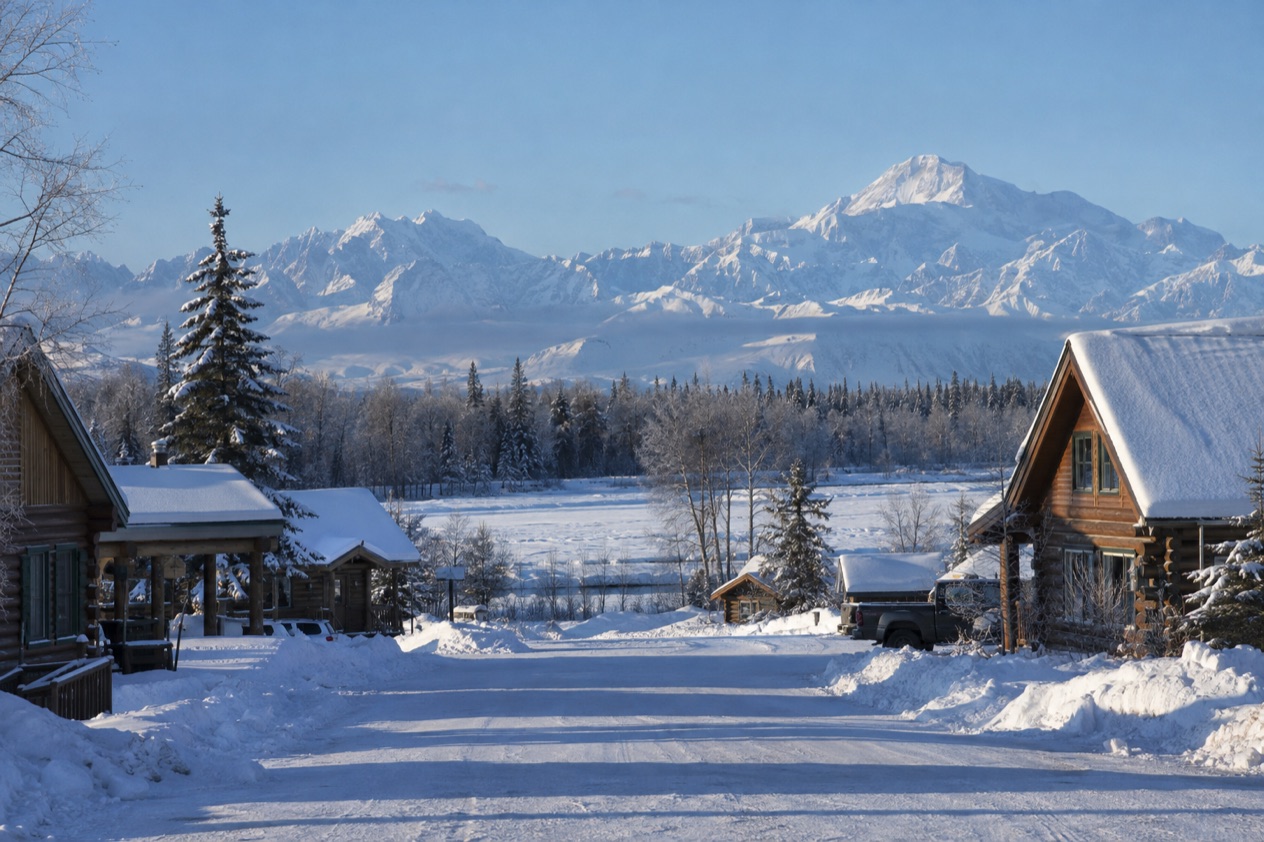
In January, Talkeetna’s main street is quiet, the snow squeaks underfoot, and the low sun barely clears the tree line before the sky turns to blue dusk. Smoke rises from chimneys in a town that is not even officially a town, and the cat that serves as honorary mayor naps in the general store. This is the month for people who come to Talkeetna for the cold itself: long nights, a slow pace and a chance at the northern lights.
What is the weather like in Talkeetna in January?
January in Talkeetna is cold and mostly dry, with temperatures that stay below freezing all day and fall well into the single digits at night.
| Month | Average high (°F) | Average low (°F) | Precipitation (in) | Days with precipitation | Daylight on the 15th |
|---|---|---|---|---|---|
| December | 23.4 | 7.8 | 1.66 | 4.9 | 5 h 07 min |
| January | 21.8 | 5.4 | 1.34 | 3.9 | 5 h 59 min |
| February | 28.2 | 9.4 | 1.24 | 3.9 | 8 h 48 min |
Mornings are the coldest part of the day, and the air feels sharp and still. Afternoons climb only a little, so even the warmest hour is a time for a real winter coat, insulated boots and a hat that covers your ears.
At these temperatures whatever falls from the sky is snow, and it comes on a handful of days rather than in a long gray spell. Most days are simply cold, often with clear stretches.
The light is the other thing you plan around. Daylight lasts about six hours, so the sun rides low, the shadows are long, and the snow takes on soft pink and blue tones near the edges of the day. By late afternoon it is already evening. That suits the northern lights, which need darkness, and it leaves a long stretch of the day for a warm meal and a slow evening.
What to do in Talkeetna in January
The main thing January offers in Talkeetna is a dark winter sky. The aurora is a natural light display caused by charged particles from the sun striking gas in the upper atmosphere, and in Alaska its viewing season stretches from late summer into April.
January sits in the middle of that season. The northern lights oval covers most of Alaska, which puts Talkeetna under a sky where the lights can appear. They remain a chance, never a promise, and clear weather matters as much as darkness.
For Interior Alaska, the likelihood of seeing the aurora is roughly twice as high at the equinoxes as at the winter solstice. January is a little past the solstice, so it is not the peak of the odds. People come anyway, because the nights are long and the cold keeps the sky crisp. Step away from porch lights and give your eyes time to adjust.
The town itself on a winter day
Talkeetna is a historic district with older wooden buildings, vacation homes and no local government other than that cat mayor, who lives in the general store. Walking the main street in January is a small pleasure. You pass log storefronts with snow piled on their roofs, step into a shop or café to warm your hands, and see more locals than visitors.
Allow time to wander slowly. The cold makes everything feel close, and the short day invites a loop of the town before the light fades.
The Susitna River runs nearby, and its banks in winter are a place to stand and look at the frozen edges and the white forest beyond. Beyond the town, the Talkeetna Mountains rise across the valleys, their highest peak, Sovereign Mountain, deep in a heavily glaciated and remote part of the range.
The railroad depot
Talkeetna Depot is a stop on the Alaska Railroad’s Denali Star, Aurora Winter Train and Hurricane Turn trains. Even if you are not riding, the depot is a good place to see the railroad’s role in the town’s history, and it shows how the community has long been linked to Anchorage and Fairbanks by rail. The Denali Star covers the route between those two cities, with stops in Wasilla, Talkeetna and Denali National Park.
On a clear day, the Denali Star offers a view of Denali, the tallest mountain in North America. Whether it appears depends on the weather, and winter skies can change quickly.
Dog sledding and the Denali kennels
Winter is the true dog-sledding season in Alaska, and teams in the state traditionally pull in pairs, side by side, rather than in a fan. The sleds are typically the built-up type, with a high rail on each side. In Anchorage, dog sledding typically runs from October through March, which includes January.
At Denali National Park, the kennels welcome visitors through the winter on weekends only. The park’s winter visitor center is the Murie Science and Learning Center, near the start of the Denali Park Road.
| Site | Open |
|---|---|
| Denali National Park kennels (late September through winter) | Saturdays and Sundays, 1 pm to 4 pm |
Food in a place this small is simple and warming. Think of bowls of soup, hot coffee, baked goods and hearty plates served in cozy dining rooms where boots are left steaming by the door. After a cold day outside, the warmth of those rooms is half the experience.
A two-day itinerary for Talkeetna in January
Day 1 is for the town. Start mid-morning once the light is up, since the day is short and the cold is hardest early. Walk the main street, stop in at the general store to look for the cat mayor, and browse the shops that are open. Then head to the Talkeetna Depot to see the station and its role as a stop on the Alaska Railroad.
Spend the middle of the day on a long lunch in a café or a dining room with a woodstove. In the afternoon, walk toward the Susitna River while there is still daylight, then return to town as the sky darkens. After dinner, dress in every layer and go to a dark spot away from lights to watch for the aurora. If the sky is gray, stay in and linger over a hot drink.
Day 2 widens the view. If it is a Saturday or Sunday, set out toward Denali National Park for the kennels in the afternoon and the Murie Science and Learning Center, which is the park’s winter visitor center.
Because the trip takes about three hours each way, an early start is sensible. On a weekday, spend the day in and around Talkeetna instead, with a second walk by the river and an unhurried look at the shops you skipped.
If snow is falling or the cold is too deep, the rain card here is a snow card. Stay with the indoor places: a café, a gift shop, a long meal and time at the depot. Then try the sky again that evening, because clouds often clear.
Is Talkeetna busy in January?
No, January is a quiet month in Talkeetna, with a pace set by the cold and the short days.
The town is small, with a population just over a thousand, and winter leaves it feeling even smaller. Streets are calm, conversations with shopkeepers are easy, and the main activity is people coming in from the cold. The people you meet are as likely to be locals as travelers, and that is part of the charm.
Nights belong to those chasing the aurora, and the town’s quiet helps because few lights spoil the dark. The weekend is when the Denali kennels open to visitors, so that is the moment an outing in the direction of the park makes sense.
What to pack for Talkeetna in January
With highs below freezing and nights well below that, packing is about warmth that you can adjust as you move between outdoors and heated rooms.
- A heavy insulated coat, for afternoons that never warm up.
- Base layers of wool or synthetic fabric, for the coldest mornings and for night watching.
- Insulated, waterproof boots with good grip, for snow and packed paths.
- A warm hat, gloves or mittens and a scarf, for standing still under the sky.
- A headlamp or small flashlight, since the day is short and the evenings are dark.
- A camera you can operate with gloves, in case the aurora appears.
Good to know before you go
Talkeetna is reached by car on the George Parks Highway, the main road between Anchorage and Fairbanks, and the drive from Anchorage takes about two hours. The town is also a stop on the Alaska Railroad.
In January the daylight is short, so plan outdoor time around the middle of the day and keep evenings for dinner and the night sky. The Denali kennels are open on weekends only, so a day trip toward the park depends on the calendar.
Talkeetna in January vs December and February
Moving the trip to December brings the shortest days of the winter. The light is thinnest, the nights are at their longest, and the cold is similar, with slightly more snowfall days. It suits travelers who want the deepest winter and the most darkness for aurora watching, and it comes with the holiday season in the background.
February is a clear step toward spring light. Days stretch noticeably, afternoons feel a touch milder, and you gain more time outside in daylight. The aurora season runs on into April, so the lights are still possible, and the odds begin to climb as the equinox approaches. Dog sledding in Anchorage also continues through March.
Choose December for darkness and a holiday mood, and February for more daylight and an easier rhythm outdoors. January sits between them, with enough light for a real day and enough night for the sky.
Is January a good time to visit Talkeetna?
Yes, January is a good time for travelers who want a quiet, cold, small-town Alaska winter and are happy to plan around short days.
It will suit people who like a slow pace, warm interiors, long dinners and the possibility of the northern lights. It is a poorer fit for anyone who wants long hours of daylight, or who does not enjoy standing outside in deep cold. Those travelers will be happier in a later month.
On arrival, start with the town on foot in the middle of the day, when the light is best and the air is at its mildest. Save the evening for the sky. What is special about January here is the contrast: a tiny historic district glowing with warm windows, and above it a long, dark winter sky that sometimes comes alive.
Sources
- NOAA NCEI, U.S. Climate Normals 1991-2020, monthly (https://www.ncei.noaa.gov/access/services/data/v1?dataset=normals-monthly-1991-2020&stations=USW00026528), station Talkeetna Ap, elevation 350 feet, checked October 11, 2026
- Computed from the date and the latitude of the place (sunrise equation, solar elevation -0.833 degrees), October 11, 2026
- University of Alaska Fairbanks Geophysical Institute, Aurora forecast (https://www.gi.alaska.edu/monitors/aurora-forecast), checked October 11, 2026
- Wikivoyage, Northern lights (https://en.wikivoyage.org/wiki/Northern_lights), checked October 11, 2026
- Wikipedia, Aurora (https://en.wikipedia.org/wiki/Aurora), checked October 11, 2026
- Visit Anchorage, northern lights viewing (https://www.anchorage.net/winter/things-to-do/northern-lights-viewing/), checked October 11, 2026
- Visit Anchorage, dog sledding (https://www.anchorage.net/winter/things-to-do/dog-sledding/), checked October 11, 2026
- Wikipedia, Dog sled (https://en.wikipedia.org/wiki/Dog_sled), checked October 11, 2026
- National Park Service, Denali National Park & Preserve, plan your visit: kennels (https://www.nps.gov/dena/planyourvisit/kennels.htm), checked October 11, 2026
- National Park Service, Denali National Park & Preserve, plan your visit: winter activities (https://www.nps.gov/dena/planyourvisit/winter-activities.htm), checked October 11, 2026
- Wikivoyage, Talkeetna (https://en.wikivoyage.org/wiki/Talkeetna), checked October 11, 2026
- Wikipedia, Talkeetna, Alaska (https://en.wikipedia.org/wiki/Talkeetna,_Alaska), checked October 11, 2026
- Wikipedia, Talkeetna Mountains (https://en.wikipedia.org/wiki/Talkeetna_Mountains), checked October 11, 2026
- Wikipedia, Susitna River (https://en.wikipedia.org/wiki/Susitna_River), checked October 11, 2026
- Alaska Railroad, Denali Star (https://www.alaskarailroad.com/ride-a-train/our-trains/denali-star), checked October 11, 2026
- Wikipedia, Climate of Alaska (https://en.wikipedia.org/wiki/Climate_of_Alaska), checked October 11, 2026
To plan your stay
- Things to Do in Talkeetna: Denali Flightseeing, the Hurricane Turn Train and Friday Evenings
- Where to Stay in Talkeetna: Main Street, the River Confluence, Cabins in the Woods and the Parks Highway
- Talkeetna from Anchorage: Parks Highway, Denali Star Train and Hurricane Turn
- Know Before You Go to Talkeetna: Getting There, Weather Layers, Bears and Local Habits