
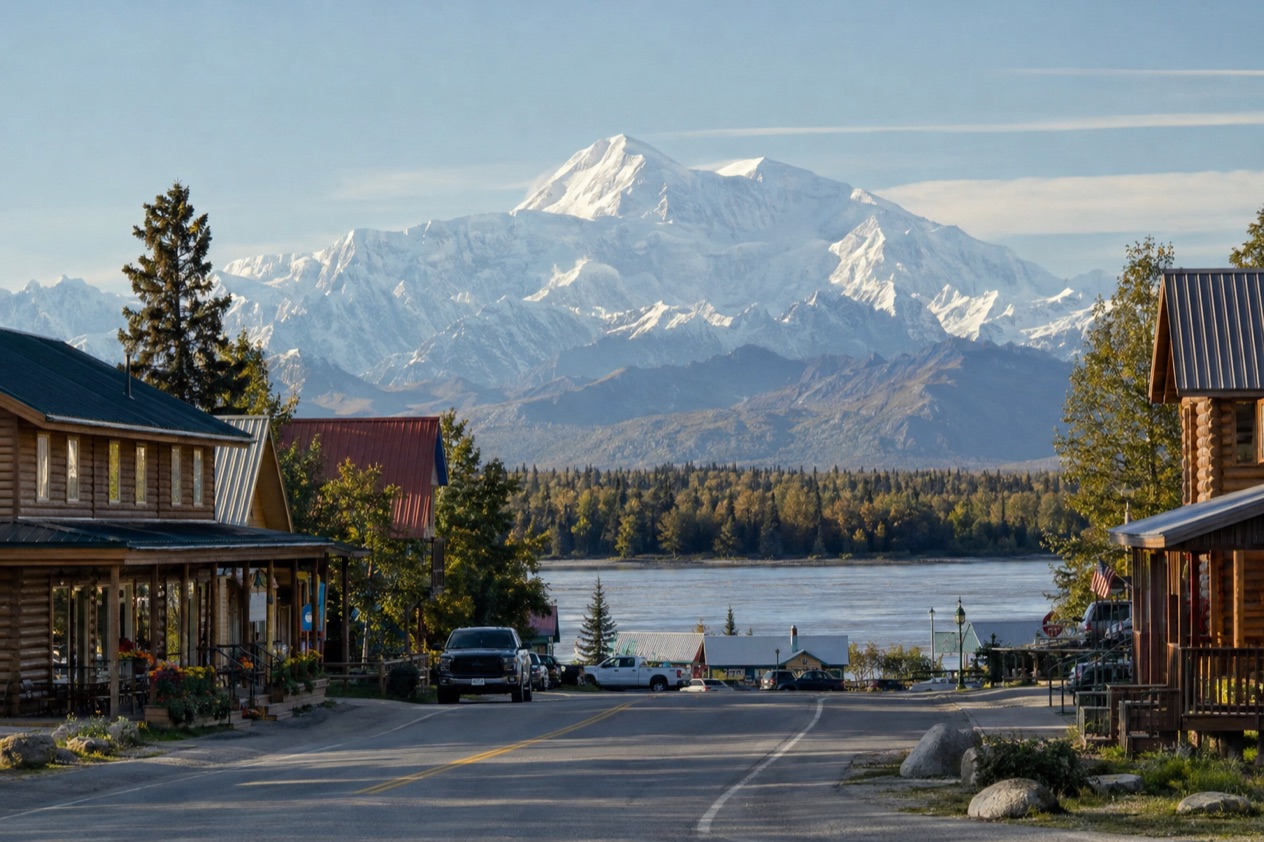
On a summer Friday evening, Talkeetna’s main street fills with neighbors and visitors for the free events, the light lingers over the three rivers, and beyond the rooftops Denali may show itself if the sky is clear. Winter pulls the town indoors to woodstoves and short bright afternoons, while fall and spring are the quiet in-betweens. Talkeetna, the small historic district at the foot of North America’s tallest peak, has a true high season and a true off-season, and each suits a different kind of traveler.
When is the best time to visit Talkeetna?
For travelers the best time is late May through early summer, with the rest of summer close behind, because that is when the days are longest, the trains and events are running and the mountain has its best chance of appearing. Winter is the better choice if the aurora and a snowy small-town mood matter more to you than sightseeing.
For sightseeing and Denali views, June and July give the most daylight and the mildest air, with afternoons in the sixties and evenings that stay light for hours. Denali stands at 20,310 feet, and on a clear day it dominates the northern sky from town and from the Denali Star train.
Clouds often hide it, so give yourself more than a single day. The free Friday evening events run from May 22 through September, which makes a Friday a good anchor for a stay.
For wildlife and the parks, the main summer season at Denali National Park and Preserve runs from late May to early September, and Talkeetna works as a base on the way. The Susitna River carries runs of Chinook and Coho salmon, along with grayling, burbot and rainbow trout, so anglers will want to plan around the river’s fishing seasons. Animals are never guaranteed anywhere in Alaska, but long summer days give you more hours to look.
The quiet seasons have their own appeal. Late August and September bring cooler air and more rain, and the evenings darken again. October through April is for travelers who want solitude, snow and a chance at the northern lights. Families with children usually do best in June and July, when daylight stretches the day and the schedule is the least constrained.
Talkeetna weather by month
Talkeetna’s year swings from deep winter cold to mild, long-lit summers, with the wet weather arriving late in the warm season.
| Month | Average high (°F) | Average low (°F) | Precipitation (in) | Days with precipitation | Daylight on the 15th |
|---|---|---|---|---|---|
| January | 21.8 | 5.4 | 1.34 | 3.9 | 5 h 59 min |
| February | 28.2 | 9.4 | 1.24 | 3.9 | 8 h 48 min |
| March | 34.6 | 12.4 | 1.08 | 3.4 | 11 h 37 min |
| April | 46.6 | 25.8 | 1.32 | 3.5 | 14 h 44 min |
| May | 58.7 | 36.7 | 1.56 | 4.6 | 17 h 41 min |
| June | 67.1 | 47.0 | 1.71 | 5.3 | 19 h 50 min |
| July | 68.7 | 51.4 | 2.87 | 7.8 | 18 h 58 min |
| August | 65.1 | 47.9 | 4.70 | 10.2 | 16 h 10 min |
| September | 56.0 | 39.0 | 4.48 | 9.7 | 13 h 06 min |
| October | 41.8 | 26.5 | 2.78 | 7.0 | 10 h 07 min |
| November | 27.9 | 13.2 | 1.77 | 5.0 | 7 h 06 min |
| December | 23.4 | 7.8 | 1.66 | 4.9 | 5 h 07 min |
The warmest stretch is June and July, and even then you want a light jacket for the evenings and a rain shell within reach. The wettest weather comes in August and September, when showers are frequent and gray days stack up. Winter has far fewer wet days, but the precipitation in those months includes melted snow, and the cold is the main story: highs stay near or below freezing from November through March, so insulated layers, boots and warm headwear matter more than rain gear.
Daylight shapes the day as much as temperature. In early summer the evening light lasts long after dinner, which gives you room for a late walk along the river. In December the day is short, and the sun stays low, so outdoor plans fit into a narrow bright window. Spring gains light quickly, and fall loses it just as fast.
What is there to do in Talkeetna in each season?
The long days of summer
Summer is when Talkeetna is fully open. You can walk the town’s main street and its older buildings, watch the three rivers meet, and head out for the free Friday evening events. Fishing the Susitna is a draw for anglers, and the river is navigable for 85 miles upstream from its mouth to Talkeetna, which says something about how central it is to the area’s life.
The summer Hurricane Turn Train runs from Talkeetna to Hurricane from mid-May to mid-September, Thursday through Monday. It offers flagstop service, so passengers can get on or off anywhere along the backcountry route, with stops named Chase, Curry, Sherman, Gold Creek, Twin Bridges and Chulitna. It is a ride into country that the highway does not reach, and the Denali Star also stops at the depot.
Fall, and the shoulder weeks
As September gives way to October, the rain becomes steadier, the evenings darken and the cooler air arrives. The town grows calmer, and the walks along the rivers feel more private. Fall color may appear in the surrounding woods, but it is a chance, and the weather decides how much of it you see.
Aurora viewing begins to return when the nights darken. The University of Alaska Fairbanks describes the aurora season in Fairbanks as roughly late August to late April, and activity tends to be stronger around the equinoxes. That is a statement about Interior Alaska, so treat the northern lights in Talkeetna as a possibility on clear nights, never a promise.
Winter and the spring thaw
Winter is quiet, cold and bright on a clear day. The Alaska Railroad’s Aurora Winter Train also stops at the Talkeetna depot, which gives winter visitors a way into town. Short days mean you plan around the daylight, and evenings are for warm rooms and, with luck, a look at the sky.
Spring arrives fast. Daylight stretches by many hours between March and May, and temperatures climb from below freezing to something close to comfortable. It is a transitional season, with melting snow and a town waking up before the summer events begin.
When is Talkeetna cheapest and least crowded?
Talkeetna is quietest from October to April, and its busiest weeks fall in the main summer season, late May to early September, when the Denali region receives most of its visitors. Roughly 600,000 people travel to Denali National Park and Preserve each year, mostly in that stretch, and Talkeetna sits on the route between Anchorage and the park.
In the quiet months you will find a smaller town with a slower pace. Rooms and tours are easier to come by simply because fewer people are traveling, although some summer services are not running. The Hurricane Turn is a summer train, so it is not part of a winter visit, while the Aurora Winter Train is the one that serves the town in the cold months.
The shoulder weeks, late spring before the Friday events begin and the end of summer after they wind down, offer a middle path: fewer people, longer or still-decent light, and the town mostly open. Fall brings the wettest weather, so the quiet comes with a trade-off in rain.
Which months should you avoid in Talkeetna?
No month is wrong for everyone, but the dark, cold months of December and January are the hardest for a sightseeing trip, and August and September are the wettest, so avoid them if you want dry views of the mountain.
The months of long daylight, May through July, are when the most things are running: the Friday events, the Hurricane Turn, and the Denali park’s main season. In the same months the sky never gets dark enough for the aurora in Interior Alaska, according to the University of Alaska Fairbanks, so a summer visit is not the time to chase the northern lights.
From late fall to early spring, the summer-only services are not available, and the days are short, so there is less to do outdoors. The cold deepens through winter, and the town goes quiet.
If your plan depends on the Hurricane Turn, the Friday events or the Denali park’s main season, avoid the months outside them. If your plan is solitude, snow and the night sky, those same months are the ones to choose.
Festivals and events in Talkeetna through the year
Summer Fridays and the Fourth of July
The steadiest event in Talkeetna’s calendar is the run of free Friday evening gatherings, listed by the Talkeetna Chamber of Commerce from late May through September. They give the town a weekly rhythm, with neighbors and visitors on the same street and the long light stretching the evening.
The Fourth of July falls in the middle of the long days, and a small town with the sun up so late tends to make a long holiday of it. Talkeetna also has a cat mayor who lives in the general store, a local curiosity that is part of the town’s character, and a good reason to wander in.
Late summer and fall in the Mat-Su Valley
Talkeetna is one of the towns of the Mat-Su Valley, along with Palmer, Wasilla, Willow and Sutton. The Alaska State Fair in Palmer, held in late summer, is where world-record-sized cabbages and other vegetables are displayed each year.
Fall is also the start of the aurora season described for Interior Alaska, from late August onward. Clear nights, patience and a place away from town lights are what improve the chances, and the equinox period around late September is when activity tends to be stronger.
Winter holidays and the aurora months
Christmas and New Year’s arrive in the darkest weeks, when the town’s older buildings and lights stand out against the snow and the daylight is at its shortest. It is a quiet, cozy way to see Talkeetna, with warm rooms and a short bright afternoon for a walk.
Through the winter and into early spring, the aurora season continues, ending roughly in late April in the Fairbanks description. Spring brings the light back, and with it the first stirrings of the summer season, the trains and the Friday evenings that open the year again.
Sources
- NOAA NCEI, U.S. Climate Normals 1991-2020, monthly (https://www.ncei.noaa.gov/access/services/data/v1?dataset=normals-monthly-1991-2020&stations=USW00026528), station Talkeetna Ap, elevation 350 feet, checked October 11, 2026
- Computed from the date and the latitude of the place (sunrise equation, solar elevation -0.833 degrees), October 11, 2026
- Talkeetna Chamber of Commerce (https://www.talkeetnachamber.org/), checked October 11, 2026
- Alaska.org, dest talkeetna (https://www.alaska.org/destination/talkeetna), checked October 11, 2026
- Wikivoyage, Talkeetna (https://en.wikivoyage.org/wiki/Talkeetna), checked October 11, 2026
- Wikipedia, Talkeetna, Alaska (https://en.wikipedia.org/wiki/Talkeetna,_Alaska), checked October 11, 2026
- Wikipedia, Talkeetna Mountains (https://en.wikipedia.org/wiki/Talkeetna_Mountains), checked October 11, 2026
- Wikipedia, Susitna River (https://en.wikipedia.org/wiki/Susitna_River), checked October 11, 2026
- Alaska Railroad, Denali Star (https://www.alaskarailroad.com/ride-a-train/our-trains/denali-star), checked October 11, 2026
- Alaska Railroad, Hurricane Turn (https://www.alaskarailroad.com/ride-a-train/our-trains/hurricane-turn), checked October 11, 2026
- Wikipedia, Denali (https://en.wikipedia.org/wiki/Denali), checked October 11, 2026
- Wikipedia, Mount Denali (https://en.wikipedia.org/wiki/Mount_Denali), checked October 11, 2026
- Wikipedia, Mat-Su Valley (https://en.wikipedia.org/wiki/Mat-Su_Valley), checked October 11, 2026
- Wikipedia, George Parks Highway (https://en.wikipedia.org/wiki/George_Parks_Highway), checked October 11, 2026
- National Park Service, Denali National Park & Preserve, plan your visit (https://www.nps.gov/dena/planyourvisit/index.htm), checked October 11, 2026
- Wikipedia, Climate of Alaska (https://en.wikipedia.org/wiki/Climate_of_Alaska), checked October 11, 2026
- University of Alaska Fairbanks Geophysical Institute, Aurora forecast (https://www.gi.alaska.edu/monitors/aurora-forecast), checked October 11, 2026
To plan your stay
- Things to Do in Talkeetna: Denali Flightseeing, the Hurricane Turn Train and Friday Evenings
- Where to Stay in Talkeetna: Main Street, the River Confluence, Cabins in the Woods and the Parks Highway
- Talkeetna from Anchorage: Parks Highway, Denali Star Train and Hurricane Turn
- Know Before You Go to Talkeetna: Getting There, Weather Layers, Bears and Local Habits