
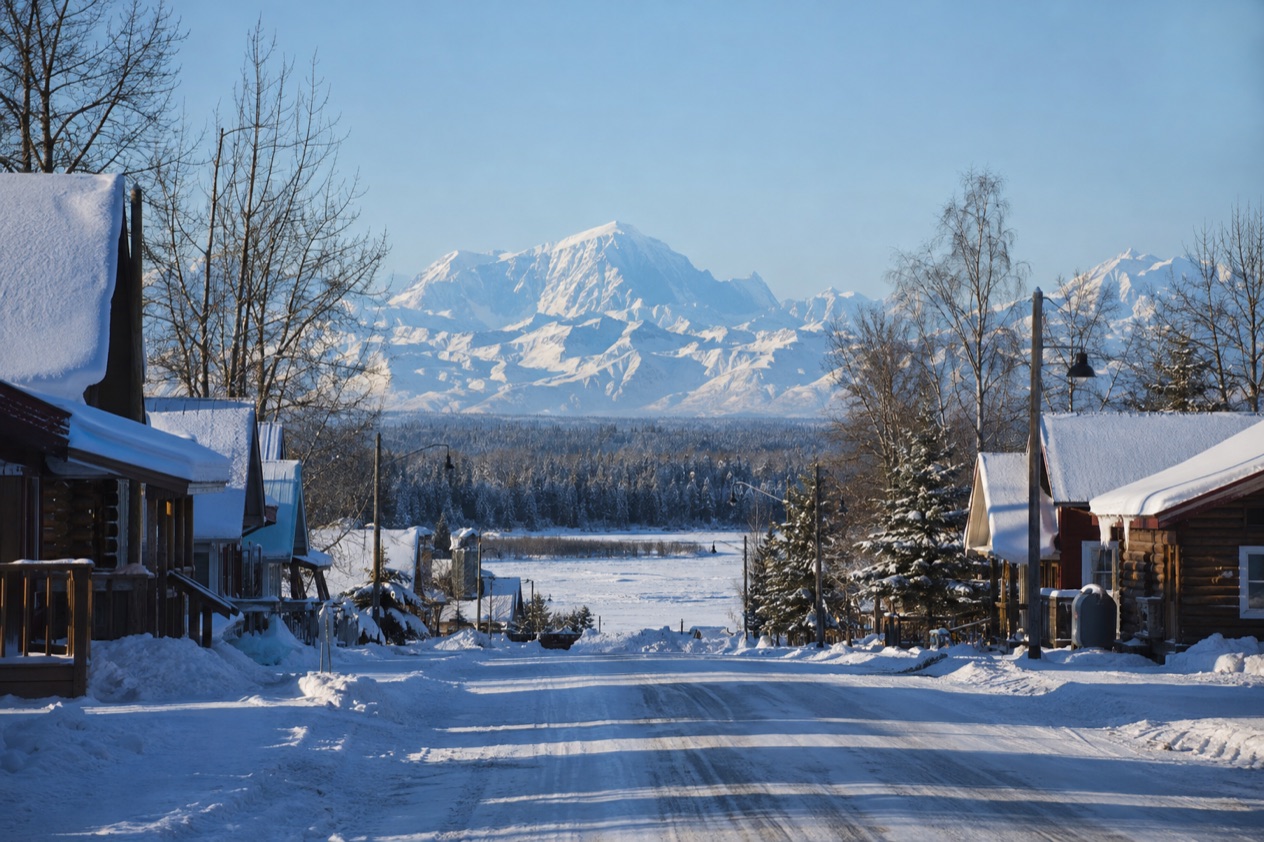
February in Talkeetna is a world of snow squeaking underfoot, chimney smoke hanging straight up in the cold air and the pale light of a low sun on the false-front buildings of the main street. The town sits in a quiet stretch of winter, and the Alaska Range waits on the horizon for the days when the clouds lift. It is a month for bundled-up walks, hot drinks, long evenings and a real chance at the aurora.
What is the weather like in Talkeetna in February?
February in Talkeetna is cold and dry-ish, with hard frost at night, afternoons that stay below freezing and daylight that is returning quickly.
| Month | Average high (°F) | Average low (°F) | Precipitation (in) | Days with precipitation | Daylight on the 15th |
|---|---|---|---|---|---|
| January | 21.8 | 5.4 | 1.34 | 3.9 | 5 h 59 min |
| February | 28.2 | 9.4 | 1.24 | 3.9 | 8 h 48 min |
| March | 34.6 | 12.4 | 1.08 | 3.4 | 11 h 37 min |
Mornings are the coldest part of the day, sharp and still, and the afternoons are the time to be outside, when the air softens toward the freezing mark. Evenings drop back into deep cold quickly.
What this changes for you is mostly about layers. The light is the other big change: the day has stretched well beyond the dark weeks of January, so there is time for a full outing in daylight and still a long night for watching the sky.
Higher up and nearer the mountains, conditions can differ, so treat them as the feel of the streets of Talkeetna rather than of the range beyond.
What to do in Talkeetna in February
The best of February here is slow and winter-flavored: wandering a small town in the snow, warming up in a café or tavern, and staying up for the sky. Talkeetna is part of the Mat-Su Valley, and the George Parks Highway, the main road to Denali National Park and Preserve and Denali State Park, passes close by.
Many summer services are not what you come for now. The Hurricane Turn Train, for example, runs Thursday through Monday from mid-May to mid-September, so it is not a February outing.
Watching for the northern lights
The aurora is the great draw of a winter night. The northern lights oval covers most of Alaska, and the viewing season in the Interior runs from late August to late April, so February sits well inside it. The northern lights are caused by charged particles from the sun colliding with gas molecules in the upper atmosphere, and they show up as green, and sometimes red or purple, light.
Clear skies are the whole game, so a cloudy night means trying again the next. Auroral activity tends to be stronger around the equinoxes than at midwinter, and February falls on the way toward the spring one. Dress for standing still in the cold, pick a spot away from street lights and give yourself several nights rather than one. A sighting is a chance, never a promise.
Mountain views and dog sled country
Denali, at 20,310 feet the highest peak in North America, rises in the Alaska Range, and the Koyukon Athabaskans have called it Denali, meaning the tall one, for centuries. On a clear day the whole range stands pale against the sky, and February’s growing daylight gives you more hours to catch it. The mountain often hides in cloud, so enjoy it as a bonus when it shows.
Sled dogs are part of the winter picture across Alaska. In the state, dog teams traditionally pull side by side in pairs, and sleds are the built-up type with a high rail on each side.
At Denali National Park, the kennels are open Saturdays and Sundays only, from 1 pm to 4 pm, through the winter. The park’s winter visitor center is the Murie Science and Learning Center at mile 1.3 on the Denali Park Road, and the park’s winter season runs from late September until early May.
| Site | Open |
|---|---|
| Denali National Park kennels (late September through winter) | Saturdays and Sundays, 1 pm to 4 pm |
In town, the pleasures are simple ones: the main street under snow, a hot bowl of soup, a local brew by a stove and a long evening of conversation. The pace is unhurried, and that is the point of a Talkeetna winter.
A two-day itinerary for Talkeetna in February
Day 1 is about the town in daylight. Start late, after the coldest hour has passed, with a hearty breakfast at a café. Walk the main street while the low sun is on the buildings, and pop into shops and galleries to warm up between stretches outside.
Spend the afternoon, the mildest part of the day, outdoors for as long as your layers allow, with the light lasting nearly nine hours. Have an early dinner at a local tavern or restaurant, then come back out after dark for the first look at the sky. If clouds roll in, a long evening by a stove is a fine plan B.
If it is a weekend, the kennels are open from 1 pm to 4 pm, so build the day around that visit and stop at the Murie Science and Learning Center, the park’s winter visitor center. Keep lunch simple and take a hot drink along.
Return to Talkeetna in the evening for supper and a second try at the aurora, which gets better with each night you give it. If the weather turns gray, spend the time indoors over a long meal and plan the sky for the next clear night.
Is Talkeetna busy in February?
February is a quiet month in Talkeetna, far from the summer rhythm of trains and boats.
What you find is a small community going about winter life, with the visitors who do come mostly there for the sky and the snow. Denali National Park is in its winter season, which runs from late September until early May, and its kennels keep short weekend hours.
What to pack for Talkeetna in February
Days are below freezing and nights are far colder, so pack for standing outside in the cold, especially when watching the sky.
- Insulated, waterproof boots, for snowy sidewalks and long evenings outside.
- A warm base layer and a fleece or wool middle layer, to build warmth in steps.
- A windproof outer jacket, because the afternoon air bites when it moves.
- Hat, mittens and a neck gaiter, for the aurora watch.
- Sunglasses, since low sun on snow is bright.
- A thermos, for hot drinks on the long nights out.
Good to know before you go
Winter shapes everything in February. The Hurricane Turn Train is a summer service, and Denali National Park’s kennels open only on weekends from 1 pm to 4 pm. Daylight lasts nearly nine hours in mid-month, which is enough for a full outing, and the long nights are the time for the aurora. The George Parks Highway is the main road to Denali National Park and Preserve and Denali State Park.
Talkeetna in February vs January and March
Moving a month earlier brings deeper cold and a much shorter day, with only about six hours of daylight in mid-January. The aurora season is on, but you have less light for anything else, so January suits those who want the sky and a very quiet town above all.
A month later, March is milder, with afternoons rising above freezing and daylight stretching to nearly twelve hours. Auroral activity tends to be stronger near the spring equinox, so March has its own appeal for the sky, and the longer days make outdoor plans easier.
February sits in the middle: enough daylight for real outings, cold enough to feel like deep winter and still well inside the aurora season. Choose January for the starkest cold, March for gentler afternoons, and February for the balance.
Is February a good time to visit Talkeetna?
Yes, for travelers who like cold, quiet and a night sky worth waiting for. February gives you real winter, a town with space to itself and daylight long enough for a proper day outside.
It is less suited to anyone who wants summer services, since the train season is far off, or who dislikes the cold. On arrival, settle in, layer up and plan the first clear evening for the sky, because the weather decides when it happens. A February night here, with the snow quiet and the sky open, is the thing to come for.
Sources
- NOAA NCEI, U.S. Climate Normals 1991-2020, monthly (https://www.ncei.noaa.gov/access/services/data/v1?dataset=normals-monthly-1991-2020&stations=USW00026528), station Talkeetna Ap, elevation 350 feet, checked October 11, 2026
- Computed from the date and the latitude of the place (sunrise equation, solar elevation -0.833 degrees), October 11, 2026
- University of Alaska Fairbanks Geophysical Institute, Aurora forecast (https://www.gi.alaska.edu/monitors/aurora-forecast), checked October 11, 2026
- Wikivoyage, Northern lights (https://en.wikivoyage.org/wiki/Northern_lights), checked October 11, 2026
- Wikipedia, Aurora (https://en.wikipedia.org/wiki/Aurora), checked October 11, 2026
- Visit Anchorage, northern lights viewing (https://www.anchorage.net/winter/things-to-do/northern-lights-viewing/), checked October 11, 2026
- Visit Anchorage, dog sledding (https://www.anchorage.net/winter/things-to-do/dog-sledding/), checked October 11, 2026
- Wikipedia, Dog sled (https://en.wikipedia.org/wiki/Dog_sled), checked October 11, 2026
- National Park Service, Denali National Park & Preserve, plan your visit: kennels (https://www.nps.gov/dena/planyourvisit/kennels.htm), checked October 11, 2026
- National Park Service, Denali National Park & Preserve, plan your visit: winter activities (https://www.nps.gov/dena/planyourvisit/winter-activities.htm), checked October 11, 2026
- Alaska Railroad, Hurricane Turn (https://www.alaskarailroad.com/ride-a-train/our-trains/hurricane-turn), checked October 11, 2026
- Wikipedia, Denali (https://en.wikipedia.org/wiki/Denali), checked October 11, 2026
- Wikipedia, Mount Denali (https://en.wikipedia.org/wiki/Mount_Denali), checked October 11, 2026
- Wikipedia, Mat-Su Valley (https://en.wikipedia.org/wiki/Mat-Su_Valley), checked October 11, 2026
- Wikipedia, George Parks Highway (https://en.wikipedia.org/wiki/George_Parks_Highway), checked October 11, 2026
- Wikipedia, Climate of Alaska (https://en.wikipedia.org/wiki/Climate_of_Alaska), checked October 11, 2026
To plan your stay
- Things to Do in Talkeetna: Denali Flightseeing, the Hurricane Turn Train and Friday Evenings
- Where to Stay in Talkeetna: Main Street, the River Confluence, Cabins in the Woods and the Parks Highway
- Talkeetna from Anchorage: Parks Highway, Denali Star Train and Hurricane Turn
- Know Before You Go to Talkeetna: Getting There, Weather Layers, Bears and Local Habits