
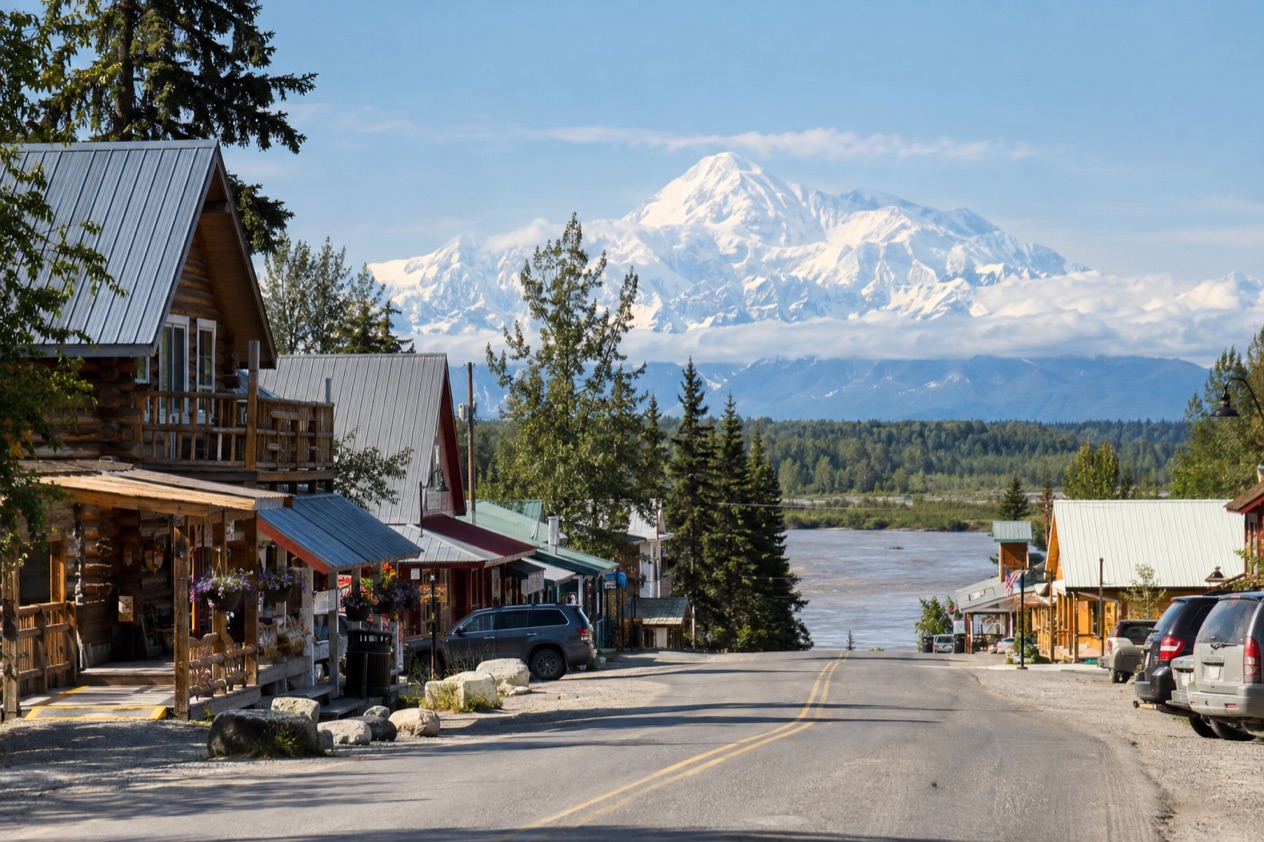
You step off the train or out of the car and Talkeetna announces itself with a main street of wooden storefronts, a general store with a cat for a mayor, and, on a clear day, the huge white shoulder of Denali standing over the roofs. It is a small place and it keeps a slow rhythm. A few things are worth knowing before you arrive: how the town connects to Anchorage and Denali, what to wear, and how Alaskans expect you to behave around bears.
What should you know before visiting Talkeetna?
Four things matter most here: Talkeetna sits on its own spur of the road network at the base of Denali, the weather calls for layers even in the warm months, bears are part of daily life and food must be kept secure, and the town is tiny and informal. It is a historic district rather than a legal town or city, with no local government other than a cat mayor who lives in the general store.
Location is the first thing to get straight. Talkeetna lies at the confluence of the Chulitna, Susitna and Talkeetna Rivers, halfway between Anchorage and Denali in the Matanuska-Susitna Valley. You reach it by car on the George Parks Highway, the main road from Anchorage to Fairbanks, and the Alaska Railroad also stops at the Talkeetna Depot. Expeditions to climb Denali start from here, which explains the climbers you will see packing gear around town.
What surprises first-time visitors is how close the mountain feels and how small the town is. Talkeetna is closer to Denali than the entrance of Denali National Park is, yet the mountain is not always visible, so a cloudy day does not mean a ruined one.
The town is also more of a gathering place than a set of sights: you wander the main street, sit in a café or brewery, watch the river, and let the afternoon go. Many of the buildings are older, and a good number are vacation homes, which gives the place the feel of a village that people return to rather than one built for passing through. Friday evenings add free events from May 22 through September, according to the Talkeetna Chamber of Commerce calendar.
Fees, passes and reservations
Nothing in the information gathered for Talkeetna sets a fee, a park pass or a reservation requirement for the town itself, so there is no amount to budget for just to walk its streets. The Friday evening events from May 22 through September are free, which makes them an easy addition to a stay.
If your plans reach beyond town, the question becomes which place you are heading to, because each park, railroad service and operator keeps its own rules. Denali National Park and Preserve lies about 3 hours by car to the north, and anything you want there, from park access to transportation, is settled with the park itself and not with Talkeetna. The same goes for the Alaska Railroad, whose Denali Star, Aurora Winter Train and Hurricane Turn trains all stop at the Talkeetna Depot: fares and schedules belong to the railroad.
Climbing Denali is its own world. Expeditions start in Talkeetna, but that is a mountaineering undertaking with its own arrangements, far from a day visit. For most travelers, the useful point is simple: decide before you go which outings you want, then settle any fees or reservations for each one with the operator or agency that runs it.
Money, phones and getting online
Talkeetna is in the United States, so everything is in U.S. dollars and there is nothing to exchange. That is the whole of the money question for an American traveler, and it keeps the planning simple.
Phones and internet are less certain. The information gathered for Talkeetna says nothing about cell coverage or Wi-Fi, so it is wiser to download what you need before you leave Anchorage: maps, reservations, train confirmations and any offline notes. The area around the town is made of rivers, forest and mountains, and the Talkeetna Mountains to the east are described as remote and heavily glaciated in their central part, a reminder that this is not a place to count on a signal everywhere.
One online tool is worth knowing if you are driving. Alaska 511, run by the Alaska Department of Transportation, publishes road conditions in categories from Good and Fair to Difficult, Very Difficult, Hazardous and Road Closure, along with No Winter Maintenance.
The Department has also partnered with Waze to show Waze-reported incidents and closures on the site, and its map lets you add cameras to a My Cameras list. It is a useful thing to open before you take the highway.
Getting around and staying connected
Most people arrive by road or by rail. By car, Talkeetna is about 2.5 hours from Anchorage according to one source, and a drive of about 2 hours according to another, so plan on a range of roughly 2 to 2.5 hours depending on the day.
From Denali National Park and Preserve the drive is about 3 hours. The route is the George Parks Highway, the main road between Anchorage and Fairbanks, which puts Talkeetna on a natural stop between the two.
The Alaska Railroad is the other way in. The Talkeetna Depot is a stop on the Denali Star, the Aurora Winter Train and the Hurricane Turn. The names alone tell you the trains serve different purposes, and the railroad is the source for their routes and timing. Arriving by rail leaves you free to look out of the window instead of at the road, and the depot puts you in the middle of the village.
Once in town, the place is small, with a population of 1,055 at the 2020 census, and its center is a short stretch of main street. Information on taxis, ride-hailing, buses or rental cars in Talkeetna is not part of what is known here, so it is best not to count on any of them. Before you leave, check Alaska 511 for conditions on the highway, since the road is the main link to everything else.
Weather, daylight and wildlife
Dress in layers, whatever the month. From spring to early fall, Alaska temperatures run between 50 and 70 degrees Fahrenheit, with possible rain and wind, and the advice is a fully waterproof, breathable shell with a hood on the outside, plus a backpack so you can remove layers as the weather changes.
Talkeetna’s own numbers show how much the seasons differ. The table gives the averages for four months at the town’s airport station, which sits at 350 feet.
| Month | Average high (°F) | Average low (°F) | Precipitation (inches) | Days with precipitation |
|---|---|---|---|---|
| January | 21.8 | 5.4 | 1.34 | 3.9 |
| April | 46.6 | 25.8 | 1.32 | 3.5 |
| July | 68.7 | 51.4 | 2.87 | 7.8 |
| October | 41.8 | 26.5 | 2.78 | 7.0 |
In words: January is deeply cold, with lows near zero and nights that call for serious winter gear. April is still near freezing overnight, so a warm layer stays in the bag even as afternoons soften. July is the warm month, with pleasant afternoons and cool nights, and showers on some days. October is cold again, with the wettest stretch of the autumn months shown here and lows below freezing.
Wildlife is part of the landscape. Black bears, brown bears and polar bears all live in Alaska, and people in Alaska must keep all human sources of food secure from bears. Dangerous bear situations are reported to the Alaska Department of Fish and Game through its wildlife encounter form. The Susitna River, navigable for 85 miles upstream from its mouth to Talkeetna, is one of Southcentral Alaska’s premier sport fishing streams, with runs of Chinook and Coho salmon and resident grayling, burbot and rainbow trout.
Local customs and etiquette
Alaskans dress for the weather, not for the occasion. Rain jackets, sturdy boots and fleece show up at restaurants and bars, and nobody will look twice at a muddy pair of shoes. Pack the same way and you will fit in, from a brewery table to the Friday evening events.
The pace is unhurried. Talkeetna is a village where people stop to talk on the sidewalk, where the cat mayor is part of the local humor, and where a long lunch is normal.
Friendliness is easy and direct, and a hello to the person behind the counter or the climber at the next table is the usual way to begin. Locals tend to appreciate visitors who linger and pay attention to the place instead of rushing through for a photograph.
Respect for wildlife is a shared habit. Alaskans take bears seriously, and they treat food, trash and campsites with care so that animals do not learn to look for people. Admire animals from where you are, never feed them, and let the local people and the agencies tell you what is expected where you are. The land around Talkeetna has long been home to Alaska Native peoples, and the sensible approach is the one you would take anywhere: be courteous, ask before photographing people, and treat cultural sites and gathering places as places that matter to someone.
Climbers also shape the town’s character. Expeditions to climb Denali begin here, so you will hear plans and stories at tables around you. Listening is welcome. Treat the people and their gear with the same easy courtesy as everything else in town.
Good to know before you go
The Friday evening events run from May 22 through September, and the Aurora Winter Train name is a reminder that the railroad changes with the season, so look at the railroad’s own schedule for the month you travel. Alaska is on Alaska Time, nine hours behind UTC in standard time and eight in daylight saving time, which changes on the second Sunday in March and the first Sunday in November. A last habit worth keeping: open Alaska 511 before you drive, and keep a waterproof layer within reach.
Sources
- Talkeetna Chamber of Commerce (https://www.talkeetnachamber.org/), checked October 11, 2026
- Alaska.org, dest talkeetna (https://www.alaska.org/destination/talkeetna), checked October 11, 2026
- Wikivoyage, Talkeetna (https://en.wikivoyage.org/wiki/Talkeetna), checked October 11, 2026
- Wikipedia, Talkeetna, Alaska (https://en.wikipedia.org/wiki/Talkeetna,_Alaska), checked October 11, 2026
- Wikipedia, Talkeetna Mountains (https://en.wikipedia.org/wiki/Talkeetna_Mountains), checked October 11, 2026
- Wikipedia, Susitna River (https://en.wikipedia.org/wiki/Susitna_River), checked October 11, 2026
- Wikipedia, Climate of Alaska (https://en.wikipedia.org/wiki/Climate_of_Alaska), checked October 11, 2026
- Alaska 511 (https://511.alaska.gov/), checked October 11, 2026
- Alaska Department of Fish and Game, Living with bears (https://www.adfg.alaska.gov/index.cfm?adfg=livingwithbears.main), checked October 11, 2026
- Alaska.org, what to wear (https://www.alaska.org/advice/what-to-wear-in-alaska), checked October 11, 2026
- Wikipedia, Alaska Time Zone (https://en.wikipedia.org/wiki/Alaska_Time_Zone), checked October 11, 2026
- NOAA NCEI, U.S. Climate Normals 1991-2020, monthly (https://www.ncei.noaa.gov/access/services/data/v1?dataset=normals-monthly-1991-2020&stations=USW00026528), station Talkeetna Ap, elevation 350 feet, checked October 11, 2026
To plan your stay
- Best Time to Visit Talkeetna: Weather by Month, Denali Views and What to Do in Each Season
- Things to Do in Talkeetna: Denali Flightseeing, the Hurricane Turn Train and Friday Evenings
- Where to Stay in Talkeetna: Main Street, the River Confluence, Cabins in the Woods and the Parks Highway
- Talkeetna from Anchorage: Parks Highway, Denali Star Train and Hurricane Turn