
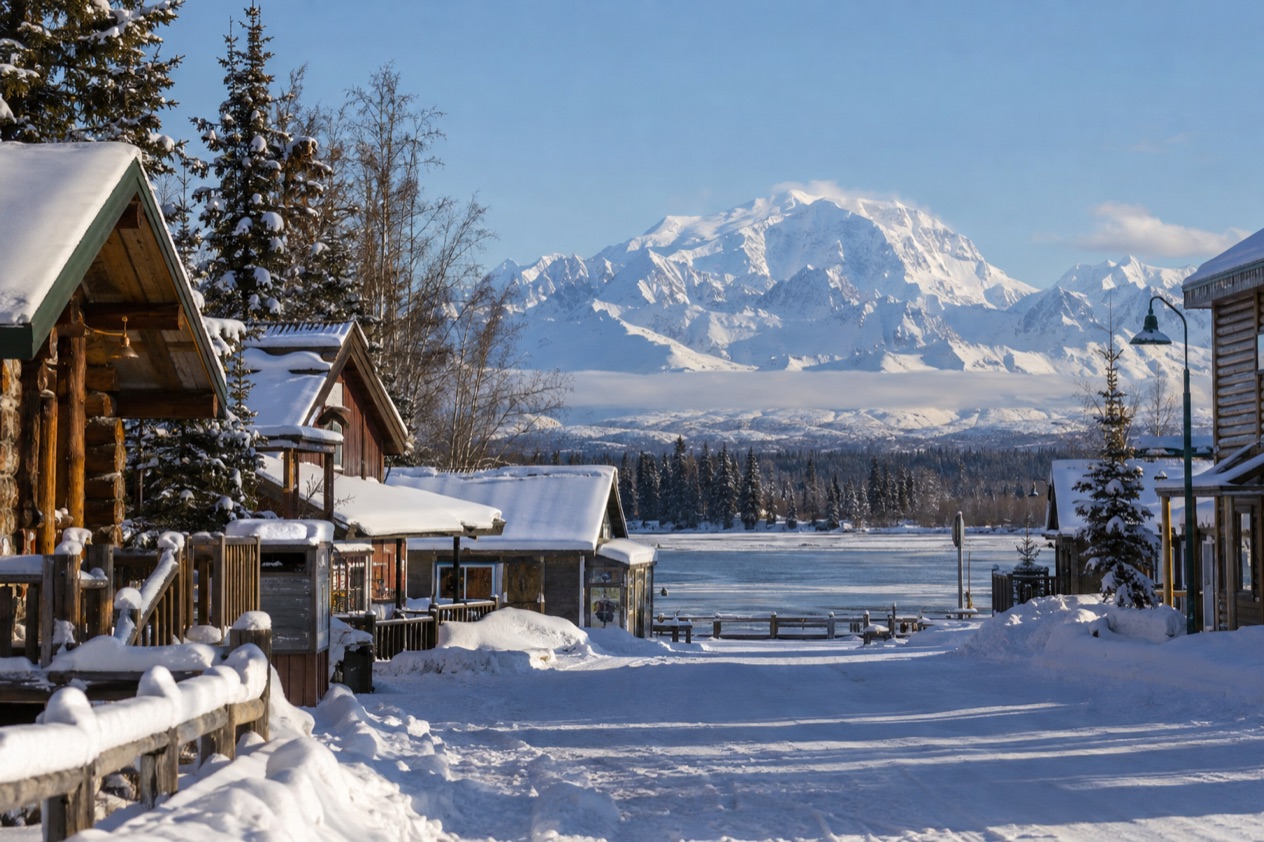
In December, woodsmoke hangs low over Talkeetna’s Main Street, boots squeak on cold snow, and the daylight slides toward the horizon almost as soon as lunch is over. The village is a historic district rather than a legal town, and in midwinter it feels like a place that belongs to its few hundred year-round residents. December here means deep cold, long dark evenings with a chance of aurora, and a slow pace in the shadow of the Alaska Range.
What is the weather like in Talkeetna in December?
December in Talkeetna is cold all day and colder at night, with afternoons that stay well below freezing and only a few days of snowfall.
| Month | Average high (°F) | Average low (°F) | Precipitation (in) | Days with precipitation | Daylight on the 15th |
|---|---|---|---|---|---|
| November | 27.9 | 13.2 | 1.77 | 5.0 | 7 h 06 min |
| December | 23.4 | 7.8 | 1.66 | 4.9 | 5 h 07 min |
| January | 21.8 | 5.4 | 1.34 | 3.9 | 5 h 59 min |
Mornings begin in the dark and in deep cold, so the first walk of the day is a matter of layers rather than of choosing a destination. The afternoon high never climbs near the freezing point. With air this cold, what falls from the sky is mostly snow, and it arrives on a handful of days rather than as a steady drizzle. Between those days, the sky is often clear and hard.
The light is the real constraint. Daylight lasts barely five hours in mid-December, and the sun stays low, so the town is washed in long, pale tones even at midday. Plan outdoor time in the middle of the day and keep the evenings for the stove, a hot meal and, if the sky cooperates, a look outside.
Dress for standing still, not only for walking. Insulated boots, a warm hat, mittens over liners and a long down coat matter more than rain gear here.
What to do in Talkeetna in December
The best of a Talkeetna December is quiet and atmospheric: a walk through a snow-covered village, a warm room at dusk, a long look at the night sky. The town is small, with a population of 1,055 at the last census, and what it offers in winter is a mood more than a checklist.
Main Street and the village
Talkeetna is not legally a town or a city. It is a historic district of older buildings and vacation homes, with no local government except a cat who holds the title of mayor and lives in the general store. In winter the wooden storefronts and cabins sit under snow, and the whole village can be walked in an unhurried hour or two.
Go in the early afternoon, when the low sun gives the best light on the facades and the cold is at its mildest. Stop for something hot in a café or tavern, warm up, and walk out again. On a clear day, the Alaska Range may show itself above the rooftops, a chance rather than a promise.
Talkeetna is also the town of the climbers who head for Denali, but that season belongs to another part of the year. In December the streets lean toward locals, dogs and woodsmoke rather than expedition gear.
The depot and the Susitna River
The Talkeetna Depot is a stop on the Alaska Railroad’s Denali Star, Aurora Winter Train and Hurricane Turn trains. Even without boarding anything, the depot is a good place to feel how the village connects to the rest of Alaska, with the tracks running through the edge of town.
Beyond the village, the Susitna River is the great water of the area. It is navigable for 85 miles upstream from its mouth to Talkeetna, and it is known for salmon runs, which belong to the warm months. In December the river is a cold, quiet presence at the edge of the village, best looked at from the bank rather than anything more adventurous.
Looking for the aurora
The Northern Lights oval covers most of Alaska, and sources on Alaska’s skies place the aurora season from late summer through the middle of April, which includes December. Talkeetna’s long nights give plenty of dark hours for a look. A clear sky is the one thing that decides it, so the chance is real but never a guarantee.
One detail worth knowing: auroral activity in Interior Alaska is statistically about twice as likely around the equinoxes as around the solstices, and December is a solstice month. That says nothing about any single night, but it explains why some nights are quiet even under a perfectly clear sky. Step away from the lights of the village, give your eyes time to adjust and dress as if you will stand still for a long while.
Denali’s winter side
Talkeetna is about 3 hours by car from Denali National Park and Preserve, which makes the park a long outing in this light. Its winter season runs from late September until early May, and the winter visitor center is the Murie Science and Learning Center at mile 1.3 on the Denali Park Road. The park’s sled dog kennels, which the rangers keep, are open in winter on weekends only.
| Site | Open |
|---|---|
| Denali National Park kennels (late September through winter) | Saturdays and Sundays, 1 pm to 4 pm |
In Alaska, sled dogs traditionally pull side by side in pairs, not fanned out, and the sleds are the built-up type with a high rail on each side. At the kennels you see the working dogs of the park, a very different picture from the summer routine. Because the visit means a long drive in short daylight, it suits a weekend and an early start.
A two-day itinerary for Talkeetna in December
Day 1 is for the village. Wait for the day to open up, since the light is short and the morning is the coldest part. Late morning, walk Main Street with a hot drink in hand, look at the old buildings and find the general store with its cat mayor. Lunch is a sit-down meal in a warm tavern or café.
In the early afternoon, when the sun is still above the horizon, walk to the depot and the riverbank for the last decent light. Be back indoors as the day fades. In the evening, eat something hearty, then step out once or twice to check the sky away from the street lamps for a chance of aurora.
Day 2 is for Denali, if it falls on a weekend. The kennels are open Saturdays and Sundays from 1 pm, and the drive is about 3 hours each way, so leave in the morning and expect to drive back in the dark. Stop at the Murie Science and Learning Center, the park’s winter visitor center, to see what the park does in the cold season.
If it is a weekday or the weather turns, stay in Talkeetna and make a slow day of it: a long breakfast, a look into the shops that stay open, a second walk along the river when the sky clears. When snow falls, the village is prettiest from a window, and an evening by a stove is the best rain card there is.
Is Talkeetna busy in December?
No, December is a quiet month in a village of about a thousand people, with the short days and the cold setting a slow pace.
What December does bring is winter itself: the aurora season, the winter side of Denali National Park and, at the Talkeetna Depot, the Aurora Winter Train among the railroad’s stops. The Denali kennels are open only on weekends, so those two days are the ones to plan around if the dogs are on your list.
The rhythm of the village follows the light. Outings cluster around the middle of the day, and the evenings are for indoor warmth and, with luck, a clear sky overhead.
What to pack for Talkeetna in December
Packing for Talkeetna in December is about staying warm while standing outdoors in the dark for aurora and walking in the low light of midday.
- Insulated, waterproof boots, because afternoons stay well below freezing and snow covers the village.
- Base layers of wool or synthetic, for the cold mornings and the long evenings.
- A long, warm coat for standing still while you watch the sky.
- Warm hat, scarf and mittens over liners, since fingers and ears feel the cold first.
- A headlamp or flashlight for the dark hours at both ends of the short day.
- A camera you can use with gloves, in case the aurora shows.
Good to know before you go
Talkeetna is reached by car on the George Parks Highway, the main road between Anchorage and Fairbanks, and the drive from Anchorage takes about 2 hours. The Alaska Railroad’s Talkeetna Depot is also a stop on three of its trains. Daylight is short in December, so plan outdoor activities around the middle of the day.
Denali National Park’s winter season runs from late September until early May, and its kennels keep weekend-only hours in winter. If the sled dogs are part of your plan, shape the trip around a Saturday or Sunday.
Talkeetna in December vs November and January
Earlier, in November, the days are about two hours longer and the cold is a little less hard, which makes walking around the village more comfortable. The light is still limited, but there is more room in the middle of the day for outings and for the drive to Denali. The aurora season is also under way, so the sky is still an option.
Later, in January, the cold deepens, with the lowest temperatures of the three months, while the daylight starts to return. The gain is nearly an hour over mid-December, which is enough to feel the difference on a clear afternoon. January is also the driest of the three, with fewer days of snowfall.
Choose November if you want a bit more light and a milder chill. Choose January if the deepest winter and returning daylight appeal. Choose December if you want the darkest, quietest weeks of the year, with the long nights and the village at its most wintry.
Is December a good time to visit Talkeetna?
Yes, for travelers who want a quiet winter village, long nights under a possible aurora and a slow pace, and no for anyone who needs long days of daylight or wants to be outdoors for hours.
December suits people who enjoy stillness: a walk on snowy streets, a warm meal at dusk, a night spent watching the sky. It also suits those who like to pair a small village with a winter look at Denali and its sled dogs.
On arrival, take a first walk along Main Street in the early afternoon, while the sun is still up, and get your bearings at the depot. Save the evening for the sky. What December gives Talkeetna is a village drawn down to its essentials: snow, woodsmoke, a cat mayor in the general store and a dark sky overhead.
Sources
- NOAA NCEI, U.S. Climate Normals 1991-2020, monthly (https://www.ncei.noaa.gov/access/services/data/v1?dataset=normals-monthly-1991-2020&stations=USW00026528), station Talkeetna Ap, elevation 350 feet, checked October 11, 2026
- Computed from the date and the latitude of the place (sunrise equation, solar elevation -0.833 degrees), October 11, 2026
- University of Alaska Fairbanks Geophysical Institute, Aurora forecast (https://www.gi.alaska.edu/monitors/aurora-forecast), checked October 11, 2026
- Wikivoyage, Northern lights (https://en.wikivoyage.org/wiki/Northern_lights), checked October 11, 2026
- Wikipedia, Aurora (https://en.wikipedia.org/wiki/Aurora), checked October 11, 2026
- Visit Anchorage, northern lights viewing (https://www.anchorage.net/winter/things-to-do/northern-lights-viewing/), checked October 11, 2026
- Visit Anchorage, dog sledding (https://www.anchorage.net/winter/things-to-do/dog-sledding/), checked October 11, 2026
- Wikipedia, Dog sled (https://en.wikipedia.org/wiki/Dog_sled), checked October 11, 2026
- National Park Service, Denali National Park & Preserve, plan your visit: kennels (https://www.nps.gov/dena/planyourvisit/kennels.htm), checked October 11, 2026
- National Park Service, Denali National Park & Preserve, plan your visit: winter activities (https://www.nps.gov/dena/planyourvisit/winter-activities.htm), checked October 11, 2026
- Wikivoyage, Talkeetna (https://en.wikivoyage.org/wiki/Talkeetna), checked October 11, 2026
- Wikipedia, Talkeetna, Alaska (https://en.wikipedia.org/wiki/Talkeetna,_Alaska), checked October 11, 2026
- Wikipedia, Talkeetna Mountains (https://en.wikipedia.org/wiki/Talkeetna_Mountains), checked October 11, 2026
- Wikipedia, Susitna River (https://en.wikipedia.org/wiki/Susitna_River), checked October 11, 2026
- Alaska Railroad, Denali Star (https://www.alaskarailroad.com/ride-a-train/our-trains/denali-star), checked October 11, 2026
- Wikipedia, Climate of Alaska (https://en.wikipedia.org/wiki/Climate_of_Alaska), checked October 11, 2026
To plan your stay
- Things to Do in Talkeetna: Denali Flightseeing, the Hurricane Turn Train and Friday Evenings
- Where to Stay in Talkeetna: Main Street, the River Confluence, Cabins in the Woods and the Parks Highway
- Talkeetna from Anchorage: Parks Highway, Denali Star Train and Hurricane Turn
- Know Before You Go to Talkeetna: Getting There, Weather Layers, Bears and Local Habits