
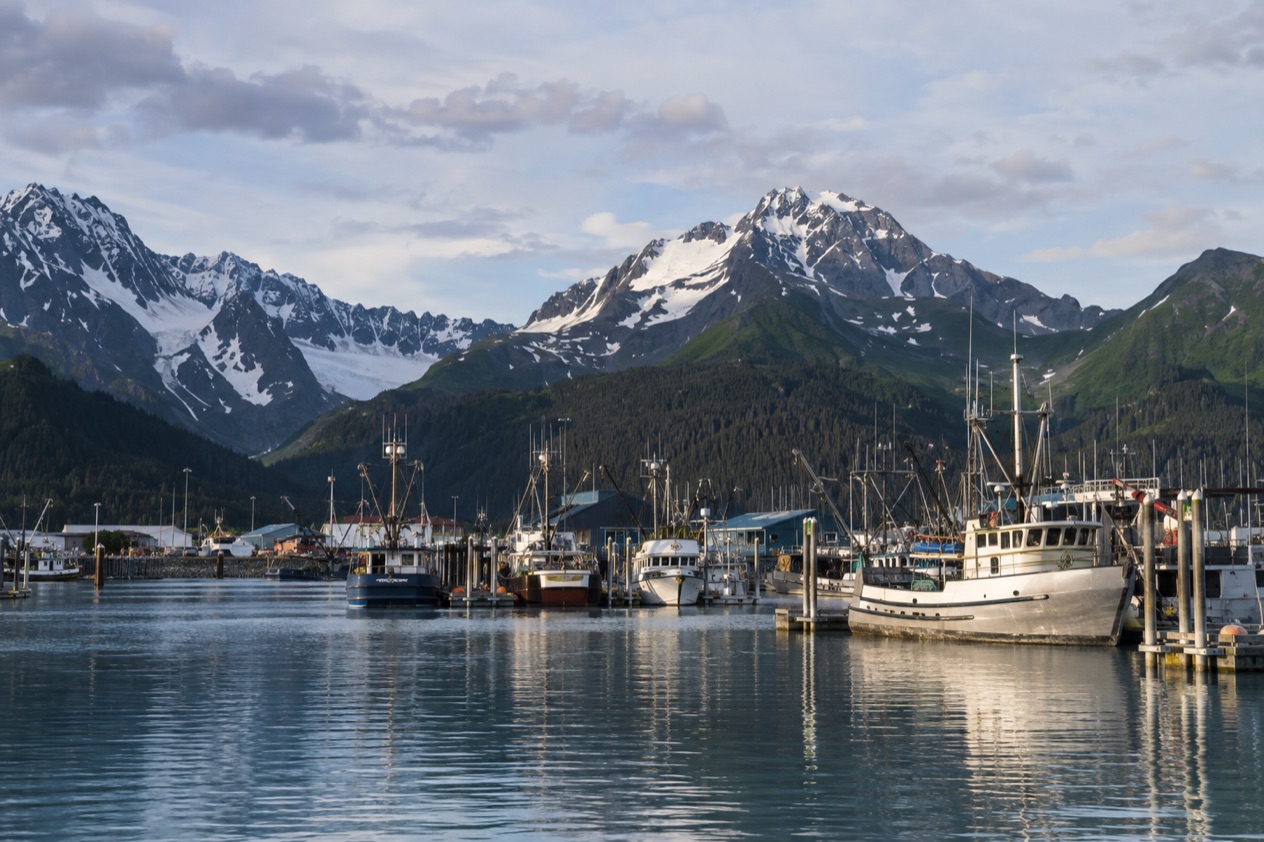
On a summer evening in Seward, the light lingers over Resurrection Bay long after dinner, fishing boats nose back into the harbor, and Mt. Marathon stands over the town with its upper slopes catching the last sun. In winter the same bay turns quiet and gray-blue, the days shrink, and snow settles on the mountains that crowd the shore. This is a small port town at the end of the Seward Highway, and its best months are the long, bright ones of early summer, with a quieter and moodier side the rest of the year.
When is the best time to visit Seward?
The best time to visit Seward is from late spring through the end of summer, roughly June to August, when the days are longest, the air is mildest and the seasonal train and bus from Anchorage are running.
For sightseeing, the summer months give you the most room to work with. The Alaska Railroad’s Coastal Classic runs between Anchorage and Seward in summer, and the Park Connection bus does the same from mid-May to mid-September. The train winds along Turnagain Arm, where the Chugach mountains drop straight to the water.
The Seward Highway, a designated All-American Road, is there for drivers in every month. With evenings that stay light for hours, you can fit a morning on the water and an evening stroll along the waterfront into the same day.
Exit Glacier, the one part of the park reachable by road, is open to cars until snow closes the road, usually in mid-November.
Marine life, glaciers and birds are chances rather than promises, and long daylight simply gives you more hours to look. The Alaska SeaLife Center, the state’s only public aquarium, is a good anchor for a gray day in any season.
If crowds and quiet matter more to you than warmth, the shoulder months of May and September are worth a look. May brings lengthening days and the first summer services, while September is the wettest stretch of the year and calls for real rain gear.
Winter suits travelers who want a snowy small town and are happy with short days. Families will find summer the most comfortable season, since children spend more time outdoors when the air is mild and the daylight is long.
Seward weather by month
Seward has a cool maritime climate, with summer highs in the low 60s at best and winters that hover around freezing.
| Month | Average high (°F) | Average low (°F) | Precipitation (in) | Days with precipitation | Daylight on the 15th |
|---|---|---|---|---|---|
| January | 31.3 | 21.1 | 6.47 | 10.1 | 6 h 38 min |
| February | 34.3 | 23.5 | 6.35 | 9.7 | 9 h 06 min |
| March | 37.3 | 24.9 | 3.85 | 7.8 | 11 h 39 min |
| April | 45.4 | 32.2 | 4.29 | 9.3 | 14 h 29 min |
| May | 53.4 | 39.2 | 3.50 | 7.6 | 17 h 06 min |
| June | 59.0 | 45.7 | 2.34 | 5.7 | 18 h 51 min |
| July | 62.2 | 50.2 | 3.11 | 7.4 | 18 h 10 min |
| August | 62.0 | 49.6 | 5.39 | 10.3 | 15 h 46 min |
| September | 55.7 | 43.4 | 9.90 | 13.1 | 13 h 00 min |
| October | 45.7 | 34.7 | 8.69 | 11.8 | 10 h 17 min |
| November | 36.1 | 26.6 | 7.60 | 9.9 | 7 h 36 min |
| December | 33.2 | 23.2 | 8.22 | 11.1 | 5 h 55 min |
The year has two clear halves. From May to July the air warms, the rain eases and the days grow very long, so mornings are cool and afternoons are pleasant with a fleece and a light shell.
August brings the first real turn, with more rainy days and shorter evenings. September and October are the wettest part of the year, and a hooded waterproof jacket matters more than an umbrella on a waterfront that often gets wind off the bay.
Winter is not dry. Precipitation falls on about as many days as in the wetter months of summer, but with temperatures near freezing it comes as a mix of rain and melted snow rather than summer showers, so waterproof boots and warm layers earn their place. Daylight is the other half of the story. In December the sun is up for under six hours, so sightseeing happens in a short, soft midday window, while in June the light carries on well into the evening and you can plan dinner and a walk without watching the clock.
What is there to do in Seward in each season?
Summer: long days, the train and the fjords
Summer is when Seward does most of what people come for. The Coastal Classic train rolls in from Anchorage by way of Girdwood, and the trip takes about four and a half hours, a slow ride along Turnagain Arm that National Geographic Traveler once ranked among North America’s top train rides. Drivers can cover the same route on the Seward Highway in about two and a half hours, passing through Chugach National Forest and the Kenai Mountains.
Once in town, the days fill easily. Kenai Fjords National Park is the reason people stay, and Seward has a long reputation as one of Alaska’s premier sportfishing destinations.
On land, the Exit Glacier area has a system of hiking trails leading to the foot of the glacier and up to the Harding Icefield. Back in town, the Alaska SeaLife Center sits on the shore of Resurrection Bay, and on Saturdays the farmers market sets up in the alley beside The Ranting Raven with produce, art and goods from local makers.
Fall: rain, softer light and the glacier road
By September the rain arrives in earnest and the evenings shorten quickly, which gives the harbor and the mountains a moodier look. The summer train and bus wind down around mid-September, so the highway becomes the way in for the weeks that follow. Wildlife and fall color are chances only, but a trip to Exit Glacier remains possible, since the road stays open to cars until snow arrives, usually in mid-November.
This is a season for the aquarium, for long lunches on the waterfront and for walks between showers. Pack for wet and cool weather, and treat any clear afternoon as a bonus.
Winter and the spring thaw
When snow arrives, the Exit Glacier road closes to cars and opens to winter recreation, including snow machines, dogsleds, fat-tire bicycles and cross-country skiers. The glacier itself is accessible year-round, which means winter visitors see it under snow, in a very different light. Seward also marks Mile 0 of the Iditarod Trail on its shoreline, a quiet reminder of the town’s place in Alaska’s winter-travel history.
Spring comes slowly. March and April lengthen the days quickly, with daylight growing from midday gloom to well over fourteen hours, yet highs stay cool and some summer services have not started. May is the transition, with the train and bus beginning their season in mid-May. Leave the boat-and-hiking itinerary for June or later, and use spring for quiet walks and a slower look at the town.
When is Seward cheapest and least crowded?
Seward is quietest in the dark months, from late fall through winter, and the peak runs through the summer weeks when the train and bus are in service and the days are longest. The town has about 2,700 residents, and the contrast between a busy summer harbor and a hushed winter waterfront is striking.
In practice, the shoulder months of May and September are the middle ground. In May the days are already long and the first summer services begin. In September the rain is heavier, but the light is still generous in the early weeks. The harbor is calmer in these months than at the height of summer, and you are more likely to have a table or a trail to yourself.
Winter is the quietest time of all. The town keeps its daily rhythm, with fishermen, locals and the aquarium, but the long list of summer activities shrinks and the days are short.
If a peaceful waterfront, snowy mountains and the chance to see Exit Glacier in its winter coat appeal, this is the season for it.
Whatever the season, Seward is a short trip from Anchorage by road, which makes a quick getaway outside the peak weeks entirely workable. The Seward Highway runs all the way, and the drive itself is part of the visit.
Which months should you avoid in Seward?
No month needs to be skipped outright, but September and October are the ones to approach with the lowest expectations for dry weather, and December and January are the ones to approach with the lowest expectations for daylight. September is the wettest month of the year, and October is not far behind it.
The Alaska year breaks into clear phases. From May to July the days are longest and the weather is at its mildest.
The Alaska Railroad’s summer service runs daily between Anchorage and Seward from mid-May to mid-September, with the Park Connection bus on the same stretch of the calendar. Outside those months, the highway is the connection, and the Exit Glacier road is open to cars until snow comes, usually in mid-November.
From November on, the cold sets in, the road to Exit Glacier turns over to winter recreation, and the light is short.
Winter in Seward also means weather that stays near freezing, with precipitation falling on many days, so waterproof boots and warm layers matter.
If your plan centers on the glaciers and the park, aim for June to August. If you want the town to yourself and are comfortable with a short day, any winter month will do. If you want the lowest chance of a wet day, June is the best single bet.
Festivals and events in Seward through the year
Summer: the Fourth of July and the Saturday market
The Fourth of July is the biggest day on Seward’s calendar. The town is known for the Mount Marathon Race, a footrace up and down the steep mountain that rises straight behind the town. Spectators line the streets and the lower slopes, and the holiday atmosphere fills the waterfront with families and visitors. It is a day built around the town itself, not an outing from it.
Saturdays through the summer have a gentler rhythm. From June into early September, the Seward Wilderness Collective Farmers Market sets up in the alley next to The Ranting Raven, with fresh produce, art and goods from local makers.
It is a pleasant place for a morning wander, a coffee and a look at what the town grows and makes. The Seward events calendar lets anyone submit an event online, so smaller gatherings often appear there through the season.
Fall and winter: a small port town indoors
As the season turns, the calendar shifts indoors and toward the community. Fall and winter are quieter in Seward, with local gatherings, holiday lights and the usual rhythms of a working harbor town. Christmas on December 25 arrives in a place with very short days, so lights on the waterfront and in windows do a lot of work against the dark.
Seward is the ancestral homeland of the Alutiiq, or Sugpiaq, people, and the Alaska SeaLife Center, which opened on May 20, 1998, is a good place to spend a gray day. It is the state’s only permanent marine mammal rehabilitation facility, and its work is part of what keeps the town busy outside the summer months.
Winter and the trail: Mile 0 and Exit Glacier
Winter has its own outdoor program, centered on the Exit Glacier area. Once the road closes to cars, usually in mid-November, it opens to snow machines, dogsleds, fat-tire bicycles and cross-country skiers. It is not a festival, but it is the clearest seasonal event of the cold months, and it gives the winter calendar a purpose.
The Iditarod Trail’s Mile 0 is marked on the shoreline at the southern end of town. A winter stop there, with snow on the mountains and the bay quiet, gives you a sense of the trail’s history. Check the town’s events calendar for any gatherings tied to the season, since local events change from year to year.
Sources
- NOAA NCEI, U.S. Climate Normals 1991-2020, monthly (https://www.ncei.noaa.gov/access/services/data/v1?dataset=normals-monthly-1991-2020&stations=USW00026438), station Seward Ap, elevation 22 feet, checked October 11, 2026
- Computed from the date and the latitude of the place (sunrise equation, solar elevation -0.833 degrees), October 11, 2026
- Visit Seward (https://www.seward.com/), checked October 11, 2026
- Seward, cruise ship terminal (https://www.seward.com/maritime/dock-facilities/seward-cruise-ship-terminal/), checked October 11, 2026
- Seward, boat harbor (https://www.seward.com/maritime/dock-facilities/seward-boat-harbor/), checked October 11, 2026
- Alaska.org, dest seward (https://www.alaska.org/destination/seward), checked October 11, 2026
- Wikivoyage, Seward (https://en.wikivoyage.org/wiki/Seward), checked October 11, 2026
- Wikipedia, Seward, Alaska (https://en.wikipedia.org/wiki/Seward,_Alaska), checked October 11, 2026
- Wikipedia, Seward Highway (https://en.wikipedia.org/wiki/Seward_Highway), checked October 11, 2026
- Alaska SeaLife Center, Seward (https://www.alaskasealife.org/), checked October 11, 2026
- Wikipedia, Alaska SeaLife Center (https://en.wikipedia.org/wiki/Alaska_SeaLife_Center), checked October 11, 2026
- National Park Service, Kenai Fjords National Park, plan your visit (https://www.nps.gov/kefj/planyourvisit/index.htm), checked October 11, 2026
- Wikipedia, Kenai Fjords National Park (https://en.wikipedia.org/wiki/Kenai_Fjords_National_Park), checked October 11, 2026
- Wikipedia, Exit Glacier (https://en.wikipedia.org/wiki/Exit_Glacier), checked October 11, 2026
- Seward, Silver Salmon Derby and events (https://www.seward.com/events/), checked October 11, 2026
- Alaska Railroad, Coastal Classic (https://www.alaskarailroad.com/ride-a-train/our-trains/coastal-classic), checked October 11, 2026
- Wikipedia, Kenai Peninsula (https://en.wikipedia.org/wiki/Kenai_Peninsula), checked October 11, 2026
- Wikipedia, Climate of Alaska (https://en.wikipedia.org/wiki/Climate_of_Alaska), checked October 11, 2026
To plan your stay
- Things to Do in Seward: Exit Glacier, the SeaLife Center, Kenai Fjords Boat Trips and Fishing
- Where to Stay in Seward: Downtown, the Boat Harbor, Mt. Marathon Streets and Lodges Outside Town
- Seward from Anchorage: the Seward Highway, the Coastal Classic Train and the Park Connection Bus
- Know Before You Go to Seward: Getting There, Weather, Bears and Local Habits