
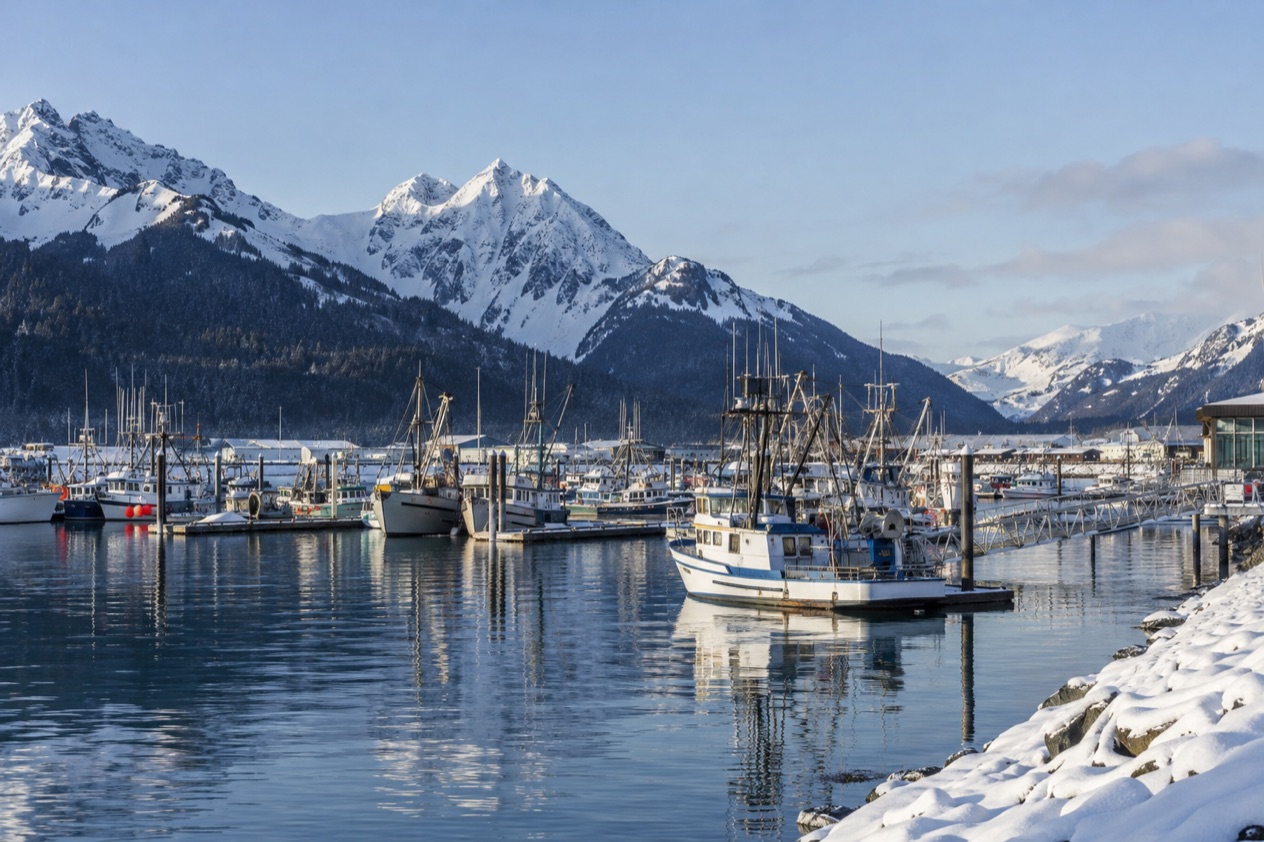
February in Seward is a town of wet snow on the rooftops, steam on the windows of the coffee shops, and mountains that rise straight from the head of Resurrection Bay and wear a different shade of gray and white every hour. The light is low and soft, the harbor is quiet, and the pace follows the short winter days. It suits travelers who want a coastal Alaska town in its cold-season mood, with an aquarium, a glacier road and a long mountain highway close at hand.
What is the weather like in Seward in February?
February in Seward is cold but not deeply frozen, with highs a little above freezing and nights well below it, and precipitation that can come as snow, rain or something in between. The days are lengthening quickly, and the town feels it.
| Month | Average high (°F) | Average low (°F) | Precipitation (in) | Days with precipitation | Daylight on the 15th |
|---|---|---|---|---|---|
| January | 31.3 | 21.1 | 6.47 | 10.1 | 6 h 38 min |
| February | 34.3 | 23.5 | 6.35 | 9.7 | 9 h 06 min |
| March | 37.3 | 24.9 | 3.85 | 7.8 | 11 h 39 min |
Afternoons hover right around the point where snow turns to slush, so the same street can be crunchy at breakfast and wet by lunch. Nights drop into the low 20s, which is cold enough to keep puddles frozen and make early walks feel crisp. Precipitation arrives on roughly one day in three, often as a gray, damp spell rather than a single dramatic storm.
Dress in layers: a warm base, an insulating middle and a waterproof outer shell, since melting snow and rain both end up on your jacket. Insulated boots matter more than anything else you pack. The light is the real gift of the month. Daylight now lasts a good part of the day, so there is time for a morning outdoors and a late-afternoon walk along the water before dusk settles over the bay.
Resurrection Bay stays cold all winter, a place to look at rather than to enter, and wind coming off it can make a calm-looking waterfront feel sharper than the thermometer suggests. Cloud often sits low on the mountains, then lifts for an hour and shows peaks you did not know were there.
What to do in Seward in February
February in Seward is about slowing down and choosing a few good things: an aquarium on the waterfront, a glacier valley reached by road, and long looks at a bay framed by mountains. The month has a quiet, lived-in feel, with locals in the cafés and the harbor trading summer bustle for stillness. Think of it as a town you walk, photograph and warm up in, rather than one you race through.
Alaska SeaLife Center
The Alaska SeaLife Center sits on the shores of Resurrection Bay at 301 Railway Avenue, and it is a public aquarium as well as Alaska’s only permanent marine mammal rehabilitation facility. That second role gives it a different character from a typical aquarium, because the building is also a working place for marine animals in need of care.
It is the natural anchor for a February day, since the galleries and tanks are indoors and the wet, gray weather matters far less once you are inside. You come to see the marine life of Alaska’s waters up close, and the bay outside the windows gives you the setting those animals come from. It suits families, wildlife lovers and anyone who wants a warm hour or two that still feels completely local.
The center opened on May 20, 1998, and it is run by a nonprofit, the Seward Association for the Advancement of Marine Science. Pair a visit with a walk on the waterfront before or after, so the day has both indoor and outdoor halves.
Exit Glacier and Kenai Fjords National Park
Kenai Fjords National Park lies near Seward and holds over 600,000 acres, with the coast, Exit Glacier and the Harding Icefield as its key places. Visitors primarily reach the park by road to retreating Exit Glacier, which makes it the part of the park most tied to Seward itself. Even in winter, the idea of ice and mountains at the edge of town shapes the mood of the whole month.
The park lists Exit Glacier Road status under Current Conditions and Alerts, so that is the place to look before you plan a day around it. February snow and slush change what a road, a trail or a viewpoint feels like from one week to the next, and the park’s own notices are the ones that matter. If conditions line up, the valley is a study in blue ice, dark rock and white slopes under a low sky.
The Seward Highway
The Seward Highway runs 125 miles between Seward and Anchorage, and it carries three scenic designations: National Forest Scenic Byway, State Scenic Byway and All-American Road. It passes through the Kenai Mountains, Chugach National Forest and along Turnagain Arm, so even a partial look at it gives a sense of the country around Seward.
In February the scenery is wintry, with snowy slopes, dark forest and the pale water of the arm under changing cloud. Leave room in the day for stops and for the short daylight. It is a good way to see how the town sits in its landscape, and a good reason to keep a flexible plan when the weather shifts.
Back in town, the rest of the month is for small pleasures. Walk the harbor and the waterfront to watch the mountains change color, settle into a café with a hot drink while snow falls past the window, and look for the plain, working side of the town, with boats waiting out the cold and locals going about their business. A dinner of Alaska seafood is a fitting end to a day outdoors, wherever you find it.
Photographers will like the soft winter light on the bay, which turns the mountains into layers of blue and gray. Bring patience for cloud, since a view that vanishes at ten in the morning may return after lunch.
A two-day itinerary for Seward in February
Day 1 starts slowly, with a hot breakfast in town and a walk along the waterfront while the light is still low over the bay. The mountains across the water are most dramatic when cloud is lifting, and you get a feel for the town’s layout before anything else. Keep this walk loose, since a snow squall can turn it into a short one.
Spend the middle of the day at the Alaska SeaLife Center, where the weather does not matter and the marine animals give the day its focus. In the late afternoon, take a second waterfront walk while daylight lasts, then finish with dinner in a warm local restaurant.
Day 2 is for the landscape beyond the town. Start with a look at the park’s Current Conditions and Alerts for Exit Glacier Road, then head toward Kenai Fjords National Park if the status allows, spending the brightest hours in the glacier valley. Wear the full layering system, because wet snow and wind make the same place feel different from hour to hour.
If the road or the weather does not cooperate, turn the day toward the Seward Highway, whose scenic designations make even a short stretch worthwhile, with the Kenai Mountains and Chugach National Forest around you. Return for a late lunch in town, and keep the evening unhurried, with a hot drink and a view of the dark bay.
Is Seward busy in February?
February in Seward moves at a winter pace, with short days and a town that feels settled rather than hurried. The weather and the daylight, about nine hours in mid-month, set the rhythm more than any crowd does.
What matters for planning is less the number of people and more the conditions. Exit Glacier Road status is posted by the national park, and that notice should guide any plan involving the glacier. The Alaska SeaLife Center gives you a dependable indoor option when snow or rain fills the day, which is useful because precipitation falls on nearly one day in three.
What to pack for Seward in February
Packing for Seward in February means preparing for wet cold, with layers you can add or remove as the day moves between snow, slush and gray light.
- A waterproof outer shell, because precipitation comes as rain, snow and melted snow.
- Insulated, waterproof boots, since sidewalks and trailheads turn slushy in the afternoon.
- Warm base layers and a fleece or wool middle layer for nights that fall well below freezing.
- A hat and gloves for waterfront walks, where wind off the bay sharpens the cold.
- Wool socks, with a spare pair for days when your feet get wet.
- A camera with a spare battery, since cold drains them quickly and the winter light is worth capturing.
Good to know before you go
Daylight is the thing to plan around in February, with about nine hours in the middle of the month, so do the outdoor part of the day first and keep indoor stops for the dark hours. The national park posts Exit Glacier Road status under Current Conditions and Alerts, and that is the page to consult before heading toward the glacier. The Seward Highway links the town with Anchorage across 125 miles and passes through Chugach National Forest, so allow for winter conditions and a changing sky on any trip along it.
Seward in February vs January and March
Moving the trip a month earlier means deeper winter. January has the shortest days of the three months, a little less warmth and slightly more days with precipitation. The mood is darker and quieter, and daylight is tight for anything outdoors, so the indoor hours at the aquarium carry more of the schedule.
Moving it a month later brings a clear shift. March is milder, drier and noticeably brighter, with the longest daylight of the three, which gives you more room for the glacier road, the highway and waterfront walks. The town still feels like winter, but the light begins to change the whole landscape, and precipitation falls less often.
Travelers who want the deep, quiet winter mood with a bit more daylight than January should stay with February. Those who care most about long outdoor days and gentler weather should look at March, and those who want the darkest, most wintry setting can choose January.
Is February a good time to visit Seward?
Yes, February is a good time for travelers who like winter scenery, a small waterfront town and an aquarium that doubles as a refuge for marine animals. It rewards people who enjoy gray light, wet snow and quiet streets, and who are happy to build the day around the weather.
Travelers who want long outdoor days, wide-open trail options or a lively waterfront should choose a different month. Those who need a fixed outdoor schedule will find February’s changing snow, slush and cloud demanding. On arrival, check the park’s notice for Exit Glacier Road, then spend your first clear hours on the waterfront, where the bay and mountains set the tone for the stay.
What is special about February in Seward is the combination of a mountain-ringed bay in winter dress, a glacier valley close to town, and daylight that is already returning after the darkest weeks. The town feels like itself, with no pretense, and the landscape does the talking.
Sources
- NOAA NCEI, U.S. Climate Normals 1991-2020, monthly (https://www.ncei.noaa.gov/access/services/data/v1?dataset=normals-monthly-1991-2020&stations=USW00026438), station Seward Ap, elevation 22 feet, checked October 11, 2026
- Computed from the date and the latitude of the place (sunrise equation, solar elevation -0.833 degrees), October 11, 2026
- Wikipedia, Seward Highway (https://en.wikipedia.org/wiki/Seward_Highway), checked October 11, 2026
- Alaska SeaLife Center, Seward (https://www.alaskasealife.org/), checked October 11, 2026
- Wikipedia, Alaska SeaLife Center (https://en.wikipedia.org/wiki/Alaska_SeaLife_Center), checked October 11, 2026
- National Park Service, Kenai Fjords National Park, plan your visit (https://www.nps.gov/kefj/planyourvisit/index.htm), checked October 11, 2026
- Wikipedia, Climate of Alaska (https://en.wikipedia.org/wiki/Climate_of_Alaska), checked October 11, 2026
To plan your stay
- Things to Do in Seward: Exit Glacier, the SeaLife Center, Kenai Fjords Boat Trips and Fishing
- Where to Stay in Seward: Downtown, the Boat Harbor, Mt. Marathon Streets and Lodges Outside Town
- Seward from Anchorage: the Seward Highway, the Coastal Classic Train and the Park Connection Bus
- Know Before You Go to Seward: Getting There, Weather, Bears and Local Habits