
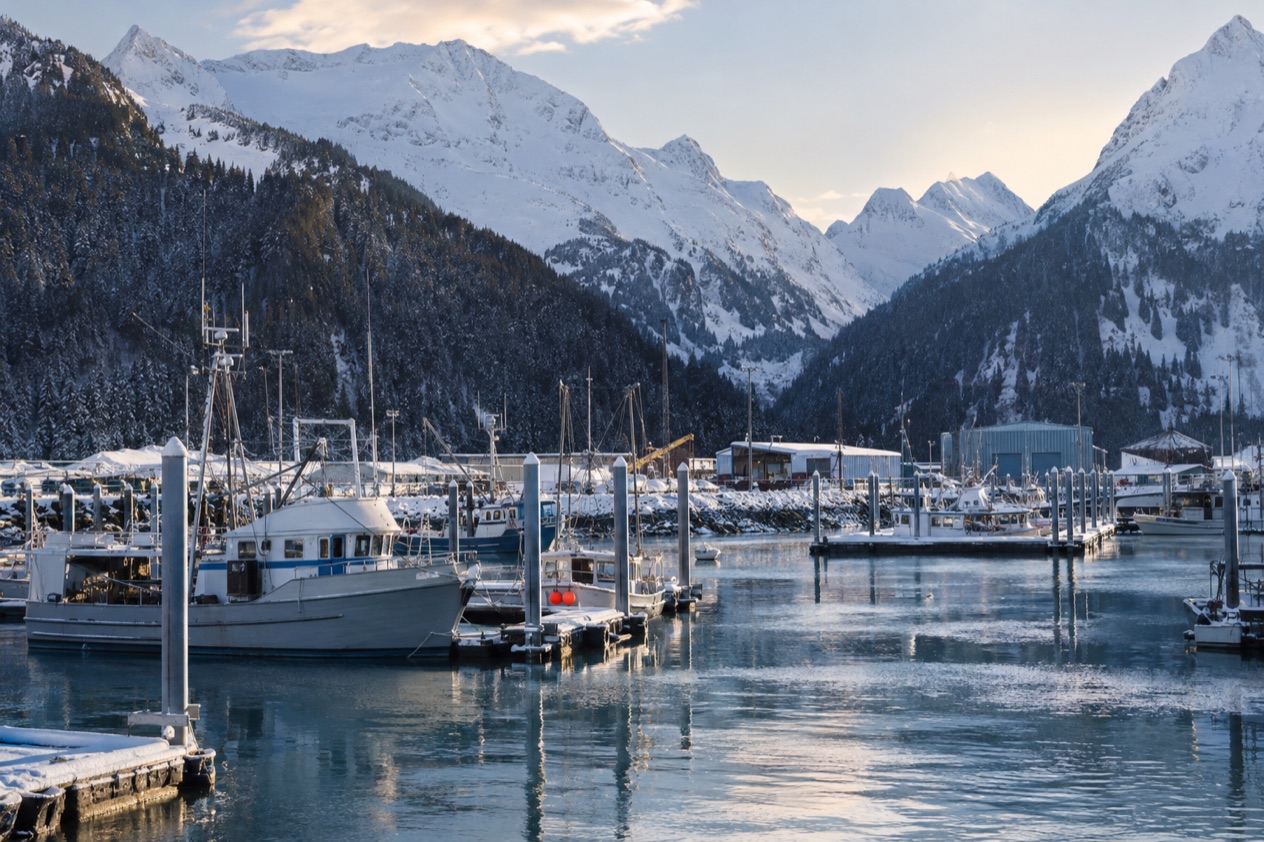
In January, Seward is a small harbor town under a low winter sun, with Mt. Marathon standing white and steep behind the rooftops and Resurrection Bay lying cold and quiet below it. Boats sit still in the harbor, the streets are calm, and the town goes about its own business without a crowd. It is a month for travelers who want a working Alaska port at its slowest, with the mountains and the water close at hand.
What is the weather like in Seward in January?
January in Seward is cold, damp and short on daylight, with afternoons hovering just above freezing and nights well into the 20s. Here are the three winter months side by side.
| Month | Average high (°F) | Average low (°F) | Precipitation (in) | Days with precipitation | Daylight on the 15th |
|---|---|---|---|---|---|
| December | 33.2 | 23.2 | 8.22 | 11.1 | 5 h 55 min |
| January | 31.3 | 21.1 | 6.47 | 10.1 | 6 h 38 min |
| February | 34.3 | 23.5 | 6.35 | 9.7 | 9 h 06 min |
Precipitation arrives on about one day in three, and with temperatures this close to freezing it can fall as snow, as rain, or as a wet mix that changes during the day. Expect gray, soft light on many days, and the occasional clear spell when the peaks around the bay stand out sharply.
Daylight is the real limit on a January plan. The days are short but already growing, and they are noticeably longer than in December. Outings fit best in the middle of the day, and the long evenings suit a slow dinner indoors.
Dress in layers: a warm base, an insulated middle layer and a waterproof shell, since damp cold feels sharper than the thermometer suggests. Boots with good grip matter on sidewalks that can turn icy after a freeze, and a hat and gloves earn their place every day.
What to do in Seward in January
January here is about quiet things done well: a walk along the harbor, an hour among the tanks of an aquarium, a long look at the mountains from the shore.
The Alaska SeaLife Center
The Alaska SeaLife Center is the state’s only public aquarium, and on a short, gray winter day it is the natural anchor for an outing. Inside, you move through the marine life of the Alaska coast at your own pace, in the warmth, while the weather does what it likes outside. It suits couples, families and anyone who wants to see the sea life of the region up close.
Pair it with a walk afterward to stretch your legs and get some air. Because January light is brief, going in the middle of the day lets you use the daylight on the shore before or after your visit.
The harbor and the waterfront
Seward Boat Harbor, established in 1964 and a certified Alaska Clean Harbor, is the heart of the town’s working life. In January, the moored boats and the working docks give the waterfront a settled, off-season feel, with the bay opening wide beyond them and the mountains of Kenai Fjords National Park framing the view.
Walk the shoreline slowly and look back at Mt. Marathon rising steeply behind the town. On clear days the contrast between the dark water and the white slopes is the best free show in town. Dress for wind off the bay, which makes the cold feel sharper.
Mile 0 of the Iditarod Trail
Mile 0 of the Iditarod Trail is marked on the shoreline at the southern end of Seward. It is a simple spot with a lot of history behind it, a place to stand for a few minutes and think about where the trail begins and how far it runs. It suits anyone with an interest in Alaska’s mushing story.
Winter is a fitting time to visit, with snow on the ground and the bay cold beside you. Combine it with a waterfront walk, since the two are close together on the same shore.
Seward also has a long reputation as one of Alaska’s premier sportfishing destinations. That story belongs mostly to other seasons, but the harbor keeps its character in January, and the fishing culture of the town is easy to feel in its docks, its shops and its talk. After a day outdoors, the town’s cafés and restaurants offer warm food and hot drinks, which is exactly what the weather asks for.
A small town of about 2,700 people has a particular winter rhythm. Locals run errands, harbor workers tend to boats, and visitors find that conversations come easily. Treat the days as slow ones and let the weather set the pace.
A two-day itinerary for Seward in January
Day 1 begins late, after a slow breakfast in town, because the morning light is thin and the cold is at its sharpest. Around midday, head to the waterfront for a walk along the harbor, taking in the bay and the mountains while daylight is at its strongest. Follow it with a warm lunch in one of the town’s casual cafés.
In the afternoon, go to the Alaska SeaLife Center and spend an unhurried couple of hours inside. When you come out, the light will be fading, so make the evening about dinner at a harbor-side restaurant and an early night.
Day 2 starts the same gentle way, with coffee and a look at the weather. If the sky is clear, make the most of it by going straight to Mile 0 of the Iditarod Trail on the shoreline at the southern end of town, then walk back along the water for views of Mt. Marathon.
Spend midday in a café or small shop, then use the afternoon for a second look at the bay from a different stretch of shore. If rain or wet snow sets in, keep the day indoors, browsing the shops and settling into a long lunch. Finish with a hot meal and, if the sky is clear, a short look at the night from outside town.
Is Seward busy in January?
No, January is a quiet month in Seward, and the town runs at a slow, local pace. The Alaska Railroad’s daily passage between Anchorage and Seward runs in summer, from May 13 to September 14, and the Park Connection bus runs twice daily from mid-May to mid-September, so neither is part of a January trip.
What that means on the ground is a calm waterfront, open streets and a town that belongs mostly to its residents. It suits travelers who like their destinations unhurried and who do not need a full calendar of excursions.
What to pack for Seward in January
Seward in January asks for warmth and waterproofing, since the air hovers near freezing and the precipitation can fall as rain or snow. Pack for walking outdoors in damp cold and for moving in and out of warm buildings.
- A waterproof shell, because rain and wet snow both arrive.
- Insulated layers, to adjust between the waterfront and indoor stops.
- Boots with good grip, for sidewalks that can ice over.
- A warm hat and gloves, since wind off the bay sharpens the cold.
- A headlamp or small flashlight, for the early dark.
Good to know before you go
Daylight is the thing to plan around in January, with only about six and a half hours on the 15th, so keep outdoor time for the middle of the day. Seward is easily accessible from Anchorage, and the drive takes about 2.5 hours along the Seward Highway. The summer train and bus services are not running this month, so the road is the way to plan the trip.
Seward in January vs December and February
Moving the trip earlier, to December, means a darker, wetter month. December has the shortest days of the three, with less than six hours of daylight on the 15th, and the most precipitation. The cold is only slightly milder, but the light is thinner, which leaves less room for walks.
Moving later, to February, brings a noticeable gain in light, with more than nine hours of daylight by the middle of the month, and slightly milder afternoons. The precipitation eases, so outdoor time on the waterfront gets easier to fit in.
Choose December if the dark, quiet town appeals to you, and February if you want longer days for walking. Stay with January if you want a middle path: days that are already lengthening, a calm harbor and the same unhurried pace.
Is January a good time to visit Seward?
Yes, for travelers who like quiet, cold places and are happy to build a trip around a few good indoor and outdoor stops. It suits people who enjoy a working harbor, a mountain backdrop and the slow pace of a small Alaska town.
It is not the month for anyone who wants a full lineup of boat trips, train rides or long days of daylight. Those who need a busy schedule should pick another time of year.
On arrival, start with the waterfront, while the daylight lasts, then settle in at the Alaska SeaLife Center. What makes January special here is the stillness: Resurrection Bay lying cold beneath Mt. Marathon, a harbor at rest, and a town that lets you see it without a crowd.
Sources
- NOAA NCEI, U.S. Climate Normals 1991-2020, monthly (https://www.ncei.noaa.gov/access/services/data/v1?dataset=normals-monthly-1991-2020&stations=USW00026438), station Seward Ap, elevation 22 feet, checked October 11, 2026
- Computed from the date and the latitude of the place (sunrise equation, solar elevation -0.833 degrees), October 11, 2026
- Seward, boat harbor (https://www.seward.com/maritime/dock-facilities/seward-boat-harbor/), checked October 11, 2026
- Visit Seward, things to do (https://www.seward.com/things-to-do), checked October 11, 2026
- Alaska.org, dest seward (https://www.alaska.org/destination/seward), checked October 11, 2026
- Wikivoyage, Seward (https://en.wikivoyage.org/wiki/Seward), checked October 11, 2026
- Wikipedia, Seward, Alaska (https://en.wikipedia.org/wiki/Seward,_Alaska), checked October 11, 2026
- Wikipedia, Climate of Alaska (https://en.wikipedia.org/wiki/Climate_of_Alaska), checked October 11, 2026
To plan your stay
- Things to Do in Seward: Exit Glacier, the SeaLife Center, Kenai Fjords Boat Trips and Fishing
- Where to Stay in Seward: Downtown, the Boat Harbor, Mt. Marathon Streets and Lodges Outside Town
- Seward from Anchorage: the Seward Highway, the Coastal Classic Train and the Park Connection Bus
- Know Before You Go to Seward: Getting There, Weather, Bears and Local Habits