
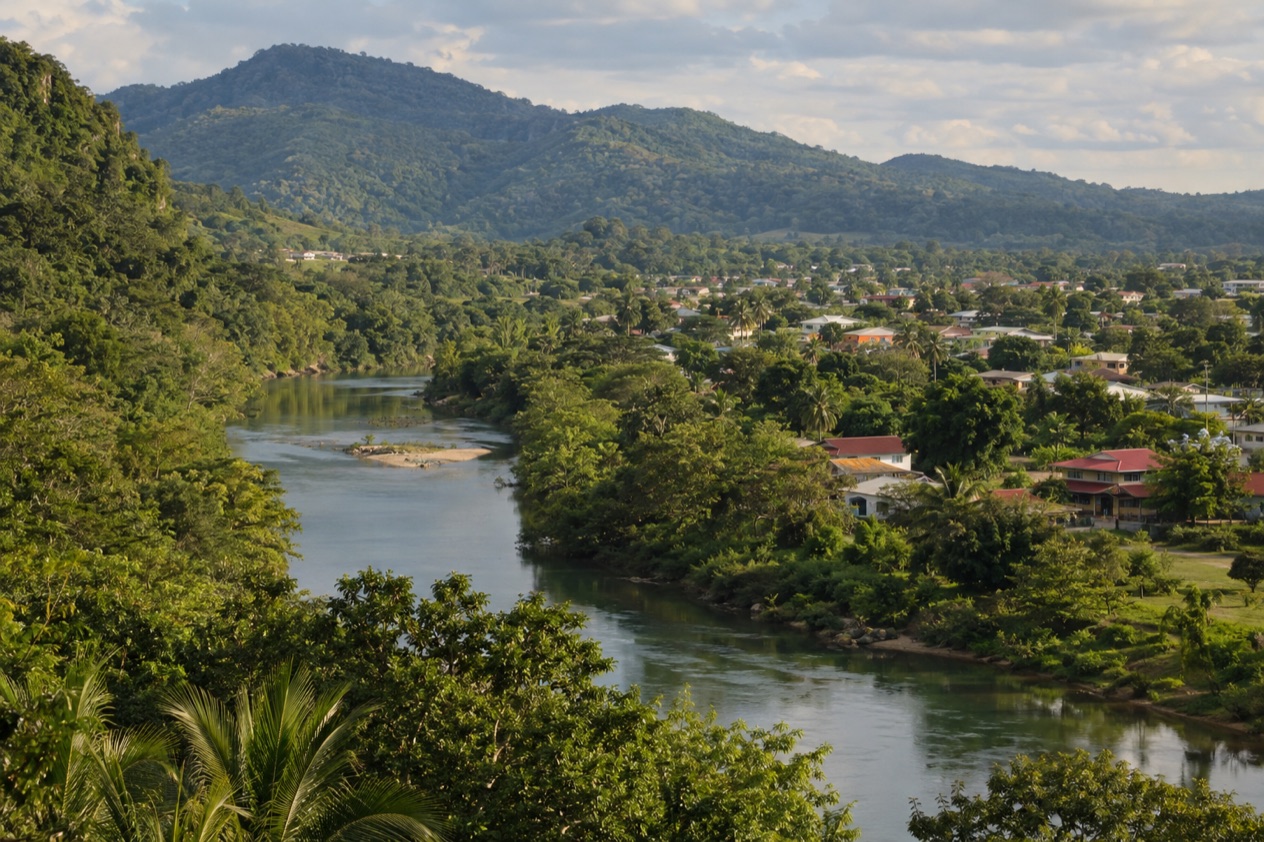
On a clear morning in San Ignacio, the Macal River runs brown and slow under the Hawkesworth Bridge, and the market in town is loud with produce and talk. Beyond the last streets, jungle hills rise toward Maya temples, and the pine ridge to the south fades into mist.
The year here swings between a dry, sunlit stretch that suits ruins and caves and a green, wet stretch when the rivers swell and the forest turns loud with frogs and birds. This is the season-by-season picture of Belize’s western hills, for anyone deciding when to go.
When is the best time to visit San Ignacio and the Cayo District?
The best months for most travelers are February through April, when the days are bright and the rain stays mostly away, though anyone who likes green hills and quiet trails can happily go in the wet season too. San Ignacio is an inland base, so the trip is about ruins, caves, rivers and forest rather than beaches.
For sightseeing, the dry stretch is the easy choice. Cahal Pech sits above the town, Xunantunich rises over the Mopan River, and the long road toward Caracol is at its friendliest when the ground is firm. Birders and nature lovers have their own reasons to come in the cooler months around December and January, when the forest is lush after the rains and the light is soft.
If you want a beach as well, the Cayo is simply the first half of a trip. Many travelers pair it with a stay on the coast or a caye, and the sea, the sargassum and the storm season belong to that second stop and its own calendar. For the hills, think in terms of rivers and rain.
Budget and quiet seekers should look at the wet months, roughly June to November, when the trails are empty and the forest is at its greenest. Expect rivers that run high and plans that bend around the weather. March can coincide with U.S. spring breaks, so some lodges may feel busier. Early February or late April gives the same dry weather with a calmer mood.
San Ignacio and the Cayo District weather by month
The days in the Cayo stay long all year, and the length of daylight is the steadiest clue to the season.
| Month | Daylight on the 15th |
|---|---|
| January | 11 h 15 min |
| February | 11 h 38 min |
| March | 12 h 05 min |
| April | 12 h 35 min |
| May | 12 h 59 min |
| June | 13 h 11 min |
| July | 13 h 05 min |
| August | 12 h 44 min |
| September | 12 h 16 min |
| October | 11 h 47 min |
| November | 11 h 22 min |
| December | 11 h 09 min |
The year runs in two broad halves. Late winter and spring are the drier months, with the fewest rainy days arriving in March and April, while June through November is the wet season, with October the rainiest stretch. December and January sit between the two, greener than spring and with showers and passing winter fronts rather than steady downpours.
In Belize City, highs reach about 90°F by September, and the rainy days build from June to a peak in October. The land shapes the weather you feel. The Cayo is a country of river valleys, limestone hills and the higher pine forest of Mountain Pine Ridge, which rises well above the valley floor. Daylight is longest around June and shortest in December, so a winter visit means planning ruins and caves for the earlier part of the day and keeping evenings for the verandas of town.
What is there to do in San Ignacio and the Cayo District in each season?
The dry months: February to April
This is the season for the big outings. Caracol is the largest Maya site in the district, and its great pyramid, Caana, is the tallest manmade structure in Belize at 141 feet. Xunantunich begins with a ride across the Mopan River on a hand-cranked ferry, and the pyramid El Castillo, 130 feet tall, looks out over the border country.
Closer to town, Cahal Pech overlooks San Ignacio and is a short 10-minute walk from the center. Its name means the Place of Ticks, and its courtyards show how Maya building changed over the centuries. The caves also belong to the dry months. Actun Tunichil Muknal in the Tapir Mountain Nature Reserve holds skeletons, ceramics and the rare Monkey Pot, and Barton Creek Cave is both a tourist destination and an archaeological site.
The green months: June to November
When the rains settle in, the hills turn deep green and the rivers climb. This is the time for slow days in town, long meals on the Macal riverbank and the market on a rainy morning. The big Maya sites are still there, and the forest around them is noisy and thick with growth.
Plan the wettest weeks with flexibility, since heavy rain can bend a day’s plans, and leave the farthest outings for a drier month. Travelers who like quiet get a very different Cayo then, one with fewer groups on the plazas and more time to look at the carved stone.
Shoulder months and the winter holidays
May comes just before the wet season, while November and December are transitional months. These shoulder months suit people who want greenery without a full wet season. Rain may fall at any point in them, but long stretches of sun are common too, so ruins and river days remain on the table.
December and early January add a festive layer. Lodges decorate for Christmas, the town fills with music and families visiting, and the cooler air makes walking uphill to Cahal Pech or along the river pleasant. Save beach time for the coast and use the Cayo for hills, forest and history.
When is San Ignacio and the Cayo District cheapest and least crowded?
The quietest months are the wet ones, from about June through November, when trails, plazas and riverside lodges are noticeably emptier. Rooms are easier to find then, and the big sites can feel nearly private on a gray morning.
The busiest weeks follow the U.S. calendar. Christmas and New Year bring holiday prices and full lodges, Easter week draws families and locals on vacation, and March spring break fills pools and breakfast rooms with groups. Mexican school vacation, from about early July to late August, adds travelers across Belize even during the green season.
For the best mix of calm and good weather, look at the edges of the dry season: early February, the weeks after Easter and the stretch from late April into early May. November, after the main rains ease, is another quiet window, with the forest still lush and the holiday rush yet to start.
There is no beach in San Ignacio to crowd, so the pressure falls on the sites, the tour vans and the restaurants along the main streets. A midweek visit to a Maya site is generally more relaxed than a weekend one, and early starts keep the plazas to yourself.
Which months should you avoid in San Ignacio and the Cayo District?
No month is off-limits, but September and October ask for the most flexibility, since they bring the heaviest rain and sit inside the Atlantic hurricane season, which runs from June 1 to November 30.
The season’s peak comes in early September, with most activity from mid-August to mid-October. An average Atlantic hurricane season has 14 named storms, but that basin-wide figure does not predict conditions in San Ignacio.
May is the other month to think about. May sits between the dry months and the wet season. Starting early in the day helps.
Sargassum and winter cold fronts matter mostly on the coast, not in the hills. If a sea stay is part of your trip, remember that sargassum is usually heavier from spring into summer, and no beach should be assumed to be spared. In the Cayo, winter fronts can mean a gray day, a cooler evening and a shower or two.
Festivals and events in San Ignacio and the Cayo District through the year
Winter holidays and Easter week
Christmas on December 25 is a family holiday across Belize, and in San Ignacio it means lights in the park, church services and visiting relatives. Restaurants are lively, and the town has a warm, festive hum in the days around it. New Year’s Day follows with fireworks and late dinners.
Holy Week and Easter move each year, usually landing in March or April. The days around them bring processions, church services and a long weekend when many families travel. Baron Bliss Day on March 9 and Labour Day on May 1 are public holidays.
September Celebrations
September is Belize’s national month. St. George’s Caye Day falls on September 10 and Independence Day on September 21, with parades, school bands, flags and the national colors on every street. San Ignacio joins in with its own gatherings, drums and food stalls.
It comes in the middle of the rainy season and the hurricane season, so plan around the weather. For travelers who like local color over quiet trails, it is a good time to watch the town celebrate.
Nature seasons in the Cayo
The Cayo’s nature calendar follows the rain. In the green months the forest is full of growth, orchids and bromeliads open in the trees, and birdsong is constant. In the drier months you may find more wildlife near rivers and water holes, though sightings are never guaranteed.
Mountain Pine Ridge, a forest reserve established in 1944 to protect its native pines, changes the scenery completely, with open pine slopes and cooler air above the valley. Bird lovers often time a trip for the cooler months of winter, when the forest is still green and migrants pass through, but no sighting can be promised.
Sources
- sunrise-sunset.org, sunrise and sunset calculated for the 15th of the month, checked October 11, 2026
- NOAA NCEI, GHCN-Daily station BHM00078583 (Philip S. W. Goldson International Airport, Belize City), normals 1991-2020 computed from the daily record (https://www.ncei.noaa.gov/access/services/data/v1?dataset=daily-summaries&stations=BHM00078583), checked October 11, 2026
- Wikipedia, San Ignacio, Belize (https://en.wikipedia.org/wiki/San_Ignacio,_Belize), checked October 11, 2026
- Wikivoyage, San Ignacio (Belize) (https://en.wikivoyage.org/wiki/San_Ignacio_(Belize)), checked October 11, 2026
- Wikipedia, Cayo District (https://en.wikipedia.org/wiki/Cayo_District), checked October 11, 2026
- Wikipedia, Xunantunich (https://en.wikipedia.org/wiki/Xunantunich), checked October 11, 2026
- Wikipedia, Cahal Pech (https://en.wikipedia.org/wiki/Cahal_Pech), checked October 11, 2026
- Wikipedia, Caracol (https://en.wikipedia.org/wiki/Caracol), checked October 11, 2026
- Wikipedia, Mountain Pine Ridge Forest Reserve (https://en.wikipedia.org/wiki/Mountain_Pine_Ridge_Forest_Reserve), checked October 11, 2026
- Wikivoyage, Mountain Pine Ridge (https://en.wikivoyage.org/wiki/Mountain_Pine_Ridge), checked October 11, 2026
- Wikipedia, Actun Tunichil Muknal (https://en.wikipedia.org/wiki/Actun_Tunichil_Muknal), checked October 11, 2026
- Wikipedia, Barton Creek Cave (https://en.wikipedia.org/wiki/Barton_Creek_Cave), checked October 11, 2026
- NICH ticketing, Xunantunich (https://ticketing.nichbelize.org/product/xunantunich/), checked October 11, 2026
- NICH ticketing, Cahal Pech (https://ticketing.nichbelize.org/product/cahal-pech/), checked October 11, 2026
- Wikipedia, Benque Viejo del Carmen (https://en.wikipedia.org/wiki/Benque_Viejo_del_Carmen), checked October 11, 2026
- Wikipedia, Melchor de Mencos (https://en.wikipedia.org/wiki/Melchor_de_Mencos), checked October 11, 2026
- Wikipedia, Mennonites in Belize (https://en.wikipedia.org/wiki/Mennonites_in_Belize), checked October 11, 2026
- Wikipedia, Climate of Belize (https://en.wikipedia.org/wiki/Climate_of_Belize), checked October 11, 2026
- NOAA National Hurricane Center, Climatology (https://www.nhc.noaa.gov/climo/), checked October 11, 2026
- U.S. Department of State, Belize Travel Advisory, Level 2, March 11, 2026 (https://travel.state.gov/), checked October 11, 2026
To plan your stay
- Things to Do in San Ignacio and the Cayo District: Maya Ruins, Caves, Rivers and Local Food
- Where to Stay in San Ignacio and the Cayo District: Riverside Lodges, Town Stays and the Mountain Pine Ridge
- San Ignacio and the Cayo District from Belize City: Distance, Bus, Rental Car and Day Trips
- Know Before You Go to San Ignacio and the Cayo District: Entry, Money, Getting Around and Health