
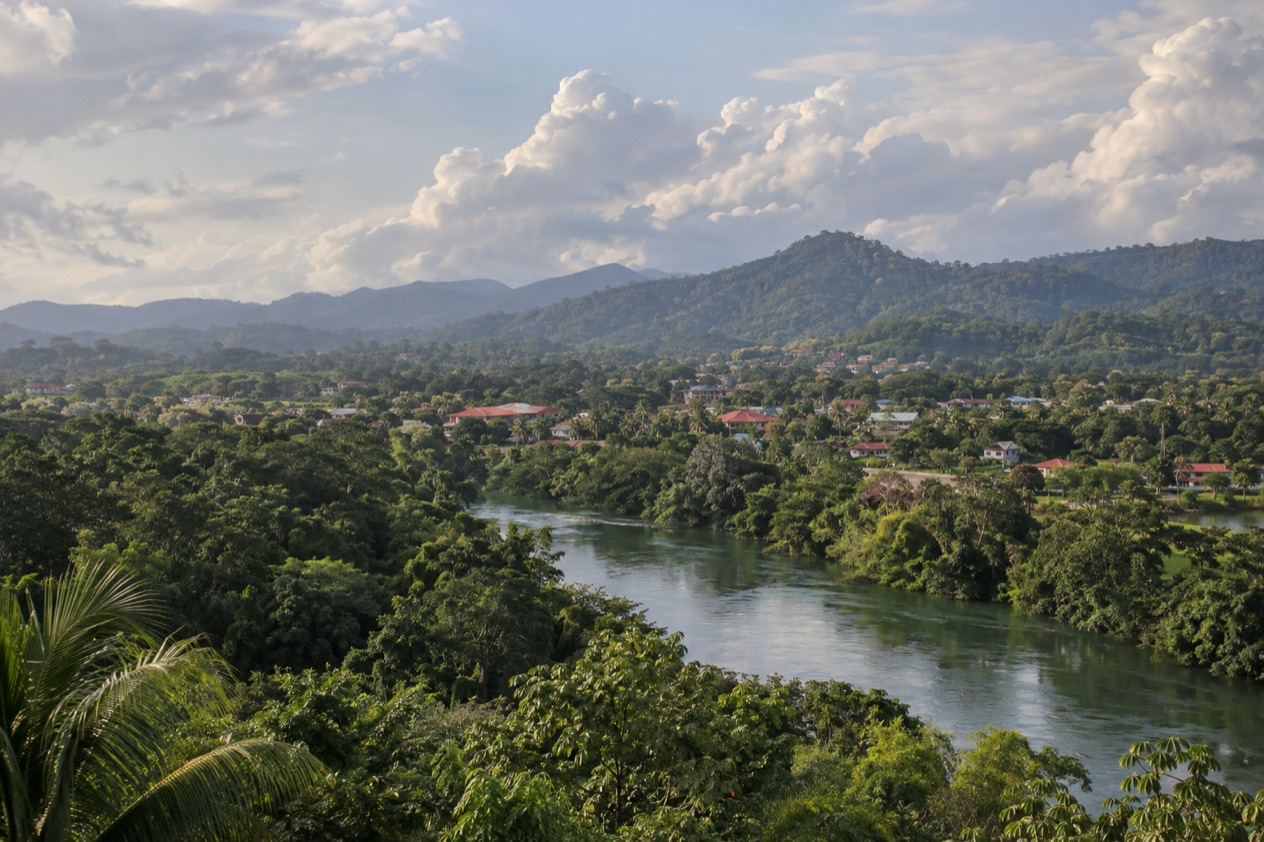
In August, the Macal and Mopan rivers run brown and full beside San Ignacio, and the hills around town are a deep, wet green. Evenings bring the sound of frogs and insects from the trees, and the market streets smell of fresh fruit and frying tortillas. It is a month for the Maya sites above the town, for river and rainforest outings, and for a Cayo District at its leafiest.
What is the weather like in San Ignacio and the Cayo District in August?
August is a green, humid month in the Cayo hills, with warm days, mild nights and regular rain, and light that lasts well into the evening.
| Month | Daylight on the 15th |
|---|---|
| July | About 13 hours 05 minutes |
| August | About 12 hours 44 minutes |
| September | About 12 hours 16 minutes |
In Belize City, highs average about 90°F in August, a useful picture of the warmth of the season across the country. In the Cayo hills, the rainy season shapes the landscape more than any number. The rivers are full, the forest is thick, the trails can be muddy, and the ground around the Maya plazas stays green.
Daylight stretches to a little under thirteen hours, which gives a full day for climbing temple stairs, floating a river or walking a jungle trail, and still leaves time for dinner on a terrace. Evenings are soft and humid, so a light layer is plenty, and a rain jacket is more useful than a sweater.
Plan the outdoor hours with the wet season in mind: ruins and trails first, then a long lunch when the sky closes in. Rain is part of the season here, and it is what keeps the Cayo so lush.
What to do in San Ignacio and the Cayo District in August
August in the Cayo is about the green: full rivers, thick forest, and Maya ruins rising out of wet grass. The town of San Ignacio is the base, a lively little place of cafés, craft shops and restaurants where river guides, backpackers and families all end up for dinner.
Cahal Pech above the town
Its name means the Place of Ticks, and its interconnected structures show how Maya architecture changed over centuries. You wander between courtyards and low pyramids with the town roofs spread out below.
In the green season the plazas are very grassy and the surrounding trees are loud with birds. It suits a slow early visit, before the day warms, and then a stroll down into town for lunch. Resident and non-resident ticket categories exist for the site.
Xunantunich, Caracol and the wider Maya Cayo
The Cayo District pairs its Maya sites with major cave excursions such as Actun Tunichil Muknal. Each has its own setting, from hilltop plazas to forest-wrapped courtyards, and the wet season makes each look its most luxuriant.
Choose one or two for a day rather than racing between them. Pair a ruin with a river or a trail in the same direction, and keep an eye on the sky, since the forest paths are at their muddiest this month.
Rivers, markets and the table
The Macal and Mopan rivers define the area, and the rainy season fills them. In town, the market and the small restaurants serve Belizean staples such as rice and beans, stewed chicken, fry jacks and fresh tropical juices.
Mennonite farmers from nearby communities bring produce into the region, so the stalls are full of vegetables, eggs and cheese. After a day outdoors, a plate of stew chicken and a cold drink on a town terrace is the classic way to end it.
Not every outing needs a ruin. A browse through the craft shops, a slow coffee in a café, or an evening walk along the main street gives the town its due, and it is an easy fallback when the weather turns.
A two-day itinerary for San Ignacio and the Cayo District in August
Day 1 starts early on the hill at Cahal Pech, while the light is soft and the plazas are quiet. Walk up from the town center, wander the courtyards, then come back down for lunch at a café. Spend the middle of the day in the market and the craft shops, with a long lunch of stew chicken or a plate of rice and beans.
In the afternoon, take it slowly along the river or the town’s main street, and watch the sky. If rain arrives, a café or a covered terrace is the right place to be. With nearly thirteen hours of daylight in the month, dinner can be unhurried, ending with fruit juice or a cold local beer.
Day 2 is for Xunantunich, one of the larger Maya sites of the Cayo District. Start early so the walk across the plazas happens in the cooler hours. Back in town, finish with a simple dinner, and keep an indoor plan, such as a long meal, ready if the afternoon rain sets in.
Is San Ignacio and the Cayo District busy in August?
August is a month of summer travel for many families, and the town has a steady stream of visitors, but the wet season gives it a relaxed feel rather than a crush.
Later in the month, plans can be looser. Restaurant tables in town are rarely a problem, and the ruins are spread out enough to feel open.
What stays quiet is the rhythm of the evenings. Once the day trips are over, the town settles into its terraces and cafés, and there is a calm that suits travelers who like to linger. Border traffic at Benque Viejo del Carmen, the westernmost town in Belize, adds to the movement through the district, but the pace in San Ignacio stays easy.
What to pack for San Ignacio and the Cayo District in August
Pack for warm, wet and green: light clothes that dry quickly and shoes that can handle mud.
- A light rain jacket, for the showers that come with the green season.
- Shoes with good grip, for muddy trails and wet temple steps.
- Quick-drying clothes, since humidity keeps things damp.
- Insect repellent, for the forest and the river evenings.
- A hat and sunscreen, for the open plazas of the ruins.
- A small dry bag, to protect a phone and camera on river outings.
Good to know before you go
The U.S. State Department rates Belize Level 2, “Exercise increased caution”, because of crime, and says the south side of Belize City has historically had the highest concentration of violent crime.
August falls inside the Atlantic hurricane season, which runs from June 1 to November 30, with the most activity between mid-August and mid-October. The Cayo is inland, but a tropical system can still bring days of heavy rain, so keep some flexibility in your plans. In a typical season, the Atlantic sees 14 named storms.
San Ignacio and the Cayo District in August vs July and September
Moving the trip to July gives slightly longer days and a similar green, wet landscape. The mood is much the same, with rivers full and the forest thick, so the choice is more about the calendar than the scenery.
September has shorter days and sits at the peak of the Atlantic hurricane season. The Cayo stays lush, but the weather picture deserves more attention, and plans benefit from extra flexibility. Rooms are generally easier to find as the summer vacation weeks end.
Choose July if you want the longest light for ruins and rivers. Stay with August for a balance of long days and a quieter feel late in the month. Pick September if you like a slower town and can be flexible with the weather.
Is August a good time to visit San Ignacio and the Cayo District?
Yes, for travelers who like green landscapes, river outings and Maya ruins without needing a dry sky, and less so for anyone who wants guaranteed sunshine for every hour.
People who enjoy forest, birdsong and slow evenings will love the month. Those who dislike humidity or muddy trails may prefer a drier season. What makes August special here is the color: full rivers, glossy leaves, and temples that seem to float above a sea of green, with a market full of fruit down below.
Sources
- sunrise-sunset.org, sunrise and sunset calculated for the 15th of the month, checked October 11, 2026
- NOAA NCEI, GHCN-Daily station BHM00078583 (Philip S. W. Goldson International Airport, Belize City), normals 1991-2020 computed from the daily record (https://www.ncei.noaa.gov/access/services/data/v1?dataset=daily-summaries&stations=BHM00078583), checked October 11, 2026
- NOAA National Hurricane Center, Climatology (https://www.nhc.noaa.gov/climo/), checked October 11, 2026
- Wikipedia, Hurricane Hattie (https://en.wikipedia.org/wiki/Hurricane_Hattie), checked October 11, 2026
- Wikipedia, Hurricane Keith (2000) (https://en.wikipedia.org/wiki/Hurricane_Keith_(2000)), checked October 11, 2026
- Wikipedia, Hurricane Dean (https://en.wikipedia.org/wiki/Hurricane_Dean), checked October 11, 2026
- Wikipedia, Hurricane Lisa (2022) (https://en.wikipedia.org/wiki/Hurricane_Lisa_(2022)), checked October 11, 2026
- Wikipedia, Hurricane Earl (2016) (https://en.wikipedia.org/wiki/Hurricane_Earl_(2016)), checked October 11, 2026
- Wikipedia, Hurricane Iota (https://en.wikipedia.org/wiki/Hurricane_Iota), checked October 11, 2026
- Belize Tourism Board, Sargassum resource (https://www.belizetourismboard.org/tourism-resources/sargassum-resource/), checked October 11, 2026
- NICH ticketing, Cahal Pech (https://ticketing.nichbelize.org/product/cahal-pech/), checked October 11, 2026
- Wikipedia, Benque Viejo del Carmen (https://en.wikipedia.org/wiki/Benque_Viejo_del_Carmen), checked October 11, 2026
- Wikipedia, Melchor de Mencos (https://en.wikipedia.org/wiki/Melchor_de_Mencos), checked October 11, 2026
- Wikipedia, Mennonites in Belize (https://en.wikipedia.org/wiki/Mennonites_in_Belize), checked October 11, 2026
- Wikipedia, Cayo District (https://en.wikipedia.org/wiki/Cayo_District), checked October 11, 2026
- Wikipedia, Climate of Belize (https://en.wikipedia.org/wiki/Climate_of_Belize), checked October 11, 2026
- U.S. Department of State, Belize Travel Information, Entry and exit requirements (https://travel.state.gov/), checked October 11, 2026
- U.S. Department of State, Belize Travel Advisory, Level 2, March 11, 2026 (https://travel.state.gov/), checked October 11, 2026
To plan your stay
- Things to Do in San Ignacio and the Cayo District: Maya Ruins, Caves, Rivers and Local Food
- Where to Stay in San Ignacio and the Cayo District: Riverside Lodges, Town Stays and the Mountain Pine Ridge
- San Ignacio and the Cayo District from Belize City: Distance, Bus, Rental Car and Day Trips
- Know Before You Go to San Ignacio and the Cayo District: Entry, Money, Getting Around and Health