
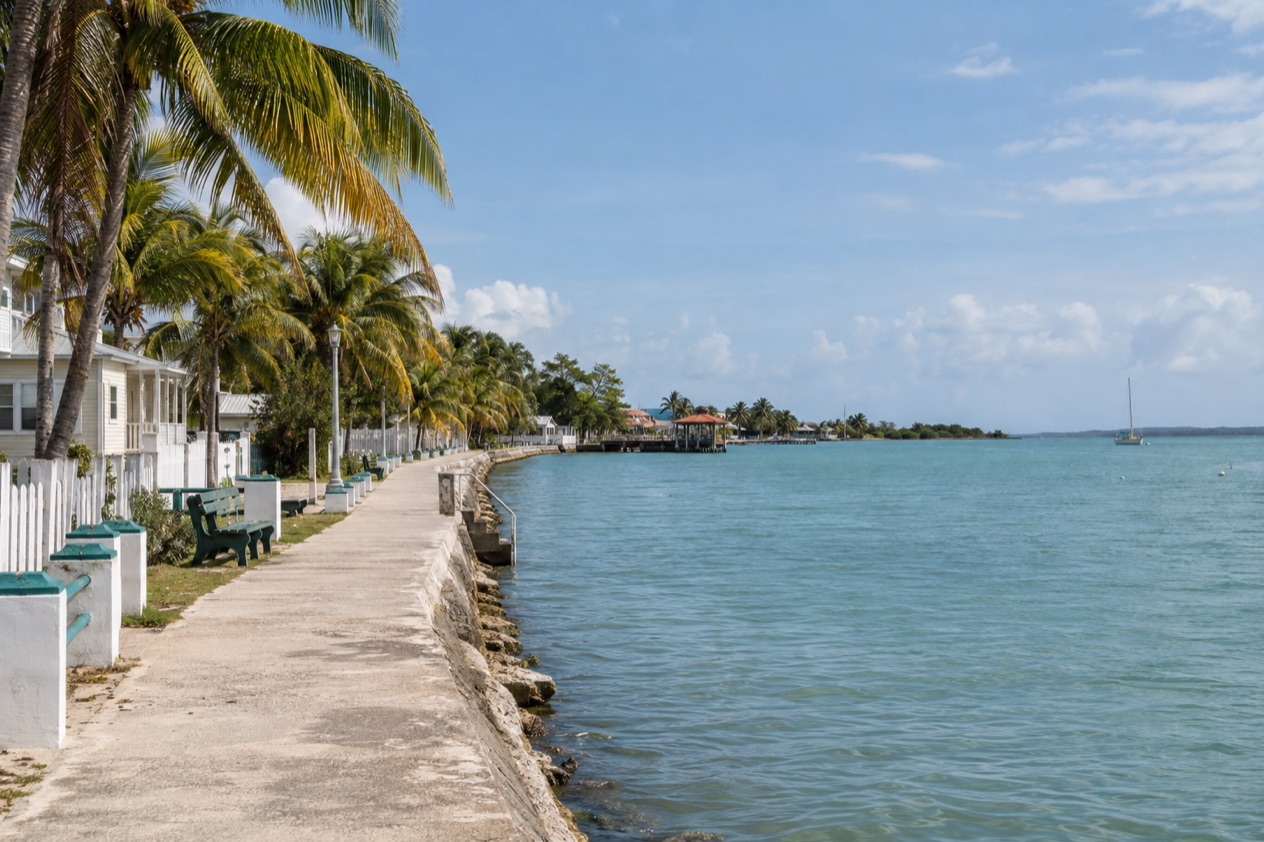
Early in the evening, Corozal’s waterfront fills with families walking the bayside, fishing boats rock at the dock, and the smell of fresh tortillas and grilled meat drifts from the streets behind the park. Spanish is the language you hear most, and the pace is slow. This is Belize’s northernmost town, a quiet Caribbean bay settlement with Maya ruins on its doorstep and Mexico next door, suited to travelers who like small places, local food and a base for the north.
Where is Corozal and what is it like?
Corozal Town sits on the Caribbean Sea in the far north of Belize, 84 miles north of Belize City, and it is the capital of the district that carries its name. Corozal is the northernmost district of the country, and the town lies just south of the Río Hondo, the river that forms the border with Mexico. The setting is a wide, quiet bay rather than an open-ocean beach, with the horizon low and the light soft in the evenings.
The character of the place is Mestizo. Spanish predominates in the streets, in shops and at the market, and the town’s story is told in a mural inside the House of Culture.
Corn shapes the farmland around the town and the food in it, with tamales and tacos turning up everywhere. Many of the buildings are fairly recent, because Hurricane Janet destroyed an estimated 90 percent of the town in 1955, and most of what stands today was built afterward.
Under the modern town lie older foundations. Corozal rests on the site of the ancient Maya ceremonial center of Santa Rita, so the ground beneath a walk to the market has a very long story. The town does not try to be a resort. There are no cruise crowds and no strip of nightlife, just a district capital where people go about daily business, with the bay close at hand.
Who will love it: travelers who enjoy a border-town atmosphere, history, birding and fishing, and those who want to see northern Belize at an unhurried pace. Who may not: anyone looking for a reef-and-resort vacation with a lively beach scene.
For that, the island of San Pedro on Ambergris Caye is a short hop away, and many people pair the two for contrast. Corozal works best as a place where you slow down, eat well and look at things that are not in the big brochures.
What is there to do in Corozal?
Corozal’s appeal is a mix of Maya history, bay fishing, birds and wildlife, and an easy rhythm of eating and shopping across the border. What sets it apart from its neighbors is that you do all of this from a small, genuine town rather than from a tourist enclave.
Maya ruins: Santa Rita and Cerros
Two Maya sites anchor a visit. Santa Rita is right by the town, a pre-Columbian ceremonial center that dates back to around 2000 BC, so you can reach it without leaving the district capital behind. You walk among grassy mounds and low structures, and you sense how old the settlement beneath modern Corozal really is.
Cerros lies across Corozal Bay. You can reach it by boat from the main dock in Corozal, which gives the trip a seagoing feel, or by a 10-mile dirt road that can be very washed out after bad weather. The boat is the more reliable choice when rain has been heavy. Pair the two sites in a single visit and you see both a town-edge center and a bayside one.
| Site | Open |
|---|---|
| Santa Rita Archaeological Site | Daily, 08:00 to 17:00 |
| Cerros Maya Ruins | Daily, 08:00 to 17:00 |
The bay: fishing, birds and wildlife
Corozal is a good base for fishing excursions in the calm bay, and for bird and wildlife-viewing tours around the district. The shoreline, the mangroves and the fields behind town give birders a mix of water and farmland habitat to scan, and the early hours on the water are a pleasure even if you never touch a rod.
If you want a deeper dose of coast life, the fishing village of Sarteneja sits at the mouth of the Bay of Chetumal. It is the largest fishing community in Belize and lives mainly from the sea, away from the main tourist crowds. Near it lies the privately owned Shipstern Conservation and Management Area, which adds a nature angle to a visit.
Across the border: Chetumal and Bacalar
Shopping trips to Chetumal, Mexico, are part of Corozal life. Chetumal is the capital of the state of Quintana Roo, a real city with markets, stores and the Museum of Mayan Culture, whose sections and hundreds of regional exhibits walk through Maya society. It is a very different scale from Corozal, which makes it a useful change of pace.
Beyond it, Bacalar is a Mexican lakeside town named a Pueblo Mágico in 2006. Its Fortress of San Felipe, finished in 1729, may be visited today, and the town’s story reaches back to a Maya city and a Spanish settlement founded in 1545. It is a place for history and a slow stroll.
Food and a splash of fun
Eating is a main activity here. Corn is central to farming around Corozal, and it shows on the plate in tamales and tacos, the staples you find all over town. Sit down at a small local place, order what the cook recommends and you taste the Mestizo cooking that defines the north.
For families, Maximum Water Park opened in Corozal Town in April 2021 and gives children a change from ruins and meals. It is a modern addition to a town that otherwise moves at an old-fashioned pace.
How many days do you need in Corozal?
A long weekend covers Corozal well, and a few extra days let you use it as a base for the north. The town itself is small, so what fills the time is what lies around it.
In a short stay, spend a morning at Santa Rita, then walk the waterfront and the central streets to see the House of Culture and its mural. Make a meal of tamales and tacos, and take a boat out on the bay if you can. An evening by the water, with the families out walking, is the part most people remember. That is the town in a nutshell, unhurried and friendly.
With a few more days, add Cerros by boat from the main dock, or by the dirt road if the weather has been dry. Book a fishing excursion or a bird and wildlife tour, then give a day to Chetumal for shopping and the Museum of Mayan Culture. Corozal’s position next to Mexico means a day across the border fits naturally into a longer stay.
A week lets you stretch farther. Sarteneja, the fishing village on the peninsula, adds a different side of the coast, and Shipstern is close by for nature. Bacalar adds the fortress and the lakeside town. Since Corozal is a short hop from San Pedro on Ambergris Caye, you can also finish with island time, and the Bacalar Chico National Park and Marine Reserve at the northern end of that island is a World Heritage reef site if you want a natural highlight to close the trip.
Corozal is not a place to rush. If you have only a day, you can see Santa Rita and the waterfront, but you will leave feeling you have only just arrived. Two or three nights suit it far better.
Where to stay in Corozal
The natural place to stay is Corozal Town itself, the district capital on the bay. Sleeping in town puts you close to the waterfront, the central park area, the market and the places where locals eat, so an evening stroll replaces any need for a destination dinner. It suits travelers who want the border-town atmosphere and are happy to wander on foot between meals and sights.
The town’s low-rise streets reflect its rebuilding after 1955, so you will not find a historic old quarter of colonial lanes. What you find instead is a practical, friendly place, and that is its charm. Staying here means you are near the dock where boats leave for Cerros and the start of fishing and birding excursions on the bay.
For a different mood, the village of Sarteneja lives mainly from fishing and sits away from the main tourist crowds, at the mouth of the Bay of Chetumal. A stay there suits people who like a very quiet coastal village, with a church that survived the hurricane of 1956 and a community that has had running water and electricity since the 1970s. It is a place for walking, watching the boats and talking to people.
A third choice is to base yourself across the border in Chetumal, a much larger city with many more services, if the pull is shopping and museums. Most people reading about Corozal, though, will want the town, for its smaller scale and its place in Belize.
In every case, think about what you want from the evenings. In Corozal Town they are about the bay breeze, the park and a simple dinner. In Sarteneja they are about silence and water. In Chetumal they are about city streets and a wider range of shops and restaurants.
How do you get to Corozal and get around?
You reach Corozal by road from the south or from Mexico, or by air to its small airstrip. The Corozal Municipal Airstrip has the code CZH, and the town is a short hop from San Pedro on Ambergris Caye, which makes an island-to-north connection natural.
By road, Corozal lies 84 miles north of Belize City, and the district is the northernmost in the country. It also sits close to the border, so travelers coming from Cancun or Chetumal in Mexico have easy access. Chetumal has its own International Airport with commercial service, and the San Pedro Belize Express Water Taxi leaves from the Terminal Maritima Internacional Filiberto Sabido Padilla there for Belize City, Caye Caulker and San Pedro.
Getting around Corozal itself is mostly a matter of walking. The town is small, and the waterfront, the park, the House of Culture and the market all sit close together. The sites outside the town need a little more planning. Santa Rita is near town, while Cerros lies across the bay and is reached by boat from the main dock or by the long dirt road, which can be very washed out after bad weather.
Sarteneja lies on its own peninsula, and the road reaches it about forty miles from Orange Walk Town. If you are planning to visit, treat it as its own excursion rather than a quick stop. Whatever you choose, give weather a role in your plans, because the road to Cerros is the one that changes most when the rain has been heavy, and the bay is there as the alternative.
When is the best time to visit Corozal?
The months from December through May are the natural choice, because they fall outside the official hurricane season, which runs from June 1 to November 30. January gives a good picture of winter: in Belize City, highs sit in the low 80s and nights fall into the upper 60s, and the sea near Corozal averages around 80°F. It is pleasant for walks along the bay, a day at Santa Rita and outdoor meals.
July sits in the middle of the hurricane season and feels much hotter. In Belize City, highs reach the upper 80s and nights stay in the upper 70s, while the sea near Corozal warms to nearly 88°F.
Rain is part of the picture: Belize City records about ten rain days in January and nearly twelve in July, so neither month is a dry one, and a rainy spell can leave the Cerros road very washed out. Choose the boat when that happens.
October and November, the tail of the hurricane season, are the months to follow forecasts and keep plans flexible. The season has shaped this coast before, with Hurricane Janet in 1955 and another storm in 1956 that destroyed Sarteneja. Corozal does not have a big tourist season, so the crowds rarely change much through the year, and the choice of month is mostly about heat, rain and how outdoor you want your days to be.
Good to know before you go
The U.S. State Department rates Belize Level 2, “Exercise increased caution”, because of crime, and says the south side of Belize City has historically had the highest concentration of violent crime.
Corozal is a small town with a Spanish-speaking majority, so a few words of Spanish go a long way in shops and at the market. Prices in Belize are in Belize dollars, and the neighboring Mexican city of Chetumal is a place where people go to shop. The Atlantic hurricane season runs from June 1 to November 30, so travel in those months with an eye on forecasts and extra flexibility in your plans.
If you head to Cerros by road, remember that the dirt track can be very washed out after bad weather, and the boat from the main dock is the other way across the bay. Sarteneja and its neighbors are quiet places where days are slow and you set the pace.
Sources
- Wikipedia, Corozal Town (https://en.wikipedia.org/wiki/Corozal_Town), checked October 11, 2026
- Wikivoyage, Corozal (https://en.wikivoyage.org/wiki/Corozal), checked October 11, 2026
- Wikipedia, Corozal District (https://en.wikipedia.org/wiki/Corozal_District), checked October 11, 2026
- Wikipedia, Sarteneja (https://en.wikipedia.org/wiki/Sarteneja), checked October 11, 2026
- Wikivoyage, Sarteneja (https://en.wikivoyage.org/wiki/Sarteneja), checked October 11, 2026
- Wikipedia, Chetumal (https://en.wikipedia.org/wiki/Chetumal), checked October 11, 2026
- San Pedro Belize Express Water Taxi, Chetumal (https://belizewatertaxi.com/destinations/chetumal/), checked October 11, 2026
- Tropic Air, Corozal (https://www.tropicair.com/corozal-czh/), checked October 11, 2026
- Maya Island Air, Corozal flights (https://www.mayaislandair.com/belize-flights-corozal/), checked October 11, 2026
- Wikipedia, Bacalar (https://en.wikipedia.org/wiki/Bacalar), checked October 11, 2026
- Belize Fisheries Department, Bacalar Chico Marine Reserve (https://fisheries.gov.bz/bcmr/), checked October 11, 2026
- Wikipedia, Climate of Belize (https://en.wikipedia.org/wiki/Climate_of_Belize), checked October 11, 2026
- Open-Meteo Marine API, average 2015-2024, checked October 11, 2026
- NOAA NCEI, GHCN-Daily station BHM00078583 (Philip S. W. Goldson International Airport, Belize City), normals 1991-2020 computed from the daily record (https://www.ncei.noaa.gov/access/services/data/v1?dataset=daily-summaries&stations=BHM00078583), checked October 11, 2026
- U.S. Department of State, Belize Travel Advisory, Level 2, March 11, 2026 (https://travel.state.gov/), checked October 11, 2026
- NOAA National Hurricane Center, Climatology (https://www.nhc.noaa.gov/climo/), checked October 11, 2026
All our pages
When to go
- Best Time to Visit Corozal: Weather by Month, Sea Temperatures and Festivals
- Corozal in January: Sea Warmth, George Price Day and Days on the Bay of Chetumal
- Corozal in February: Warm Sea, Maya Ruins, Bay Fishing and a Two-Day Plan
- Corozal in March: Bay Sea, Long Light, National Heroes Day and Slow Days Out
- Corozal in April: Warm Sea, Maya Ruins and Bay Fishing
- Corozal in May: Warm Bay Water, Maya Sites and Slow Border-Town Days
- Corozal in June: Warm Bay Water, Sarteneja, Bacalar Chico and Mango Season
- Corozal in July: Sea, Weather, Maya Ruins and the Bay
- Corozal in August: Warm Bay Water, Hurricane Season, Sarteneja and Bacalar Chico
- Corozal in September: Independence Celebrations, Warm Sea and What to Do
- Corozal in October: Weather, the Sea, Things to Do and a Two-Day Plan
- Corozal in November: Garifuna Settlement Day, the Warm Bay and Maya Ruins
- Corozal in December: Weather, the Bay, Sarteneja and the Christmas Season