
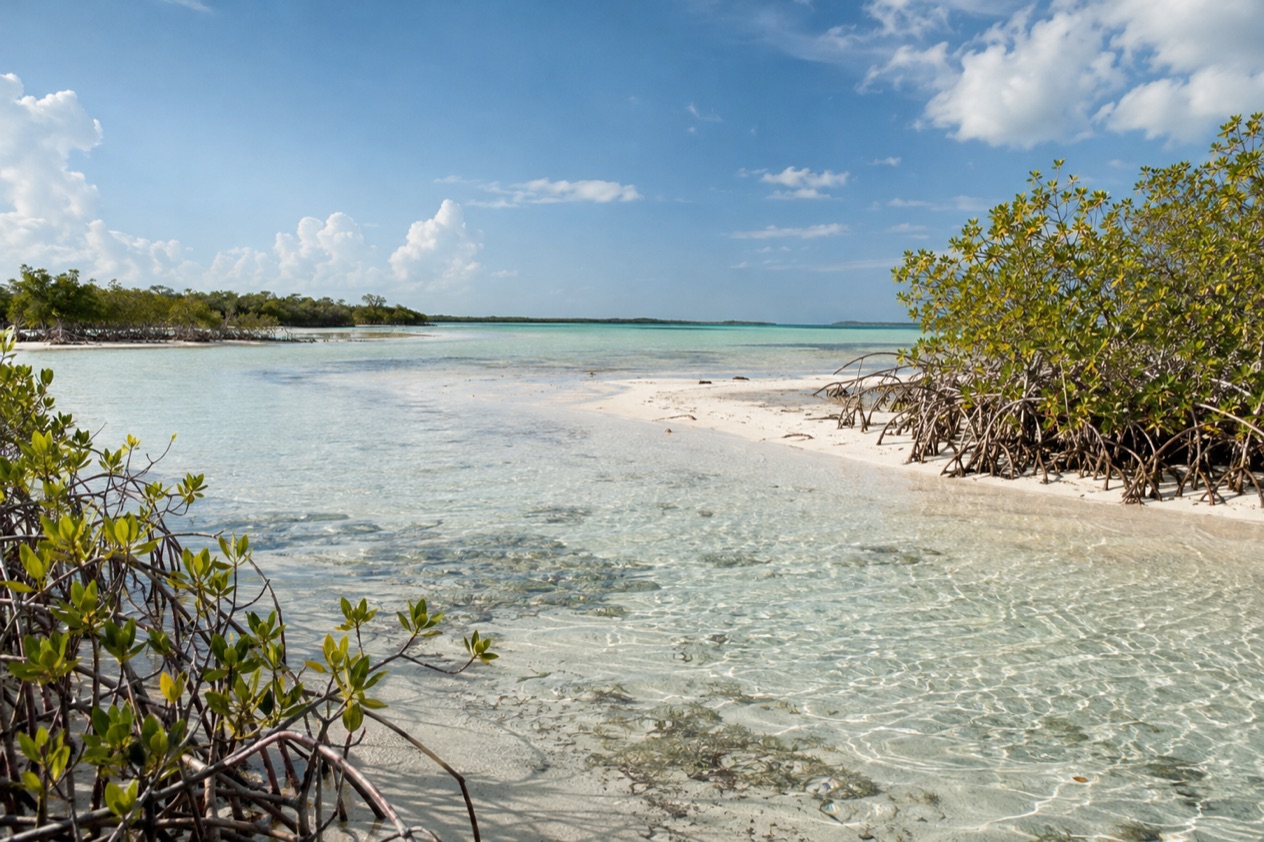
At first light on Andros, anglers wade the pale flats with their eyes on the water, and the only sounds are a breeze in the mangroves and the occasional splash of something moving in a creek. Inland, pine forest gives way to dark, round blue holes, and offshore a long reef runs beside the edge of very deep water. Andros is the Bahamas for travelers who want wild water, big skies and a slow day outdoors more than a resort pool.
Where is Andros and what is it like?
Andros lies just west of Nassau, across a deep channel called the Tongue of the Ocean, and it is the largest island in the Bahamas. Much of it is pine forest, mangrove and tidal swamp, cut by creeks and ringed by shallow flats.
The island is really an archipelago. North Andros, Mangrove Cay and South Andros are the three major islands, with hundreds of small islets and cays tied together by mangrove estuaries. Locals and visitors speak of the island in four parts: North, Central, South and Mangrove Cay. Andros Town, on Fresh Creek in the central part, is one of the best-known names, and it is where the airport sits.
The distances are generous. Andros stretches for 104 miles and is about 40 miles across at its widest, so a trip here is shaped by which part you choose. Only about 31 miles of sea separate it from Nassau, but the mood is a world away. Days are organized around tides, light and weather rather than a schedule of sights.
Andros suits anglers, divers, snorkelers, birders, kayakers and anyone who likes to watch water change color. The area around Fresh Creek is known among tourists on angling holidays. It may not suit travelers who want nightlife, shopping streets or a beach club with a bar every few steps. The reward is space, silence and a coastline that still looks like itself.
What is there to do in Andros?
The big reasons to come to Andros are water in three forms: a barrier reef, the blue holes and the flats and creeks. Each is a different kind of day, and together they make Andros unlike the island resorts that most of its neighbors offer. Here the scenery is the attraction.
The barrier reef
The Andros Barrier Reef runs along the eastern side of the island for about 140 miles, one of the longest coral reefs in the world. On the island side the water is shallow, while on the ocean side the wall plunges some 6,000 feet into the Tongue of the Ocean. That contrast gives a diver the feeling of hanging above a cliff made of blue.
Scuba diving and snorkeling are the ways visitors meet the reef. The reef averages a short distance from shore, so it reads as a long band of lighter water seen from the coast. Expect coral heads, fish drifting along the edge and, farther down, the dark of deep water. It suits travelers who want to spend time under the surface rather than on a beach towel.
Blue holes and the national parks
Andros holds the world’s greatest collection of blue holes, more than 180 of them inland and along the shore. They are flooded sinkholes that look like perfect dark circles in the forest or in the sea, and the freshwater ones can be at least ten degrees cooler than the surface water around them. The effect from above is startling, a ring of deep blue set in green.
Blue Holes National Park covers about 40,000 acres of the island. It was created in 2002 to protect the blue holes, the freshwater reservoirs and the surrounding pine and coppice forest. One of the best-known holes is the Guardian Blue Hole, with a freshwater pond at the surface and explored depths of 436 feet. The Andros Tourist Office, at (242) 368-2286, can give information about it.
West Side National Park protects another 1.5 million acres of wilderness on the other side of the island. Few places in the Bahamas offer so much untouched land in one stretch, and it gives the whole island its feeling of emptiness. This is a landscape to look at and move through slowly, and it rewards curiosity about birds, trees and water.
Flats, creeks and angling
The mangrove creeks and shallow flats are the third reason to visit. Fresh Creek and the central coast attract anglers, and the island has long been associated with bonefishing, which means wading or poling quietly across pale sand while watching for a shadow. Even if you never pick up a rod, the flats at low tide are beautiful, full of birds, rays and light.
Among its neighbors, Andros trades convenience for character. Nassau and the resort islands offer polish and crowds. Andros offers water you reach by boat or on foot and long stretches where you meet almost no one. For travelers drawn to nature, that difference is the whole point.
How many days do you need in Andros?
A long weekend is enough to taste Andros, and a week lets you understand it. The island is large and its pleasures are scattered, so the best plan is to pick one region and settle into it rather than chase every highlight.
In a short stay, aim for two big things. One day goes to the water, either on the reef with a mask and fins or in a boat across the flats. Another goes inland, toward the pine forest and a blue hole, where the contrast between the dark circle and the green around it is the real show. Evenings stay slow, with a late dinner and the sound of insects and tide.
With a week, the rhythm changes. You can give a full day to diving and another to the flats, then keep a morning for walking, birding or just watching the sea.
Time also lets you shift the focus from the central coast around Andros Town toward another part of the island, since North, South and Mangrove Cay each have their own feel. A long ride along a coast that runs for more than a hundred miles is part of the experience.
Andros also works as an add-on to a stay in Nassau, since the two are only a short stretch of sea apart. A few nights here make a striking contrast with the capital. Leave room for weather, because a gray or windy day can reshuffle plans on the water, and a flexible schedule is part of the pleasure.
Where to stay in Andros
The choice of where to stay is really a choice of which part of the island you want to wake up in. Central Andros, around Andros Town and Fresh Creek, is the natural base for a first visit. It holds the airport, it sits beside the creek and the flats, and the barrier reef lies just off the eastern coast. Angling visitors have long gathered in this area.
North Andros suits travelers who want to be near the island’s wilder upper coast and its forests and mangroves. Its position makes it feel like the front door of a very large place, and it fits those who like to be out exploring early. It is a good match for people who prefer to move around rather than stay put.
South Andros is the quiet end. More than a hundred tidal, freshwater blue holes are found there, so it appeals to travelers who put the blue holes at the center of the trip and enjoy a sense of distance from everything else. Expect a calm, remote atmosphere and long stretches of open landscape.
Mangrove Cay sits between the two ends, in the middle of the island’s chain of waterways. It suits visitors who like creeks, channels and small-scale settings, and who care more about a view of the water than a lively street. Wherever you stay, the sea is never far, and a morning or evening on the water is a certainty rather than a bonus.
How do you get to Andros and get around?
You arrive by air at Andros Town Airport, also known as Fresh Creek Airport, a public airport run by the government that serves Andros Town in the central part of the island. It sits only a few feet above sea level and has a single asphalt runway of about 4,058 feet. Arriving here places you right at the middle of the island, beside the creek.
The island lies about 31 miles west of Nassau, with the Tongue of the Ocean between them. That deep channel is part of what keeps Andros feeling separate from the capital, and it is the same deep water that falls away beyond the reef. From above, the contrast between pale shallows and dark ocean is easy to see.
Getting around is a matter of scale. Andros stretches for 104 miles from end to end and is split into North, Central, South and Mangrove Cay, so moving from one part to another is a real journey rather than a hop. The sensible approach is to settle near the area you care about most and let the activities come to you, whether a reef dive, a blue hole visit or a morning on the flats.
Inside the central area, the creek and the coast shape daily movement, and the water often matters as much as the road. Once you are in place, much of the experience is outdoors and close to the shoreline. For contact about the Guardian Blue Hole, the Andros Tourist Office is the number to call.
When is the best time to visit Andros?
The winter months are the most comfortable for being outside all day, and January is a good example. In Nassau, highs reach about 79 degrees with only a handful of rainy days, and the sea near Andros Town sits in the upper 70s. That is warm enough to snorkel in but cool enough that a day on the flats or a walk in the forest never feels heavy.
Summer is a different island. In July, Nassau highs climb to about 91, around a dozen days bring some rain, and the sea near Andros Town warms to the mid-80s. Showers tend to arrive as short bursts, and the air is heavy, so mornings on the water are the pleasant hours. It is the season for warm reef time and for visitors who love heat.
The Atlantic hurricane season runs from June 1 to November 30, and it covers the late summer and fall months, when Andros can see tropical weather and plans need to stay flexible. Spring and early winter sit at either side of that window and give the calmest planning. Andros has no big festival crowds to work around, so the choice of month comes down to weather and the sea.
Good to know before you go
The U.S. State Department rates the Bahamas Level 2, “Exercise increased caution”, and says most crime occurs in Nassau on New Providence and in Freeport on Grand Bahama.
Andros is a place of open space and few services, so bring what you need for the day when you head into the forest or out onto the water, and keep your plans loose enough to bend around weather. Many of the best experiences, from the reef to the blue holes, are about the natural setting, so a patient, curious attitude gets the most out of the island. The hurricane season runs through the end of November, which makes travel insurance and flexible plans a sensible habit for a late-year trip.
Sources
- Bahamas Ministry of Tourism, Investments & Aviation (bahamas.com), Andros (https://www.bahamas.com/islands/andros), checked October 10, 2026
- Wikipedia, Andros, Bahamas (https://en.wikipedia.org/wiki/Andros,_Bahamas), checked October 10, 2026
- Wikipedia, Fresh Creek (Andros Town) (https://en.wikipedia.org/wiki/Fresh_Creek), checked October 10, 2026
- Bahamas Ministry of Tourism, Investments & Aviation (bahamas.com), travel blog, Andros nature (https://www.bahamas.com/blog/the-wild-side-of-andros), checked October 10, 2026
- Bahamas Ministry of Tourism, Investments & Aviation (bahamas.com), Blue Holes National Park (https://www.bahamas.com/natural-wonders/blue-holes-national-park), checked October 10, 2026
- Bahamas Ministry of Tourism, Investments & Aviation (bahamas.com), Guardian Blue Hole (https://www.bahamas.com/natural-wonders/guardian-blue-hole), checked October 10, 2026
- Bahamas Ministry of Tourism, Investments & Aviation (bahamas.com), Sapphire Blue Hole (https://www.bahamas.com/natural-wonders/sapphire-blue-hole), checked October 10, 2026
- Wikipedia, Andros Town Airport (https://en.wikipedia.org/wiki/Andros_Town_International_Airport), checked October 10, 2026
- Wikipedia, Geography of the Bahamas (https://en.wikipedia.org/wiki/Geography_of_the_Bahamas), checked October 10, 2026
- Open-Meteo Marine API, average 2015-2024, checked October 10, 2026
- NOAA NCEI, GHCN-Daily station BF000078073 (Nassau Airport), normals 1991-2020 computed from the daily record (https://www.ncei.noaa.gov/access/services/data/v1?dataset=daily-summaries&stations=BF000078073), checked October 10, 2026
- U.S. Department of State, The Bahamas Travel Advisory, Level 2 (https://travel.state.gov/), checked October 10, 2026
- NOAA National Hurricane Center, Climatology (https://www.nhc.noaa.gov/climo/), checked October 10, 2026
All our pages
When to go
- Best Time to Visit Andros: Weather by Month, Sea Temperatures, Hurricane Season and Festivals
- Andros in January: Sea, Barrier Reef, Blue Holes and Crawfish Season
- Andros in February: Sea, Blue Holes, Barrier Reef and Crawfish Season
- Andros in March: Sea, Blue Holes, Last Crawfish and a Two-Day Plan
- Andros in April: Warming Seas, Blue Holes, Creeks and Quiet Settlements
- Andros in May: Sea Temperatures, Reef and Blue Holes, and a Two-Day Plan
- Andros in June: Warm Sea, Barrier Reef, Blue Holes and a Two-Day Plan
- Andros in July: Independence Day, Warm Seas, Blue Holes and a Two-Day Plan
- Andros in August: Crawfish Season, Warm Seas and Mangrove Creeks
- Andros in September: Warm Sea, Crawfish Season, Blue Holes and the Reef
- Andros in October: Weather, Reef and Blue Hole Outings, Crawfish Season and a Two-Day Plan
- Andros in November: Warm Water, Crawfish Season, Blue Holes and Quiet Settlements
- Andros in December: Sea Temperature, Junkanoo Season, Crawfish and Reef Days
Things to do
- Things to Do in Andros: Blue Holes, Barrier Reef Diving, Bonefish Flats and Island Food
- Andros Barrier Reef: Sharks, Blue Holes, Diving and How to Get There