
On Andros, a pickup truck rolls slowly past a settlement of pastel houses, the driver lifts two fingers off the wheel, and a woman on a porch answers with a nod. Beyond the last house the pine forest opens onto tidal flats where a heron stands motionless in an inch of clear water. This is the Bahamas without the crowds and without the cruise-port bustle, a vast, green, mostly empty island for divers, anglers, kayakers and anyone who likes a place that stays quiet on its own terms.
What are the best things to do in Andros?
The best things to do in Andros are almost all about water: diving along a long offshore reef, looking down into blue holes, wading the flats after bonefish and paddling through mangrove creeks. A few land-based pleasures round them out, from batik cloth to a plate of fresh conch beside a harbor.
- Dive or snorkel the Andros Barrier Reef, where the shallow reef flat gives way to a wall that falls into deep ocean.
- Visit Blue Holes National Park and look into the round, dark-blue pits that Andros is known for.
- Stand at the edge of the Guardian Blue Hole, where a freshwater pond sits above one of the deepest explored caves in the islands.
- Fish the tidal flats for bonefish, a quiet kind of sport that suits early mornings.
- Paddle the mangrove creeks and channels that tie North Andros, Mangrove Cay and South Andros together.
- Walk through Fresh Creek and Andros Town, where boats, a harbor and old settlement streets set the pace of the day.
- Look for Androsia batik, the bright hand-dyed cloth that is the island’s best-known craft.
- Eat crab, conch and grouper the way Androsians cook them, in small restaurants and lodge dining rooms.
Andros rewards slowness. It is far bigger than it looks on a map of the Bahamas, and its settlements are spread along a long coastline with forest and wetland in between. Most visitors pick one stretch of the island, settle in, and let the days organize around tides, light and the sea.
It also helps to think of Andros as three islands rather than one. North Andros, Mangrove Cay and South Andros are divided by tidal channels, and each has its own character: the north is the largest and greenest, the middle is small and settled, the south is long, remote and dotted with blue holes. What you do depends on where you base yourself.
Nassau lies across the Tongue of the Ocean, close enough that on a clear day the sense of two worlds is strong. Nassau is about its harbor, shops and resorts. Andros is about silence, salt flats and the sound of a bonefish tailing in the shallows.
Sights and landmarks in Andros
The sights of Andros are less built than natural, and the island’s scale is part of the story. Landmarks here are a lighthouse-style harbor, a batik workshop, a pine ridge, a pit of blue water in the forest and the long line of reef offshore.
A good way to read the island is by its water. The east coast faces the deep Tongue of the Ocean and the reef. The interior is a maze of creeks, mangroves and tidal swamp. The west is a vast shallow bank with flats and very few people. Each side shows you something different.
| Natural feature | Figure |
|---|---|
| Length of Andros | 104 miles |
| Width at the widest point | 40 miles |
| Total area | 2,300 square miles |
| West Side National Park | 1.5 million acres |
| Blue Holes National Park | about 40,000 acres |
| Andros Barrier Reef, along the east side | about 140 miles |
| Guardian Blue Hole, deepest explored point | 436 feet |
Fresh Creek and Andros Town
Fresh Creek is the center of gravity on the central east coast. Until the district system changed in the mid-1990s it was a district of its own, and today it sits within Central Andros. The creek runs between two settlements, with fishing boats tied up along the water, children walking home from school and a general air of unhurried errands.
Andros Town is the name most travelers meet first, because its airport, also called Fresh Creek Airport, is a public airport run by the government and sits just above sea level. From here the east coast spreads out in both directions: dive operations, lodges and the road to Androsia. Walk the waterfront in the late afternoon, when the boats come in and the light turns the creek the color of tea, and you get the best sense of how the island lives.
The crossing of the creek by the small bridge is itself a pleasant ritual. You look down into mangrove roots, spot small fish and often see a ray or a barracuda hanging in the current. It is not a sight with an entrance gate. It is simply the first postcard of Andros.
Blue Holes National Park
Blue Holes National Park was established in 2002 and protects inland blue holes in the island’s pine and coppice forest. The holes look like perfectly round pools of dark blue set into pale limestone and green scrub. Andros has more than 180 blue holes inland and along its shore, the highest concentration in the world, and the park is the clearest introduction to them.
What you see is color. The edge of each hole is a shallow turquoise ring, then the water drops to a blue so dark it looks inked. Many start amid shallow coral reefs and plunge to 300 to 400 feet. Some inland holes are tidal, rising and falling with the ocean through hidden passages in the rock, which is why the water can look alive even in the middle of the forest.
Go with time to stand quietly. Birds call from the pines, lizards move on the rock and the pit holds your attention longer than you expect. It suits anyone curious about geology and anyone who likes to photograph water. Bring a hat for the open stretches of forest track.
The Guardian Blue Hole
The Guardian Blue Hole is the one that cave divers talk about. Its maximum explored depth is 436 feet, which makes it said to hold the second deepest cave in the islands of the Bahamas. At the surface it is a quiet pond of fresh water, a surprise in a landscape so close to the sea.
Beneath that fresh layer lies a halocline, the boundary where fresh water meets salt, and a layer of hydrogen sulfide is sometimes present there. For the casual visitor the point is simpler: you stand at the rim of a pond and know that a cave of enormous depth opens under your feet. It is a place for looking and thinking, and the stillness of the surface makes the idea of the depth stranger still.
Settlements, craft and the chickcharnie
Smaller landmarks fill the gaps. Androsia batik is made on the island, with cloth dyed in sea-and-sun colors that turn up in shirts, dresses and table linens across the Bahamas. Seeing the cloth hung out in bright strips makes for a good stop. Basket work and straw weaving are also part of the island’s craft tradition, and many settlements have older churches that anchor the community on Sundays.
Then there is the chickcharnie, the red-eyed, three-fingered creature of Androsian folklore said to live in the pine forest. Locals tell the story with a straight face: treat it well and you gain luck, cross it and you suffer. You will see its image on signs and souvenirs, and you may hear the legend from someone at dinner. It is part of what makes Andros feel like its own place.
Beaches and outdoor things to do in Andros
Andros is a place for the outdoors more than for the classic resort beach. The coast is long and often quiet, with pale sand, shallow flats, mangrove edges and reefs, and the strongest experiences happen on or under the water. Some stretches are empty enough that you may see no one else for a long time.
Conditions vary from one coast to another, so treat any beach as a place to enjoy on the day rather than a guaranteed swimming spot. The east shore faces the deep Tongue of the Ocean., while the western flats are shallow and wide, and each feels different underfoot and underwater.
The Andros Barrier Reef
The Andros Barrier Reef runs along the eastern side of the island, on average a short boat ride from shore. On the island side the reef reaches only about eight feet below the surface, while on the ocean side it drops toward 6,000 feet into the Tongue of the Ocean. That contrast is the whole appeal: a shallow garden of coral on one side and a blue wall into the deep on the other.
Visitors come for scuba diving and snorkeling. Divers describe the wall as the main event, with drop-offs, sponges, sea fans and schools of reef fish. Snorkelers stay over the shallow reef top, where coral heads and small fish are close to the surface. Dive lodges along the east coast arrange boat trips to the reef, and most of the island’s diving traditions grew up around Fresh Creek and Small Hope Bay.
A morning boat outing is the usual rhythm, with lunch and a nap after. You may see turtles, rays and sharks in the open water, though wildlife is never guaranteed, and the reef is best taken as a place to look and listen to the quiet of the underwater world.
Blue hole exploring
Beyond the national park, blue holes are scattered through the island, inland in forest and offshore in the shallow sea. South Andros alone has more than 100 tidal, freshwater blue holes. Some are visited by boat from the coast, while others are reached by walking through scrub. For divers they are technical environments, and for everyone else they are visual wonders.
Offshore holes often show as dark discs in the middle of a pale flat, easy to pick out from a boat. Seen from above, they look like eyes in the sea. The best light is mid-morning to early afternoon, when the sun is high and the color in the water is strongest.
Bonefishing and the flats
The tidal flats of Andros are the island’s other great attraction. Anglers wade or stand in a skiff while a guide scans the shallows for the faint shape of a bonefish, then casts a fly into the path of the fish. It is a patient sport built on stillness and sharp eyes. A morning on the flats can pass without a single bite and still feel well spent.
Even if you never pick up a rod, the flats are worth knowing. They are where herons, egrets and sometimes flamingos feed, and where the sky and the water seem to merge at the horizon. The vast protected wilderness of West Side National Park, covering 1.5 million acres, gives a sense of how much untouched land and water this island holds.
Kayaking and mangrove creeks
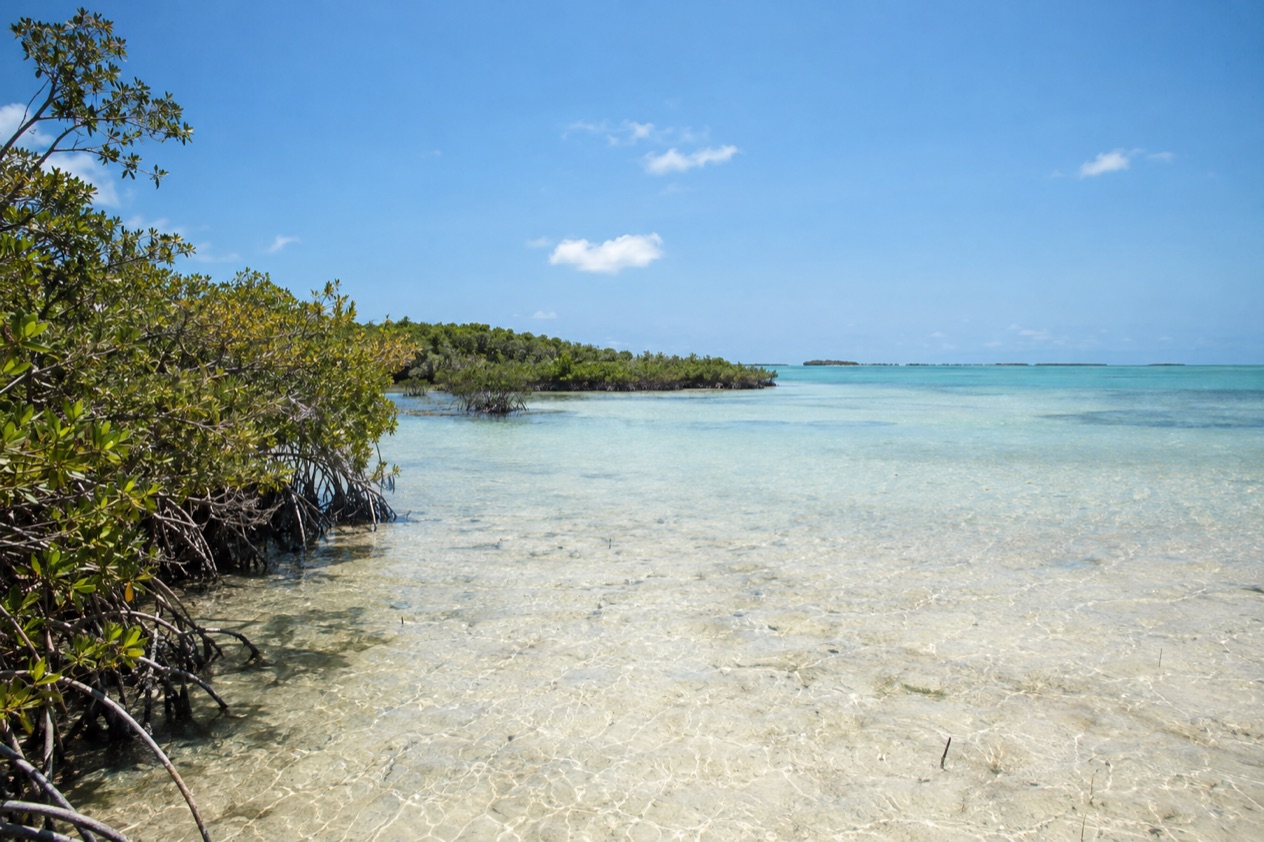
The three major islands of Andros are joined by mangrove estuaries and tidal swamplands, along with hundreds of small islets and cays. Paddling a creek here means slipping between green walls of mangrove roots, with small fish below and birds overhead. It is a very quiet way to see the island.
Go with the tide in mind, because the water in these creeks moves, and let a guide or lodge show you which channels make sense. The reward is the sound of oars in still water, the smell of salt and mud, and the chance to see how the nursery of the reef begins, among the mangrove roots.
Day trips from Andros
On an island this large, a day trip usually means moving to a different part of Andros rather than leaving it. Nassau lies about 31 miles to the east, across the Tongue of the Ocean, but the outings that tend to define a stay are the ones that go deeper into the island, along the reef or into the forest.
A day at Blue Holes National Park
The park lies in the interior of the island and covers about 40,000 acres of pine forest, scrub and blue holes. A day here is a mix of short stops at pits, quiet pauses in the shade and time listening to birds. It suits travelers who like geology, nature photography and a slow rhythm.
Plan it as a morning or an afternoon, with water and a hat, and pair it with a meal in a nearby settlement. The best moment is when the sun is high enough to light the water but the day has not yet turned its hottest. Stay on the paths and let the stillness do the work.
A day on the reef
The reef is the day trip that people plan their stays around. A boat leaves from the east coast, crosses the short stretch of water to the reef and spends several hours moving between dive or snorkel sites. Divers go for the wall, snorkelers for the shallow reef top, and some simply ride along and watch the water change color.
It suits anyone who likes boats and sea life, and it is the best way to understand why Andros is known to divers. Take sun protection, because the open water offers little shade, and let the lodge or operator say which sites suit the day.
Mangrove Cay and South Andros
Mangrove Cay sits in the middle of Andros, small and settled, with a few communities strung along its shore and a reputation for quiet. South Andros, beyond it, is long and remote, with tidal blue holes and fishing settlements, and it feels farther from everything. Both are separate from North Andros by tidal channels, which is part of why they feel like different islands.
A visit here is for travelers who want solitude: fishing, birdwatching, empty shoreline and a chance to see how small communities live. It is an outing for people who enjoy the journey as much as the arrival, and who are happy with a plain plate of fish and a view of the water.
North Andros settlements
North Andros is the largest of the three main islands and the greenest, with settlements such as Nicholls Town and Lowe Sound along the coast. The pace is slow, and the draw is a mix of shoreline, creek and forest rather than any single site. It is a good day for a traveler who likes wandering and talking with whoever is on the road.
Smaller outings fill the rest of the list: a stop at a batik workshop, a walk along an empty beach, a creek paddle, a lunch at a harbor restaurant and a late-afternoon visit to a settlement when fishermen are cleaning the catch.
What to eat in Andros
Eating in Andros means seafood, starch and sweetness, cooked simply and served in generous portions. The island’s food follows the sea and the land crab, and it is the kind of cooking that belongs on a long table with friends. A meal here is rarely rushed.
Conch is the national shell of the table. It appears raw in conch salad, chopped with onion, pepper, tomato and a splash of lime and sour orange, and it appears cracked, pounded thin, breaded and fried until crisp. Conch fritters, golden and spiced, are the usual first snack, and they taste best hot, with a squeeze of lime.
Grouper and snapper come grilled, fried or steamed, often with peas and rice, which in the Bahamas means pigeon peas cooked with rice, thyme and tomato. Boiled fish, a peppery, lime-bright breakfast stew, is a local ritual, and a bowl of it with a piece of johnnycake is a good reason to wake up early.
Crab, lobster and the sea
Crab is a treasured dish on Andros, where land crabs live in the coppice and are cooked into rich, spicy stews, often served with rice. Crab and rice is the kind of dish people talk about, and it can take hours to prepare, which is why it often appears at family gatherings rather than on a daily menu.
Spiny lobster, known locally as crawfish, shows up grilled or in cracked-style preparations when it is in season. Fish are grilled whole, split and seasoned, or served in a spicy broth. Because many restaurants are small and cook to what the boats bring in, the best meal is often the day’s catch.
Breads, sides and sweets
Johnnycake, a dense, slightly sweet cornmeal or flour bread, comes with breakfast and with soups. Macaroni and cheese, baked until firm, appears alongside fried fish as a standard side, and so do fried plantains and coleslaw. Guava duff, a rolled pastry filled with guava and served with a warm sweet sauce, is a classic Bahamian dessert.
Coconut shows up in tarts, candy and bread. Fresh fruit, from sapodilla to pineapple, turns up in season. Pair a dessert with a cup of strong coffee and you have the right ending to a long lunch.
Drinks
Kalik, the Bahamian lager, is the beer of choice on the island, served cold with a plate of fried fish. Rum drinks follow the usual pattern, from rum punch to simple rum and coconut water. Sky Juice, a sweet-and-creamy mix of gin, coconut water and condensed milk, is a Bahamian classic and a good way to cool off in the afternoon.
You will find food in lodge dining rooms, small settlement restaurants and informal spots near the harbor, usually with a short menu and a friendly pace. Order what the cook recommends, and be ready to wait a little, since good food here is cooked to order.
Things to do in Andros at night
Nights in Andros are quiet, and that is the point. There is no strip of clubs and no late-night crowd, but there is a dark sky, a soft sea sound and a few places where music and conversation carry on well into the evening. If you want a lively scene, the island will not supply one, but if you want to slow down it fits perfectly.
Dinner by the water
The evening usually begins with dinner, often at a lodge or a harbor-side restaurant where the day’s catch is on the menu. Tables are often shared, stories get traded about the day’s dive or the one that got away, and the meal stretches on. It is a natural way to meet other travelers who have come for the same quiet reasons.
After dinner, people drift to a porch or a dock. The air is soft, insects hum, and the only light may be a lantern and the stars. It suits couples, small groups and anyone who likes talking more than shouting over a speaker.
Music and local bars
Local bars in the settlements are the center of social life on many evenings. A bar might have a jukebox, a domino table and a cooler of Kalik. On weekends, you may hear Bahamian music: rake-n-scrape with its saw, goatskin drum and accordion, gospel from a nearby church, or a DJ playing island favorites.
Join in respectfully and keep the mood light. Bahamians are generous with conversation, and a visitor who sits down and listens is usually welcomed. Check with your lodge or host for what is happening locally, since events are informal and tend to spread by word of mouth.
Stargazing and quiet evenings
With few lights, the sky over Andros is dark enough for the Milky Way to show on a clear night. A walk to the end of a dock or a stretch of empty beach gives you the full sweep of stars, with the sound of small waves for company. It costs nothing and often turns into the memory people keep.
Other quiet pleasures include sitting on a veranda with a book, listening to frogs and night birds, or watching the lights of a fishing boat far out on the water. If you are staying at a dive lodge, evenings often include a slide show or conversation about the day under the water.
Things to do in Andros with kids
Children who like nature, boats and open space tend to enjoy Andros, because the island is built around the outdoors. It is more of an adventure than an amusement destination, with few built attractions but plenty to look at, touch and explore. Parents will find it calm, and kids will find it full of small discoveries.
Beach days and shell hunting
A quiet shoreline is a playground in itself. Children can build sand castles, collect shells, look for small crabs and watch fish from the edge. The shallow flats are full of life, from starfish to hermit crabs, and a slow walk with a bucket can fill a morning.
Keep a close eye on children near any water, since conditions on a given shore are not something to assume. Sun protection matters because shade is limited on open beaches, and a hat, a shirt with sleeves and plenty of water make the day much more comfortable.
Boats, reefs and creek paddles
A boat ride is an event for most children. Whether it is a skiff on the flats or a larger boat to the reef, the movement over the water, the color change from pale to deep blue and the chance of spotting a ray or turtle keep them engaged. Snorkeling over the shallow reef top is something older children may enjoy with a guide.
A gentle paddle through a mangrove creek can be fascinating, with its tangle of roots and small fish. Let an operator or lodge say what suits your children’s age and experience, and let the kids set the pace.
Stories, crafts and animals
The chickcharnie legend is a ready-made bedtime story: a red-eyed, three-fingered creature that lives in the pine trees and brings luck to those who respect it. Children often love the tale and look for the creature in every tree. It also gives the forest a bit of mystery.
Colorful batik cloth is another good stop for young visitors, who can see how patterns are made and pick a small souvenir. Birds in the wetlands, lizards on the rocks and fish in the creek give them plenty to point at. Distances on the island are long, so plan fewer stops and more time at each one.
Good to know before you go
The U.S. State Department rates the Bahamas Level 2, “Exercise increased caution”, and says most crime occurs in Nassau on New Providence and in Freeport on Grand Bahama.
Andros is a very large island with settlements spread far apart, so it pays to choose one area and stay put rather than try to see everything. Andros Town Airport, also known as Fresh Creek Airport, serves Andros Town on the central east coast.
The Atlantic hurricane season runs from June 1 to November 30, and it belongs in your planning if you travel in that stretch. Bring sun protection, a hat and an unhurried attitude, since the island is built around quiet days and the rhythm of the sea.
Sources
- Bahamas Ministry of Tourism, Investments & Aviation (bahamas.com), Andros (https://www.bahamas.com/islands/andros), checked October 10, 2026
- Wikipedia, Andros, Bahamas (https://en.wikipedia.org/wiki/Andros,_Bahamas), checked October 10, 2026
- Wikipedia, Fresh Creek (Andros Town) (https://en.wikipedia.org/wiki/Fresh_Creek), checked October 10, 2026
- Bahamas Ministry of Tourism, Investments & Aviation (bahamas.com), travel blog, Andros nature (https://www.bahamas.com/blog/the-wild-side-of-andros), checked October 10, 2026
- Bahamas Ministry of Tourism, Investments & Aviation (bahamas.com), Blue Holes National Park (https://www.bahamas.com/natural-wonders/blue-holes-national-park), checked October 10, 2026
- Bahamas Ministry of Tourism, Investments & Aviation (bahamas.com), Guardian Blue Hole (https://www.bahamas.com/natural-wonders/guardian-blue-hole), checked October 10, 2026
- Bahamas Ministry of Tourism, Investments & Aviation (bahamas.com), Sapphire Blue Hole (https://www.bahamas.com/natural-wonders/sapphire-blue-hole), checked October 10, 2026
- Wikipedia, Andros Town Airport (https://en.wikipedia.org/wiki/Andros_Town_International_Airport), checked October 10, 2026
- Bahamas Ministry of Tourism, Investments & Aviation (bahamas.com), Things to do (https://www.bahamas.com/plan-your-trip/things-to-do), checked October 10, 2026
- U.S. Department of State, The Bahamas Travel Advisory, Level 2 (https://travel.state.gov/), checked October 10, 2026
- NOAA National Hurricane Center, Climatology (https://www.nhc.noaa.gov/climo/), checked October 10, 2026
To plan your stay
- Best Time to Visit Andros: Weather by Month, Sea Temperatures, Hurricane Season and Festivals
- Where to Stay in Andros: North Andros, Mangrove Cay, South Andros and How to Choose
- Andros from Nassau: Flights, Mailboats and the Fresh Creek Side of the Island
- Know Before You Go to Andros: Entry Rules, Money, Getting Around and Island Etiquette