
You step out of the airport into a warm, steady wind, and the first words you hear might be bon bini, Papiamento for welcome. Taxi drivers, hotel clerks and waiters slide between Dutch, Spanish and English without a pause. A few things are worth settling before the trip: the arrival form, how you pay, what comes out of the tap and how the island likes to be treated.
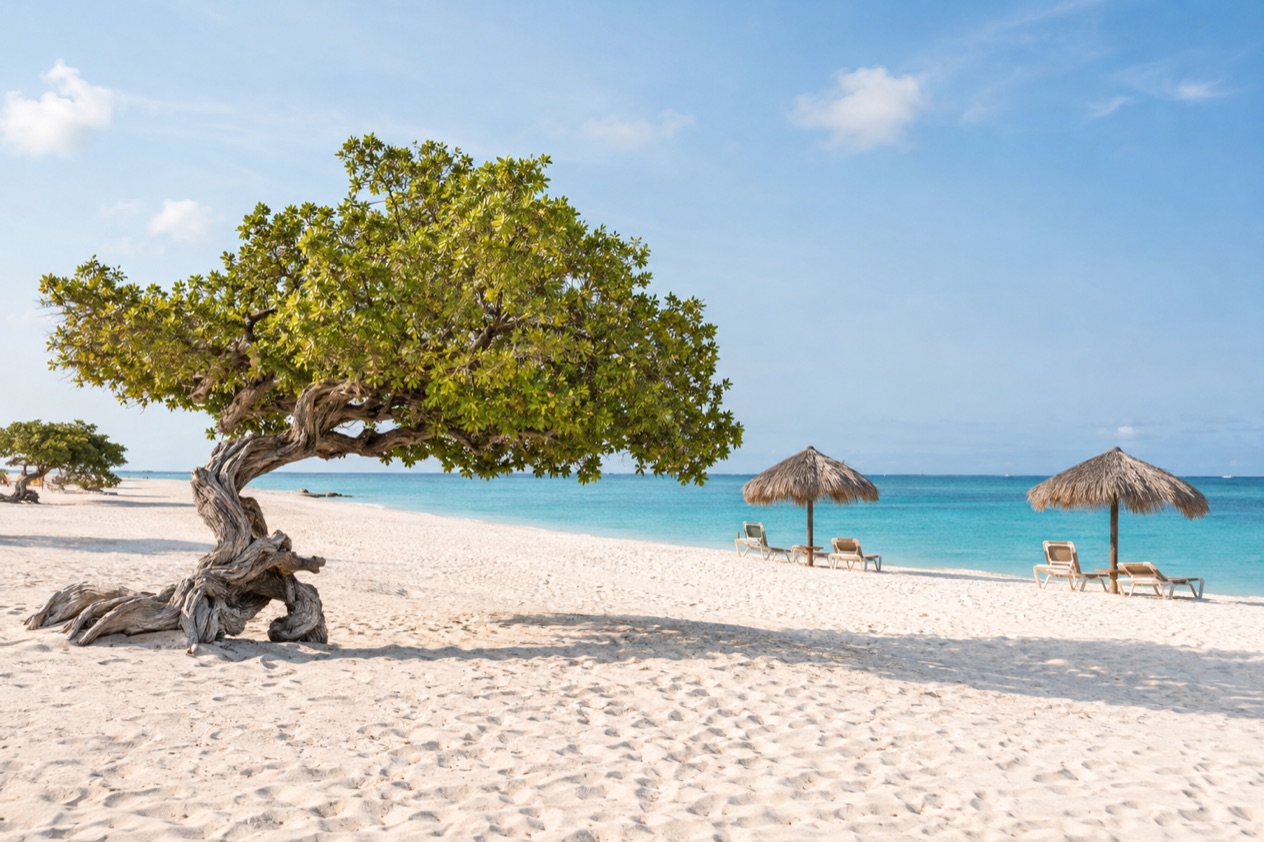
What should you know before visiting Aruba?
Four things matter most: the arrival paperwork (a passport and a digital form), the money (U.S. dollars work, but the florin is the local currency), the medical side (U.S. health insurance is not accepted on the island) and the reef-friendly rules for sunscreen. Get those right and the rest of the trip runs in a relaxed, island-sized way.
First-time visitors are often surprised by how much of the island is ordinary and well run. The tap water is good enough to fill a bottle from, English is spoken almost everywhere you go, and the roads are modern. Aruba is also a dry island with no natural rivers, so the green you see in hotel gardens is cared for. The water that comes out of your faucet is made with great effort.
Size is the other surprise. At 70 square miles, Aruba is a place where you can have breakfast in one town and watch the sunset on the other side of the island on the same day without feeling you have crossed a country.
Finally, there is the question of language. Dutch and Papiamento are the official languages, and Papiamento is a Creole that was born in this part of the Caribbean. Most Arubans speak at least four languages, English and Spanish among them, which is why a visitor rarely has trouble making themselves understood and why a few words of Papiamento are received with real pleasure.
Entry, fees and paperwork
U.S. citizens do not need a visa to enter Aruba, but they do need a current passport, and it must be valid for the whole length of the stay. Every passenger is covered by this rule, so check the expiry date well before you pack, and do the same for each family member.
The second document is the Embarkation and Disembarkation Card, known as the ED Card. It is a mandatory form for every passenger traveling to Aruba, babies and children included, so a family of five means five forms. It is completed within 7 days before travel, and the official platform for it is edcardaruba.aw. Treat that site as the one place to fill it in.
Immigration also expects you to show a return or onward ticket, along with proof that you have enough money to cover your accommodations and food during the stay. Keep your return or onward ticket and proof that you have enough money for accommodations and food where you can reach them, on your phone or on paper, before you reach the immigration desk.
Food and customs are the other small points. The airport has a list of prohibited items for luggage and screening checkpoints.
If you are flying on to the United States, declaring permissible food items to U.S. Customs & Border Protection in Aruba can save you fines and delays. The permitted list includes pasteurized or hard cheese, seafood, cooked poultry, bananas and bakery items without pork or beef.
Money, cards and tipping
The official currency is the Aruban florin, but U.S. dollars are widely accepted, so you can spend the way you would at home and rarely need to exchange anything. When you do pay in dollars, the cash rate is Afl 1.77 to the dollar, which is worth remembering if change comes back in florins. Coins and notes in the local currency make a pleasant small souvenir.
For cash, the banks are a reliable starting point. Aruba Bank branches keep weekday hours, and the bank runs a network of ATMs across the island, so you are rarely far from a machine. Banco di Caribe has a branch in Oranjestad, the island capital, which is handy if you are already in town for the day.
| Bank | Open | ATMs |
|---|---|---|
| Aruba Bank (most branches) | Weekdays, 8:00 am to 4:00 pm | More than 20 across the island |
Tipping in Aruba is not mandatory. Some restaurants and bars add a service charge of about 15% to the bill for groups, and it appears at the bottom of the receipt. Glance at the receipt before you add anything, because the charge may already be there and a second tip on top would be a double payment.
Where no service charge appears, a little extra for a meal or a ride you enjoyed is a gesture of thanks and not a duty. It is a pleasant habit to ask for the bill, read it quietly and decide on the spot, without feeling hurried or judged. That keeps the choice yours, in the spirit of an island where the tip is meant to be a thank-you.
Getting around and staying connected
Aruba is a small island, and its roads are safe and modern, so moving between the beaches, Oranjestad and the other towns is straightforward on paper. Visitors can rent a vehicle at Queen Beatrix International Airport, which means you can collect the keys on arrival and drive straight to your lodging if that suits your plans.
If you do drive, remember that traffic keeps to the right-hand side of the road and overtaking is done on the left, the same as at home. Speed limits are posted in kilometers per hour and are lower in towns than on the faster roads, so read the signs rather than trusting your habits from back home. Take it slowly through built-up areas.
In Oranjestad, paid parking is concentrated around Caya Betico Croes, the Main Street, and along L.G. Smith Boulevard, the waterfront road. Regular spaces are marked with white lines and carry registration numbers. Yellow-lined spaces are reserved for employees and permit-holders, so leave them alone even if they look free and convenient.
For planning your days, the clock is simple. Aruba keeps Atlantic Standard Time all year and never changes it, so there is no spring-forward surprise to throw off flights, tours or dinner reservations. If you are used to traveling between time zones, that steady rhythm is a small gift, especially for anyone arriving on a late flight.
Health, water and the sun
The tap water in Aruba is safe to drink and is known for its quality and clean taste. It meets the highest standard set by the World Health Organization, so you can fill a refillable bottle at your lodging. That is quite a feat for an island with no natural rivers or freshwater sources, and a quiet reason to waste as little of it as you can.
The sun is the next thing to plan for, and it comes with a local rule. Aruba has banned sunscreens containing oxybenzone since 2019, and visitors are asked to choose mineral-based reef-safe sunscreens, which are more likely to be biodegradable and gentler on the reef. If you forget yours, local companies such as Aruba Aloe and Arubalife Organics sell sunscreen on the island.
Medical care deserves a clear look before you leave. Access to quality care is limited in Aruba, and facilities may not match the standards Americans expect at home. U.S. health insurance is not accepted, so be ready to pay with cash or a credit card at medical facilities. Ambulance services are widely available.
Prescriptions from doctors abroad are generally not honored at local pharmacies, which may ask you to see a local doctor, so carry any medicine you need for the whole trip. Divers should know there is no decompression chamber on the island, and anyone with decompression sickness must be medically evacuated for treatment.
Travelers with special needs should plan ahead. Hotel rooms for guests with special needs are reserved on a special-request basis and depend on availability. Wheelchairs are not available at hotels, but wheelchairs, walkers, crutches, special medical equipment and home healthcare products can be rented through Labco at +297 582-6651. Guide dogs are generally allowed with proper documentation.
Local customs and etiquette
A greeting goes a long way. Bon dia is good morning, bon tardi good afternoon and bon nochi good evening, and saying them to a shopkeeper or a hotel clerk before you ask for anything is a small courtesy that Arubans tend to appreciate. Danki means thank you, and masha danki means thank you very much.
Dress follows the rhythm of the day. Swimsuits and sandals belong on the beach and at the pool, and when you walk into a restaurant, a shop or a church in town, throwing a shirt or a light wrap over your swimwear is the polite habit. Evenings in a nicer restaurant call for a step up from beachwear, though nothing formal is expected on a vacation island.
At the table, the pace is relaxed. Meals are meant to be enjoyed rather than rushed, and a waiter will rarely bring the bill before you ask for it, so ask when you are ready. Local dishes such as keshi yena, a baked cheese shell filled with spiced meat, and pastechi, fried pastries filled with cheese or meat, are good conversation starters with whoever is serving you.
In craft stalls and souvenir markets, a friendly chat is the usual way to do business. Ask where a piece was made and what it is called before deciding whether to buy it. Respect the island too: it is small, dry and easily marked by careless visitors, so take your trash with you and keep to marked paths and beach areas.
Good to know before you go
The U.S. State Department rates Aruba Level 1, ‘Exercise normal precautions,’ and says Aruba is generally a safe destination for travelers, with petty crime the main concern in popular tourist areas.
Keep your documents in one place: the passport, the confirmation of your ED Card, your return or onward ticket and your hotel booking. Receipts matter on the island too, since the bottom of a restaurant bill shows whether a service charge has been added. Then carry a refillable water bottle, pack mineral-based sunscreen, and let the florin and the dollar sit side by side in your wallet.
Sources
- Aruba Tourism Authority, Passports and visas (https://www.aruba.com/us/plan-your-visit/getting-to-aruba/passports-and-visas), checked October 9, 2026
- Aruba Tourism Authority, Online ED card (https://www.aruba.com/us/plan-your-visit/getting-to-aruba/online-ed-card), checked October 9, 2026
- Aruba Tourism Authority, Currency (https://www.aruba.com/us/plan-your-visit/tips-for-visitors/currency), checked October 9, 2026
- Aruba Tourism Authority, Tipping (https://www.aruba.com/us/plan-your-visit/tips-for-visitors/tipping), checked October 9, 2026
- Aruba Tourism Authority, Drinking water (https://www.aruba.com/us/plan-your-visit/tips-for-visitors/drinking-water-in-aruba), checked October 9, 2026
- Aruba Tourism Authority, Banks (https://www.aruba.com/us/plan-your-visit/tips-for-visitors/banks-in-aruba), checked October 9, 2026
- Aruba Tourism Authority, Time zone (https://www.aruba.com/us/our-island/island-facts/aruba-time-zone), checked October 9, 2026
- Aruba Tourism Authority, Language (https://www.aruba.com/us/our-island/island-facts/language), checked October 9, 2026
- Aruba Tourism Authority, Getting around Aruba (https://www.aruba.com/us/plan-your-visit/getting-around-aruba), checked October 9, 2026
- Aruba Tourism Authority, Parking (https://www.aruba.com/us/plan-your-visit/tips-for-visitors/aruparking), checked October 9, 2026
- Aruba Tourism Authority, Taking items back home (https://www.aruba.com/us/plan-your-visit/tips-for-visitors/taking-items-back-home), checked October 9, 2026
- Aruba Tourism Authority, Driving in Aruba (https://www.aruba.com/us/plan-your-visit/getting-around-aruba/driving-in-aruba), checked October 9, 2026
- Aruba Tourism Authority, What to bring (https://www.aruba.com/us/plan-your-visit/getting-to-aruba/what-to-bring), checked October 9, 2026
- U.S. Department of State, Aruba Travel Information, Entry and exit requirements (https://travel.state.gov/content/travel/en/international-travel/International-Travel-Country-Information-Pages/Aruba.html), checked October 9, 2026
- Aruba Tourism Authority, Sustainability (https://www.aruba.com/us/our-island/island-facts/sustainability), checked October 9, 2026
- Aruba Tourism Authority blog, Responsible guest (https://www.aruba.com/us/blog/how-to-be-a-responsible-guest-protecting-arubas-beaches-and-marine-life), checked October 9, 2026
- Aruba Tourism Authority, Special needs (https://www.aruba.com/us/our-island/island-facts/special-needs), checked October 9, 2026
- U.S. Department of State, Aruba Travel Information, Health (https://travel.state.gov/content/travel/en/international-travel/International-Travel-Country-Information-Pages/Aruba.html), checked October 9, 2026
- U.S. Department of State, Aruba Travel Advisory, Level 1, issued August 19, 2026 (https://travel.state.gov/content/tsg_aem/us/en/home/international-travel/travel-advisories/destination.abw.html), checked October 9, 2026
To plan your stay
- Best Time to Visit Aruba: Weather by Month, Peak Season and Festivals
- Things to Do in Aruba: Beaches, Arikok National Park, Island Tours and Food
- Where to Stay in Aruba: Palm Beach, Eagle Beach, Oranjestad and All-Inclusives
- Aruba Airport (AUA): Arrival, Getting to Your Hotel, U.S. Preclearance and Departure