
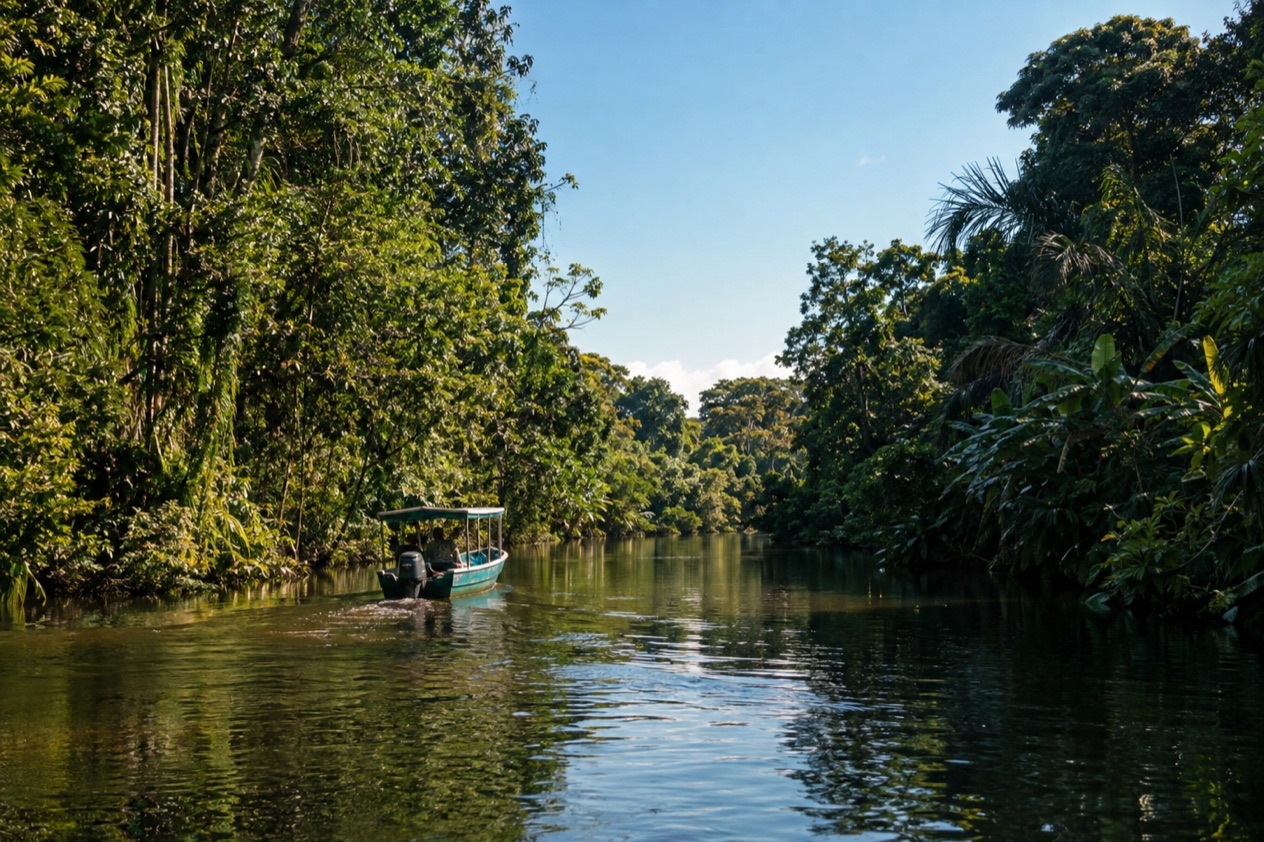
Before sunrise in January, the canals behind Tortuguero are the color of strong tea and almost perfectly still, broken only by a howler monkey chorus rolling over the treetops and the first paddle strokes of a kayak. By seven the herons are working the banks, and the village smells of coconut rice and coffee. Perched on the Caribbean coast, this rainforest village can be entered only by boat or small plane, and January brings warm days, passing showers and a festive holiday-season feel, with less of December’s soaking rain.
What is the weather like in Tortuguero in January?
January in Tortuguero is warm, humid and showery, with rain on more than half the days but usually in passing spells rather than all-day downpours.
| Month | Average high (°F) | Average low (°F) | Rain days | Sea (°F) |
|---|---|---|---|---|
| December | 80.1 | 71.9 | 20.8 | 82.6 |
| January | 80.0 | 71.2 | 16.0 | 82.3 |
| February | 80.9 | 71.5 | 11.8 | 81.9 |
Mornings start soft and sticky, warm enough for a T-shirt on the first boat of the day, and the afternoons feel heavy and tropical without being punishing. Nights barely cool down, so there is no need for a sweater, though the air on a moving boat before dawn can feel fresher than you expect.
Rain on this coast has no fixed schedule. It can fall as a short, loud shower in the afternoon, as a gray drizzle that lingers through a morning, or as a downpour in the night that leaves the canals high and the village paths muddy. Wet days are part of the rhythm here, and the forest looks its greenest and glossiest after them.
The light is often soft and hazy rather than blazing, which helps photographers and keeps the midday boat rides comfortable. Rain gear matters more than sun gear, though you will still want sunscreen for the open stretches of the canals and the beach.
Can you swim in Tortuguero in January?
The water is warm enough for a long swim, but the surf and currents are the real question here, not the temperature.
The beach in front of Tortuguero is a long, wild stretch of dark sand facing open Caribbean water, and the waves usually arrive with real weight. On this coast rip currents pose a serious threat and every year they lead to multiple drownings of tourists from the U.S., while lifeguards and posted warnings are absent at most Costa Rican beaches. Many visitors simply walk the shoreline, let the foam wash over their ankles and do their swimming in a lodge pool.
Rip currents are very dangerous, and most beaches have no lifeguards or warnings about unsafe conditions. Snorkeling is not the draw here, since river water often clouds the sea near the shore. Families with small children and nervous swimmers will be happier with the pool, the canals from a boat and the sand itself. Bring a rash guard for sun and a towel for the sudden showers.
What to do in Tortuguero in January
January here has no big festival of its own. New Year’s Day is a national holiday, and the village keeps a relaxed holiday mood in the first days of the month, with lodges full of families, boats leaving at dawn and tables filling up at the small restaurants along the main path. The famous Fiestas Civicas, with bull-riding, parades and street food, take place in Santa Cruz in Guanacaste, on the other side of the country, so they belong on a different trip.
Nature fills the calendar instead. Green turtles mostly nest on these beaches from roughly July through October, but leatherbacks deposit their eggs earlier in the year, so January is not the month to plan around turtles.
What you may see, though, is plenty: herons, kingfishers, toucans and parrots, caimans on the banks, spider and howler monkeys in the trees, and sometimes a sloth hanging motionless in a cecropia. Animals are chances, never promises, and a guide who knows the canals improves them.
The food reflects the Caribbean coast. Rice and beans cooked in coconut milk, fried or stewed fish, patacones (smashed fried plantain), and rondón, a slow-cooked coconut stew with root vegetables and seafood, are what to look for. Fresh pineapple, passion fruit juice and local cacao round things out.
Canal trips by boat or kayak
The canals are the reason most people come, and the early morning is the time to go. Wildlife is most active in the cool first hours, the water is glassy, and the light is gentle. A small, quiet boat, either a paddled one or an electric one, lets you slip under overhanging branches without scaring everything away.
In January, a rain shower during the outing is not unusual, and it is part of the experience. The forest goes silent, the drops patter on the leaves and the birds come back out when it eases. Kayaking suits people who are comfortable on the water and want the stillness. A motorized or electric boat suits families, older travelers and anyone who prefers to sit and look.
Wear lightweight clothing in layers, pack a poncho, and store your camera inside a dry bag. Arrange your dawn canal outing in advance with a provider that confirms the departure time.
The village and the beach walk
Tortuguero village is a thin strip of land between the canal and the sea, with painted wooden houses, small shops, a soccer field, a church and a handful of simple restaurants and craft stalls.
The beach walk is the natural counterpart. The sand is dark, the driftwood is stacked high and the waves are loud, and you may spot crabs, birds and, now and then, the tracks of earlier nesting. A small turtle museum and conservation center in the village explains the nesting seasons and why this coast matters, which helps if you are visiting outside turtle months.
A rubber-soled sandal or light trail shoe works better than flip-flops on muddy paths. Go in the late afternoon, when the heat eases and the light turns golden over the water, and keep out of the sea beyond ankle depth.
Walking the rainforest trails
The national park around the village holds forest trails where the humidity is thick and the sounds are layered: frogs, insects, distant monkeys, the occasional rustle in the leaf litter. Bring rubber boots for the wet trails, and consider a guide to help spot a tiny poison dart frog or a camouflaged lizard.
Before you go, use the park’s official page to confirm current opening, access, ticketing and reservation requirements. Mud can slow a walk, so go at a patient pace and bring insect repellent.
A two-day itinerary for Tortuguero in January
Day 1 begins with the boat or small plane in, which sets the tone: the canals open up, the village appears on its narrow strip and the forest crowds the banks. Settle in at the lodge, have an early lunch of fish or rice and beans, and if rain comes, let it pass on the porch. January offers about eleven and a half hours of daylight, so plan to be outdoors by mid-afternoon.
In the afternoon, walk the village from end to end, stop at the turtle conservation center and finish on the beach as the light turns gold. Stay out of the surf. Dinner is simple and local, at a small restaurant in the village or at the lodge, followed by an early night so the dawn alarm does not hurt.
Day 2 starts before sunrise with a boat or kayak on the canals, when the birds and monkeys are most active and the water is calm. Back at the lodge, have a big breakfast and rest through the warmest hours, then use the late morning for a guided walk on a forest trail in rubber boots.
Afternoon is for a second, gentler canal outing or a quiet hour with binoculars from the lodge dock. If the weather turns gray and wet, the rain card is simple: a long lunch of rondón, a hot chocolate on a covered porch, a hammock, and an hour listening to the forest, which sounds better in the rain than you might expect. Dinner is at the lodge, then bed for the journey out.
Is Tortuguero busy in January?
It is moderately busy, with the liveliest stretch in the first days of the month and a calmer second half.
New Year’s Day is a national holiday, and Costa Rican schools are on their long break from December into early February, so Costa Rican families and foreign visitors fill lodges at the start of the month. Boats on the canals can be shared with others at the popular dawn hours, and the village restaurants fill at dinner.
Because Tortuguero is reached only by boat or small plane, there is a limited number of rooms and seats, and they go first. For the holiday weeks at the start of the month, book lodging and transport early. The village usually grows quieter later in January, but do not assume that lodging and transport can be booked at the last minute.
Since no roads reach the village, a rental car never enters the equation. The decisions that matter are the lodge, the way in and out, and the timing of your guided outings. Dawn boats and guided walks are easiest to arrange as soon as you arrive, and a quick word at the front desk usually sorts them.
What to pack for Tortuguero in January
Pack light, quick-drying clothes and plan for rain on any day. Soft bags travel better on small boats and planes.
- A lightweight rain jacket or poncho, because showers can arrive at any hour.
- Quick-drying shirts and long, light pants for the canals and the mosquitoes.
- Sandals for the village and closed shoes or boots for muddy trails.
- Insect repellent and sunscreen for the forest and the open water.
- Binoculars and a dry bag to protect cameras and phones.
- A swimsuit for the lodge pool.
Good to know before you go
The U.S. State Department rates Costa Rica Level 2, ‘Exercise increased caution,’ due to crime; it says petty crime is common throughout Costa Rica and that violent crime also affects tourists, including armed robbery, homicide and sexual assault.
The journey itself is half the fun, because boats and small planes are the only ways into the village. A passport valid for your stay and proof of onward travel are the entry basics.
In January, the holiday weeks make early booking sensible, and the wet air means gear should be kept in dry bags. Lodges often handle transport, meals and outings, so ask them what is included and what needs arranging. Rain can slow boats and delay schedules, so keep a little slack on the day you travel in or out.
Tortuguero in January vs December and February
Moving four weeks earlier brings you into December, which is noticeably wetter here, with more rainy days and heavier downpours, and the village is at its busiest around Christmas and New Year. The sea is a shade warmer, but the difference is hardly something you would feel. Trails are muddier, and rain is more likely to interrupt the canal trips.
Moving four weeks later brings February, which is drier and often brighter, with fewer wet days and easier conditions for boat outings and photography. Temperatures are almost the same. Schools stay out into early February, so the crowds ease only as the month goes on, and rooms become easier to find toward its end.
Choose January if the holiday atmosphere appeals and you accept some showers. Shift to February if you want the best chance of drier canal mornings, and to December only if the festive mood matters more than the weather. Turtle seekers should look to July through October instead.
Is January a good time to visit Tortuguero?
Yes, for travelers who want rainforest, birds and monkeys on quiet water, and who are fine with a shower or two. It is less suited to sunbathers, ocean swimmers and anyone who has come to watch turtles nest, since that season is later in the year.
On arrival, drop your bags, ask the lodge about the dawn boat for the next morning and take a first walk through the village. Let the rest of the plan follow the weather. A wet afternoon is not a lost one here, because the forest comes alive when it rains. What makes January special in Tortuguero is the sight of the canals at first light, with mist lifting off dark water, monkeys calling from the canopy and a heron standing perfectly still in the reeds as your boat glides past.
Sources
- Open-Meteo / ECMWF ERA5, normals 1991-2020 computed for the grid cell at 10.543N 83.502W, checked October 8, 2026
- Open-Meteo Marine API, average 2015-2024, checked October 8, 2026
- sunrise-sunset.org, sunrise and sunset calculated for the 15th of the month, checked October 8, 2026
- U.S. Department of State, Costa Rica Travel Information, Safety and security (https://travel.state.gov/content/travel/en/international-travel/International-Travel-Country-Information-Pages/CostaRica.html), checked October 8, 2026
- U.S. Department of State, Costa Rica Travel Advisory, issued April 1, 2026 (https://travel.state.gov/content/travel/en/traveladvisories/traveladvisories/costa-rica-travel-advisory.html), read via the State Department open data API on October 8, 2026
- U.S. Department of State, Costa Rica Travel Information, Entry and exit requirements (https://travel.state.gov/content/travel/en/international-travel/International-Travel-Country-Information-Pages/CostaRica.html), checked October 8, 2026
To plan your stay
- Things to Do in Tortuguero: Canal Boats, Turtle Nesting, Rainforest Walks and Caribbean Food
- Where to Stay in Tortuguero: Village, Beachfront and Canal Lodges
- Tortuguero National Park: Turtle Nesting, Canal Boat Tours, Hours and How to Get There
- Best Time to Visit Tortuguero: Turtle Season, Weather by Month and Canal Tours