
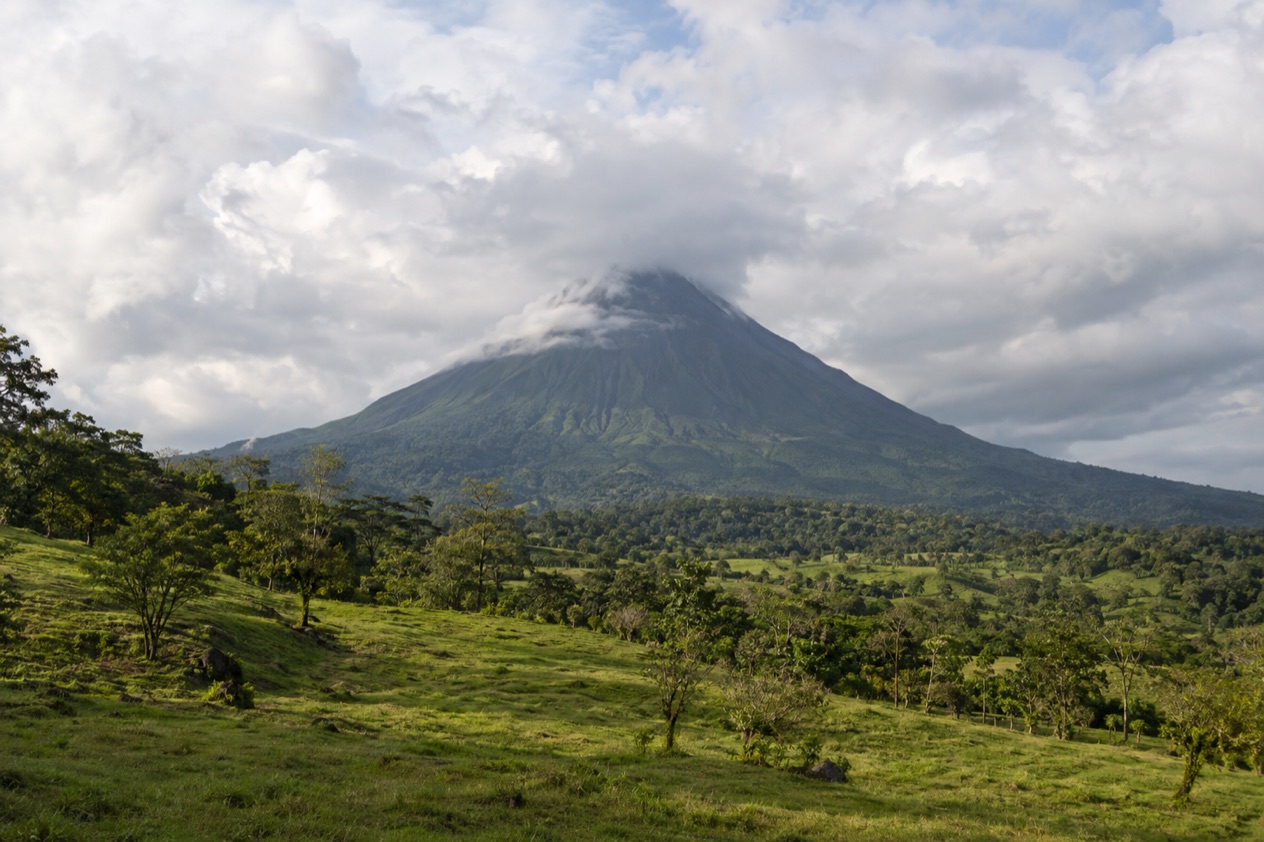
Early in the morning in La Fortuna, steam lifts off the warm rivers, roosters answer each other across the town, and the perfect cone of Arenal slowly comes out of the clouds above the rooftops. By afternoon the street outside the bakeries is full of muddy boots and wet towels hung over rental-van mirrors. This is a small town in Costa Rica’s northern lowlands built around a volcano, and it suits travelers who like their days spent outdoors and their evenings spent soaking in hot water.
Where is La Fortuna and what is it like?
La Fortuna is a small town at the foot of the Arenal Volcano in the northern lowlands of Costa Rica, and it is the main base for the area’s hot springs, waterfall, hanging bridges and lake. It sits well away from either coast, in green farmland where cattle graze in fields that run right up to the base of the mountain. Lake Arenal lies beyond the volcano, and the cloud forests and the Tenorio area are within reach for a day out.
The town itself is easy to read. A central square with a church faces the volcano, and around it you find sodas (small family restaurants) serving casado, the plate of rice, beans, salad, plantain and a choice of meat or fish that works as the national lunch.
There are also tour offices, bakeries, ice cream counters and a good number of places selling coffee grown in the surrounding hills. Nothing is far on foot, and the evenings are quiet once the tours are back.
The pace is that of a nature base, not a beach resort. Mornings start early because the volcano is most often clear then, and many visitors plan their day around a hike, a waterfall or a soak.
It is a natural fit for families, couples and anyone who wants to see Costa Rican forest without roughing it. If you want sand, surf and nightlife, the coast will suit you better, and if you dislike rain jackets and damp trails, this green country takes some getting used to.
The Arenal volcano is a classic cone that erupted almost continuously from 1968 and has been quiet since 2010. People come now for the view and the walks across old lava flows, not for glowing eruptions, and the mountain is still the center of everything.
What is there to do in La Fortuna?
There are four big reasons to come: the volcano and its trails, the waterfall, the hot springs and the high-canopy walks above the forest. Together they make La Fortuna an easy place to fill several days without leaving the immediate area. What sets it apart from its neighbors is that so much is concentrated here, and most of it is warm enough to enjoy in a swimsuit or a light shirt.
Arenal Volcano National Park
Arenal Volcano National Park lies near the town and has short trails across old lava flows and forest, with views of the cone and of Lake Arenal on clear mornings. You walk over dark, rough rock that tells the story of the eruptions, then step into shade where the trees close in and birds call from the canopy. Howler monkeys, coatis and toucans are sometimes seen, though nothing is guaranteed.
Go early, since the summit tends to be most visible before the clouds build. Wear shoes with grip, because the lava rock and the wet soil can both be slippery.
The La Fortuna Waterfall
The La Fortuna Waterfall drops into a green basin outside the town and is reached by a long staircase down. The sound of the water reaches you well before you see it, and the last turn opens onto a tall white ribbon falling into a deep pool ringed by ferns and wet rock. Swimming in the pool at the bottom is a popular stop, and visitors often linger to watch the spray catch the light.
The climb back up is the price of the visit, so take it slowly and bring water. Mornings are cooler and usually quieter, and the water level and the force of the falls change with the rain, so the scene looks different from one month to the next.
Hot springs heated by the volcano
The Arenal area is known for hot springs heated by the volcano, from simple local pools to large resort complexes with many pools at different temperatures. The more elaborate ones have streams, small waterfalls, swim-up bars and gardens lit after dark, and you move from pool to pool until you find your preferred heat. The plainer places feel more like a village bath, with a few pools, a shaded terrace and a quiet crowd.
An evening soak is the classic way to end a day of hiking. It is easy to pair with dinner, and it works for almost every age, though very hot pools are better for adults than for small children. Bring a towel and sandals, and expect to spend a few relaxed hours.
Hanging bridges and the lake
Hanging bridges are among the reasons La Fortuna is a base for the area, and the walks give you a view from forest level that the ground trails cannot. Suspended walkways cross ravines and run through the canopy, and early morning is the best time for birds. Guides are the usual way to spot sloths, frogs and insects that blend into the leaves.
Lake Arenal, on the far side of the volcano, adds a quieter option for the day: a still sheet of water with the cone rising behind it, good for a lakeside lunch and a slow afternoon.
How many days do you need in La Fortuna?
A long weekend is enough to taste La Fortuna, and a week lets you see it at a gentler speed with day trips added. The activities are close together, so you do not spend your time in transit once you arrive.
With two or three days, a good rhythm is the volcano park in the morning of the first day, a hot springs soak that evening, and the waterfall on the second morning when it is quieter. A third day can go to the hanging bridges or a lakeside outing. That covers the big four without a rush, and it leaves afternoons free for the rain, which in this part of the country is rarely far away.
With four or five days you can slow down and let the weather choose. On a clear morning you go to the volcano. On a gray one you head to the hot springs or the bridges.
Add a market stop in town, a coffee or chocolate tour on the farms nearby, and long lunches at a soda. The town is relaxed enough that a day with only a swim and a nap does not feel wasted.
A week opens up the day trips. Rio Celeste, in the Tenorio Volcano area, is a river that turns a milky turquoise where two streams mix, and a trail leads past a waterfall to the spot where the color changes.
Tenorio Volcano National Park lies in the volcanic mountain range in Guanacaste and protects lowland mountain rain forests, tropical wet forest and very wet premontane forest. It makes a full day out from La Fortuna, and the trail can be muddy, so plan sturdy shoes.
Where to stay in La Fortuna
There are three main places to sleep: in the town itself, along the road that runs toward the volcano, and out toward the lake. Each gives a different mood, and the choice depends on whether you want to walk to dinner or wake up facing the cone.
Staying in town is the practical choice for travelers without their own transport. You can walk to the square, the restaurants and the tour offices, and the sound of the town is part of the stay. Guesthouses, small hotels and hostels cluster here, and it suits solo travelers, couples on a modest plan and anyone who likes to wander in the evening for an ice cream.
The road toward the volcano is where the larger lodges and hot springs resorts sit, often among gardens with the mountain in view from the room or the terrace. It suits families and couples who want to stay put, soak, eat on site and take a day tour from the door. You do give up the walk to town in the evening, so you will rely on a shuttle or a taxi if you want to go out.
Out toward Lake Arenal, the mood becomes quieter and more rural. Lodges here look over the water and the cone, there is more birdsong and less traffic, and the days are slower. It suits travelers who want peace, who are happy to drive or hire transport for outings, and who prefer a wide view to a lively street.
How do you get to La Fortuna and get around?
Most visitors reach La Fortuna from one of two international airports: Juan Santamaria International (SJO), near San Jose in the Central Valley, or Daniel Oduber Quiros International (LIR), at Liberia in the northwest. Both are common entry points for the northern part of the country, and the trip to the town continues by road from either one. Plan for a good part of a travel day, and allow extra time in the rainy months when the mountain roads are slower.
From the airport you can take a shared shuttle, a private transfer or a public bus with a change along the way. Private transfers cost more but fit your schedule, and public buses suit those with time and a light bag.
Once in La Fortuna, getting around is simple. The town is compact enough to explore on foot, and taxis cover the short trips to the waterfall, the hot springs and the volcano park.
Those who drive themselves find the roads around the volcano and lake more winding than they look on a map, so allow extra time.
Lake Arenal sits across the volcano, and crossing it takes a longer drive around the water or a transfer that combines a boat and a car. Plan that outing as its own half day.
When is the best time to visit La Fortuna?
The drier stretch generally runs from about December to April, though rain remains possible throughout. In April the average high reaches the low 80s and rain falls on roughly seven days, which leaves plenty of time for trails, waterfalls and long afternoons by the pool. The volcano also shows itself more often in the morning, which matters for the views.
Even in the drier months La Fortuna is not a desert. January still brings showers on about thirteen days, often short, and the region’s position on the wetter side of the mountains means that rain can arrive at any time of year.
July and October are the wet months, with rain on all but a few days and gray skies that can hide the cone for days. October is the wettest month of the four we describe, with heavy downpours that can flood trails and make roads muddy.
Temperatures hardly move through the year. Days are warm in the high 70s or low 80s and nights stay near 70, so you can wear light clothes in every season and carry a rain jacket in all of them.
Christmas, New Year and Holy Week, which falls at a different time each spring, are the busiest stretches, and rooms and tours fill up early. In the green season the hot springs feel even better in the rain, and the waterfalls run full.
Good to know before you go
The U.S. State Department rates Costa Rica Level 2, ‘Exercise increased caution,’ due to crime; it says petty crime is common throughout Costa Rica and that violent crime also affects tourists, including armed robbery, homicide and sexual assault.
U.S. dollars are widely accepted in tourist areas, and many hotels, tours and restaurants quote their prices in dollars, though the Costa Rican currency is the colon and change often comes back in colones. Keep a few small colon bills for sodas and the town’s smaller shops.
As anywhere in the country, keep your valuables out of sight in parked cars and watch your bag at crowded stops. Bring a light rain jacket, quick-dry clothes, sturdy shoes and a swimsuit, since you will want all four on most days.
Sources
- Open-Meteo / ECMWF ERA5, normals 1991-2020 computed for the grid cell at 10.4679N 84.6427W, checked October 8, 2026
- Costa Rica Tourism Board (ICT), Tenorio Volcano National Park (https://visitcostarica.com/where-to-go/protected-areas/tenorio-volcano-national-park), checked October 8, 2026
- U.S. Department of State, Costa Rica Travel Advisory, issued April 1, 2026 (https://travel.state.gov/content/travel/en/traveladvisories/traveladvisories/costa-rica-travel-advisory.html), read via the State Department open data API on October 8, 2026
- U.S. Department of State, Costa Rica Travel Information, Entry and exit requirements (https://travel.state.gov/content/travel/en/international-travel/International-Travel-Country-Information-Pages/CostaRica.html), checked October 8, 2026
All our pages
When to go
- Best Time to Visit La Fortuna: Dry Months, Rainy Season, Arenal Volcano and Festivals
- La Fortuna in January: Weather, Hot Springs and What to Do Near Arenal
- La Fortuna in February: Weather, Hot Springs and What to Do Around Arenal
- La Fortuna in March: Hot Springs, the Waterfall, Arenal Views and a Two-Day Plan
- La Fortuna in April: Weather, Hot Springs, Arenal Walks and Holy Week
- La Fortuna in May: Green Season Rains, Hot Springs and Arenal Volcano Days
- La Fortuna in June: Green Season Weather, Hot Springs, Waterfall and a Two-Day Plan
- La Fortuna in July: Green Season Weather, Hot Springs, Waterfalls and Arenal Views
- La Fortuna in August: Green-Season Rain, Hot Springs and Plans for Wet Afternoons
- La Fortuna in September: Faroles, Green Season Rain and Hot Springs
- La Fortuna in October: Rain, Arenal Walks, Hot Springs and What to Do
- La Fortuna in November: Rainy-Season Weather, Hot Springs, Waterfalls and a Two-Day Plan
- La Fortuna in December: Weather, Hot Springs, Waterfall and Holiday Season
Things to do
- Things to Do in La Fortuna: Arenal Volcano, Hot Springs, the Waterfall and Day Trips
- Day Trips from La Fortuna: Rio Celeste, Arenal Volcano Park, Monteverde and Hot Springs
- 3 Days in La Fortuna: Arenal Volcano, Hot Springs and the Waterfall
- La Fortuna Waterfall: The Staircase, the Pool, the Rainy Season and Getting There