
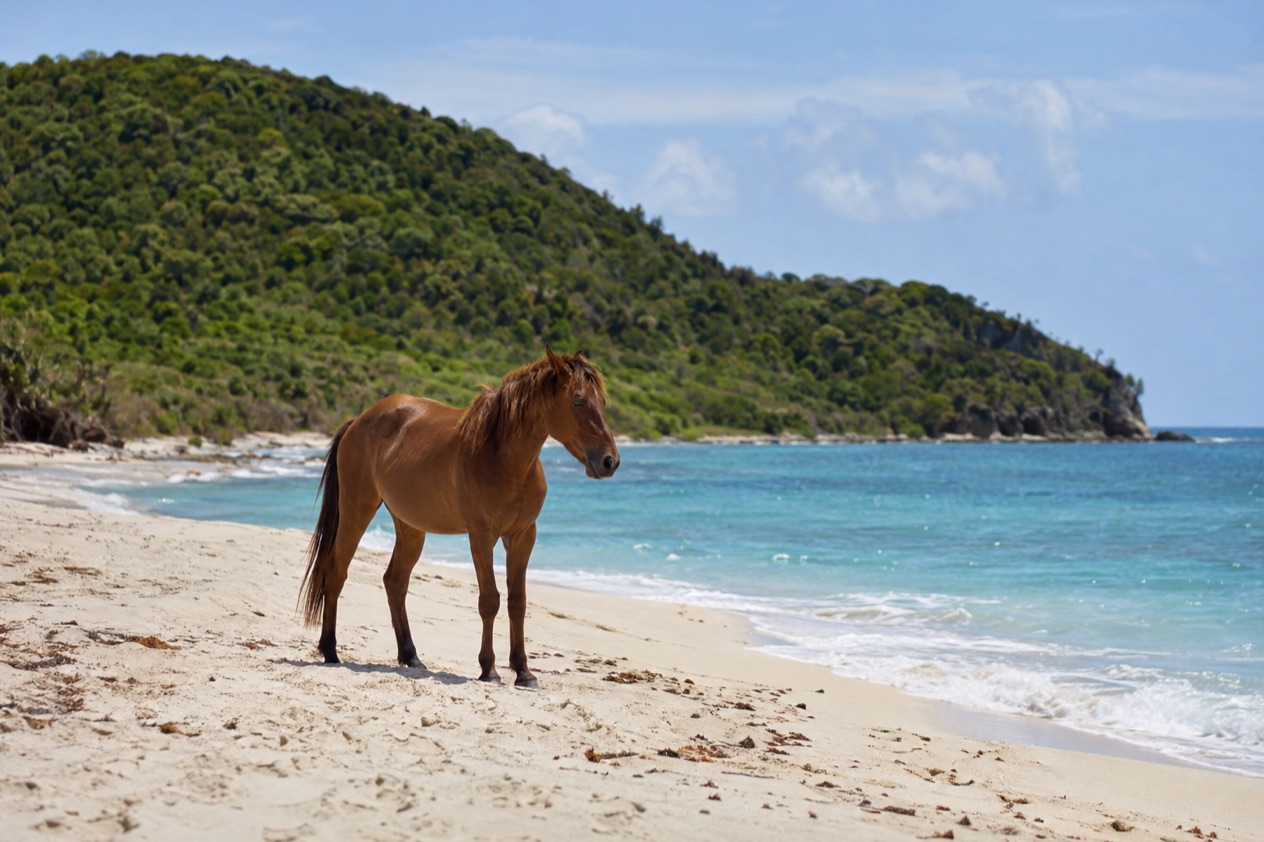
The morning starts in the dark on the road east, with the Luquillo mountains turning from black to green as the light comes up. At the end waits a small island of long empty beaches, wild horses grazing along the roadside and a waterfront village where the restaurants have no walls. Getting from San Juan to Vieques takes a little planning, but the trip is part of the pleasure.
How do you get to Vieques from San Juan?
The easiest way is to drive about an hour east to Ceiba, on the northeast coast, and take the public ferry across, or to skip the road altogether and fly a small propeller plane from San Juan. Either way, Vieques sits roughly 8 miles off the main island, so the sea crossing itself is the short part of the day.
What decides between the two is mostly how you like to travel and what you carry. The Autoridad de Transporte Marítimo runs the ferry, which leaves Ceiba several times every day.
When the drive and a terminal are no trouble for you, this option serves you well and delivers you to Isabel Segunda, the north coast’s ferry town. If you are pressed for time and flying appeals to you, depart from Luis Muñoz Marín International Airport or Isla Grande Airport and land at Antonio Rivera Rodríguez Airport, the island’s small airstrip.
Ceiba itself is worth a moment if you arrive early. It is a quiet town on the Atlantic, home for decades to the Roosevelt Roads Naval Station, and it has its own beaches, mangroves and a river pool known as Charco Frío. Many travelers pass through without stopping, but a coffee here before the boat is a gentle start. A third thing to weigh is the time of year: the Atlantic hurricane season runs from June 1 to November 30, and schedules by sea and air can change when weather turns, so follow the National Hurricane Center and local official alerts if you travel in those months.
Ways to get to Vieques from San Juan
By rental car and public ferry
When traffic cooperates, the drive from San Juan to Ceiba runs roughly an hour, and there you board the public ferry run by the Autoridad de Transporte Marítimo. The road runs along the northeast coast, past Fajardo, and the last stretch feels more rural, with small bridges and glimpses of the Sierra de Luquillo on your right.
This is the option for people who like to set their own pace and stop for breakfast along the way. It suits couples and small groups who travel light. The crossing lands at Isabel Segunda, where the old lighthouse and the fort sit above town.
A useful tip is to plan the drive so that you reach Ceiba with room to spare. Plan ahead for transportation on Vieques.
By small plane
You can reach Vieques by plane in 20 to 30 minutes from either Isla Grande Airport in San Juan or Luis Muñoz Marín International Airport. From Ceiba Airport the flight lasts about 5 minutes. The planes are small propeller aircraft, because the island airport accepts nothing larger.
Flying suits anyone short on time, anyone who would rather skip the drive, and travelers who want to see the coast from above, with the reefs and the green of the east visible through the window. At the San Juan airport, small and regional operators are mostly found in Terminal D, but check which terminal your airline uses before you leave. Check your airline’s baggage rules before you pack.
By organized tour
If you would rather not drive on unfamiliar roads, book a package that includes a local guide, since that guide knows where the horses gather and which beaches to try first.
It works best for a single day trip. Expect a long day, early out and late back, with a few hours on the island itself. Ask whether the program includes a beach stop and time for lunch in Esperanza, the waterfront village on the south coast, rather than only a drive past the sights.
By private driver
A private driver takes you from your San Juan hotel or the airport to the Ceiba terminal, then you cross on the ferry and continue on your own. It removes the parking question and the road, and it suits families with luggage, or anyone arriving late from a mainland flight and not wanting to drive in the dark.
Ask the driver to wait until you have your ferry ticket in hand, and to drop you where the boarding line forms. The ride east takes about an hour, a pleasant stretch for watching the island change from city to coast to rural hills.
Options compared
| Option | Time each way | Best for | What to know |
|---|---|---|---|
| Rental car and ferry | About 1 hour by road to Ceiba, then the ferry crossing | Independent travelers who like stops on the way | Ferry leaves Ceiba several times a day and lands at Isabel Segunda |
| Small plane from San Juan | 20 to 30 minutes in the air | Short on time, no wish to drive | Small propeller aircraft land at the island airport |
| Small plane from Ceiba | About 5 minutes in the air | Skipping the ferry after the drive | Departs from Ceiba Airport |
| Organized tour | About 1 hour by road to Ceiba, then the crossing | Day trippers who want no logistics | Often a long day with limited time on the island |
| Private driver | About 1 hour by road to Ceiba, then the ferry | Families and late arrivals | Continues on the ferry on foot |
Put simply, the ferry is the classic choice and the plane the quick one. If you are staying overnight, either works well, and the ferry feels like the more local way to arrive, with islanders and their groceries sharing the deck. If you only have a day, the flight gives you back the hours you would spend on the road and in the terminal, which you can then spend on a beach.
Mixing the two is also possible, for example going over by ferry and returning by plane at the end of a long beach day. Vieques is about 20 miles long and under 5 miles wide.
Making a day of it
A good day starts early, with the drive east in the cool morning and a stop in Ceiba or Fajardo before the crossing. When the trip allows a break, Ceiba’s places of interest include Medio Mundo y Daguao’s mangroves, Playa Los Machos and Charco Frío y Las Tinajas.
On the island, Isabel Segunda is where you arrive, a small town with a fort and a handful of cafés. From there you head to the beaches. Long sweeps of sand define Sun Bay, Red Beach and Blue Beach, three of the most popular spots, where a few wild horses often roam close by.
Much of the island was once a Navy range and is now a national wildlife refuge, which is why the beaches feel so undeveloped. The refuge is open year-round and free to enter, but a large part of the eastern side is closed because of unexploded ordnance, so stay on the open areas and signed paths, and leave the drone at home, since drones are prohibited.
For lunch, Esperanza on the south coast has guesthouses and open-air restaurants along the water, with a relaxed pace that makes a long meal easy. Bring sunscreen, a hat, water and a swimsuit, plus shoes you can walk in on sandy tracks. Check beach flags and signs where they exist, since conditions change from beach to beach and from day to day.
If you can stay past dark, Mosquito Bay is the island’s night draw. You can go out with a guide in a kayak or an electric boat, and since the glow peaks when there is no moon, the water may sparkle around your paddle.
That makes a day trip tight, since you would return late, so an overnight stay suits it better. Two or three nights let you cover the beaches, the refuge and the bay without rushing.
Good to know before you go
The U.S. dollar is the currency in Puerto Rico, and no passport is required for the trip if you are a U.S. citizen. Vieques is a quiet island, so bring what you need for the beach. In hurricane season, which runs from June 1 to November 30 with a peak in September, keep an eye on forecasts and official alerts, as ferry and flight schedules can shift when the weather changes.
Sources
- Wikipedia, Ceiba (https://en.wikipedia.org/wiki/Ceiba,_Puerto_Rico), checked October 8, 2026
- U.S. Fish and Wildlife Service, Vieques National Wildlife Refuge (https://www.fws.gov/refuge/vieques), checked October 8, 2026
- Wikipedia, Vieques (https://en.wikipedia.org/wiki/Vieques,_Puerto_Rico), checked October 8, 2026
- Wikipedia, Luis Muñoz Marín International Airport (https://en.wikipedia.org/wiki/Luis_Muñoz_Marín_International_Airport), checked October 8, 2026
- NOAA National Hurricane Center, Climatology (https://www.nhc.noaa.gov/climo/), checked October 8, 2026
To plan your stay
- Best Time to Visit Vieques: Weather by Month, Beaches, Crowds and Festivals
- Things to Do in Vieques: Mosquito Bay, Wild Beaches and Esperanza Evenings
- Where to Stay in Vieques: Esperanza, Isabel Segunda, Sun Bay Rentals and the Refuge Coast
- Know Before You Go to Vieques: Ferry and Flights, Refuge Rules, the Bioluminescent Bay and Sun