
You step out of the taxi onto a street of low colonial houses painted ochre and pink, and somewhere nearby a brass band is rehearsing for a wedding or a saint’s day. The Zócalo sits under its laurel trees, the cathedral glows in the late light, and the smell of roasting chocolate and corn drifts from the market. A few practical habits make Oaxaca easier to enjoy, from how you pay to how you move around the valley and what is polite in a church or at a market stall.
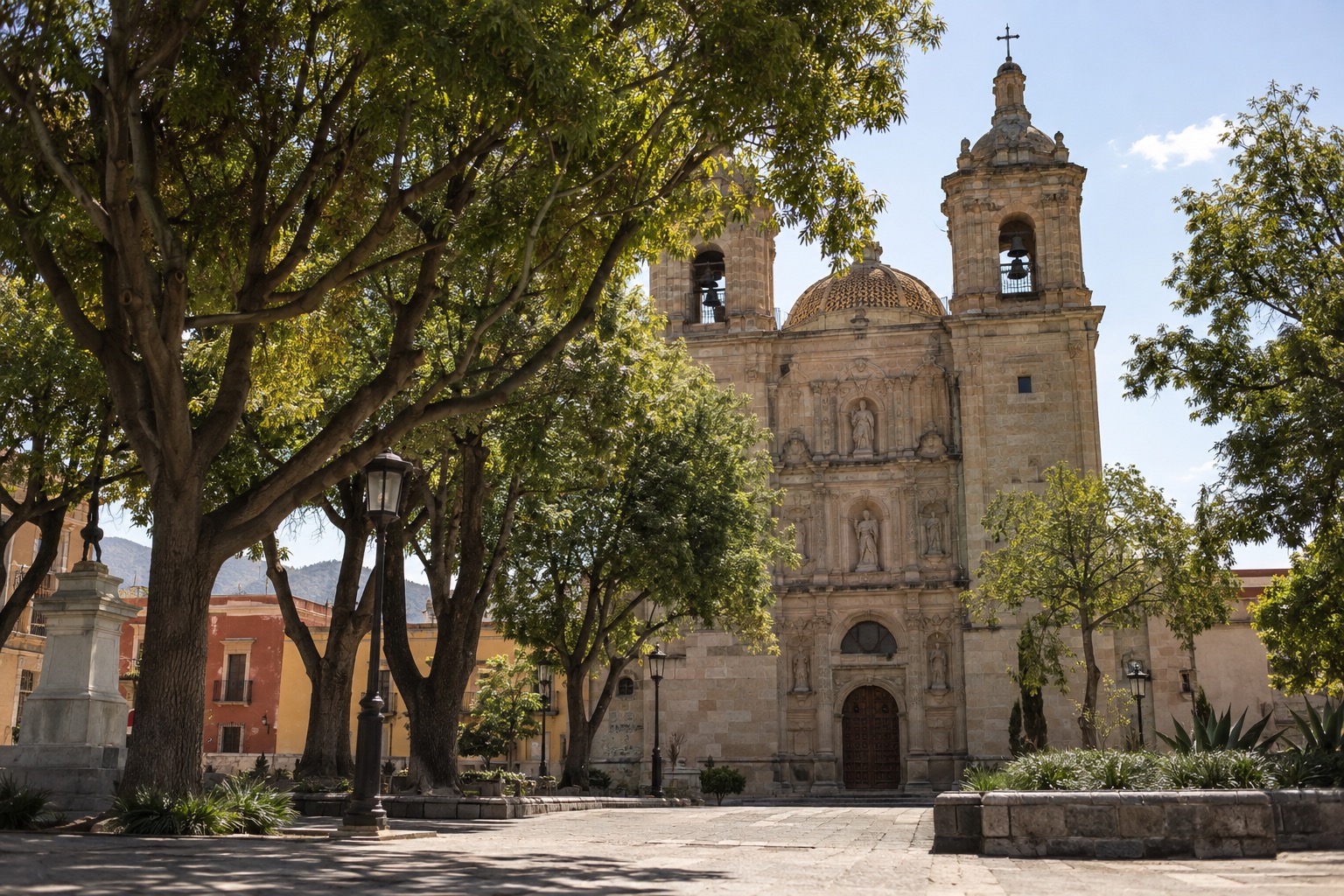
What should you know before visiting Oaxaca?
Four things matter most: carry cash in small bills, plan your day trips around the sun and the weekly markets, expect strong sun at the ruins, and treat photography and tastings with a little courtesy. Almost everything else in Oaxaca is easy and walkable.
First-time visitors are often surprised by how much of the good stuff sits outside the city, and by how little of it is on a schedule you can set yourself. The Sunday market at Tlacolula is a morning affair, the weavers of Teotitlán are happiest to receive visitors on weekday afternoons, and the mezcal palenques depend on the owner’s time. The city center is compact, but the valley rewards an early start.
Entry, fees and paperwork
Oaxaca’s main sights charge modest admission, and foreign visitors pay the general rate while Mexican nationals and foreign residents of Mexico pay half. Monte Albán, Mitla, Yagul and the Museo de las Culturas de Oaxaca, in the former Santo Domingo convent, all follow the same pattern. The museum is closed on Mondays, and the archaeological sites keep the same daily hours.
Some places work differently. At Hierve el Agua, the local community looks after the petrified waterfalls and mineral pools and takes its own entrance fee right there. Teotitlán del Valle has no entry fee, though the family workshops expect you to watch the weaving before you decide to buy.
Most mezcal palenques do not charge for entry, and tastings are usually free, with the quiet hope that you will take a bottle home. Entry to the public cemeteries at Día de Muertos is free, and some community altars may ask for a voluntary donation.
| Site | Open | General admission (pesos) | Residents and nationals (pesos) |
|---|---|---|---|
| Monte Albán | Daily, 8 a.m. to 5 p.m. (last entry 4 p.m.) | 210 | 105 |
| Mitla | Daily, 8 a.m. to 5 p.m. (last entry 4 p.m.) | 210 | 105 |
| Yagul | Daily, 8 a.m. to 5 p.m. (last entry 4 p.m.) | 210 | 105 |
| Museo de las Culturas de Oaxaca | Tuesday to Sunday, 9 a.m. to 5 p.m. | 210 | 105 |
Money, cards and tipping
Cash in small bills is the quiet currency of the valley. Colectivo fares, market snacks, woven goods in Teotitlán and bottles bought straight from a mezcal producer are all easier with small denominations in your pocket. Larger restaurants and hotels in the center are more likely to take cards, but a market stall will not.
On the coast the same rule applies even more. In a village such as Mazunte, cash machines are scarce and plenty of smaller businesses won’t take cards, so come with sufficient pesos. As for tipping, it is a habit rather than a rule: diners usually add a tip at a sit-down restaurant, and people commonly leave a little for a guide, a driver or someone who carries your bags.
Getting around and staying connected
The historic center is made for walking, with pedestrian streets, museums, restaurants and the Zócalo within easy reach of each other. Jalatlaco, the colorful barrio just north, is a flat stroll to the Zócalo, and taxis there are easy to find. The airport is a short drive from the center, and Xochimilco, a more local barrio, sits within a walk or a short bus or taxi ride of the center.
Day trips along Highway 190
Most of the valley sights lie along Highway 190. To reach Mitla, catch buses or shared colectivos at the Central de Abastos or the baseball stadium, going past the Teotitlán del Valle turnoff, while colectivos marked for Tlacolula depart from the stadium or the second-class bus station. Teotitlán is roughly half an hour to forty minutes away, Mitla around an hour at most, and Tlacolula a bit under an hour.
The mezcal town of Santiago Matatlán sits on the same road, about 45 minutes to an hour from the city, and many tours stop at several palenques in one outing. Yagul lies just past Tlacolula on the Panamerican Highway. A taxi or a rental car gives more freedom to link several stops in one day, while colectivos suit those who like to travel the way locals do.
Monte Albán and Hierve el Agua
Monte Albán is a short drive up from the center, by car, taxi or a local bus that leaves near downtown. Go soon after it opens, or head over late in the afternoon, once the sunshine has softened and the tour groups have thinned. Inside the archaeological zone, you won’t find a stand for food or drinks, and since the plaza’s ground is uneven and shade is scarce, pack water, a hat and sun protection.
Hierve el Agua is a longer outing, about one and a half to two hours each way. You might ride a bus or shared taxi in the direction of Mitla, then a local taxi or truck out of San Lorenzo Albarradas. Plenty of drivers also head straight there. On the coast, getting between La Punta, Zicatela and the center of Puerto Escondido usually means a scooter, taxi or shared colectivo, and the airport is a quick taxi ride from town.
Health, water and the sun
The sun in the Oaxaca valley is strong even when the air feels pleasant, and the ruins have almost no shade. A hat, sunscreen and a full water bottle make a real difference at Monte Albán, Mitla and Yagul. Mornings are the kindest hours for walking the sites, and midday is better spent in a shaded courtyard with a long lunch.
Days are warm all year, but nights can be cool, especially in winter, so a light layer is useful for evenings. July brings a rainy pattern, with rain on most days, usually as afternoon showers.
On the Pacific coast, the surf is powerful, especially at Playa Zicatela, where strong currents make swimming a poor idea. Calmer Playa Mazunte is gentler, but it is still wise to read the beach flags and ask locals about the water that day.
Local customs and etiquette
A greeting goes a long way. A simple buenos días when you enter a shop, a market stall or a small restaurant is the usual courtesy, and people respond warmly. Meals follow a relaxed rhythm, with a late and leisurely lunch as the main event of the day and dinner often eaten later than Americans expect.
In churches, dress modestly, with covered shoulders and a quiet step, and ask before photographing people or the interior. The same courtesy applies to weavers in Teotitlán and to workers at a palenque. In markets, a little friendly bargaining is customary for crafts, but not for food or for items that are clearly priced, and it should always stay good-humored.
During Día de Muertos, the cemetery vigils call for quiet and respect. Before you take a photo of anyone, ask first, stay off the graves, and speak quietly. Since the crowds are packed tight, full of smoke, and shadowy, the vigils are better for grown-ups and older kids than for little children.
Good to know before you go
The U.S. State Department rates the state of Oaxaca Level 2, Exercise Increased Caution, and places no restrictions on travel to Oaxaca City, Monte Alban, Puerto Escondido or Huatulco.
Hurricane season on the Pacific coast has its own timetable and begins in mid-May, so a summer beach stay in Puerto Escondido or Mazunte calls for flexible plans. The valley around the city is a different story, but a tropical system can still bring days of heavy rain, which is worth remembering in July. Keep your admission receipts handy at the sites, carry small bills, and start your day trips early, because Oaxaca’s best hours are the first ones.
Sources
- INAH, Zona Arqueologica de Monte Alban (inah.gob.mx/zonas/94-zona-arqueologica-de-monte-alban), checked September 29, 2026
- UNESCO (whc.unesco.org/en/list/415) ; INAH, Monte Alban ; chronologie corrigee le 03/10 (relecture Fable)
- INAH, lugares.inah.gob.mx (Mitla), via Fable re-read of 03/10/2026
- INAH, Zona Arqueologica de Yagul (inah.gob.mx/zonas/zona-arqueologica-de-yagul), checked September 29, 2026
- INAH, Museo de las Culturas de Oaxaca Santo Domingo (inah.gob.mx/museos/museo-de-las-culturas-de-oaxaca-santo-domingo), checked September 29, 2026
- U.S. Department of State, Mexico Travel Advisory, State of Oaxaca (travel.state.gov, date issued May 29, 2026), checked October 3, 2026
- official tourism site
- municipality
- Servicio Meteorologico Nacional (CONAGUA), normales climatologicas 1991-2020, estacion 20079 (Oaxaca, Oaxaca De Juárez), checked September 29, 2026
- sunrise-sunset.org, sunrise and sunset on the 15th of the month, checked September 8, 2026
To plan your stay
- Best Time to Visit Oaxaca: Weather, Día de Muertos, Rainy Season and Festivals
- Things to Do in Oaxaca: Monte Albán, Mezcal, Markets and Day Trips
- Where to Stay in Oaxaca: Historic Center, Jalatlaco, Xochimilco and the Pacific Beaches
- Oaxaca Airport to City: Taxi and Car Rides to the Historic Center, Jalatlaco and Xochimilco