
MEXICO · MONEY AND TIPS · PESOS · DOLLARS
Mexico is a country where the money side of the trip is a pleasure to sort out. There’s a national currency with a clear legal footing, a tipping culture that runs on generosity and good judgment, and a couple of small fees that are quick to settle. Once they’re handled, the rest of the planning belongs to the tacos, the beaches and the ruins.
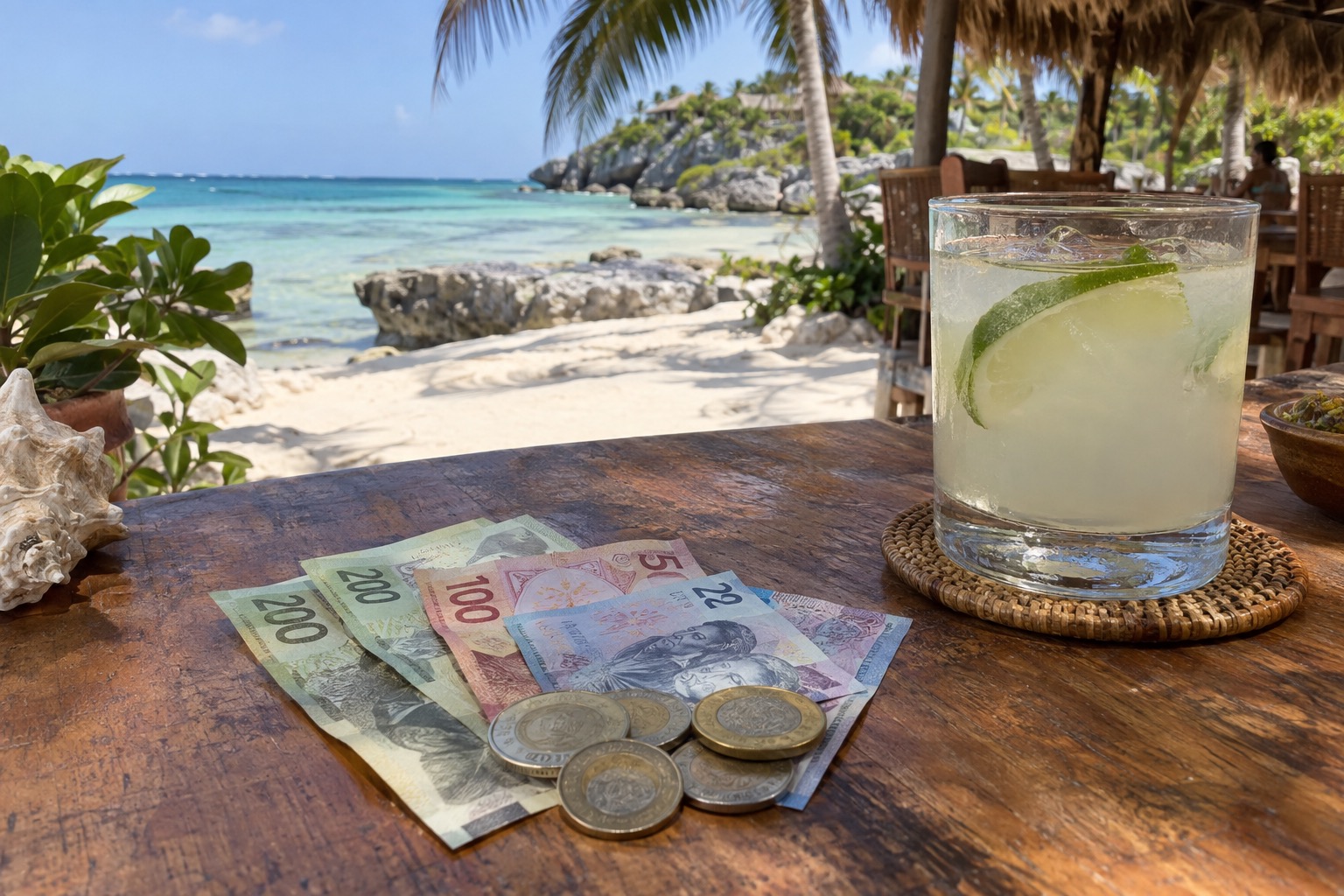
The peso is the money of the land, and dollars are welcome or not depending on the counter you’re standing at. Tips follow a range, so you get to reward the evening you actually had. Regional guides for the rest of the country start at our destinations index.
MONEY AT A GLANCE · MEXICO
Spend in pesos, treat dollars as a courtesy that each business may or may not extend, and pay the small entry fees once, ahead of time.
THE PESO IS THE LEGAL UNIT · DOLLARS AT EACH BUSINESS’S DISCRETION · TIPS IN A RANGE
Go for: pesos for everyday spending, a few dollars as a spare where a till takes them, and a tip pitched to the service you actually got.
Think twice before: counting on any till to take dollars at a fair rate, or tipping on top of a check that already says propina incluida without looking at the total first.
Ley Monetaria · Ley de Derechos del Estado de Quintana Roo · Ley Federal de Derechos · tipping ranges are custom, not published rules · full sources at the end
On this page
- What currency does Mexico use?The peso, and Article 1 of the Ley Monetaria
- Can I pay in US dollars?Article 8, and why each till sets its own answer
- What fees do tourists pay?Visitax at about 293 pesos, the FMM at 717 pesos base, the 5 USD cruise fee
- How much to tip in Mexico10 to 15 percent at a table, 15 to 20 in resort towns, and the smaller gestures
A U.S. passport card gets you back into the United States from Mexico by land or sea. It is not valid for international air travel, so flyers need the passport book. A first-time card costs 65 USD for an adult, plus a separate execution fee paid to the acceptance facility. Coming back overland or by boat, an Enhanced Driver’s License or a NEXUS, SENTRI or FAST card also works. Children under 16 need only a birth certificate or other proof of citizenship by land or sea, but must show their own passport by air.
What currency is used in Mexico?
The peso is Mexico’s money by law. Article 1 of the Ley Monetaria de los Estados Unidos Mexicanos sets it as the unit of the country’s monetary system, which is why it’s the currency to build your budget around.
The same law has a rule for foreign-currency obligations payable in Mexico: they are settled by delivering the peso equivalent at the exchange rate in force on the day of payment. Even when a dollar figure appears on paper, the peso stays at the center of the transaction.
Can I use US dollars in Mexico?
Article 8 of the Ley Monetaria gives foreign currency no legal-tender status in the Republic, unless another law expressly says otherwise.
For a traveler, that means no shop or restaurant has to accept dollars. Whether a till takes cash dollars, at what exchange rate and up to what amount is each business’s own call, and the answer shifts a great deal between tourist resorts and everywhere else.
The useful questions at the counter are short: do you take dollars, at what rate, and is there a limit? If a dollar price and a peso price sit side by side, convert one into the other at the rate you’re being offered before you choose.
The easy plan is to have pesos in your wallet from the first day and keep dollars as the spare that a resort till may take with a smile. Where dollars are turned down, nobody has broken a rule, since the law doesn’t oblige anyone to accept them.
What fees do tourists pay in Mexico?
Quintana Roo, the state around Cancun and Playa del Carmen, charges foreign visitors a fee under Article 51-Octies of its Ley de Derechos: 2.50 UMA (Unidad de Medida y Actualizacion). The UMA’s 2026 daily value is 117.31 pesos, in force since February 1 and published by INEGI, so the fee comes to about 293 pesos per person. Payment is online at visitax.gob.mx before the trip, or in cash at the airport before departure. The portal is run by the state tax service, SATQ.
The law names the payer as las personas visitantes extranjeras entering the state, and article 51-Octies writes no age exemption into it. Visitors entering through Quintana Roo’s southern border are exempt. Cruise passengers pay a separate right of 5 US dollars under article 51-Nonies, collected by the cruise line when the ticket is bought, and proof of that payment exempts them from the Visitax fee. Crew members are exempt from the cruise-passenger fee.
Foreign tourists entering Mexico also need a Forma Migratoria Multiple (FMM) from the Instituto Nacional de Migracion. Article 8-I of the Ley Federal de Derechos set the fee for visitors without permission for paid activities at 717 pesos, in the reform in effect since January 1, 2024. That base amount is indexed and republished each year, so the 2026 charge can differ. Flying in, the international airline collects and remits it for you, and the paper form has been replaced by a digital FMMd, delivered as a QR code after your passport is stamped.
How much to tip in Mexico
At a sit-down restaurant in Mexico the custom runs around 10 to 15 percent of the bill for good service, drifting toward 15 to 20 percent in resort towns such as Cancun, Puerto Vallarta or Playa del Carmen. Treat those figures as a bearing you’re free to adjust: go higher when the table looked after you all evening, lower when it didn’t.
Look at the bottom of the check for propina incluida or servicio incluido. When it says so, a service charge is already in the total, and a tip on top is a second, optional gesture rather than the first one.
Away from the table the gestures are smaller and softer: a little something per bag for a porter, a little something per day for housekeeping, and a rounding-up or a modest percentage for a taxi or rideshare driver. Keep a few small notes in your pocket for exactly these.
Sources & data for this guide
- Peso as monetary unit (art. 1) and foreign currency without legal-tender status (art. 8) · Ley Monetaria de los Estados Unidos Mexicanos · checked Sep 29, 2026
- Visitax fee (art. 51-Octies), cruise-passenger right (art. 51-Nonies) and exemptions · Ley de Derechos del Estado de Quintana Roo · checked Sep 29, 2026
- UMA 2026 daily value of 117.31 pesos · INEGI press release 1/26, Jan 8, 2026 · checked Sep 29, 2026
- Visitax online and airport payment · visitax.gob.mx · checked Sep 29, 2026
- FMM fee (art. 8-I, Ley Federal de Derechos, via an APTA mirror) and FMMd · Instituto Nacional de Migracion · checked Sep 29, 2026 · we could not confirm the exact 2026 indexed amount, so the 717-peso base is shown as published for 2024
- U.S. passport card, fees and validity · U.S. Department of State · page updated Sep 28, 2026 · checked Sep 29, 2026
- Return documents by land, sea and air, children’s rules · U.S. Customs and Border Protection, WHTI · checked Sep 29, 2026
- Dollar acceptance at tills follows from art. 8 and is reported practice, not published by any single authority. Tipping ranges are widely reported custom with no official source: they are bearings, not rules, and prices and fees change · check before you fly.