
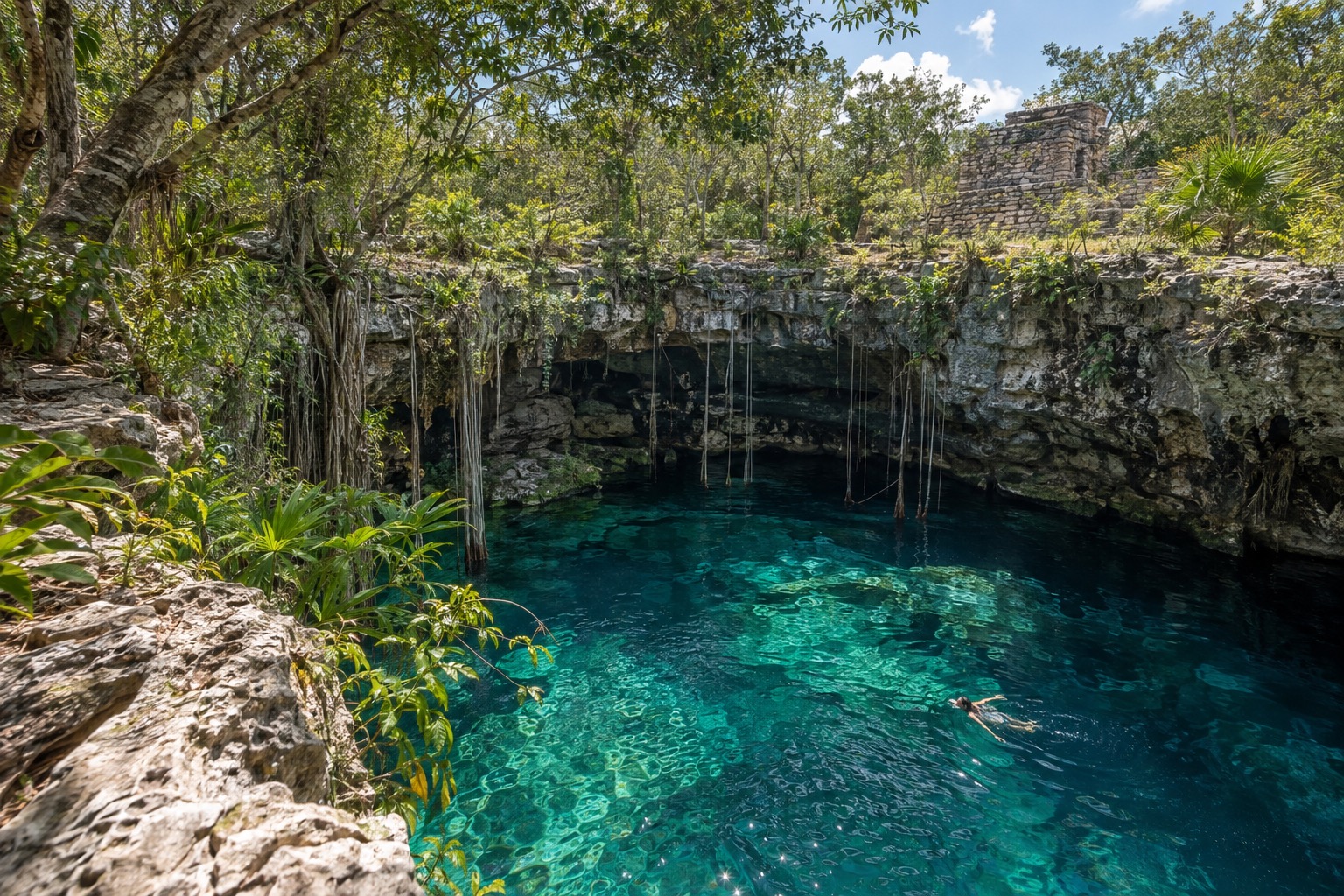
You walk down a few worn steps, the jungle heat drops away, and a shaft of light falls through a hole in the limestone onto water so clear it looks like glass. Roots hang down from the opening, small fish drift over pale rock, and every voice echoes a little. A cenote visit is a cool swim in the middle of the forest, a world away from the beaches of Cancun, and the best ones lie inland along the Riviera Maya corridor.
Is visiting the Cenotes near Cancun worth it?
Yes, especially for anyone who likes to swim or snorkel and wants a break from the sea, the sun and the resort strip. The cenotes suit couples, families with water-loving kids and curious travelers who want to see how the Yucatan really works underground.
The peninsula is flat limestone with almost no rivers, so its fresh water hides in sinkholes, some open to the sky and some fully enclosed caves. That makes a cenote a different experience from the Hotel Zone beaches or the Nichupte lagoon: the water is still, sheltered and framed by rock and roots, and there is no sargassum to rake. Each one is independently run, so no two feel alike.
What to see at the Cenotes near Cancun
The Ruta de los Cenotes toward Puerto Morelos
The closest cenotes sit inland from Cancun, mostly on the Puerto Morelos side, within about a one-hour drive. Here you find cenotes such as Zapote, Kin Ha and Las Mojarras, where you can swim or snorkel from wooden platforms and ladders. Those platforms make getting in and out simple, even for people who do not like jumping.
Expect a mix of open pools ringed with trees and half-covered caverns where the light comes in as a beam. Snorkelers look for fish gliding over submerged rock and the shapes the limestone has taken over thousands of years. This is the easiest stretch to fit into a day based in Cancun, and it pairs well with a lunch in Puerto Morelos afterward.
Ik Kil and the Sacred Cenote near Chichen Itza
Ik Kil is the cenote most travelers picture: a round, open-air pool with vines hanging down the walls and a stairway leading to the water. It sits near Chichen Itza, so most visitors pair the two on the same day. Ik Kil is independently run, with its own rules separate from the ruins.
Inside Chichen Itza itself, the Sacred Cenote is the one with a story. The Maya treated it as a sacred place and cast offerings into its depths, and it is part of a visit that also includes El Castillo, the Great Ball Court, the Temple of the Warriors and the Observatory (El Caracol).
You look at the Sacred Cenote from its edge, as part of the walk through the ruins. A cool dip at Ik Kil afterward is a welcome end to a hot morning among stone.
Dos Ojos, Gran Cenote and Cenote Azul
Dos Ojos and Gran Cenote both lie near Tulum, farther down the coast. Dos Ojos is a cave system named for its two linked pools, the "two eyes," and it draws snorkelers and cave divers with its long, clear passages. Gran Cenote is known for its stalactites, shallow turquoise water and the turtles that often drift among the swimmers.
Cenote Azul lies along the road toward Bacalar, a calmer, more open setting that suits a slow afternoon in the water. All three are independently run, so each sets its own pace and feel. Because they lie in the south, they fit best into a day built around Tulum rather than a quick outing from Cancun.
Hours, tickets and rules
Most cenotes are small private businesses, so hours and entry prices are set by each one. The best-documented stop is Chichen Itza, home of the Sacred Cenote, which opens in the morning and charges foreign visitors a single combined ticket.
| Site | Open | Admission |
|---|---|---|
| Sacred Cenote, Chichen Itza | Opens at 8 a.m. | 697 pesos for foreign visitors (105 pesos to INAH plus 592 pesos to the Yucatan state agency) |
At Zapote, Kin Ha and Las Mojarras you can swim or snorkel from the wooden platforms and ladders. The Nichupte lagoon behind the Hotel Zone is used for boat tours and kayaking, not for swimming, because of boat traffic and crocodiles.
How to get to the Cenotes near Cancun
The cenotes closest to Cancun lie inland toward Puerto Morelos and the Riviera Maya corridor, rather than in the city itself. Several are a short drive away, and that stretch is the natural base for an easy outing from Cancun or Puerto Morelos.
The better-known names are farther out. Ik Kil is near Chichen Itza, Dos Ojos and Gran Cenote are near Tulum, and Cenote Azul is on the road toward Bacalar. Each of these makes a longer day, so plan it around the ruins or the town nearby rather than as a quick swim.
When to visit the Cenotes near Cancun
Go early. Arriving at opening time beats the midday heat and the tour buses, which matters most around Chichen Itza and Ik Kil. A cool swim is also most welcome in the hot early afternoon, when the jungle heat is at its peak.
February to April brings the fewest rainy days, so those are the easiest months for a cenote day. October is the wettest month, with showers on most days, and it falls inside the Atlantic hurricane season, which runs through the end of November. From about November to February, cold fronts called nortes bring a day or two of wind, cloud and cooler air every week or two, which can make a shaded cenote feel brisk.
Tips for your visit
Bring a swimsuit, a towel and a snorkel mask if you have one, and wear something you can slip off easily for the steps and platforms. Plan a half day for the cenotes near Puerto Morelos, and a full day when you combine Ik Kil with Chichen Itza.
Pair the cenotes with what lies nearby: the ruins of Chichen Itza for Ik Kil, the Tulum archaeological zone for Dos Ojos and Gran Cenote, and a seafood lunch in Puerto Morelos for the Ruta de los Cenotes. Families will find the wooden platforms and ladders at Zapote, Kin Ha and Las Mojarras easy for getting in and out of the water. Some cenotes, Ik Kil among them, are reached by steps, so travelers with limited mobility should keep that in mind.
Good to know before you go
The U.S. State Department rates the state of Quintana Roo Level 2, ‘Exercise increased caution,’ due to terrorism and crime; its advice there is to pay attention to your surroundings after dark and to stay in well-lit pedestrian streets and tourist zones.
Dollars have no legal-tender status in Mexico, so small businesses may refuse them or set their own exchange rate, and carrying pesos makes small cenote entries and snacks easier. Resorts and big tourist businesses usually accept dollars. The Atlantic hurricane season runs from June 1 to November 30, and these two charges are worth knowing about when you plan a stay.
| Fee | Amount | Who pays |
|---|---|---|
| Visitax | 2.50 UMA, about 293 pesos per person | Foreign visitors entering Quintana Roo, except those entering through the state’s southern border |
| Lodging tax (Impuesto Sobre Hospedaje) | 5% of the billed value of the accommodation, 6% when a host or booking platform collects payment for a short-term rental | Guests staying in Quintana Roo accommodations |
Sources
- common knowledge
- INAH, Zona Arqueologica El Rey (inah.gob.mx) ; gratuite dominicale INAH (tarifs 2026 : Por Esto QR 06/01/2026, Chilango), checked October 3, 2026
- INAH, "Zona Arqueologica El Rey", checked September 29, 2026
- INAH, "Zona Arqueologica El Meco" (inah.gob.mx/zonas/zona-arqueologica-el-meco), checked September 29, 2026
- INAH, Museo Maya de Cancun (inah.gob.mx/museos) ; official account of the Museo Maya de Cancun (last access to the area: 16 h 30) ; Mexico es Cultura, checked October 3, 2026
- INAH, "Zona Arqueologica de San Miguelito", checked September 29, 2026
- Ultramar, "Ferry Isla Mujeres" (ultramarsales.ultramarferry.com/es/ferry-isla-mujeres.php), checked September 29, 2026
- Congreso del Estado de Quintana Roo, Ley del Impuesto al Hospedaje del Estado de Quintana Roo, art. 8 (text as of 16 December 2025, congresoqroo.gob.mx), checked September 29, 2026
- Ley de Derechos del Estado de Quintana Roo, art. 51-Octies and 51-Nonies ; UMA value 2026 : INEGI
- Ley Federal de Derechos, art. 8-I ; Instituto Nacional de Migracion, gob.mx/inm, checked September 29, 2026
- U.S. Department of State, Mexico Travel Advisory, State of Quintana Roo (travel.state.gov, date issued May 29, 2026), checked October 3, 2026
- NOAA National Hurricane Center, "Tropical Cyclone Climatology", nhc.noaa.gov, checked September 29, 2026
- Ley Monetaria de los Estados Unidos Mexicanos, art. 8
- verifie le 03/10 (CruiseMapper, Cruzely)
- https://lugares.inah.gob.mx
- https://musamexico.org
- INAH, bulletin of 19/09/2026 (inah.gob.mx, Boletines), checked October 5, 2026
- Gobierno de Quintana Roo, qroo.gob.mx (23/07/2026) ; gob.mx, Plan Tulum Renace, checked October 5, 2026
- Servicio Meteorologico Nacional (CONAGUA), normales climatologicas 1991-2020, estacion 23155 (Cancun, Benito Juárez), checked September 29, 2026
To plan your stay
- Best Time to Visit Mexico: Weather by Region, Crowds, Hurricane Season and Festivals
- Where to Stay in Mexico: Riviera Maya, Los Cabos, Puerto Vallarta, Mexico City and All-Inclusive Areas
- Getting Around Mexico: Buses, the Tren Maya, Taxis and Driving Your Own Car
- Mexico Travel Tips: Dollars, Tourist Tax, Tipping, Tap Water, Driving and Safety by State