
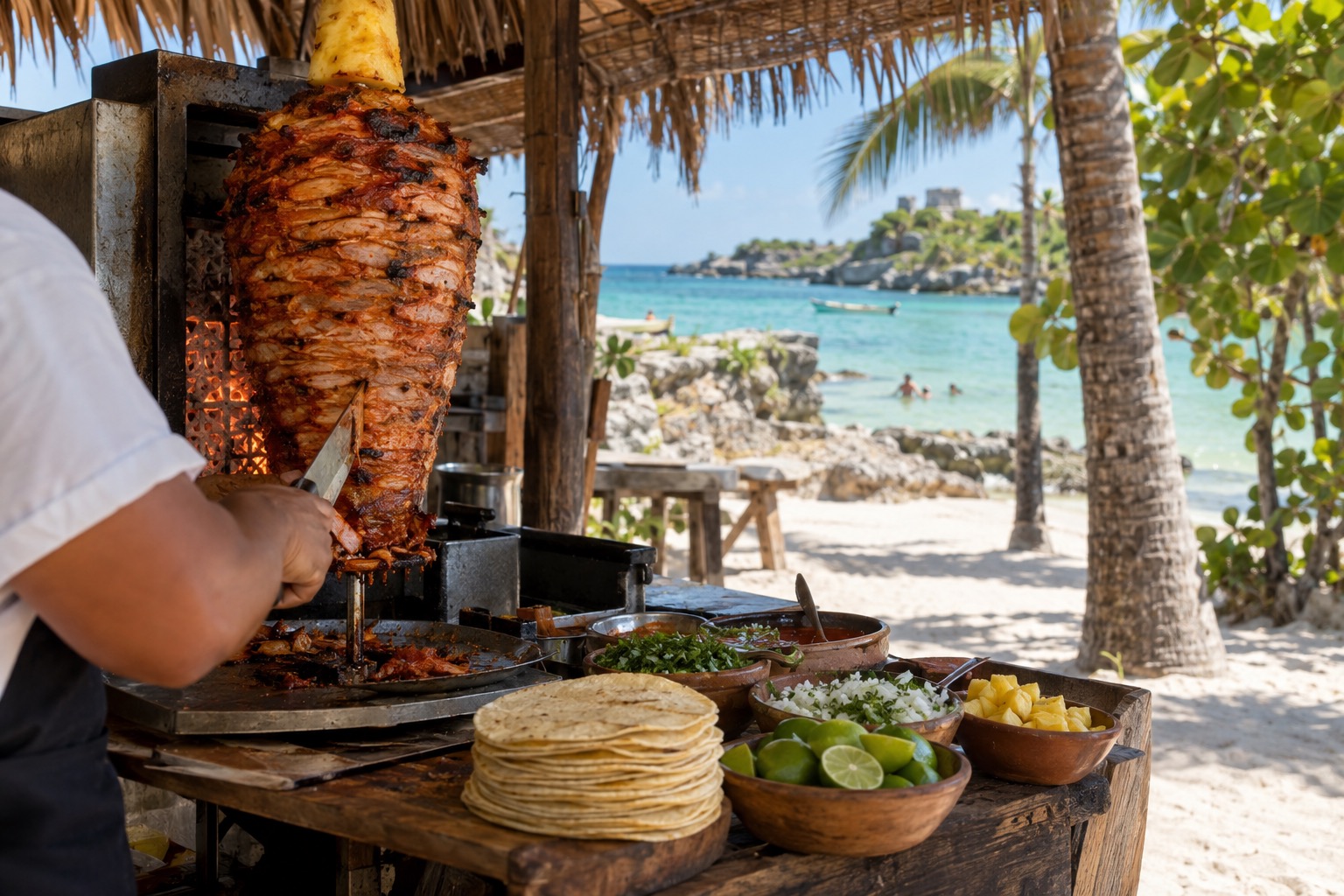
You are standing at a taco stand with a crisp bill in your hand, the al pastor is turning on its spit, and the cook looks at you with a polite smile. That small moment of “do you take dollars?” is where most Mexico questions begin. The short version: carry pesos, tip generously but without stress, stick to bottled water, and look at the state you are visiting before you plan a route.
Can I use dollars in Mexico?
Sometimes, but no one has to accept them, so pesos are the safer way to pay. Mexican law makes the peso the unit of the country’s money, and foreign currency has no legal-tender status except where a law expressly says otherwise.
In practice, whether a register takes cash dollars, at what exchange rate and up to what amount is each business’s own choice. Resort areas are used to dollars. Markets, taquerías, small-town shops and most places away from the tourist strip are much less likely to bother with them, and the rate you get may not be one you like.
If a bill is owed in dollars
When an obligation is contracted in foreign currency and payable in Mexico, it is settled by handing over the peso equivalent at the exchange rate in force on the payment date. So even a price quoted in dollars ends up as pesos on paper.
A sensible habit is to keep a small stash of pesos for street food, taxis, markets and tips, and use cards or pesos for larger bills. Dollars can then be a backup rather than your main way of paying.
Documents that matter at the border
As soon as tourists from other countries reach Mexico, they need to get a Forma Migratoria Múltiple (FMM) from the Instituto Nacional de Migración. The amount due from a visitor who lacks permission for paid work is 717.00 pesos, as established by the reform that has been in force since January 1, 2024. That underlying amount is indexed and published anew each year, so the fee charged may not match this figure.
If you fly in, the international airline collects and passes on the fee for you. When you arrive by plane, that paper form is gone, replaced by a digital version that comes as a QR code once your passport is stamped.
On the way home, U.S. citizens who return by land or sea can show a trusted traveler card (NEXUS, SENTRI, or FAST), an Enhanced Driver’s License, a passport card, or a passport. For land or sea travel, children younger than 16 only need a birth certificate or some other proof of citizenship, but if they fly, they must have their own passport.
| Passport card | Adult | Child under 16 |
|---|---|---|
| First-time application | 65 USD | 50 USD |
| Renewal | 30 USD | Must apply again in person |
| Validity | 10 years | 5 years |
A passport card will not get you onto international flights. It is meant for land and sea crossings from Mexico, Canada, some Caribbean destinations and Bermuda, and it can use the faster Ready Lanes at land borders. When you apply for the first time, the acceptance facility collects a separate execution fee.
What is the tourist tax in Mexico?
The best-known one is Visitax, a fee owed by every foreign visitor entering the state of Quintana Roo, home of Cancún, Playa del Carmen and Tulum. It is set at 2.50 UMA, which comes to about 293 pesos per person with the 2026 daily value of 117.31 pesos.
Who pays and who does not
Under the law, the payer is listed simply as foreign visitors who come into the state, while the article offers no age exemption. Travelers arriving in Quintana Roo by way of the state’s southern border are expressly exempt.
Cruise passengers do not pay Visitax separately. They are assessed a separate charge of 5 US dollars that the cruise line collects at ticket purchase, and proof of that payment keeps them from owing the Visitax fee. Crew members are not assessed this cruise-passenger fee.
You have the option of paying online at visitax.gob.mx before you travel, or handing over cash at the airport before departure. The state tax service of Quintana Roo operates this portal, so it’s smart to use the official address and not a lookalike site.
Tipping in Mexico
Tipping is part of the rhythm of eating and getting around in Mexico, and the custom at a sit-down restaurant runs around 10 to 15 percent of the bill for good service. In resort towns such as Cancún, Puerto Vallarta or Playa del Carmen it drifts up toward 15 to 20 percent. It is a bearing, not a rule.
Glance at the lower part of your bill for “propina incluida” or “servicio incluido,” and if either wording shows up, the total already covers a service charge, so anything extra you leave is an optional second gesture, not the initial one.
Away from the table
The gestures get smaller and softer. The usual practice is to give the porter a small amount for each bag, leave something daily for housekeeping, and give a taxi or rideshare driver either a rounded-up fare or a modest percentage. Small pesos in your pocket make all of this easier, since handing over a large bill and waiting for change is awkward at a hotel door or a taxi window.
Can you drink tap water in Mexico?
Most visitors don’t, and the usual habit is to drink bottled or purified water instead. In tourist areas, hotels and restaurants rely on purified water and ice, which means a cold drink at the table usually fits into the everyday pattern.
That habit extends to the small things: bottled water for the hotel room, and for brushing teeth if you prefer to be careful. It lets you enjoy the street food, from elotes to tamales and chilaquiles at breakfast, without turning every meal into a question.
What to know before driving in Mexico
The first thing to know is that insurance is required by law: every vehicle traveling on federal roads, highways and bridges must carry coverage for damage it might cause to third parties’ property and persons. The vehicle owner is responsible for taking it out, and no insurer may be forced on them.
| Coverage | Minimum amount |
|---|---|
| Property damage | 50,000 pesos |
| Bodily injury or death | 100,000 pesos |
These minimums were phased in by vehicle model year and invoice value between 2014 and 2019, when all vehicles were covered. You must pay the premium all at once, not in installments.
Driving on a federal road or bridge without the insurance contract is punished with a fine of 20 to 40 days of minimum wage. After that, the owner gets 45 calendar days to purchase the policy, and showing it to the authority during that period cancels the infraction.
Mexico travel advisory by state
The U.S. State Department rates Mexico Level 2 overall, which means exercise increased caution, due to terrorism, crime and kidnapping, but the rating changes a lot from one state to the next.
| Level | States |
|---|---|
| Level 4 – Do not travel | Colima, Guerrero, Michoacán, Sinaloa, Tamaulipas, Zacatecas |
| Level 3 – Reconsider travel | Baja California, Chiapas, Chihuahua, Guanajuato, Jalisco, Morelos, Sonora |
| Level 2 – Exercise increased caution | Aguascalientes, Baja California Sur, Coahuila, Durango, Hidalgo, Mexico City, State of Mexico, Nayarit, Nuevo León, Oaxaca, Puebla, Querétaro, Quintana Roo, San Luis Potosí, Tabasco, Tlaxcala, Veracruz |
| Level 1 – Exercise normal precautions | Campeche, Yucatán |
Popular destinations and their ratings
Quintana Roo, Baja California Sur (Los Cabos, La Paz), Mexico City, Oaxaca and Puebla all sit at Level 2. Yucatán and Campeche, the home of cochinita pibil cooked in banana leaves, are at Level 1.
Jalisco is Level 3, and in Guadalajara battles between criminal groups have happened in tourist areas. For employees of the U.S. government, no restrictions apply in the Guadalajara area, Puerto Vallarta (along with neighboring Riviera Nayarit), Chapala and Ajijic. Guanajuato, the state of San Miguel de Allende and Guanajuato city, is also Level 3, and the advisory says gang violence there mostly happens in the southern and central areas.
Where the warnings are strongest
Guerrero is Level 4, and U.S. government employees may not travel to any area in the state, including Acapulco, Zihuatanejo, Taxco and Ixtapa. U.S. citizens and lawful permanent residents have been victims of kidnapping there.
Michoacán is also Level 4, and government employees may not travel to other areas of the state, including portions of the Monarch Butterfly Reserve. Three of the four monarch sanctuaries that are open (El Rosario, Senguio and Sierra Chincua) are in Michoacán, while Piedra Herrada is in the State of Mexico, rated Level 2.
In Baja California, the rating is Level 3, with high homicide numbers in the non-tourist areas of Tijuana. In that state, the Mexicali Valley is the one place with travel restrictions. Sonora is also Level 3.
Good to know before you go
Keep a few pesos on you, drink purified water, and settle on a state before you settle on a route. Mexican cuisine, a UNESCO-listed tradition built on corn, beans and chili, is the reason many people come, so leave room in the plan for a market breakfast and a mole in Oaxaca or Puebla. The Pacific coast and the Caribbean both have their own hurricane seasons, so dates matter when you pick a beach.
Sources
- Ley Monetaria de los Estados Unidos Mexicanos, art. 1, ordenjuridico.gob.mx, checked September 29, 2026
- Ley Monetaria de los Estados Unidos Mexicanos, art. 8, ordenjuridico.gob.mx, checked September 29, 2026
- article 8 of the Ley Monetaria (see fact money/dollarnoncourslegal above); practice observed and widely reported, not published by a single authority
- Usage widely and consistently reported, not published by an authority
- U.S. Department of State, "Compare a Passport Card and Book", travel.state.gov, updated on 28 September 2026, read live via browser on 29 September 2026
- Ley Federal de Derechos, art. 8-I (current text, APTA CE mirror, update 91), apta.com.mx ; supplemented by Instituto Nacional de Migracion, "Forma Migratoria Multiple Digital (FMMd)", gob.mx/inm, checked September 29, 2026
- U.S. Customs and Border Protection, « Western Hemisphere Travel Initiative », cbp.gov/travel/us-citizens/western-hemisphere-travel-initiative, checked September 29, 2026
- Ley de Derechos del Estado de Quintana Roo, art. 51-Octies (official PDF from the Congreso de Quintana Roo, congresoqroo.gob.mx) ; UMA value : INEGI, Comunicado de prensa 1/26 "Unidad de Medida y Actualizacion (UMA)", January 8, 2026, inegi.org.mx, checked September 29, 2026
- Ley de Derechos del Estado de Quintana Roo, art. 51-Octies, congresoqroo.gob.mx, checked September 29, 2026
- Ley de Derechos del Estado de Quintana Roo, art. 51-Nonies, congresoqroo.gob.mx, checked September 29, 2026
- Portail officiel VISITAX, visitax.gob.mx/sitio, checked September 29, 2026
- U.S. Department of State, Mexico Travel Advisory (main, level banner), travel.state.gov, read live via browser (protected by Cloudflare, direct fetching blocked with 403) on 29 September 2026
- U.S. Department of State, Mexico Travel Advisory, section "Risks in specific areas" / State of Guerrero, travel.state.gov, read live via browser on September 29, 2026
- U.S. Department of State, Mexico Travel Advisory, section "Risks in specific areas" / State of Baja California, travel.state.gov, read live via browser on September 29, 2026
- U.S. Department of State, Mexico Travel Advisory, section "Risks in specific areas" / State of Baja California Sur, travel.state.gov, read live via browser on September 29, 2026
- U.S. Department of State, Mexico Travel Advisory, section "Risks in specific areas" / State of Sonora, travel.state.gov, read live via browser on September 29, 2026
- U.S. Department of State, Mexico Travel Advisory, section "Risks in specific areas" / State of Michoacan, travel.state.gov, read live via browser on September 29, 2026
- U.S. Department of State, Mexico Travel Advisory, section "Risks in specific areas" / State of Quintana Roo, travel.state.gov, read live via browser on September 29, 2026
- U.S. Department of State, Mexico Travel Advisory, section "Risks in specific areas" / State of Mexico (Estado de Mexico), travel.state.gov, read live via browser on September 29, 2026
- U.S. Department of State, Mexico Travel Advisory (reissued May 29, 2026), section « Risks in specific areas », travel.state.gov/en/international-travel/travel-advisories/mexico.html, read via browser (Cloudflare blocks curl) on 29 September 2026
- Ley de Caminos, Puentes y Autotransporte Federal, art. 63 Bis (texte en vigueur, Camara de Diputados), diputados.gob.mx, checked September 29, 2026
- Diario Oficial de la Federacion, ACUERDO 07/2014, 27 mars 2014, dof.gob.mx, checked September 29, 2026
- Ley de Caminos, Puentes y Autotransporte Federal, art. 74 Bis, fraccion II, diputados.gob.mx, checked September 29, 2026
- UNESCO, Intangible Cultural Heritage, « Traditional Mexican cuisine – ancestral, ongoing community culture, the Michoacan paradigm », inscrit en 2010 (5.COM), ich.unesco.org, checked September 29, 2026
To plan your stay
- Best Time to Visit Mexico: Weather by Region, Crowds, Hurricane Season and Festivals
- Things to Do in Mexico: Ruins, Beaches, Day of the Dead and Street Food
- Where to Stay in Mexico: Riviera Maya, Los Cabos, Puerto Vallarta, Mexico City and All-Inclusive Areas
- Getting Around Mexico: Buses, the Tren Maya, Taxis and Driving Your Own Car