
You step out of Cancun airport into warm, humid air, a driver is calling out destinations, and you realize the beach you want is a long way from the one next to it. Mexico is big, and the way you move depends on the distance: comfortable first-class buses and the Tren Maya for the regions, planes for the long jumps, and taxis or apps once you are in town.
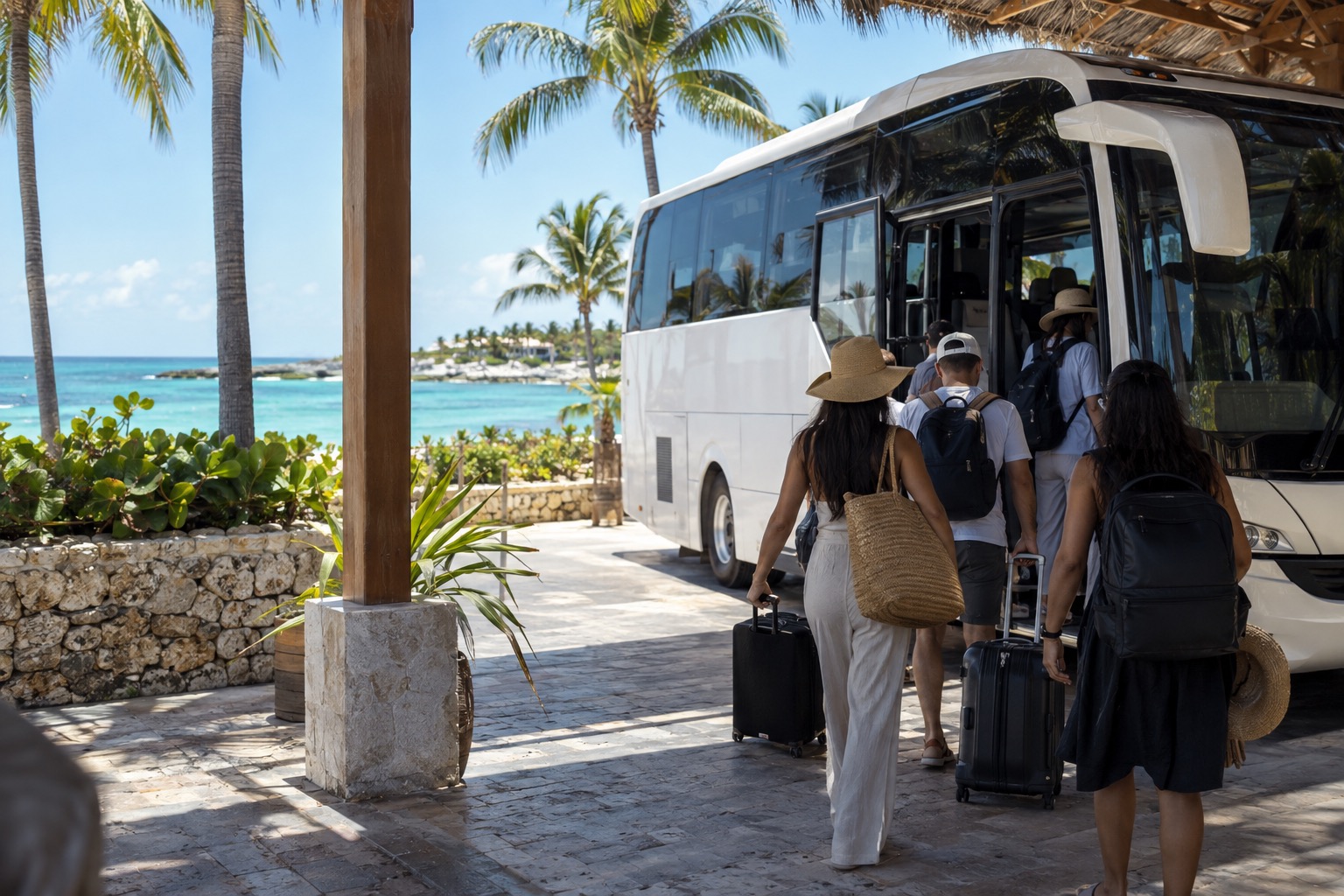
How to travel between cities in Mexico
Most travelers go between Mexican cities by long-distance first-class bus, and fly when the regions are far apart. Driving from one region to another takes days, so it rarely makes sense as a way to cover big distances.
Buses for everyday trips
The first-class bus is the ordinary way Mexicans themselves get around, and it works well for visitors too. Across the Yucatan peninsula, ADO covers the majority of routes, among them a service linking Cancun airport with Playa del Carmen and Tulum, so it’s a simple first leg once you land.
Seats are roomy, the air conditioning is often strong, and the bus stations are usually a short taxi ride from the center of town. A light layer for the cold cabin is a good habit. It suits anyone happy to watch the countryside go by, and it is less suited to tight schedules across regions.
The Tren Maya
The Tren Maya ties together towns across the peninsula, including Cancun, Merida, Valladolid and Tulum. It is a handy way to link the Caribbean coast with the colonial interior without renting a car.
It works best for a route such as the coast to Valladolid and on to Merida, where each stop has enough to fill a day or two. Pair it with a taxi or a local bus for the last stretch from the station to your hotel.
Flying between regions
Flights within the country bring together its distant places: Oaxaca, Puerto Vallarta, Los Cabos, Mexico City and Cancun. Many routes pass through Mexico City, so a trip from one coast to another often means a connection there. Plan your itinerary in a line or a loop rather than zigzagging, and you will spend more time on the beach or in the plaza and less in airports.
Is it safe to take buses in Mexico?
First-class buses are the standard way to travel for many Mexicans and visitors, but the safety picture depends on the state you cross. The U.S. State Department rates Mexico Level 2 overall, which means exercise increased caution, and rates individual states higher or lower.
Six states are at Level 4, Do not travel: Colima, Guerrero, Michoacan, Sinaloa, Tamaulipas and Zacatecas. Seven are at Level 3, Reconsider travel: Baja California, Chiapas, Chihuahua, Guanajuato, Jalisco, Morelos and Sonora. Campeche and Yucatan are at Level 1, normal precautions, and the rest sit at Level 2, including Quintana Roo, Mexico City, Oaxaca and Baja California Sur.
Some Level 3 states hold popular places. In Jalisco there are no restrictions for U.S. government employees in the Guadalajara area, Puerto Vallarta, Chapala and Ajijic.
In Guanajuato, the state of San Miguel de Allende and Guanajuato city, the advisory says gang violence mostly happens in the southern and central areas. Look at the state-by-state ratings before you pick a route, and a daytime bus between major destinations in lower-rated states is the simple way to keep a trip easy.
Uber and taxis in Mexico
Both do the trick, though a few oddities pop up: ride-hailing apps are available in plenty of Mexican cities, yet not all resort areas allow airport pickups through them. Inside the terminal at major airports, you pay for official shuttles and taxis at a booth prior to going outdoors. That is the calm way to start, with a set fare and a ticket in hand rather than a negotiation on the curb.
In town, apps are handy for getting from a bus station to a hotel or back from dinner, and street taxis are easy to find in busy areas. If an app is not allowed at a given airport, the booth is your plan B, so it helps to have the other option in mind.
Driving in Mexico as a tourist
Driving works well for regional trips, but a foreign-plated car brings paperwork, and the roads have their own habits. If you are renting inside Mexico, the main thing to know is the road itself.
Roads and habits
Toll highways, called cuotas, are generally faster for long intercity drives where they exist. If you’re heading straight from Cancun to Tulum, you’ll be on Federal Highway 307, and since it’s not a toll road, count on regular traffic and approaches to towns.
Speed bumps, known as topes, are common as you enter towns, and they can be unmarked, so slow down early. Unnecessary night driving outside cities is best avoided.
Insurance and the import permit
Article 63 Bis, a provision of the federal roads law, requires every vehicle traveling on federal roads to have insurance that covers damage to third parties. The legal minimum coverage is the same for every driver. Should you travel a federal road with no coverage, that violation costs 20 to 40 days of minimum wage, after which the owner has 45 calendar days to purchase a policy and resolve the infraction.
A Temporary Vehicle Import Permit, which Banjercito, the army bank, issues, is required once your own foreign-plated car goes past the border free zones. It is not required within the Baja California peninsula or Sonora’s northwestern free zone, which the State Department calls hassle-free zones.
| Permit item | Amount | Notes |
|---|---|---|
| Permit at a border module or consulate | 51 USD plus VAT | One-time fee |
| Permit processed online | 45 USD plus VAT | One-time fee |
| Deposit, model year 2000 or older | 200 USD | Refunded when the car’s exit is registered before the permit expires |
| Deposit, model years 2001-2006 | 300 USD | Refunded when the car’s exit is registered before the permit expires |
| Deposit, model year 2007 or newer | 400 USD | Refunded when the car’s exit is registered before the permit expires |
Good to know before you go
Think of Mexico in regions: a bus or the Tren Maya within one, a plane between them, and a taxi booth or an app for the last mile. Check which states your route crosses, favor daylight for road legs, and keep a little cash handy for small stops along the way.
Sources
- Ley de Caminos, Puentes y Autotransporte Federal, art. 63 Bis (texte en vigueur, Camara de Diputados), diputados.gob.mx, checked September 29, 2026
- Diario Oficial de la Federacion, ACUERDO 07/2014, 27 mars 2014, dof.gob.mx, checked September 29, 2026
- Ley de Caminos, Puentes y Autotransporte Federal, art. 74 Bis, fraccion II, diputados.gob.mx, checked September 29, 2026
- Banjercito, "Importacion Temporal de Vehiculos", gob.mx/banjercito, checked September 29, 2026
- Cross-check: Banjercito / ANAM (perimeter silence for Baja California, Baja California Sur, and the northwest of Sonora); U.S. Department of State, Mexico Travel Advisory, section "Travel and transportation", travel.state.gov, read live via browser on 29 September 2026
- U.S. Department of State, Mexico Travel Advisory (main, level banner), travel.state.gov, read live via browser (protected by Cloudflare, direct fetching blocked with 403) on 29 September 2026
- U.S. Department of State, Mexico Travel Advisory, section "Risks in specific areas" / State of Guerrero, travel.state.gov, read live via browser on September 29, 2026
- U.S. Department of State, Mexico Travel Advisory, section "Risks in specific areas" / State of Baja California, travel.state.gov, read live via browser on September 29, 2026
- U.S. Department of State, Mexico Travel Advisory, section "Risks in specific areas" / State of Baja California Sur, travel.state.gov, read live via browser on September 29, 2026
- U.S. Department of State, Mexico Travel Advisory, section "Risks in specific areas" / State of Sonora, travel.state.gov, read live via browser on September 29, 2026
- U.S. Department of State, Mexico Travel Advisory, section "Risks in specific areas" / State of Michoacan, travel.state.gov, read live via browser on September 29, 2026
- U.S. Department of State, Mexico Travel Advisory, section "Risks in specific areas" / State of Quintana Roo, travel.state.gov, read live via browser on September 29, 2026
- U.S. Department of State, Mexico Travel Advisory, section "Risks in specific areas" / State of Mexico (Estado de Mexico), travel.state.gov, read live via browser on September 29, 2026
- U.S. Department of State, Mexico Travel Advisory (reissued May 29, 2026), section « Risks in specific areas », travel.state.gov/en/international-travel/travel-advisories/mexico.html, read via browser (Cloudflare blocks curl) on 29 September 2026
To plan your stay
- Best Time to Visit Mexico: Weather by Region, Crowds, Hurricane Season and Festivals
- Things to Do in Mexico: Ruins, Beaches, Day of the Dead and Street Food
- Where to Stay in Mexico: Riviera Maya, Los Cabos, Puerto Vallarta, Mexico City and All-Inclusive Areas
- Mexico Travel Tips: Dollars, Tourist Tax, Tipping, Tap Water, Driving and Safety by State