
MEXICO · WHERE TO STAY · SEPTEMBER 2026
Mexico offers four different vacations before you have even booked a flight. There is the Caribbean shore of white sand, cenotes and Maya ruins, the desert cape at the tip of Baja California, the jungle-backed bay of Puerto Vallarta, and a highland capital of museums and food. Any one of them makes a good trip.
Six names cover most first trips: Cancun, Playa del Carmen and Tulum on the Caribbean, Los Cabos at the desert tip, Puerto Vallarta on the Pacific bay, and Mexico City in the highlands. Choosing the region first narrows six names to one or two.
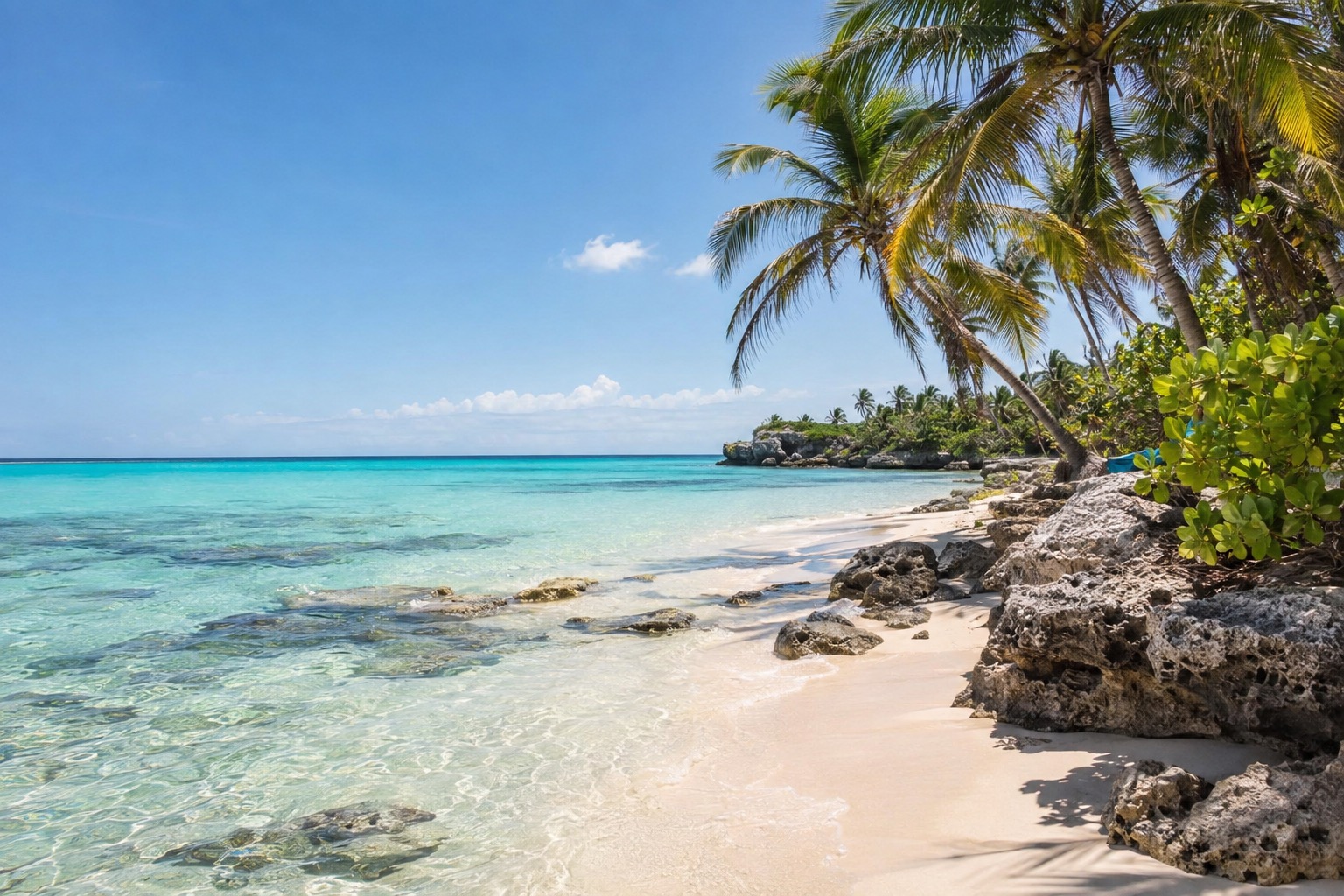
WHERE TO STAY AT A GLANCE · MEXICO
Choose the region before the town: the Caribbean coast for beaches and ruins, Los Cabos for desert and sea, Puerto Vallarta for a jungle-backed bay, Mexico City for museums and food.
ADVISORY LEVEL 2 NATIONWIDE · VISITAX IN QUINTANA ROO · SARGASSUM: TYPICAL PEAK JUNE OR JULY
Go for: a base picked by sea first (Caribbean shore, desert cape, Pacific bay) or by highland museums, with the advisory level read for each state.
Think twice before: booking anywhere in Guerrero or the five other Level 4 states, or a Caribbean summer week without a look at the sargassum outlook.
U.S. Department of State · Quintana Roo state law · INEGI · USF Optical Oceanography Lab · full sources at the end
On this page
- Where to stay in Mexico for a first tripFour regions, and where the advisory levels sit
- Where to stay in Cancun, Playa del Carmen or TulumRiviera Maya towns, the Visitax fee and the sargassum months
- Where to stay in Los CabosCabo San Lucas or San Jose del Cabo, and where you can swim
- Where to stay in Puerto Vallarta or SayulitaBay of Banderas, Riviera Nayarit and Jalisco’s Level 3 rating
- Where to stay in Mexico CityNeighborhoods, the Level 2 rating and the highland neighbors
- Best all-inclusive areas in MexicoFour resort zones, what the rate covers, what costs extra
Still comparing Mexico with other countries? Start from the destinations index, then come back once Mexico is the answer.
Where to stay in Mexico for the first time
The U.S. State Department rates Mexico as a whole at Level 2, exercise increased caution, in the advisory reissued May 29, 2026. Ratings then split by state. Quintana Roo (Cancun, Tulum), Baja California Sur (Los Cabos), Nayarit (Riviera Nayarit) and Mexico City all sit at Level 2 as well.
Six states are rated Level 4, do not travel: Colima, Guerrero, Michoacan, Sinaloa, Tamaulipas and Zacatecas. Guerrero matters most for beach planning, since the advisory names Acapulco, Zihuatanejo, Taxco and Ixtapa among the areas U.S. government employees may not visit. For a Pacific beach week, Puerto Vallarta and Riviera Nayarit are the alternatives covered below.
The four regions give four different trips. The Caribbean coast is white sand, cenotes and Maya ruins. Los Cabos is desert meeting the sea, and Puerto Vallarta sits on a bay with jungle hills behind it. The central highlands hold Mexico City, Oaxaca, Guadalajara and San Miguel de Allende: colonial centers, museums and food in place of beaches, with nights that stay cool.
Where to stay in the Riviera Maya
The Caribbean coast of Quintana Roo holds Cancun, Playa del Carmen, Tulum, Cozumel and Isla Mujeres. Expect white-sand beaches, cenotes and Maya ruins, with Tulum’s own ruins on the coast and Chichen Itza inland in Yucatan. The Riviera Maya resort strip runs between Playa del Carmen and Tulum, and the Cancun Hotel Zone is the other big cluster. Yucatan is rated Level 1, exercise normal precautions, the lowest of the four levels.
Every foreign visitor entering Quintana Roo owes the Visitax fee, set by article 51-Octies of the state’s Ley de Derechos at 2.50 UMA. With the 2026 UMA at 117.31 pesos (in force since February 1, 2026), that works out to about 293 pesos per person. The article writes no age exemption, so check before assuming a child travels free. Visitors who enter Quintana Roo through the state’s southern border are explicitly exempt.
You can pay online at visitax.gob.mx before the trip, or in cash at the airport before departure. The portal is run by the state tax administration, the SATQ. Cruise passengers do not pay it separately: article 51-Nonies charges them a distinct 5 US dollars, which the cruise line collects when the ticket is bought, and proof of that payment covers the Visitax fee too. Crew members are exempt from the cruise-passenger charge.
Sargassum washes up along this coast from Cancun down through Playa del Carmen and Tulum to Mahahual. The University of South Florida’s Optical Oceanography Lab, which runs the Sargassum Watch System, describes the seaweed as typically peaking in June or July, with a minimum in the winter months. It adds that some years carry a large quantity even through winter. The lab’s monthly outlook bulletins are worth a read before you book a summer week.
Where to stay in Los Cabos
Los Cabos sits at the tip of the Baja California peninsula, where desert meets the sea. Cabo San Lucas is the base for nightlife and for the arch, and San Jose del Cabo is the quieter of the two towns.
Many of the Pacific-facing beaches around Los Cabos are too rough for swimming, so check the hotel’s own beach or pool before anything else. Los Cabos and Puerto Vallarta both sit outside the Atlantic sargassum belt, which takes the Caribbean’s summer seaweed question off the table here. Resorts cluster in this corner too (see the all-inclusive areas below).
Baja California Sur is rated Level 2, exercise increased caution, and the advisory lists no specific restrictions on travel for U.S. government employees there. Baja California, the state to the north that includes Tijuana, is rated Level 3, with its only travel restrictions in the Mexicali Valley. A headline about “Baja” can therefore concern a different state from the one you are booking.
Where to stay in Puerto Vallarta
Puerto Vallarta sits on the Bay of Banderas with jungle hills rising behind it. Next door, the beach towns of Riviera Nayarit, such as Sayulita and Punta Mita, offer a second style of base.
Puerto Vallarta lies in Jalisco, and Jalisco as a state is rated Level 3, reconsider travel. The advisory carves out the resort area: there are no restrictions for U.S. government employees in Puerto Vallarta, including neighboring Riviera Nayarit, or in the Guadalajara Metropolitan area, Chapala and Ajijic. Nayarit itself is rated Level 2. Guadalajara is a separate case, since the advisory says battles between criminal groups have happened in tourist areas there.
Choose Puerto Vallarta itself for a town on the bay, or Sayulita or Punta Mita for a beach-town base in Riviera Nayarit. North of Puerto Vallarta, that stretch is also one of the four main all-inclusive zones.
Where to stay in Mexico City
Mexico City belongs to the central highlands, so expect colonial centers, museums and food in place of beaches, and nights cool enough to want a layer. Base in Centro Histórico for the colonial core around the Zócalo, in Roma or Condesa for cafés and tree-lined streets, or in Polanco for museums and upscale dining.
Mexico City and the State of Mexico around it are both rated Level 2, and so is Oaxaca. Guanajuato, the state of San Miguel de Allende, is Level 3, though the advisory says gang violence there mostly happens in the southern and central areas. Jalisco, the state of Guadalajara, is Level 3 too, so read the state entry before adding a highland city to the route.
Best all-inclusive areas in Mexico
All-inclusive resorts concentrate in four places: the Cancun Hotel Zone, the Riviera Maya between Playa del Carmen and Tulum, Los Cabos, and Riviera Nayarit north of Puerto Vallarta. Adults-only resorts are common in all four.
An all-inclusive rate usually covers the room, meals, drinks and non-motorized water sports. Spa treatments, premium drinks, excursions and some a la carte restaurants often cost extra, and the list varies from one resort to the next.
The four zones face two different seas. The Cancun Hotel Zone and the Riviera Maya front the Caribbean, with cenotes and Maya ruins close by. Los Cabos fronts Pacific water that is too rough for swimming at many beaches, so the resort’s own pool matters more there. Riviera Nayarit looks onto the Pacific with jungle hills behind it.
All four zones sit in states rated Level 2: Quintana Roo, Baja California Sur and Nayarit. For a summer week, the Pacific zones stay outside the Atlantic sargassum belt. On the Caribbean side, winter is the lab’s usual minimum, with the caveat that some years stay heavy. Whichever zone you pick, ask for the list of extras in writing before you pay a deposit.
Sources & data
- Country and state advisory levels (Level 4, 3 and 2 lists, Guerrero, Jalisco, Guanajuato, Baja California, Baja California Sur, Yucatan) · U.S. Department of State Mexico Travel Advisory, reissued May 29, 2026 · checked Sep 29, 2026 (read in a browser, because the site blocks automated fetching)
- Visitax fee, who pays, cruise-passenger charge · Ley de Derechos del Estado de Quintana Roo, arts. 51-Octies and 51-Nonies, Congreso de Quintana Roo · checked Sep 29, 2026
- UMA 2026 daily value of 117.31 pesos, in force since February 1, 2026 · INEGI press release 1/26, January 8, 2026 · checked Sep 29, 2026
- Visitax payment options · official portal visitax.gob.mx (SATQ) · checked Sep 29, 2026
- Sargassum peak and winter minimum · University of South Florida, Optical Oceanography Lab, Sargassum Watch System · checked Sep 29, 2026
- Region, neighborhood and all-inclusive descriptions are editorial general knowledge and carry no source. We did not collect hotel rates, and advisories change · check before you book.