
Early in May, drums and shouted chants carry across Naha’s harbor as painted dragon boats race for the Haari festival, while the city’s holiday crowds eat sata andagi, the warm Okinawan doughnuts, from paper bags. The air is soft and humid, the sea has warmed enough to tempt you in, and the island still feels in between the cooler spring and the full heat of summer. This is a page for travelers weighing Okinawa in May: the weather, the water, the festivals and the food.
What is the weather like in Okinawa in May?
May in Okinawa is warm, humid and showery, a month that already feels like summer without the full heat of June.
| Month | Average high (°F) | Average low (°F) | Precipitation (in) | Days with 1 mm or more of precipitation | Hours of sunshine | Daylight on the 15th | Sea (°F) |
|---|---|---|---|---|---|---|---|
| April | 75.7 | 66.4 | 6.34 | 10.3 | 121 | 12 h 45 min | 74.2 |
| May | 80.6 | 71.8 | 9.66 | 11.4 | 138 | 13 h 25 min | 76.8 |
| June | 85.6 | 77.4 | 11.20 | 11.3 | 160 | 13 h 46 min | 79.8 |
The rain tends to come as showers between spells of sun rather than as one long gray stretch, and humidity stays high, so a shirt can feel damp even on a cloudy day. Plan for a day that mixes sun and a shower or two rather than a day that is all one or the other.
Clothing is simple. Light, quick-drying shirts and shorts suit the days, and the nights are warm enough that people stay in short sleeves, with a thin layer for air-conditioned buses, restaurants and the aquarium. A light rain jacket or a compact umbrella earns its place in the bag.
The light is generous. Daylight stretches well into the evening, which leaves time for a late walk through Naha’s streets or a long dinner after a full day out, and the extra sunshine over April means beach hours are more likely to be bright than gray.
Can you swim in Okinawa in May?
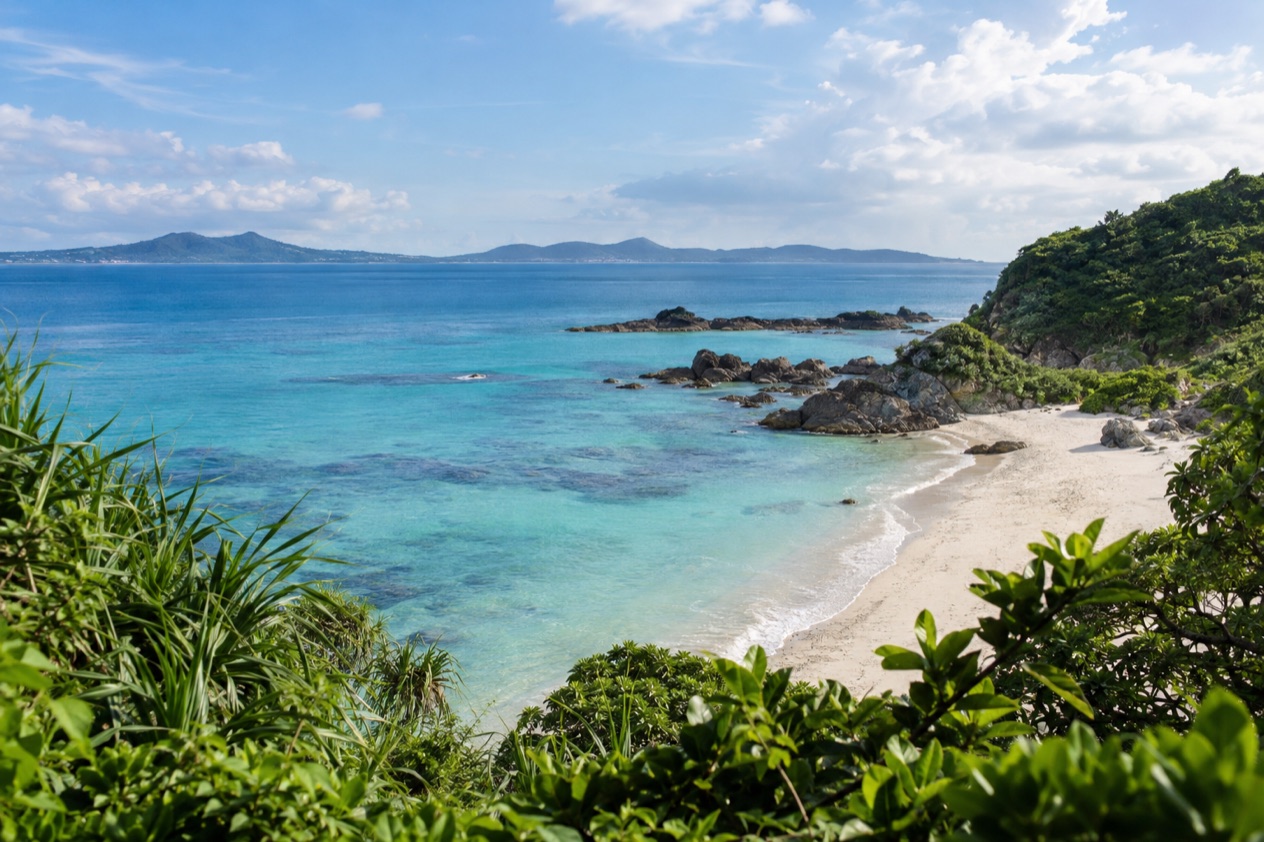
Yes, the sea near Naha averages 76.8°F in May, warm enough for a proper swim rather than a quick dip.
Okinawa Island has several named beaches, and May is a good month to try more than one. Manza Beach and Emerald Beach are among them, as are Okuma Beach and Zanpa Beach, each with its own stretch of coast on the main island.
Moon Beach and Sunset Beach in Chatan-cho complete the list. Their names alone suggest how people use them: a morning on the sand at one, a drink watching the sky turn at the other. Wherever you go, the sea changes from day to day, so look at the water before you commit to a plan built around it.
The warmer water also pairs well with the showery weather. A passing shower matters little when you are already wet, and a gray hour can turn into a bright one before you have dried off. Keep the beach for a part of the day rather than the whole of it, and leave room for the museums, markets and meals that fill the rest.
What to do in Okinawa in May
The month opens with Golden Week, when much of Japan is on holiday and Okinawa fills with domestic travelers. In Naha the Haari dragon boat races, held in early May, are the event to look for: long, brightly painted boats, rhythmic paddling, gongs and a crowd along the harbor. The tradition belongs to the old Ryukyu Kingdom, which had its own language and culture before it became part of Japan, and you can still feel that separate history in the music, the food and the way people speak.
Food is a reason to come on its own. Goya champuru, a stir-fry of bitter melon with tofu and egg, is the dish people associate with the islands, and Okinawa soba arrives in a pork-based broth with thick wheat noodles.
Look also for umibudo, the sea grapes that pop between your teeth, and taco rice, a local favorite that mixes American and Japanese habits. Awamori, the local distilled spirit, and Orion beer go with almost everything.
Naha is also the place where you reach the island’s network of transport. It has Okinawa’s only public rail network, the Okinawa Urban Monorail, known as Yui Rail, which makes the capital a handy base. Naha is home to about a fifth of the main island’s residents, so the streets carry the everyday life of the island as well as the visitors.
Shuri Castle and the Ryukyu Kingdom
The main castle is closed after the fire in 2019, but the site is partly open, and you can still see gates, stone walls and the layout of a royal hill complex that overlooks the city.
A visit here suits travelers who want history with their beaches. With May’s humidity, plan a slow pace, carry water, and pair the castle with the old streets around it, where pottery workshops and small shops make good places to cool off.
Naha’s markets and streets
Naha rewards wandering on foot. Its covered market lanes are lined with stalls selling pork, fish in colors you rarely see at home, tropical produce and Okinawan sweets, and several of the upstairs eateries will cook what you pick below. Shops in town are generally open from 10:00 a.m. to 8:00 p.m. every day, which gives plenty of room for an unhurried browse.
Tsuboya, the pottery district, is a good stop for ceramics with a distinct island character, including the lion-dog shisa figures that guard rooftops and doorways across Okinawa. In the evening, izakaya, the casual Japanese pubs, serve small plates with awamori, and many have live sanshin, the three-stringed Okinawan instrument, on certain nights.
Churaumi Aquarium
Okinawa Churaumi Aquarium, which opened on 1 November 2002, is the day’s main outing for visitors to the main island, and it is a good rain plan too. The tanks hold a wide range of Okinawan sea life, and a new female Japanese sawshark has recently arrived there as part of an effort to breed the species.
It suits everyone from small children to adults who like marine life. Give it a good part of the day, and pair it with a beach afterward to see the same sea from the other side of the glass.
| Site | Open |
|---|---|
| Okinawa Churaumi Aquarium | 08:30 to 18:30 (last admission 17:30) |
A two-day itinerary for Okinawa in May
Day 1 belongs to Naha and its old Ryukyu history. Start at Shuri Castle in the morning, while you are still fresh and before the humidity builds, and walk the grounds and the partly open site. Then descend into the Tsuboya pottery streets, where the workshops and cafés make a good midday pause, and eat Okinawa soba in a small noodle shop.
Spend the afternoon in the covered market lanes, where you can choose fish and produce from the stalls and have them cooked upstairs. With daylight lasting more than thirteen hours, you can take the Yui Rail back and wander the shopping streets until the shops close at 8:00 p.m., then finish in an izakaya with goya champuru, sea grapes and a glass of awamori. If it rains, the market arcades and pottery workshops keep you dry, and a long lunch fills the gap.
Day 2 is for the north of the main island and the sea. Head for the Churaumi Aquarium when it opens at 8:30, and take your time through the tanks, since the last admission is late in the afternoon. The aquarium is indoors, so a wet day changes nothing here.
After the aquarium, spend the afternoon on one of the beaches, such as Manza or Emerald, with a swim in water that is warm for the season. Finish with a dinner of grilled fish or taco rice at a casual place, and keep the evening light for a last slow walk. If the sky closes in, trade the sand for a café with a view of the water and wait for the shower to pass.
Is Okinawa busy in May?
It is busy at the start of the month and calmer afterward, because Golden Week brings a holiday rush across Japan.
Golden Week runs from April 29 to May 5, and four of its days are public holidays: Showa Day on April 29, Constitution Memorial Day on May 3, Greenery Day on May 4 and Children’s Day on May 5. Naha Airport is the gateway to all of Okinawa’s islands and is served by flights from dozens of cities across Japan, including low-cost carriers, so Okinawa is within reach of a long weekend at home for many Japanese travelers.
Two rules can lengthen a holiday. When a national holiday falls on a Sunday, the next working day becomes a public holiday, known as furikae kyujitsu. Any day that falls between two other national holidays also becomes a holiday, known as kokumin no kyujitsu. Both can add a day off around the same stretch.
Once the holiday period ends, the pace in Naha relaxes toward everyday life, and the market arcades, beaches and the aquarium feel less like a holiday crowd. Shops in towns are generally open from 10:00 a.m. to 8:00 p.m., while in rural areas they often close earlier, sometimes as early as 6:00 p.m., so leave the shopping for town and keep rural afternoons for the coast.
What to pack for Okinawa in May
Pack for warm, humid days with showers, a lot of walking and a few hours in the water.
- Light, quick-drying shirts and shorts, because humidity makes cotton slow to dry.
- A swimsuit and a towel, since the sea is warm enough for a full swim.
- A light rain jacket or compact umbrella for the showers that pass through.
- A thin layer for air-conditioned buses, restaurants and the aquarium.
- Comfortable walking sandals or shoes for Shuri’s stone paths and Naha’s market streets.
- Sunscreen and a hat for the beach and the long daylight.
Good to know before you go
The calendar shapes May in Okinawa more than anything else. Golden Week, from April 29 to May 5, means Japanese holiday travelers and public holidays at the start of the month, while the rest of May is a more ordinary rhythm. Rain is part of the picture, with showers on roughly a third of the days, so give any outdoor plan a backup.
Shuri Castle is partly open, but the main castle remains closed because of the fire in 2019, so go for the grounds and the history rather than the interior. In towns, shops are generally open from 10:00 a.m. to 8:00 p.m., and in rural areas they often close earlier, sometimes as early as 6:00 p.m.
Okinawa in May vs April and June
Moving four weeks earlier, to April, gives a cooler, drier island and a sea that is a little cooler. Showers are lighter, the days are shorter, and the water suits a short dip more than a long swim. April also overlaps the start of Golden Week on April 29, so the holiday rush reaches the end of the month.
Moving four weeks later, to June, brings the hottest and most humid weather of the three, the warmest sea and the most hours of sunshine. The beaches are at their warmest, but the heat and the damp take more effort on walking days, and the rainfall is the highest of the three months. The holiday crowds of early May are behind you.
Choose May if you want to see the Haari dragon boat races, enjoy warm water without the full heat, and pair beach days with the markets and history of Naha. Shift to April if you prefer cooler air for walking, and to June if long beach days matter more than comfort in the heat.
Is May a good time to visit Okinawa?
Yes, May is a good time to visit Okinawa for travelers who want warm water, long days and a mix of culture and coast.
It will suit people who like to split a day between a swim and a market, who enjoy island food, and who accept a shower now and then as the price of green hills and bright seas. It is a weaker fit if you want dry, cool weather for hiking or you dislike humidity, in which case an earlier month will feel better.
On arrival, head first to Naha and let the city set the tone, with a bowl of Okinawa soba, a walk through the market lanes and a ride on the Yui Rail. Then plan the beach days around the weather as it comes. What stays with you from May in Okinawa is the combination: drums over the harbor at the Haari races, a sea warm enough to float in for an hour, and the evening light still lingering over Naha as the izakaya fill with the sound of the sanshin.
Sources
- Japan Meteorological Agency (JMA), Normal values 1991-2020, monthly (https://www.data.jma.go.jp/stats/etrn/view/nml_sfc_ym.php?prec_no=91&block_no=47936), station Naha, elevation 28 m, checked October 11, 2026
- Open-Meteo Marine API, average 2015-2024, checked October 11, 2026
- Computed from the date and the latitude of the place (sunrise equation, solar elevation -0.833 degrees), October 11, 2026
- Japan National Tourism Organization, shop and attraction hours, national holidays (https://www.japan.travel/en/plan/business-hours-and-holidays/), checked October 11, 2026
- Wikipedia, Golden Week (Japan) (https://en.wikipedia.org/wiki/Golden_Week_(Japan)), checked October 11, 2026
- Wikipedia, Public holidays in Japan (https://en.wikipedia.org/wiki/Public_holidays_in_Japan), checked October 11, 2026
- Japan National Tourism Organization, flowers by season: cherry blossom, plum, wisteria, hydrangea, where and when (https://www.japan.travel/en/see-and-do/flowers/), checked October 11, 2026
- Wikipedia, Wisteria (https://en.wikipedia.org/wiki/Wisteria), checked October 11, 2026
- Japan Meteorological Agency, sakura2020.pdf (https://www.data.jma.go.jp/sakura/data/sakura2020.pdf), checked October 11, 2026
- Japan National Tourism Organization, spring in Japan (https://www.japan.travel/en/guide/spring-guide/), checked October 11, 2026
- Wikipedia, Kanda Matsuri (https://en.wikipedia.org/wiki/Kanda_Matsuri), checked October 11, 2026
- Wikipedia, Sanja Matsuri (https://en.wikipedia.org/wiki/Sanja_Matsuri), checked October 11, 2026
- Japan National Tourism Organization, festivals and events (https://www.japan.travel/en/see-and-do/festivals-and-events/), checked October 11, 2026
- Wikipedia, Gion Matsuri (https://en.wikipedia.org/wiki/Gion_Matsuri), checked October 11, 2026
- Japan National Tourism Organization, Okinawa (https://www.japan.travel/en/destinations/okinawa/okinawa/naha-and-the-main-island/), checked October 11, 2026
- Okinawa Churaumi Aquarium (https://churaumi.okinawa/en/), checked October 11, 2026
- Wikipedia, Okinawa Island (https://en.wikipedia.org/wiki/Okinawa_Island), checked October 11, 2026
- Wikipedia, Okinawa Prefecture (https://en.wikipedia.org/wiki/Okinawa_Prefecture), checked October 11, 2026
- Wikivoyage, Okinawa (https://en.wikivoyage.org/wiki/Okinawa), checked October 11, 2026
- Wikipedia, Shuri Castle (https://en.wikipedia.org/wiki/Shuri_Castle), checked October 11, 2026
- Wikipedia, Naha (https://en.wikipedia.org/wiki/Naha), checked October 11, 2026
To plan your stay
- Things to Do in Okinawa: Churaumi Aquarium, Shuri Castle, Kerama Reefs and Okinawan Food
- Where to Stay in Okinawa: Naha, Chatan, the Aquarium Coast and Beach Resorts
- Okinawa from Tokyo: Flying to Naha, Why No Train Goes There and a First Day on the Island
- Know Before You Go to Okinawa: Entry, Money, Getting Around and Local Etiquette