
JAMAICA · DUNN’S RIVER FALLS · 18.4° N
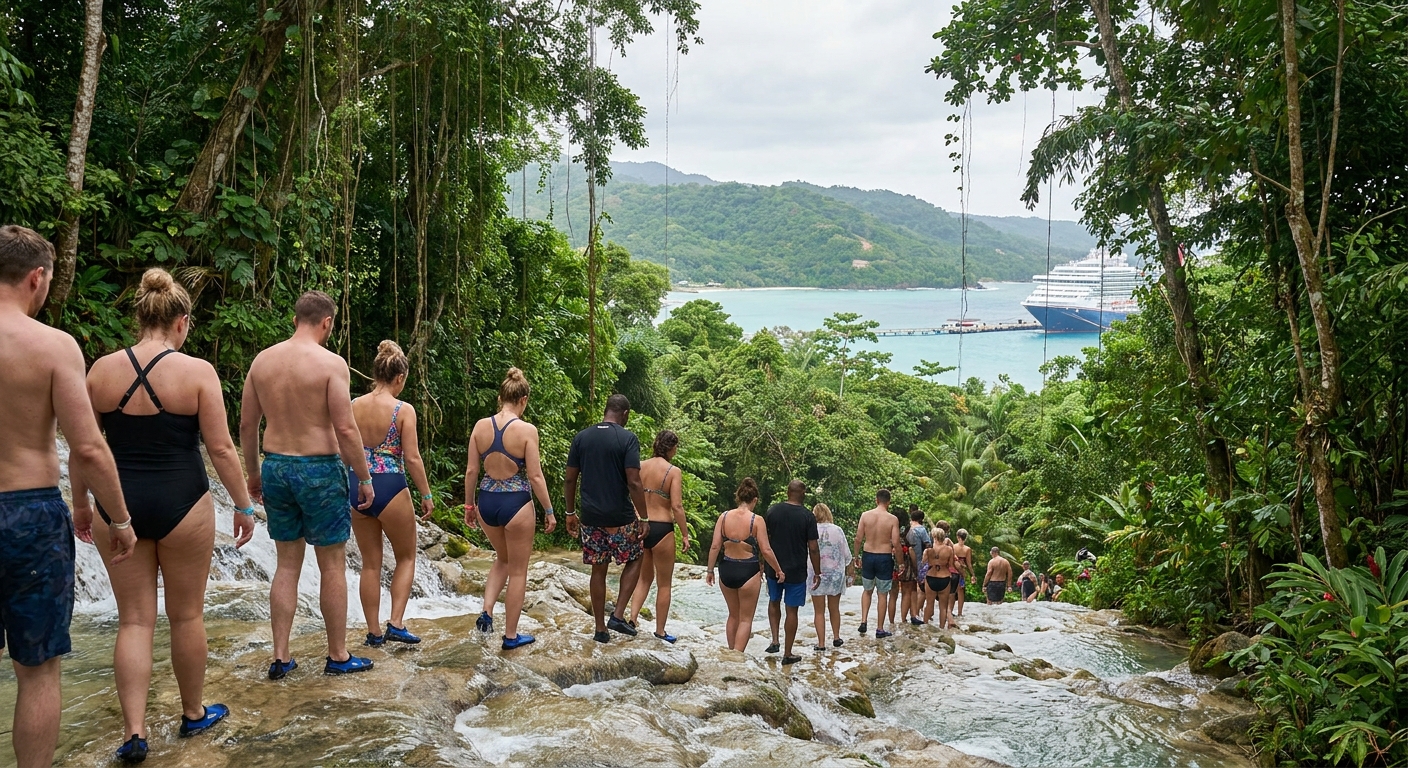
Dunn’s River Falls is the rare Caribbean attraction you climb rather than photograph: a terraced staircase of river water dropping straight into the sea on Jamaica’s north coast, a couple of miles west of Ocho Rios. Guides link the line hand to hand, the stone is slick, and most travelers book it as a half-day inside a longer week, driven over from an Ocho Rios hotel or bused across from Montego Bay after the airport transfer.
Timing the trip is not a temperature question. Average highs run from 81.4°F in January to 89.6°F in July, and the sea never averages below the low 80s, so every month of the year is climbable weather. Rain does the sorting: 1.95 inches in February against 6.19 inches in October, and 5.2 wet days against 16.2. Choose your week on that spread, and on how easily your flights and hotel nights can move if a tropical system turns up.
THE FALLS AT A GLANCE · DUNN’S RIVER
February is the driest of the twelve months at 1.95 inches and the sea still averages 81.2°F, so book the climb then and keep October for a trip whose dates can move.
DRIEST: FEBRUARY · WETTEST: OCTOBER · SEA ABOVE 81°F IN ALL TWELVE MONTHS
Go for: February and March, when rain falls on 5.2 and 7.2 days and the climb is a morning you can schedule instead of a morning you gamble on.
Think twice before: locking a non-refundable October week around the falls: 16.2 days in an average October record at least 0.10 inch of rain.
Air normals: Open-Meteo / ERA5 1991-2020 · Sea: Open-Meteo Marine 2015-2024 · Daylight: sunrise-sunset.org · full sources at the end
On this page
- Highs, rain and sea temperature by monthThe twelve-month table
- The single best month to bookFebruary, and its figures
- Sea temperature for swimmingEvery month above 81°F
- The quietest weeks of the yearSeptember and October
- The month to avoidOctober, 6.19 inches of rain
- Is April or November worth it?The two shoulder months
- Hurricane dates and monthly riskJamaica’s storm calendar
- Flights from the US to JamaicaRoutes and flying times
Short version for anyone booking this week: February is the driest month of the twelve at 1.95 inches, April is the shoulder month that costs the least in rain, and October is the one to shift if your vacation dates have any give. The water is warm enough to swim in all twelve months, so nothing here is a season you have to wait out.
Dunn’s River Falls weather month by month: highs, lows, rain and sea
| Month | Avg high | Avg low | Rain | Days ≥ 0.10 in | Sea (avg daily max) |
|---|---|---|---|---|---|
| January | 81.4°F | 71.8°F | 2.99 in | 6.4 | 82.2°F |
| February | 82.3°F | 71.6°F | 1.95 in | 5.2 | 81.2°F |
| March | 83.3°F | 71.9°F | 2.76 in | 7.2 | 81.6°F |
| April | 85.3°F | 73.3°F | 2.69 in | 7.3 | 82.5°F |
| May | 86.2°F | 75.2°F | 5.75 in | 13.4 | 84.0°F |
| June | 88.2°F | 77.2°F | 2.97 in | 7.8 | 84.9°F |
| July | 89.6°F | 77.6°F | 2.58 in | 6.9 | 85.1°F |
| August | 89.5°F | 77.8°F | 3.67 in | 10.7 | 86.7°F |
| September | 88.5°F | 77.2°F | 5.37 in | 15.2 | 87.6°F |
| October | 86.2°F | 76.2°F | 6.19 in | 16.2 | 87.3°F |
| November | 83.4°F | 74.7°F | 4.44 in | 11.4 | 85.1°F |
| December | 81.9°F | 73.2°F | 3.43 in | 8.2 | 83.1°F |
Temperature barely legislates here: the coolest month’s average high, 81.4°F in January, sits 8.2°F below July’s 89.6°F, and no month averages a low under 71.6°F. Rain draws the shape of the year instead, climbing from 1.95 inches in February to 6.19 inches in October.
The year turns twice. May breaks the dry run with 5.75 inches over 13.4 wet days, against April’s 2.69 inches over 7.3. June and July then pull it back to 2.97 and 2.58 inches, before September and October take the water for good at 5.37 and 6.19 inches.
October is the hardest of the twelve months, 6.19 inches of it falling across 16.2 days that record at least 0.10 inch, or roughly one day in two. A swimmer reads that differently from a family: the sea is at 87.3°F, near its annual best, while a week of vacation built around one stair climb has an even chance of meeting rain on the morning it was booked for.
Every figure here comes from ERA5 model reanalysis of 1991-2020, not from a weather hut at the ticket gate, and the grid cell sits over Ocho Rios, three kilometers (about two miles) east of the falls, near enough that the same weather reaches both. A wet day counts any day recording 0.10 inch or more. Days at a full inch or more stay rare all year: 0.5 of them in December and in May, the annual maximum.
When is the best time to visit Dunn’s River Falls?
February. Average high 82.3°F, average low 71.6°F, 1.95 inches of rain spread over 5.2 days at 0.10 inch or more, and not a single day in an average February records a full inch. Daylight on February 15 runs 11 hours 35 minutes, sunrise at 6:34 a.m. and sunset at 6:10 p.m. in Jamaica time, which leaves room for the climb and a beach afternoon in one visit.
Its neighbors cost you water. January carries 2.99 inches, 1.04 inch more than February, over 1.2 extra wet days. March adds 0.81 inch and two more wet days for a single degree on the high, 83.3°F against 82.3°F. The trade in February is the sea at 81.2°F, the year’s coolest reading, which is still warmer than most American pools in July.
The falls are a half-day, never a trip, so the month you book has to suit the whole week around it. Our national month-by-month verdict sets the same question for the rest of the island, the Ocho Rios guide covers where to sleep within fifteen minutes of the gate, and what a week costs puts numbers on the rest of the itinerary.
When can you swim in Dunn’s River Falls? Sea temperature month by month
There is no month below the line. The sea off this stretch of coast averages 81.2°F at its coolest, in February, and 87.6°F at its warmest, in September, with October a close second at 87.3°F and August third at 86.7°F. Even the three winter months hold 81.2°F, 81.6°F and 82.2°F, so a swim off the beach at the foot of the climb works in January as well as it does in July.
One caveat on how that number is built: each figure is the mean of daily maxima over 2015-2024, drawn from a marine model rather than a buoy at the beach, so a true 24-hour mean would land a shade lower. It is also sea surface. No monthly series for the river water inside the gorge was available to us, and the fresh water coming down the terraces runs cooler than the bay it empties into.
When is Dunn’s River Falls quietest?
September and early October are the hollow weeks. American school vacations have ended, the winter season on Jamaica’s north coast does not properly begin until the holidays, and the fall sits between the two on the calendar. That is a fact of when people travel, not a price list: what a room costs in any given week is a matter for the hotel guide and your own dates.
What you gain is water and space. The sea averages 87.6°F in September and 87.3°F in October, both warmer than July’s 85.1°F, and the falls themselves are a timed climb in groups, so fewer visitors on the coast means a shorter wait for your slot and a less crowded staircase.
What you pay is rain and light. October brings 6.19 inches over 16.2 wet days and September 5.37 inches over 15.2. Daylight on October 15 is 11 hours 46 minutes, an hour and a half shorter than the 13 hours 16 minutes of June 15. The Atlantic hurricane season also overlaps those same weeks, and our storm page carries the dates and the monthly risk.
Which month should you avoid in Dunn’s River Falls?
October, and specifically for the traveler with one fixed week and a non-refundable booking. Rain reaches 0.10 inch or more on 16.2 days of an average October, the wettest count of the twelve months, which means a trip with a single scheduled climb, a single catamaran morning and a flight home on Saturday has no spare day to shuffle things into. A flexible visitor with ten nights barely notices it.
What redeems the month is the shape of the rain rather than its total. Only 0.3 day in an average October records a full inch, so most of those 16.2 days are showers between bright hours, not washouts. Highs still average 86.2°F, the sea is at 87.3°F, and you are going to be soaked by the river anyway. Pack for it with the packing list and book the climb for the first morning, not the last.
Is the shoulder season worth it in Dunn’s River Falls?
April and November are the two edges of the winter season, and they are not equal. April records 2.69 inches over 7.3 wet days, just 0.74 inch and 2.1 days more than February. November records 4.44 inches over 11.4 wet days, 2.49 inches and 6.2 days more than February. One shoulder month asks a little, the other asks a lot.
The gain is daylight and warmer water. April 15 holds 12 hours 37 minutes of daylight, 62 minutes more than February 15, which is the difference between a climb at four in the afternoon and a climb you have to start at two. November’s sea averages 85.1°F, 3.9°F above February’s 81.2°F, and matches June.
The loss is concentrated in November: eleven wet days and change, plus 11 hours 18 minutes of daylight on the 15th, 17 minutes shorter than mid-February. And May, if anyone sells it to you as a spring extension, is a wet-season month wearing a spring label: 5.75 inches over 13.4 days.
Take April. It costs three quarters of an inch of rain over February and hands back an hour of afternoon, a degree on the water and a week when the island is calmer than it was in January. Treat November as a good bet only if your flights are changeable, and keep May for a trip whose plans live indoors half the time.
The last word
Book February if you can and April if you cannot, then make the falls the first morning of the week rather than the last, because a rained-out Tuesday has a Thursday behind it. One detail the tables publish plainly: August nights are the warmest of the year, averaging 77.8°F, so a summer visit ends with an evening that never cools. In February the sun is gone by 6:10 p.m., and a climb booked late is a climb finished in fading light.
Sources & data for this guide
- Air normals 1991-2020, monthly highs, lows and precipitation · Open-Meteo / ECMWF ERA5, grid cell 18.4074N -77.103E · model reanalysis, not an airport station record · checked Sep 14, 2026
- Wet-day counts at the 0.10 inch and 1 inch thresholds · same ERA5 series, 1991-2020 · checked Sep 14, 2026
- Sea surface temperature, mean of daily maxima 2015-2024 · Open-Meteo Marine API · checked Sep 14, 2026
- Daylight, sunrise and sunset on the 15th of each month · sunrise-sunset.org, converted from UTC to Jamaica local time · checked Sep 14, 2026
- Editorial admission: the grid cell sits over Ocho Rios, about two miles east of the falls, and no monthly series for the river water inside the gorge was available to us. Season labels here are calendar observations, not price quotes.