
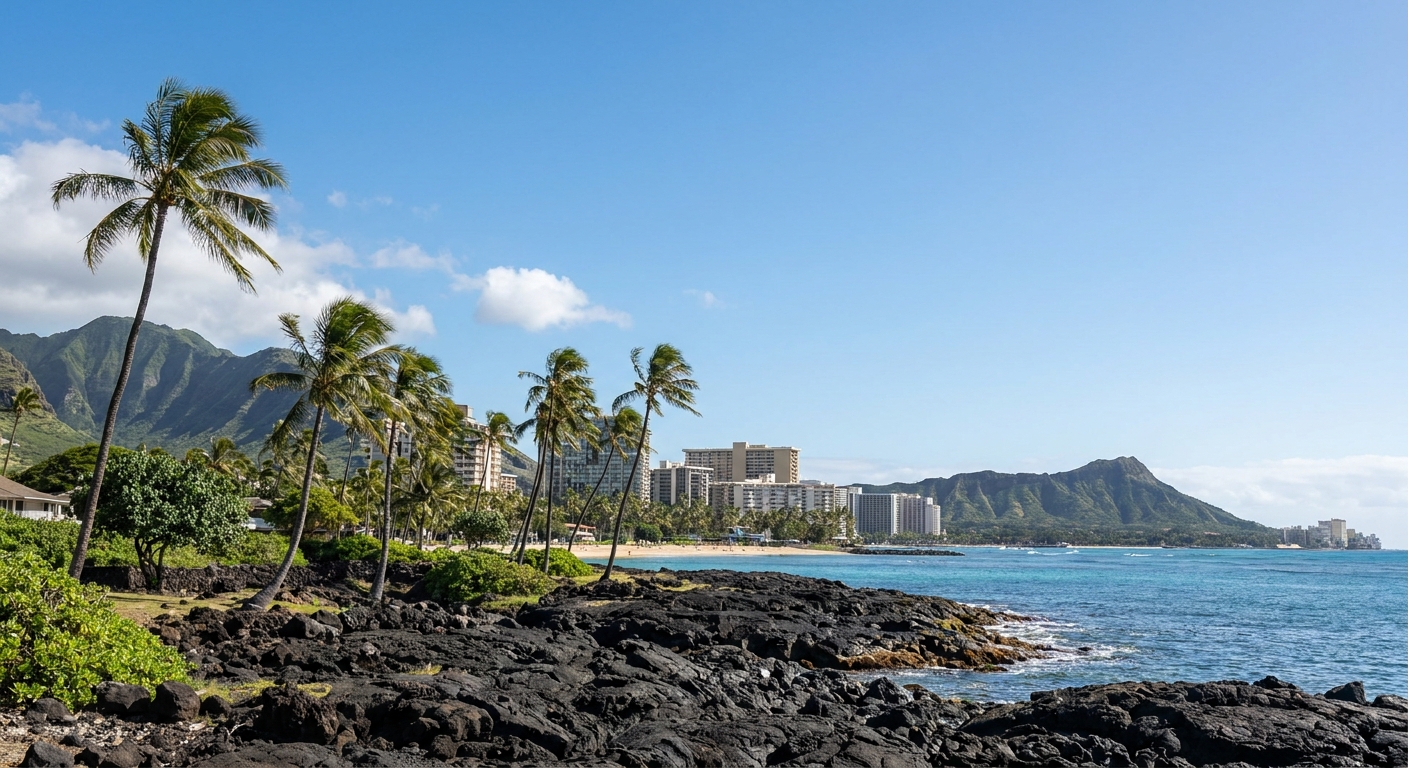
On the Kona side, the afternoon light settles over lava-black shoreline and the harbor fills with boats coming back from a day on the water. Across the island in Hilo, the farmers market spills onto the street under a gray sky, and a rainbow forms in the mist of a waterfall before breakfast. Kona is the island’s sunny, dry face and Hilo its green, rain-fed one, and the choice between them shapes the whole trip.
Which is better, Kona or Hilo?
Kona is better for most vacationers who want sunshine, beach days and resort comforts, while Hilo suits travelers who prefer waterfalls, gardens, a real small town and an easy drive to the volcano. The two sides sit on opposite sides of the island’s great mountains, so they feel like two different destinations.
| Category | Kona | Hilo |
|---|---|---|
| Beaches | Several sandy beaches, including Hapuna, and calm coves for snorkeling | Few sandy beaches, mostly black rock shoreline and sheltered parks |
| Vibe | Sunny resort coast with coffee farms | Rainy, green and laid-back small town |
| Things to do | Snorkeling, Kealakekua Bay, coffee farms, historical parks | Waterfalls, botanical gardens, farmers market, astronomy center |
| Nightlife | Waterfront restaurants and bars in Kailua-Kona | Quiet evenings, a few local spots |
| Weather | About 9.9 inches of rain a year | About 120.4 inches of rain a year |
| Getting there | Kona airport (KOA), about 2.0 million boardings in 2024 | Hilo airport (ITO), about 681,000 boardings in 2024 |
| Best for | Beach and sun vacations | Waterfalls, volcano access, low-key travel |
Beaches and the sea
Kona wins the beach contest. The leeward coast has golden-sand stretches like Hapuna Beach, plus rocky coves where snorkelers drift over reef fish and, often, a turtle resting in the shallows. Water stays warm all year, about 78°F in January and above 81°F in late summer, and the sheltered west-facing shore is usually gentler than the north-facing beaches of other islands, though winter swells can change that.
Hilo faces the open Pacific and trade-wind swell, so its shoreline is mostly lava rock, tide pools and sheltered parks rather than swimming beaches. The sea off Hilo runs a couple of degrees cooler than at Kona in winter. Because choppy surf and powerful currents can happen, look over the warnings at the beach entry and the day’s wave and current conditions before getting in, and only swim close to a lifeguard where one is on duty.
For sand and swimming, choose Kona. Hilo has its pleasures at the water’s edge, but they are for walking and looking, not lying out on the beach.
Things to do
Kona’s days revolve around the water and the land above it. Snorkeling at Kealakekua Bay, where the monument marks Captain Cook’s arrival in 1779, is the classic outing, and every vessel in the bay needs a State Parks permit. The coast also holds two historical parks.
Puuhonua o Honaunau, the old place of refuge, has a modest fee, while Kaloko-Honokohau asks for no entrance pass at all. Up the slopes, coffee farms pour tastings of Kona coffee in the cool of the upland.
| Site | Admission |
|---|---|
| Puuhonua o Honaunau National Historical Park | $20 per private vehicle, $15 per motorcycle, $10 on foot or bicycle (children under 16 free) |
| Kaloko-Honokohau National Historical Park | Free |
| Hapuna Beach State Recreation Area (non-residents) | $5 per person plus $10 per vehicle for parking |
Hilo is a town of waterfalls and gardens. Rainbow Falls drops 80 feet in Wailuku River State Park and often throws a rainbow into its mist on mornings, and Akaka Falls plunges 442 feet on a short loop through ferns and orchids. The Saturday and Wednesday style of market stalls, flower stands and fruit are part of the rhythm of town, and the Imiloa Astronomy Center explains the mountain skies above.
| Site | Admission (non-residents) |
|---|---|
| Rainbow Falls and Boiling Pots (Wailuku River State Park) | $5 per person plus $10 per vehicle, one fee for both |
| Akaka Falls State Park | $5 per person plus $10 parking, no advance reservation |
Both sides share the big volcano and the mountain. Hawaii Volcanoes National Park is far closer to Hilo, while Maunakea’s summit road requires four-wheel drive above the visitor station, which sits at 9,200 feet and is open daily from 9:00 a.m. to 9:00 p.m. The park’s entrance fee is $30 per private vehicle.
Weather and the best time to go
Kona is dry and sunny nearly every month, and Hilo is wet in all of them. Kona gets under 10 inches of rain across the whole year, with only a day or two of real rain in a typical month. Hilo gets over 120 inches, and rain falls on more than half the days, usually as passing showers rather than all-day washouts.
| Month | Kona high / low (°F) | Kona rain (in) | Hilo high / low (°F) | Hilo rain (in) |
|---|---|---|---|---|
| January | 81.4 / 68.6 | 1.35 | 78.7 / 64.1 | 7.86 |
| August | 87.3 / 75.7 | 0.54 | 82.9 / 70.4 | 11.30 |
| October | 86.2 / 74.5 | 0.89 | 82.4 / 69.0 | 10.24 |
| November | 84.4 / 72.4 | 0.83 | 80.3 / 67.6 | 14.39 |
Kona stays warm and bright from May through October and is a touch cooler in winter. Hilo is wettest in November, while spring and early summer bring somewhat less rain. Hurricane season runs from June 1 to November 30, so October and November fall inside it on both coasts.
Getting there and getting around
Both towns have their own airport, so you can fly to the side you choose. Kona’s airport is the busier of the two, with about 2.0 million boardings in 2024, while Hilo’s saw about 681,000. Flights from the mainland tend to be more plentiful into Kona.
Once there, you will want a car on either side. From Hilo, Hawaii Volcanoes National Park is a drive of about 45 minutes, while from Kailua-Kona it takes roughly 2 to 2.5 hours on the southern route or 2.5 to 3 hours through Waimea and Hilo. The Saddle Road, officially the Daniel K. Inouye Highway, climbs between Mauna Loa and Mauna Kea and links Hilo to the island’s middle.
Who should choose which
Pick Kona if you want sunshine nearly every day, a beach to return to, snorkeling, sunsets over the water and a wider choice of restaurants and resorts. It suits couples, families with young swimmers and anyone who likes a dependable forecast.
Pick Hilo if you love waterfalls, gardens and a town that feels lived in, or if the volcano is the main reason you came. It also fits travelers who do not mind carrying a rain jacket. Many visitors split the stay, a few nights on each side, which means a long cross-island drive but shows both faces of the Big Island.
Good to know before you go
Maunakea’s summit tops 13,796 feet, so the air is thin, and the Center for Maunakea Stewardship suggests stopping at the visitor station for at least 30 minutes to adjust. Sea turtles are protected, and NOAA Fisheries recommends keeping at least 10 feet away from them, on land and in the water. Lodging carries Hawaii’s 11% state accommodations tax, plus the county’s 3% on top.
Sources
- NOAA NCEI, monthly normals 1991-2020, station USW00021510, checked September 8, 2026
- Open-Meteo Marine API, average 2015-2024, checked September 8, 2026
- sunrise-sunset.org, sunrise and sunset calculated for the 15th of the month, checked September 8, 2026
- Hawaii Department of Taxation, Tax Announcement No. 2025-03 (Transient Accommodations Tax Law Changes from 2025 Legislative Session), files.hawaii.gov/tax/news/announce/ann25-03.pdf, checked September 24, 2026
- County of Hawaii, Department of Finance, Transient Accommodations Tax (TAT) page, hawaiicounty.gov/departments/finance/transient-accommodations-tax-tat (live returned HTTP 403 on request, read via Internet Archive Wayback Machine snapshot dated August 14, 2026, same official content), checked September 25, 2026
- Hawaii Department of Taxation, County Surcharge on General Excise and Use Tax page, tax.hawaii.gov/geninfo/countysurcharge/, checked September 25, 2026
- Federal Aviation Administration, CY2024 Commercial Service Enplanements (xlsx), faa.gov/airports/planning_capacity/passenger_allcargo_stats/passenger/arp-cy2024-commercial-service-enplanements.xlsx, checked September 24, 2026
- National Park Service, "Fees & Passes", nps.gov/puho/planyourvisit/fees.htm, read September 25, 2026
- National Park Service, "Fees & Passes", nps.gov/kaho/planyourvisit/fees.htm, read September 25, 2026
- Hawaiʻi Department of Land and Natural Resources, Division of State Parks, "Kealakekua Bay State Historical Park", dlnr.hawaii.gov/dsp/parks/hawaii/kealakekua-bay-state-historical-park/, read September 25, 2026
- Hawaiʻi State Legislature, Session Laws of Hawaiʻi 2024, Act 198 (H.B. No. 2298), Section 1, data.capitol.hawaii.gov/sessions/sessionlaws/Years/SLH2024/SLH2024_Act198.pdf, read September 25, 2026
- Hawaiʻi State Legislature, Session Laws of Hawaiʻi 2024, Act 198 (H.B. No. 2298), Section 1-2, data.capitol.hawaii.gov/sessions/sessionlaws/Years/SLH2024/SLH2024_Act198.pdf, read September 25, 2026
- NOAA Fisheries, "Green Turtle", fisheries.noaa.gov/species/green-turtle, read September 25, 2026
- NOAA Fisheries, "Viewing Marine Wildlife in Hawaiʻi", fisheries.noaa.gov/pacific-islands/marine-life-viewing-guidelines/viewing-marine-wildlife-hawaii, read September 25, 2026
- Hawaiʻi Department of Land and Natural Resources, Division of State Parks, "Hāpuna Beach State Recreation Area", dlnr.hawaii.gov/dsp/parks/hawaii/hapuna-beach-state-recreation-area/, read September 25, 2026
- University of Hawaiʻi at Hilo, Center for Maunakea Stewardship, "Important Things to Know", hilo.hawaii.edu/maunakea/visitor-information/important-things-to-know, read September 25, 2026
- NPS, Directions, https://www.nps.gov/havo/planyourvisit/directions.htm, checked September 25, 2026
- NOAA NCEI, monthly normals 1991-2020, station USW00021504
- NOAA NCEI, monthly normals 1991-2020, station USC00511303
- Hawaii Department of Taxation, Announcement No. 2025-03 (June 9, 2025), files.hawaii.gov/tax/news/announce/ann25-03.pdf, checked September 24, 2026
- DBEDT (Hawaii Department of Business, Economic Development & Tourism), press release « Visitor Spending Increased in December 2025 », dbedt.hawaii.gov/blog/26-04, checked September 24, 2026
- National Park Service, Hawaii Volcanoes « Fees & Passes », nps.gov/havo/planyourvisit/fees.htm, checked September 24, 2026
- Center for Maunakea Stewardship, hilo.hawaii.edu/maunakea, checked September 25, 2026
- Hawaii DLNR Division of State Parks, akaka-falls-state-park, checked September 25, 2026
- Hawaiʻi Department of Land and Natural Resources, Division of State Parks, "Wailuku River State Park", dlnr.hawaii.gov/dsp/parks/hawaii/wailuku-river-state-park/, read September 25, 2026
- Hawaiʻi Department of Land and Natural Resources, Division of State Parks, "ʻAkaka Falls State Park", dlnr.hawaii.gov/dsp/parks/hawaii/akaka-falls-state-park/, read September 25, 2026
- University of Hawaiʻi at Hilo, Center for Maunakea Stewardship, "Maunakea Visitor Information Station", hilo.hawaii.edu/maunakea/visitor-information/station, read September 25, 2026
- National Park Service, "Fees & Passes", nps.gov/havo/planyourvisit/fees.htm, read September 25, 2026
- Imiloa Astronomy Center, University of Hawaii at Hilo, About Imiloa, https://imiloahawaii.org/aboutimiloa, checked September 25, 2026
- Imiloa Astronomy Center, University of Hawaii at Hilo, homepage, https://imiloahawaii.org/, checked September 25, 2026
- NOAA National Centers for Environmental Information, Recent/Significant Tsunami Events, https://www.ncei.noaa.gov/products/natural-hazards/tsunamis-earthquakes-volcanoes/tsunamis/recent-significant-events, checked September 25, 2026
- National Weather Service, International Tsunami Information Center, Hawaii Tsunamis, https://weather.gov/itic-car/hawaii_tsunamis, checked September 25, 2026
- USGS, November 27-December 10, 2022 Eruption of Mauna Loa, https://www.usgs.gov/volcanoes/mauna-loa/science/november-27-december-10-2022-eruption-mauna-loa, checked September 25, 2026
- Hawaii Department of Transportation, New phase of Daniel K. Inouye Highway opens Oct. 10 2017, https://hidot.hawaii.gov/highways/new-phase-of-daniel-k-inouye-highway-opens-oct-10-2017/, checked September 25, 2026
- NWS Honolulu / Central Pacific Hurricane Center, « 2026 Central Pacific Hurricane Season Outlook », weather.gov/hfo/hurricaneOutlook2026, checked September 24, 2026