
Halfway through the week, you sit on a Naxos waterfront with a plate of fried potatoes and a glass of the citron liqueur called kitron, watching the ferries slide in and out of the harbor while the great marble doorway on the islet beside the town catches the light. Behind you, the lanes of Chora wind uphill toward a castle quarter.
Is 7 Days enough for Greece?
Seven days is enough for a good first look at the Cyclades, but not for the whole country, so this route stays in one island group and leaves the rest for another trip. It suits a first visit built around the sea, the lanes of the island towns and a few ancient and volcanic sights. It does not suit anyone who wants to see Greece from the mountains to the far islands.
The Cyclades are a group of islands in the southern Aegean, south of Athens and north of Crete. The archipelago holds some 2,200 islands, islets and rocks, yet only 33 are inhabited. You will see four places in a week: the capital for a first day, then three islands that each have a different character.
Paros sits in the center of the group and is one of the most popular holiday destinations in Greece. Naxos is the largest and most fertile island of the Cyclades. Santorini lies at the southern end, wrapped around a flooded volcanic crater.
What the route leaves out is a long list. Crete, the largest Greek island, belongs to a different trip, and ANEK Lines, a company founded by Cretans, sails to it from Piraeus. The same goes for Rhodes, Lesbos and the Ionian islands. Inside the Cyclades, Milos, Tinos, Andros and Syros are left for another visit.
Milos is the home of the Venus de Milo, now in the Louvre. Tinos is the largest religious center in Greece, tied to the pilgrimage of Panagia Megalochari. Andros stands apart from the usual Cycladic image, with greenery and a naval tradition. Syros is the most populated island of the group.
Seven days means three island changes, and each one costs part of a day. That is why the plan stays with three islands and lets each one have a full stretch of days. The pace is a walking, eating and swimming pace, with a few set pieces: the Acropolis at the start, a marble gate on Naxos and a volcanic crater at the end.
Thinking about the season matters, because the same route feels different in October than in July. The Athens weather for four months of the year appears in the section on adapting the route, and it shows how the mainland begins and ends the trip. The islands have their own conditions, so treat the Athens numbers as a starting point only.
The itinerary stage by stage
Day 1: Athens
Start in Athens, where the Acropolis rises over a city of cafés, rooftop terraces and busy squares. Walk the old district of Plaka, with its narrow lanes and shops selling sandals, spices and olive oil, then drop into Monastiraki for the flea market and the smell of grilled meat from the souvlaki counters. The ancient Agora, with its columns and shaded paths, tells you what daily life looked like in a classical city.
Sleep in the center, around Plaka, Monastiraki or Syntagma, then transfer to Piraeus for your booked departure. Dinner is a taverna meal of meze, small plates to share: tzatziki, grilled octopus, fried zucchini, a salad with feta, and a carafe of house wine or a glass of ouzo, the anise spirit that turns cloudy when water is added.
Days 2 and 3: Paros
From Piraeus you sail to Paros, about 93 miles to the south-east. Ferries and high-speed catamarans serve the island from Piraeus, which makes it a good first island.
The port town of Parikia has a waterfront of cafés, a maze of lanes behind it and the Panagia Ekatontapiliani church near the harbor. Paros marble, used for the Venus de Milo and for Praxiteles’ Hermes, gives the island its place in the story of ancient sculpture.
On the second day, head to the fishing harbor of Naoussa for grilled fish and a stroll among the small boats. Lefkes, a hill village inland, has marble-paved lanes and a church at the top.
Evenings on Paros are for sitting at a waterfront table with a plate of fish, local cheese and the island’s capers. Stay in Parikia if you want the ferry port, shops and restaurants at your door, or in Naoussa if you prefer a smaller harbor town.
Days 4 and 5: Naxos
Naxos is the largest island in the Cyclades, and it feels like a place with room to roam. Its capital, Chora, is where the ferries dock, since the port is too small for cruise ships.
A large marble doorway stands on a small islet by the harbor, and you walk out to it along a causeway. Above the harbor the old quarter climbs to a castle, with arched passages, balconies and small shops selling local cheese, honey and kitron.
The island is fertile and has farms as well as villages, so the food is a reason to come. Order Naxian potatoes, graviera cheese, grilled lamb and anything made with local produce.
Zas is the highest mountain in the Cyclades, and it dominates the interior, where the villages of the mountain slopes and the olive groves reward a day by car or bus. Sleep in Chora, within reach of the harbor and the lanes, and leave the second day for the countryside and the coast.
Days 6 and 7: Santorini
Santorini is the southernmost of the Cyclades, about 120 miles southeast of the mainland. It is the largest island of a small circular archipelago formed by the caldera, the crater left when a volcano collapsed. The island has an active volcano, and visitors can stay on the caldera rim. In ancient times it was known as Thera, and the ruins at Akrotiri belong to that older story.
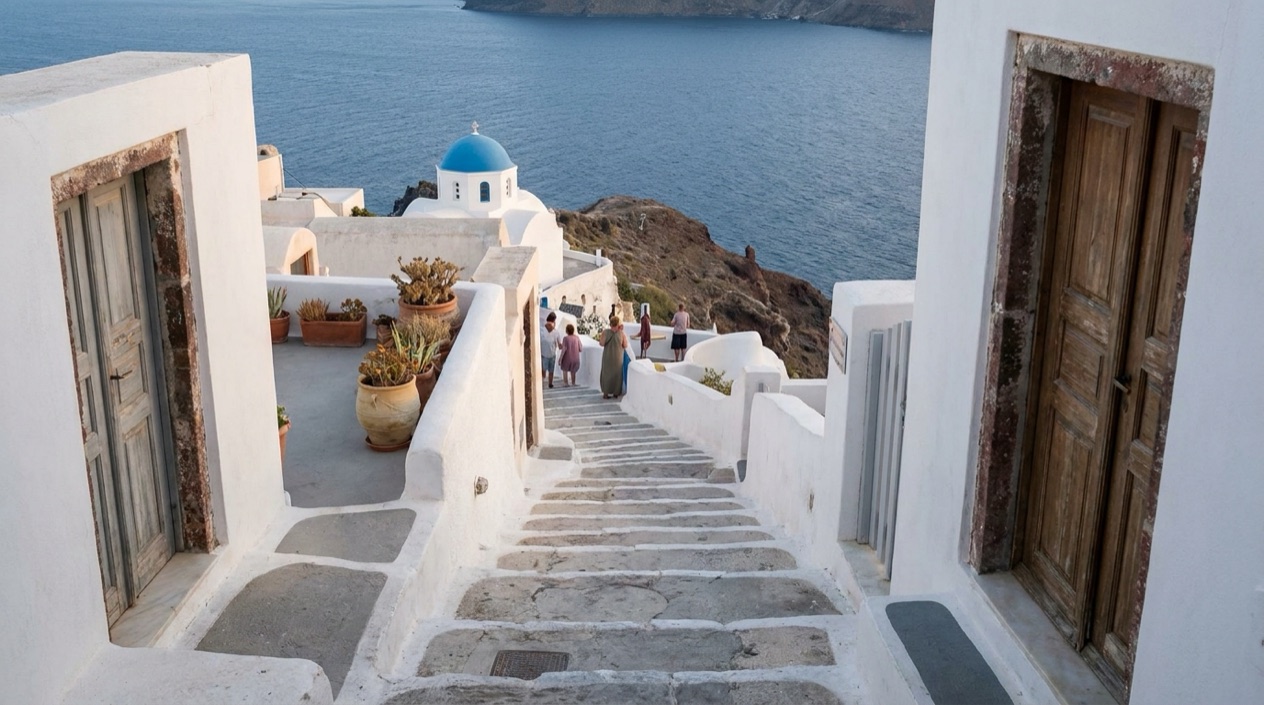
Spend the first day on the rim of the caldera: Fira, the main town, then the path along the edge toward Imerovigli and Oia, where the buildings step down the cliff over the sea. Meals here are about fava, a purée of yellow split peas, tomato fritters, white eggplant and crisp Assyrtiko wine from vines trained low to the ground.
Getting between stops
| Leg | How |
|---|---|
| Athens to Piraeus | By road |
| Piraeus to Paros | Ferry or high-speed catamaran |
| Paros to Naxos | By sea |
| Naxos to Santorini | By sea |
| Santorini to Athens | By sea or by air |
The links between the islands are by sea, and in Greece that means a mix of conventional ferries and high-speed craft. Blue Star Ferries sails between the mainland and the Aegean islands, with a fleet of 12 ferries and more than 20 destinations.
Golden Star Ferries, a company founded in 2011 and based on Andros, runs from the mainland to the Cyclades. On the Piraeus to Paros run, ferries and high-speed catamarans serve the island daily.
A fast ferry is a high-speed craft. Santorini lies at the far end of the route, so the way home from the island is by sea back toward Piraeus or by air, depending on which suits your flight.
What to book before your 7 Days in Greece
Settle the sea crossings first, because they link the four stops: Piraeus to Paros, then onward to Naxos and Santorini. Then turn to lodging, especially on Santorini, where a stay on the caldera is part of the appeal. Last come the sights, such as the Acropolis on day one, where the details are worth confirming before you travel.
Adapting the route
With less time, drop Santorini and spend the week on Athens, Paros and Naxos. Those two islands give you harbors, villages, food and countryside without another sea crossing, and the week stops feeling like a relay.
With more time, add Milos, the volcanic island in the southwestern Cyclades, roughly midway between Piraeus and Crete. It is a popular summer destination and the island where the Venus de Milo was unearthed. Tinos or Syros fit as another stop for a traveler interested in the religious and island towns.
For a slower trip, keep two bases rather than three. Paros and Naxos are enough for a week of beaches, hill villages and long lunches, and you cut a transfer day. Families with children can use the same logic: fewer moves mean fewer bags, ferry lines and early starts. Naxos, being large and fertile, offers farms, villages and cheese to taste, while Paros offers harbor towns to wander at your own pace.
The season changes what the route feels like. Athens weather gives the mainland’s side of the story, and the islands will have their own conditions, so read these numbers as the start and end of the trip only.
| Athens | Average high (°F) | Average low (°F) | Precipitation (inches) | Days with rain |
|---|---|---|---|---|
| January | 56.3 | 44.4 | 2.17 | 7.5 |
| April | 68.4 | 53.2 | 1.10 | 5.5 |
| July | 91.8 | 74.1 | 0.28 | 1.6 |
| October | 75.2 | 61.0 | 1.09 | 3.9 |
In July, Athens runs hot, so sun protection, a hat and water matter for the Acropolis and the open lanes of the old town. In January, with rain on several days and cooler air, a rain jacket and warm layers are the sensible pack for a city walk. April and October sit between the two, with the rain falling on a handful of days and the temperatures well suited to walking around the ancient sites.
Choose your pace by month. In the warm months, make the most of the sea and the island evenings. In the cooler months, lean on the museums, the tavernas and the villages, and keep a little slack in the plan, because a changed sailing can shift a day.
Good to know before you go
Greece uses the euro, and island tavernas, ferries and shops all deal in it. Pack comfortable shoes for stone lanes and steps, because every stop on this route involves climbing between harbor and town.
In the hotter months, plan sightseeing around the heat, especially in Athens, and carry water on walks. Keep a loose day at the end for the trip home from Santorini, since the island is the last link in a chain of sea and air connections.
Sources
- Wikipedia, Ancient Greece (https://en.wikipedia.org/wiki/Ancient_Greece), checked October 12, 2026
- Wikipedia, ANEK Lines (https://en.wikipedia.org/wiki/ANEK_Lines), checked October 12, 2026
- Wikipedia, Blue Star Ferries (https://en.wikipedia.org/wiki/Blue_Star_Ferries), checked October 12, 2026
- Wikipedia, Fast Ferries (https://en.wikipedia.org/wiki/Fast_Ferries), checked October 12, 2026
- Wikipedia, Golden Star Ferries (https://en.wikipedia.org/wiki/Golden_Star_Ferries), checked October 12, 2026
- Wikipedia, Greek islands (https://en.wikipedia.org/wiki/Greek_islands), checked October 12, 2026
- Visit Greece (GNTO), the Cyclades (https://www.visitgreece.gr/islands/cyclades/), checked October 12, 2026
- Wikipedia, Cyclades (https://en.wikipedia.org/wiki/Cyclades), checked October 12, 2026
- Wikivoyage, Cyclades (https://en.wikivoyage.org/wiki/Cyclades), checked October 12, 2026
- Santorini official guide (https://www.santorini.gr/), checked October 12, 2026
- Visit Greece (GNTO), Santorini (https://www.visitgreece.gr/islands/cyclades/santorini/), checked October 12, 2026
- Wikipedia, Santorini (https://en.wikipedia.org/wiki/Santorini), checked October 12, 2026
- Visit Greece (GNTO), Naxos (https://www.visitgreece.gr/islands/cyclades/naxos/), checked October 12, 2026
- Wikipedia, Naxos (https://en.wikipedia.org/wiki/Naxos), checked October 12, 2026
- Wikivoyage, Naxos (https://en.wikivoyage.org/wiki/Naxos), checked October 12, 2026
- Visit Greece (GNTO), Paros (https://www.visitgreece.gr/islands/cyclades/paros/), checked October 12, 2026
- Wikipedia, Paros (https://en.wikipedia.org/wiki/Paros), checked October 12, 2026
- Wikivoyage, Paros (https://en.wikivoyage.org/wiki/Paros), checked October 12, 2026
- Visit Greece (GNTO), Milos (https://www.visitgreece.gr/islands/cyclades/milos/), checked October 12, 2026
- Wikipedia, Milos (https://en.wikipedia.org/wiki/Milos), checked October 12, 2026
- Wikivoyage, Milos (https://en.wikivoyage.org/wiki/Milos), checked October 12, 2026
- Hellenic National Meteorological Service (HNMS), climatological normals 1991-2020 for Elliniko station (https://www.emy.gr/climatic-data), monthly mean daily maximum and minimum; rain from the ECMWF ERA5 reanalysis, 1991-2020, grid cell of Athens (Open-Meteo), checked October 12, 2026
- ECMWF ERA5 reanalysis 1991-2020, grid cell of Athens (Open-Meteo), checked October 12, 2026
- Plan de the (duree choisie by the redaction)
To plan your stay
- Best Time to Visit the Cyclades: May Through June, Early Autumn, Weather and Festivals
- The Cyclades vs the Dodecanese: Beaches, Sights, Weather and Getting There
- The Cyclades vs the Ionian Islands: Beaches, Food, Ferries and the Best Time to Go
- Things to Do in the Cyclades: Delos, Santorini's Caldera, Island Food and Nightlife