
In the Cyclades, an evening on Syros means the harbor town of Ermoupoli glowing around its waterfront, with the old quarter of Ano Syros climbing the hill above it. In the Dodecanese, the same hour on Rhodes finds people strolling the Street of the Knights inside the walls of a medieval city that is a UNESCO World Heritage Site.
Both island groups lie in the Aegean, yet they pull a trip in different directions. One offers a wide scatter of islands to hop between, the other a handful of larger islands with deep layers of history.
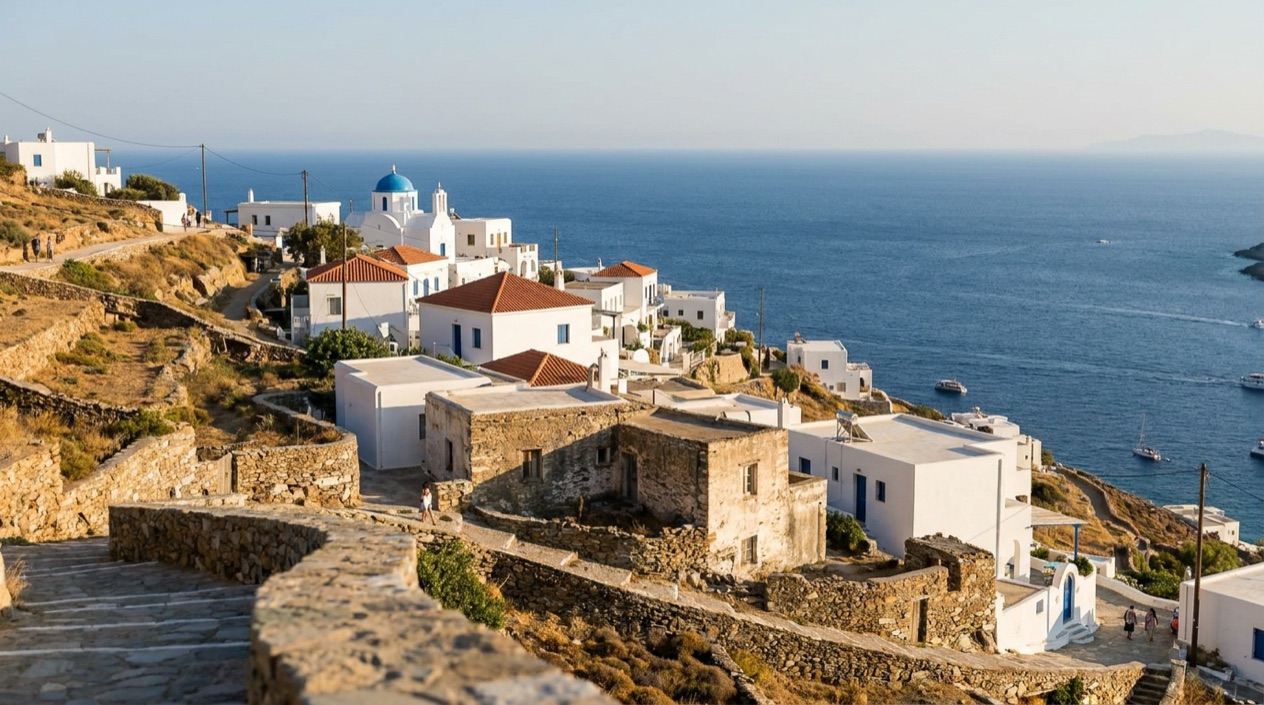
Which is better, the Cyclades or the Dodecanese?
Neither group wins outright. The choice depends on whether you picture a trip made of short stays on several islands or a trip anchored on one or two islands with plenty to explore on land.
The Cyclades form a circle around the sacred island of Delos, and the group runs from the cosmopolitan harbor of Syros to the pilgrimage church of Tinos and the green hills of Andros. The Dodecanese sit in the southeastern Aegean, off the coast of Anatolia, and revolve around Rhodes, which has led the group since antiquity, with Kos, Kalymnos, Patmos and Karpathos each adding a different flavor.
| Category | the Cyclades | the Dodecanese |
|---|---|---|
| Position | Southern Aegean, south of Athens and north of Crete | Southeastern Aegean, bordered by Turkey, Crete and the Cyclades |
| Inhabited islands | 33 | 26 |
| Beaches | Golden sandy beaches on Serifos, many smaller islands to explore along the coast | Sunshine for beach days, with the sunniest corner on southeast Rhodes |
| Vibe | Cosmopolitan on Syros, religious on Tinos, green on Andros, a circle of islands around Delos | Medieval and fortified on Rhodes, quieter and less developed on Astypalaia and Halki |
| Things to do | Island-hopping, thermal springs on Kythnos, the pilgrimage center of Tinos | Street of the Knights, Palace of the Grand Master, Valley of Butterflies on Rhodes |
| Food | Island cheeses, capers, chickpeas, fava and sweets | Chickpea fritters, stuffed pasta, shrimp, honey and herb-scented meat |
| Weather | Best May through June and September through mid-October | Hot-summer Mediterranean climate, mild winters on several islands |
| Best for | Hopping between many different islands | Medieval history and sun on larger islands |
Sights, beaches and food
In the Cyclades the sights are scattered across the circle of islands, and each island has its own subject. Syros has Ermoupoli, the chief town of the former prefecture, where the Near East meets the West in a cosmopolitan atmosphere.
Tinos is the largest religious center of Greece, tied to the pilgrimage of Panagia Megalochari. At the center of it all lies Delos, the sacred island that gives the group its name.
The Dodecanese concentrate their sights more tightly, and Rhodes carries most of them. Its Medieval City is a UNESCO World Heritage Site, and inside it you can follow the Street of the Knights and visit the Palace of the Grand Master. Beyond the walls, the Valley of Butterflies is a place to explore on foot. Elsewhere in the group, Kalymnos sits close to the coast of western Turkey, and Karpathos lies between Rhodes and Crete.
Beaches are a matter of the individual island. Serifos has snow-white villages and golden sandy beaches, and it keeps its island character intact despite tourist development. The Lesser Cyclades, including Koufonisia, Donousa, Irakleia and Schoinousa, are small islands where the sea is never far from the village. In the Dodecanese, southeast Rhodes records the highest mean annual sunshine in Greece, which is the plain reason beach days there come easily.
At the table, the Cyclades lean on what grows in dry, windy soil and what the dairies make. Think of capers and sun-dried tomatoes, yellow split pea fava, chickpea stews baked slowly in clay pots, sharp cheeses such as kopanisti and graviera, and sweets like pasteli, a sesame and honey bar, and the loukoumi of Syros.
The Dodecanese bring their own set of flavors: chickpea fritters called pitaroudia on Rhodes, makarounes (hand-rolled pasta with onions and cheese) on Karpathos, honey and fresh cheese on Kalymnos, and small shrimp on Symi. Rhodes also has its clear spirit, souma, poured in village tavernas.
The Cyclades win for variety, since a pilgrimage island, a cosmopolitan harbor, a green island and a sacred island each ask for a different kind of day. On food the two are level, with the Cyclades stronger on cheeses and pulses and the Dodecanese on pasta, fritters and seafood.
Things to do
In the Cyclades, the main activity is moving from one island to the next and letting each one set the program. Syros suits a day of wandering Ermoupoli, climbing toward Ano Syros and sitting in a harbor café.
Tinos is about the church of Panagia Megalochari and the pilgrimage that gives the island its reputation as the largest religious center of Greece. Kythnos, also called Thermia, has thermal springs where you can soak, and Serifos offers its snow-white villages and golden beaches.
Andros brings a different rhythm, with rich vegetation and a seafaring heritage that shows in its harbor town. Naxos is the largest island of the Cyclades, which makes it the natural candidate for a stay with time to cover its villages and coast.
Delos, the sacred island at the center of the circle, is the one place where the group’s own name makes sense on the ground.
On Rhodes, the day trip is the medieval city itself. You pass along the Street of the Knights, enter the Palace of the Grand Master and wander lanes where the walls frame the sky. Outside the city, the Valley of Butterflies gives a green interlude, and the long Rhodes coast gives you reasons to linger at a beach table with a plate of pitaroudia.
Other Dodecanese islands offer a different pace. Patmos is known for the monastery and cave linked to the Book of Revelation. Kalymnos has a long history of sponge diving that you can still trace in its harbor and shops.
Karpathos is a place for mountain villages and for makarounes made by hand. Astypalaia and Halki are small and not much developed, which gives them a restful feel. Evenings in the Dodecanese tend to revolve around harbor tavernas and the old town of Rhodes, with Kos town adding bars and cafés.
Nightlife and entertainment tilt toward the Cyclades if you want a choice of scenes from one island to another. Culture and history tilt toward the Dodecanese if you want a large medieval monument to walk through. Day trips work in both groups because the islands are close enough to each other for the map to suggest the next stop, such as Halki beside Rhodes or Kalymnos between Kos and Leros.
Weather and the best time to go
For the Cyclades, the best time to visit is May through June or September through mid-October. Those two windows frame the high summer months and give you the islands at a pace that suits walking villages, visiting Delos and sitting outdoors for a meal. A visit in the middle of summer is still possible, but the group is pegged to those shoulder windows for a reason.
Most of the Dodecanese have a hot-summer Mediterranean climate, which means summers are hot and sun protection becomes part of every day, with a hat, sunscreen and plenty of water as plain consequences of the climate. Karpathos, Kasos and Nisyros are different, with a hot semi-arid climate, mild winters and hot summers. That is a drier, sparser kind of landscape than the other islands of the group.
The Dodecanese stand out for their winters. Rhodes Port, Kasos, Karpathos and Kastellorizo record among the mildest winters in Europe, so the group makes more sense outside the summer months than most island groups do. Southeast Rhodes adds to the picture with over 3,100 hours of sunshine a year, the highest mean annual figure in Greece, and that long stretch of sun is what many beach-minded travelers come for.
In practice, the two groups ask different questions of the calendar. If you want a trip in May, June, September or early October, the Cyclades are laid out for it, and so are the Dodecanese given their sun.
If you are looking at the months on either side, the Dodecanese’s mild winters on Rhodes, Karpathos, Kasos and Kastellorizo give them an edge for a trip to walk the Old Town and the villages. Bring a rain jacket for any month outside the dry stretch of summer, and layers if you plan to go in the colder part of the year.
Getting there and getting around
The Cyclades are reached from Athens by air and by sea. Olympic Air and Aegean Airlines operate regular flights, mostly daily, from Athens to Mykonos, Paros, Naxos, Santorini, Milos and Syros. By sea, ferries leave from Piraeus, and the trip takes four to five hours to the closest islands, which are Kythnos, Syros, Tinos, Mykonos and Sifnos. The furthest, Santorini, takes eight to ten hours depending on the number of stops.
Once in the group, the geography does the work. The islands form a circle around Delos, so one island leads to the next, and the Cyclades are located in the southern part of the Aegean Sea, south of Athens and north of Crete.
The group counts about 220 islands, but only some of them are inhabited, and most of the smaller ones are uninhabited. Naxos is the largest and Syros the most populated, which tells you where the larger towns sit.
The Dodecanese lie in the southeastern Aegean and Eastern Mediterranean, off the coast of Anatolia. They are bordered by Turkey to the east, Crete to the southwest and the Cyclades to the west. The map explains how the group hangs together. Halki is very close to Rhodes, Karpathos lies between Rhodes and Crete, Kalymnos sits between Kos and Leros, and Astypalaia lies between Kos and Amorgos, which means it forms a bridge between the Dodecanese and the Cyclades.
That bridge matters if you plan to combine the two groups. Amorgos belongs to the Cyclades and Astypalaia to the Dodecanese, and the two islands face each other across the water.
Rhodes, as the dominant island of the Dodecanese, anchors the group, and Kos, Kalymnos and Karpathos give you further bases. With 15 larger islands and many smaller ones, the Dodecanese reward a plan built around one or two bases rather than a long chain of one-night stops.
Who should choose which
Choose the Cyclades if you want variety and the pleasure of choosing your next island. They suit travelers who like to build a trip from several short stays, who enjoy the contrast between a cosmopolitan harbor like Ermoupoli, a pilgrimage center like Tinos, a green island like Andros and a quiet one like Kythnos with its thermal springs.
They also suit anyone who wants beaches and island villages on the same trip, with Serifos as an example of snow-white houses above golden sand. Travelers who like the idea of a circle around a sacred island will enjoy the sense of a group with a clear center.
Choose the Dodecanese if you want history you can walk through and sun you can count on. They suit travelers who want to spend days in the Medieval City of Rhodes, along the Street of the Knights and through the Palace of the Grand Master, then head out to the Valley of Butterflies.
They also suit anyone drawn to quieter, less developed islands such as Astypalaia and Halki, or to Karpathos, Kasos and Nisyros with their semi-arid landscape. Travelers planning a trip outside summer will like the mild winters recorded on Rhodes Port, Kasos, Karpathos and Kastellorizo.
Combining the two groups is realistic because they share a border in the Aegean. The Cyclades lie to the west of the Dodecanese, and Astypalaia sits between Kos and Amorgos, so a trip could finish one group and begin the other without leaving the sea. A balanced plan might pair Syros or Naxos with Rhodes or Kos, one island for the harbor and the village, the other for the walled city and the sun.
Good to know before you go
Greece uses the euro in both island groups, and the two have shared an administrative home since the 2011 Kallikratis reform, when both prefectures were replaced by regional units within the South Aegean region. The Cyclades became nine units, from Andros to Tinos, and the Dodecanese four: Kalymnos, Karpathos-Kasos, Kos and Rhodes.
In the Dodecanese, where summers are hot, plan for strong sun, and stay aware of your surroundings at night as you would anywhere you travel. Island names appear in several spellings on signs and ferry boards, so Thira and Santorini are the same place, as are Chora and the main town on many islands.
Sources
- Visit Greece (GNTO), the Cyclades (https://www.visitgreece.gr/islands/cyclades/), checked October 12, 2026
- Wikipedia, Cyclades (https://en.wikipedia.org/wiki/Cyclades), checked October 12, 2026
- Wikivoyage, Cyclades (https://en.wikivoyage.org/wiki/Cyclades), checked October 12, 2026
- Visit Greece (GNTO), the Dodecanese (https://www.visitgreece.gr/islands/dodecanese/), checked October 12, 2026
- Wikipedia, Dodecanese (https://en.wikipedia.org/wiki/Dodecanese), checked October 12, 2026
- Wikivoyage, Dodecanese (https://en.wikivoyage.org/wiki/Dodecanese), checked October 12, 2026
To plan your stay
- Best Time to Visit the Cyclades: May Through June, Early Autumn, Weather and Festivals
- Things to Do in the Cyclades: Delos, Santorini's Caldera, Island Food and Nightlife
- 10 Days in Greece: Itinerary: Athens, Paros, Naxos, Mykonos and Santorini
- 14 Days in Greece: Itinerary for Athens, Paros, Naxos, Santorini, Milos and Sifnos