
On Tinos, pilgrims make their way toward the church of Panagia Megalochari, while ferries ease into harbors all over the Aegean. On Corfu, cruise liners slide in beneath the castles and the arcaded streets of the Old Town.
These are two different island worlds, one scattered across the southern Aegean, the other strung along the western coast of Greece. Choosing between them comes down to the kind of vacation you want: what you eat, how you move, and what the evenings feel like.
Which is better, the Cyclades or the Ionian Islands?
Neither wins outright. The Cyclades suit travelers who want a different island every few days, with ferry hops, village lanes and plenty of choice about mood. The Ionian Islands suit those who want to settle on one larger island and dig into its towns, castles, beaches and kitchen. The Cyclades are a many-island sampler, and the Ionian group rewards staying put.
The two groups also read differently on a map. The Cyclades sit in the southern Aegean, south of Athens, in a circle around the sacred island of Delos. The Ionian Islands sit in the Ionian Sea, west of the mainland, with Corfu at the top of the chain. That geography shapes everything else in the table: how you reach them, how you plan a route and what each stretch of coast gives you.
| Category | The Cyclades | The Ionian Islands |
|---|---|---|
| Beaches | Golden sandy beaches on Serifos, among many islands to choose from | Porto Katsiki on Lefkada, the best-known beach of the group, and the sea caves of Paxi |
| Vibe | Island-hopping, from the cosmopolitan harbor of Syros to the pilgrimage center of Tinos | Larger islands with towns of their own, led by Corfu and its Old Town |
| Things to do | Delos, villages, thermal springs on Kythnos, green hills on Andros | Corfu Old Town, castles and ruins, sea caves, Sappho’s Lefkada |
| Food | Island kitchens of the Aegean, from fava to cheeses | Corfiot and Kefalonian home cooking, with spiced stews and meat pies |
| Getting there | Flights from Athens to Mykonos, Paros, Naxos, Santorini, Milos and Syros, plus ferries from Piraeus | A chain of islands along the west coast, with Corfu receiving cruise liners in its harbor |
| Best for | Travelers who want to hop between islands | Travelers who want one larger island, or a few, as a base |
Sights, beaches and food
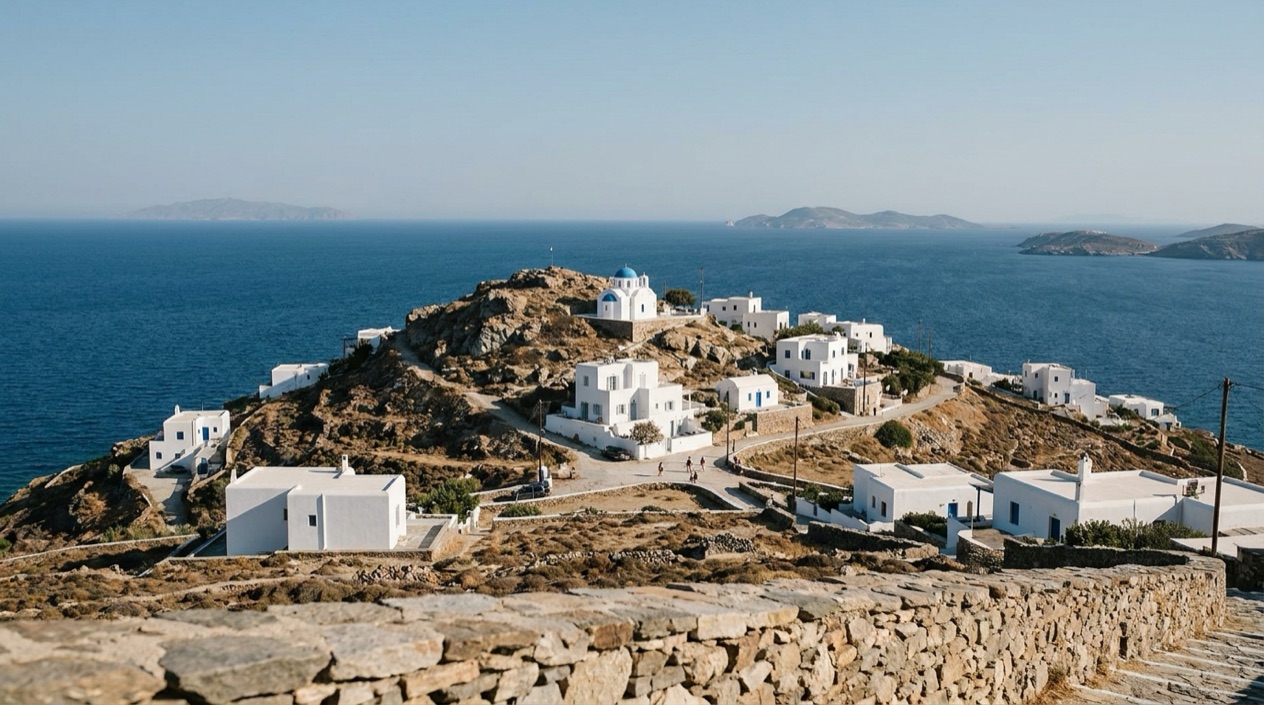
In the Cyclades, the sights are as varied as the islands. Syros has a cosmopolitan atmosphere where the Near East meets the West, and its main town, Ermoupoli, is the administrative center of the former prefecture.
Tinos is the largest religious center of Greece, tied to the pilgrimage of Panagia Megalochari. Andros departs from the usual Cycladic picture with its naval tradition and rich vegetation. Delos, the sacred island the whole group circles, gives the archipelago its name.
Beaches in the Cyclades are a matter of choosing an island. Serifos has snow-white villages and golden sandy beaches, and it keeps its island character despite tourist development.
Kythnos is known for its thermal springs and counts as one of the most authentic corners of the Aegean. At the table, expect the Aegean pantry: fava made from yellow split peas, capers, sun-dried tomatoes, grilled octopus, soft cheeses and sweets scented with honey and sesame.
The Ionian Islands answer with a more layered kind of scenery. Corfu’s Old Town is a UNESCO World Heritage site, and the island is famous for the architecture of its capital. Its harbor, scenery and wealth of ruins and castles make it a favorite stop for cruise liners.
Lefkada is associated with the myth of Sappho, and its most famous beach is Porto Katsiki. Paxi has sea caves called Graves, and Othoni, among the Diapontia Islands north of Corfu, is the westernmost point of Greece.
Ionian cooking has its own accent. Corfu is known for pastitsada, a rich dish of meat and pasta in a spiced tomato sauce, and for sofrito, thin slices of veal in garlic and white wine. Kefalonia has its meat pie and the white wine called Robola. Fish stews, olive oil and sweet preserves round out a table that feels distinct from the Aegean one.
Who wins? For variety of sights, the Cyclades, because every few days brings another island with its own character. For depth in a single place, the Ionian Islands, because Corfu alone gives you an Old Town, a fortified harbor and ruins to walk through. For food, it is a tie of two different pantries, one of the Aegean and one of the western sea.
Things to do
In the Cyclades, days are built around moving between islands and then wandering once you arrive. On Syros you walk the town of Ermoupoli and the hill village of Ano Syros. On Tinos you see the pilgrimage church that draws visitors from across the country.
Smaller islands round out a Cycladic trip. Kythnos gives you its thermal springs, Andros its greener, more wooded landscape and its seafaring heritage, and Serifos its white villages above golden beaches. The Lesser Cyclades, including Koufonisia, Irakleia, Schoinousa and Donousa, suit those who want the smallest islands of the group.
In the Ionian Islands, much of the sightseeing is on land. Corfu’s Old Town and its castles and ruins give you narrow streets, arcades and a harbor to watch from a café. Lefkada brings the drive and the walk down to Porto Katsiki, and Paxi brings its sea caves, the Graves. These are places to see by boat as much as on foot.
Nightlife and day trips differ in scale. In the Cyclades, the nightlife varies from the loud bars of Mykonos to a quiet table on a small harbor, and the day trip is often another island.
In the Ionian group, the day trip is often another island. Tourism is the major industry across the Ionian Islands, so you find a well-developed scene on the bigger islands, Corfu and Zakynthos above all.
Weather and the best time to go
For the Cyclades, the best time to visit is May through June or September through mid-October. Those are the stretches when the islands are best for walking villages, visiting Delos and moving between harbors.
The Cyclades are also the group with the longest list of places to see, so the season matters more for a route that jumps between islands. Many hops mean more time moving between harbors, and the shoulder months suit that kind of itinerary. Andros, the northernmost island and one of the greenest, adds a landscape that differs from the typical Cycladic image.
For the Ionian Islands, the choice of season follows what you came to do. Corfu’s Old Town, its castles and its ruins fill a visit whenever you go, and the beaches of Lefkada and the caves of Paxi are the reason travelers come for the warm months. Zakynthos and Kefalonia, the other large islands, are built around tourism, with a lively scene around their ports.
If your dates are fixed, pick the group by the activity. For island-hopping, aim for late spring or early autumn in the Cyclades. For a base on one island with a town to explore and a sea to look at, the Ionian group gives you more to do with a single hotel and a single harbor.
Getting there and getting around
The Cyclades are reached from Athens by air or by sea. Regular flights, mostly daily, run from Athens to Mykonos, Paros, Naxos, Santorini, Milos and Syros, operated by Olympic Air and Aegean Airlines. Other islands are reached by ferry, which is how the group is knit together once you are there.
By sea, ferry trips from Piraeus take four to five hours to the closest islands of the group, which are Kythnos, Syros, Tinos, Mykonos and Sifnos. The furthest, Santorini, takes eight to ten hours depending on the number of stops. That range tells you something about planning: the nearest islands fit easily at the start of a trip, while Santorini changes the shape of the day.
Moving around inside the Cyclades means linking islands by ferry. Of some 2,200 islands, islets and rocks, only 33 are inhabited, so the useful map is short. Naxos is the largest island of the group, and Syros the most populated. The nine regional units of the South Aegean region, among them Andros, Kea-Kythnos, Milos, Mykonos, Naxos, Paros, Thira, Syros and Tinos, give you a sense of how the main islands are organized.
The Ionian Islands form a chain along the western coast of Greece. The seven principal islands run from north to south: Corfu, Paxos, Lefkada, Ithaca, Kefalonia, Zakynthos and Kythira, although Kythira belongs administratively to Attica. The group is traditionally called the Heptanese, meaning the Seven Islands. Corfu has the largest population and receives cruise liners in its harbor.
Because the Ionian Islands are a line of separate islands, a trip there is usually built around one or two of them. Corfu, Zakynthos and Kefalonia, the largest, are where you will find the most towns and the most developed tourism. The smaller ones, Paxos and Ithaca, offer a different, slower pace.
Who should choose which
Choose the Cyclades if you like variety and movement. If a ferry ride between islands sounds like part of the fun, and if you would rather taste a handful of places than study one, this is your group.
Choose the Ionian Islands if you like depth and a base. If you prefer unpacking once and letting an island unfold, with a regional kitchen of pastitsada, sofrito and Kefalonian pies, the western sea is a good match.
Combining them is possible, but the two groups sit far apart: one in the southern Aegean, the other along the western coast. A single trip that covers both spends a good share of its days on transfers. Visitors will do better to pick one group per vacation and give it enough time. If you want both, treat them as two trips and save the other for another year.
Good to know before you go
Greece uses the euro in both island groups. Ferries, flights and island hops are the backbone of a Cyclades trip, while in the Ionian Islands the harbor towns of Corfu, Zakynthos and Kefalonia carry most of the visitor life. Plan your route around a short list of islands rather than a long one, and let the season guide the choice: May through June or September through mid-October for the Cyclades, and the activity you came for in the Ionian chain.
Sources
- Visit Greece (GNTO), the Cyclades (https://www.visitgreece.gr/islands/cyclades/), checked October 12, 2026
- Wikipedia, Cyclades (https://en.wikipedia.org/wiki/Cyclades), checked October 12, 2026
- Wikivoyage, Cyclades (https://en.wikivoyage.org/wiki/Cyclades), checked October 12, 2026
- Visit Greece (GNTO), the Ionian Islands (https://www.visitgreece.gr/islands/ionian-islands/), checked October 12, 2026
- Wikipedia, Ionian Islands (https://en.wikipedia.org/wiki/Ionian_Islands), checked October 12, 2026
- Wikivoyage, Ionian Islands (https://en.wikivoyage.org/wiki/Ionian_Islands), checked October 12, 2026
To plan your stay
- Best Time to Visit the Cyclades: May Through June, Early Autumn, Weather and Festivals
- Things to Do in the Cyclades: Delos, Santorini's Caldera, Island Food and Nightlife
- 10 Days in Greece: Itinerary: Athens, Paros, Naxos, Mykonos and Santorini
- 14 Days in Greece: Itinerary for Athens, Paros, Naxos, Santorini, Milos and Sifnos