
Amorgos is the easternmost of the Cyclades, and it is the island for people who like their Greece windy, rugged and unhurried. There's no airport, no cruise ship crowds and very little glitz. Instead you get cliffs dropping into electric blue water, pebble coves below chapels, whitewashed villages and a food scene built on the morning's catch. Getting here takes a ferry and a little intent, and the wind will shape many of your days. The island rewards travelers who like to explore and don't mind a few stairs.
Where should you stay in Amorgos?
Amorgos is a long, narrow island, and the winding mountain road between Katapola and Aegiali takes 30 to 40 minutes, so trips often take longer than they look on the map. Pick one base and split the island into north, center and south day trips. Lodging is limited and demand has grown, so book early for anything between June and early September.
Katapola
Katapola is the main port, curled around a sheltered bay in the middle of the island. It's a working harbor with a calm, lived-in feel: a school bell still rings, locals settle into the same café chairs each afternoon, and cats patrol the waterfront. The northern end of the bay, with its cluster of whitewashed houses, restaurants and bars, is the place to wander, especially early in the morning and in the soft light before sunset.
Katapola also works well as a base: rental companies sit near the port, and in summer buses run from here to Chora, Aegiali and the main beaches. Breakfast by the water while boats come and go is a fine way to start the day. There's a broad choice of guesthouses, small hotels and apartments, though many are simple, so don't expect boutique polish everywhere.
Chora
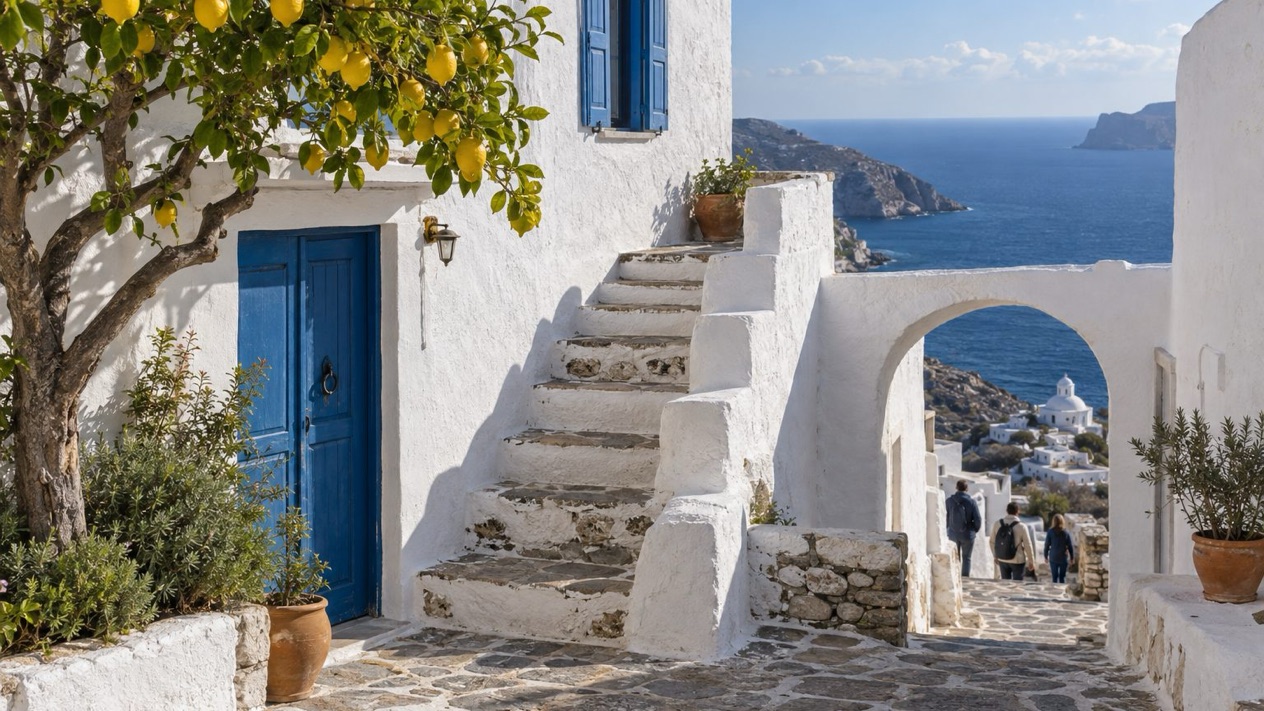
Chora, the capital, sits on a blustery hilltop in the center of the island and is considered one of the most beautiful towns in the Cyclades. It's a car-free maze of narrow cobbled lanes, bright white houses and doors painted in sea and sky blues. At the wrong hour it can feel half empty. After dark the tavernas spill into the alleys, the little bars get louder, and live bands sometimes set off impromptu folk dancing in the streets.
Stay here for atmosphere and a traditional village feel. Rooms are few and mostly in guesthouses, so book four or five months ahead, especially for July and August. Pack a sweater: evenings up here can turn chilly and gusty.
Aegiali
Aegiali, the main settlement in the north and the island's second port, is more youthful and bright than Katapola, built like an amphitheater around a sheltered bay. It's the closest thing Amorgos has to a resort, though it stays small-scale and tasteful. The long sandy beach is a five-minute stroll from the ferry dock, and in July and August it fills with Greek families and young campers. Footpaths link it with the hill villages above, which makes it a handy base for hikers.
The trade-off is distance. From Aegiali it's about an hour to the south end of the island, so southern days mean a lot of driving.
Lagada and Tholaria
The hill villages of Lagada and Tholaria sit above Aegiali. Lagada is the pick of the bunch, with soft Cycladic curves, wooden signs, white doodles of hearts, cats and stars on the walls, and a good balance of locals and visitors. Tholaria is smaller and sleepier than Lagada, with lovely views across the land and a few hiking trails passing through. Stay up here if you'd rather wake in the hills than by the sea. Lagada has several buses a day down to Aegiali, but a car makes the beach runs far easier.
What are the best things to do in Amorgos?
Visit the Monastery of Panagia Hozoviotissa
Perched on a sheer cliff face, this 11th-century monastery is the island's most important landmark and is thought to be the second oldest in Greece. Dress for it before you leave, with shoulders and legs covered, and remove your hat inside. The monastery closes for a long break at midday, so plan a morning or early evening visit. Park outside the gates and climb about 300 paved steps, or walk the footpath from Chora in around 30 minutes. The bus stops roughly a 10-minute walk away.
Pair it with Agia Anna beach just below: monastery first, then a swim.
Wander Chora, then climb to the windmills
Give Chora a late afternoon and an evening. Wander the lanes without a plan, then settle in Loza square under its huge tree before dinner. A line of windmills stands on the hilltop above town, and the short, easy walk up at sunset brings golden views over the folds of the island's mountains. Expect it to be blustery up there. If you have energy left, the castle perched on the rock above town offers more views, though the rocky steps are a climb.
Dive or snorkel
Amorgos has some of the clearest water in the Aegean. Dive sites include a wall with ancient storage jars on the seabed, plus caverns and rocky reefs. Beginners can try a first dive or get certified over a few days, and snorkeling trips and freediving courses are on offer too. Luc Besson shot The Big Blue here in 1988, and divers and film fans have been drawn to the island ever since.
Hike, but pick your season
Trails link hamlets, ancient sanctuaries, chapels and beaches that are otherwise hard to reach. Summer heat is the problem, and spring and autumn suit longer walks far better. The classic is the 8.4 mile (13.5 km) route from Chora to Lagada by way of the monastery and Aegiali Bay. A shorter favorite runs from Aegiali up to Tholaria and over to Lagada, and it can be walked as a loop of about 4.8 miles (7.7 km). Start early, carry plenty of water and sunscreen, wear a hat, avoid hiking alone and tell someone your plan. If the day is going to be too hot, don't hike.
See a bit of history
The Archaeological Collection of Amorgos, in Chora, is open from 8:30 a.m. to 3:30 p.m. in summer and closed on Tuesdays. Hours change by season, so check before you go. In winter, it opens the same hours on Monday, Wednesday and Saturday, and stays closed the other days. Full admission is €5, or €3 reduced, and entry is free on 18 April, 18 May, 28 October, the last weekend of September, and the first Sunday of each month from November 1 to March 31.
Near Arkesine in the south, the Ancient Tower at Agia Triada is free to enter. In summer it keeps the same hours, Wednesday to Monday. In winter, the hours change to 9 a.m. to 2 p.m. on Thursday, Friday and Sunday, with the tower closed the rest of the week. At the Tower, last entry is 20 minutes before closing. At both sites, climbing on monuments, eating, smoking, swimwear and drones without permission are prohibited.
The island is also famous for its Early Cycladic marble figures, found in graves around Chora and the northern settlements. The originals now live in museums in Athens, but small stone replicas make good souvenirs.
What are the best beaches in Amorgos?
Learn to love rocks and pebbles. If you're after golden sand and rows of sunbeds, this isn't your island. Wind direction matters more than anything: one side can be calm while the other gets battered, so check before you drive.
Kalotaritissa, for families and calm water
At the far south, this bay is so sheltered it looks like a lake, and it stays calm even when the rest of the island is howling. It's mostly sand, you can park right by the beach, and there are umbrellas for hire plus some natural shade. A family-run canteen serves fresh lunches and hearty spinach pie. A short boat ride crosses to uninhabited Gramvousa island and its lovely, unorganized beach, though boats stop running in strong wind.
On the way, stop at the rusting Olympia shipwreck, which ran aground in 1980 and can be reached by a short walk from the roadside. It's a fine photo stop, but it doesn't need more than a quick visit.
Mouros, for a deep swim
On the rugged southwest coast, Mouros is smooth rocks, a patch of pebbles and deep, cool water. Swim along the cliff edge and you'll find a series of shallow caves, each with its own shape; save energy for the swim back. A stone staircase leads down from the car park, and the climb up feels steeper than you expect. There are no facilities on the beach, but a café with a deck and big views sits at the top. Afternoon is the sweet spot, before the sun dips behind the mountain. The car park is small, and if it's full you'll have to wait or come back later.
Agia Anna, for the monastery view
Small, photogenic and popular, Agia Anna has a few intimate sections of coast reached by stone steps. Swim around the rocks toward open water and the monastery appears above you, which is the whole point. There's little room to spread out, so think a couple of unhurried hours. Late afternoon or early morning is quieter. Nudity is common on one section.
Maltezi, for an easy day from Katapola
From Katapola, a walk of about 15 minutes along a narrow pebble shore, where your feet may get wet, leads to the main stretch of Maltezi beach. Maltezi and neighboring Plakes beach blend into each other, so you can enjoy them as one long stretch, and the water taxi from Katapola port makes a fun alternative to walking. Arrive around noon or later for the best sun.
Aegiali and Levrossos, for kids
Aegiali's beach is the most accessible and family-friendly on the island, with gentle shallow water and lifeguards. Levrossos, a short drive or 25-minute walk around the bay, is a sandy cove with a couple of beach bars. It loses the sun in late afternoon, so go earlier in the day.
Agios Pavlos, for solitude on a calm day
A finger of grey pebble and shingle about 10 minutes' drive from Aegiali, with uninhabited Nikouria island across the water. In the wind it looks unloved, but on a calm morning it's lovely. Nikouria is home to goats, cicadas and a few small sandy beaches, so it's smart to pack what you'll need for the day. Several daily buses serve Agios Pavlos from Aegiali, Chora and Katapola.
What should you eat in Amorgos?
Eating here is affordable and unfussy. Breakfast means Greek yogurt and honey, not avocado toast. Coffee lovers may struggle, so order a traditional Greek coffee.
Look for patatato, goat slow-cooked with potatoes, and fresh fish in the Katapola harbor tavernas. Xynomizithra, the local cheese, and xerotigana, fried dough sweets, turn up on menus too. The island's own spirit is psimeni raki, blended with cinnamon, honey and clove. You may get a small glass on the house after dinner, and you'll see bottles sold around the island, often homemade.
In Chora, the creative traditional cooking at Transistoraki is worth the wait for a table; reserve if you're a group. Jazzmin pours good cocktails in a little space full of books and games, and Loza square is the spot for breakfast. In Katapola, the north end is where evenings happen: Fata Morgana for dinner and Moon Bar for drinks on wooden chairs by the pebbles. In the middle stretch of the bay, Bastet is a sundowner spot that stays open late. Vegetarians usually eat well across Greece, and To Syrma, a meat-free spot, is known for its souvlaki wrap. For simple village cooking at low prices, head for the tavernas of Vroutsi or Arkesini in the south.
When is the best time to visit Amorgos?
June through September is the main season, when buses run to the main beaches more often. Hikers are better off in late spring or early autumn, when the trails are far more pleasant. In any month, expect more wind than on a typical Greek island. It can cancel small boats and spoil a beach day, so check the forecast for the days ahead before you plan.
How many days do you need in Amorgos?
If you're island hopping, two to three days covers the highlights. About a week lets you see the whole island and still have time to relax on a rock. Either way, leave some slack, because wind can rearrange beach and boat plans. The plan below assumes a base in Katapola or Chora and a rental car.
Day 1: Chora and the monastery
Start with the monastery in the morning, then walk or drive down to Agia Anna for a swim. Have lunch in Chora, wander the lanes in the afternoon and walk to the windmills for sunset. Eat in Chora, then linger for a drink as the bars warm up.
Day 2: The south
Drive south early to the Olympia shipwreck, then settle at Kalotaritissa for lunch and a lazy afternoon, adding the boat to Gramvousa if the wind allows. On the way back, swim at Mouros in the late afternoon. Finish with dinner at the north end of Katapola.
Day 3: The north
Spend the morning on Aegiali's beach or at Levrossos. Drive up to Lagada for a wander and a late lunch, then on to Tholaria for the views. If the wind is calm, end at Agios Pavlos with the boat to Nikouria.
Day 4: An optional extra day
Walk from Katapola to Maltezi and spend the day there, or book a dive. This is also your wind buffer: if a beach is blown out, swap days and head somewhere sheltered.
How do you get to Amorgos and around?
Amorgos has no airport, though there is a helipad. The closest airport is on Naxos, a 45-minute flight from Athens International, with a ferry onward to Katapola. Direct ferries from Piraeus leave from gates E6 and E7 and take 6 to 9 hours depending on the boat, and Blue Star Ferries runs up to three a week.
Island hopping is much quicker. Amorgos connects with Naxos, Paros, Santorini, Koufonisia and the other Small Cyclades, as well as Astypalea and several Dodecanese islands. Most ferries call at Katapola, and some also stop at Aegiali in the north, so check which port is closest to your lodging before you book. Cancellations happen regularly in August, so build a buffer day into any onward travel.
On the island, a rental car is a big help for reaching places the buses don't serve, and the far south around Kalotaritissa is reached by car or scooter on a rough road with almost no facilities. Agencies cluster by the Katapola port and in Aegiali. Demand can outstrip supply, so reserve a few days ahead if you know you'll want one. Expect blind hairpins, sheer drops and strong wind; most people manage fine, but nervous drivers should think twice. Scooters get buffeted from all sides, so they're a poor choice for beginners. Plan on about 15 minutes by road from Katapola to Chora, roughly 30 from Chora to Aegiali, and 30 to 40 between the two ports.
The KTEL bus links Katapola with Chora, Aegiali and the monastery stop, with more routes in summer. Services are sparse, so treat it as transport between bases rather than a way to tour the island. Taxis are few, and ride apps don't operate here.
What should Americans know before going to Amorgos?
U.S. citizens can enter Greece without a visa for up to 90 days, and your passport should have at least three months of validity beyond your planned departure date. Greek law requires visitors to carry a valid U.S. driver's license plus an international driving permit, even if the rental company doesn't ask to see the permit.
The U.S. State Department describes Greece as a generally safe destination, but petty crime is common in tourist spots, and thieves are known to break into rental cars to steal passports, valuables and luggage. Strikes can disrupt ferries and ports with little warning, and forest fires are common in the dry summer months, occasionally closing roads. Many medical providers in Greece accept only cash.
Sources
- alongdustyroads.com (https://www.alongdustyroads.com/posts/things-to-do-in-amorgos-greece), checked October 18, 2026
- greecetravelguide.co.uk (https://www.greecetravelguide.co.uk/destinations/cyclades/amorgos-island-guide/), checked October 18, 2026
- greece-like-a-local.com (https://www.greece-like-a-local.com/travel-guide/what-to-do/travel-guide-amorgos), checked October 18, 2026
- cntraveller.com (https://www.cntraveller.com/gallery/amorgos-greece), checked October 18, 2026
- apoplous.blog (https://www.apoplous.blog/amorgos-wild-beauty-greek-seas/), checked October 18, 2026
- U.S. Department of State (https://travel.state.gov/content/travel/en/international-travel/International-Travel-Country-Information-Pages/Greece.html), checked October 15, 2026
- Hellenic Ministry of Culture, Odysseus (http://odysseus.culture.gr/h/1/eh155.jsp?obj_id=3258), checked October 15, 2026
- cyclades.culture.gov.gr (https://cyclades.culture.gov.gr/en/hours-prices/), checked October 15, 2026
- Hellenic Ministry of Culture, Odysseus (http://odysseus.culture.gr/h/3/eh355.jsp?obj_id=1806), checked October 15, 2026
- Visit Greece (GNTO) (https://www.visitgreece.gr/islands/cyclades/amorgos), checked October 15, 2026
- bluestarferries.com (https://www.bluestarferries.com/en-gb/destinations/why-should-i-visit-amorgos), checked October 15, 2026
- U.S. Department of State (https://travel.state.gov/content/tsg_aem/us/en/home/international-travel/travel-advisories/destination.grc.html), checked October 15, 2026