
Delos is a little rocky island in the heart of the Aegean, and the whole island is one big archaeological site. A 30-minute boat from the Old Port in Mykonos Town brings you to temples, mosaic floors and marble lions, and you sail back the same day. Go early, and pack a hat and sturdy shoes.
What is Delos, and why does it matter?
Ancient Greeks regarded it as the most sacred of all islands. In the myth, Leto was carrying a child of Zeus, and Hera, full of jealousy, would not let her give birth on solid ground. Turned away everywhere, Leto came to Delos, a barren island floating free of the sea floor that therefore didn't count as solid ground. Clinging to an olive tree on Mount Cynthus, she gave birth to the twins Apollo and Artemis, the gods of the sun and the moon. The island's name comes from a Greek verb meaning "to declare, to show."
People first settled here in the third millennium BC, and a sanctuary of Apollo stood by the 9th century BC. It began as a pilgrimage site for the Ionians and grew into a sanctuary for all the Greeks. Athens, Naxos and Paros competed for influence over it, and an ancient religious league met here. In 426 BC the Athenians "purified" the island, moving its graves to the neighboring islet of Rineia. Apollo's festival, the Delia, was held every four years in many periods, with athletic, equestrian and musical contests, dances, plays and banquets. Like the Olympic and Pythian Games, it was one of the great events of the Greek world.
Then came the money. After 167 BC Delos became a free port, and merchants, bankers and shipowners from all over the world moved in. They built luxurious houses decorated with frescoes and mosaic floors. Warehouses and trading companies filled the town, along with temples to foreign gods such as Isis and Sarapis and even a synagogue. A Roman-era voice from the 2nd century AD described Delos as the greatest commercial center in the whole world. That wealth made it a target. The troops of Mithridates sacked the island in 88 BC, and pirates allied with him struck again in 69 BC. Delos slowly emptied and later served as a quarry, its temple columns burned for lime. UNESCO inscribed the site on its World Heritage List in 1990.
What will you actually see on Delos?
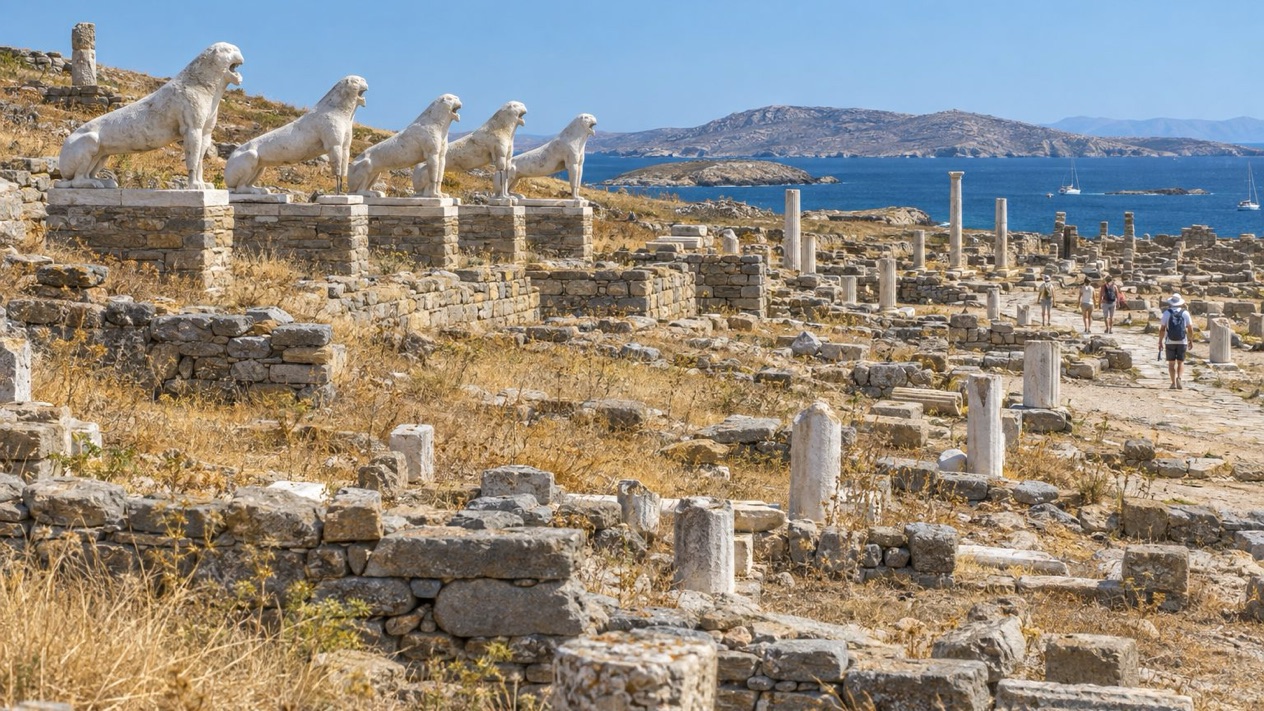
Delos has been uninhabited since the 7th century AD, and no village was ever built over the ruins. Apart from the museum, a refectory and a few small houses for staff, the island has almost no modern buildings. The result is a rare collection of Archaic, Classical and Hellenistic monuments on an island devoted entirely to archaeology.
The excavated quarters give you a rough map for the day:
- The Sacred Lake Quarter, with the Agora of the Italians and the Terrace of the Lions.
- The Theatre Quarter.
- The Inopos Quarter, home to the Heraion.
- The Stadium Quarter, where the synagogue stood.
Look down as you walk through the houses. The floors carry mosaics such as Eros riding two dolphins in the House with the Dolphins and Dionysus on a panther in the House with the Masks. The lions on the terrace are exact replicas. The original Naxian Lions were moved into the museum to protect the fragile marble from the north wind, and the museum also displays much of the island's treasure of finds. Mount Cynthus, the mountain of the myth, rises above the ruins. Rick Steves counted the hike to its summit among the highlights of his visit with a local guide.
How do you get to Delos?
Visiting Delos means taking a day-return boat from a nearby island such as Mykonos, Paros or Naxos. Mykonos is the usual base, and boats also run from Paros and Naxos. On Mykonos, Delos boats leave from the Old Port beside Mykonos Town. The big ferries use the New Port at Tourlos instead. The crossing takes 30 minutes. Tickets are often sold at or near the Old Port pier before boarding, unless a tour operator issues yours digitally.
To reach Mykonos, flights take 45 minutes from Athens and 1 hour 10 minutes from Thessaloniki. SEAJETS also sails from Rafina, which is very close to Athens airport. The big ferries dock at the New Port, about 1.2 miles (2 km) north of town. The SeaBus, local buses and taxis all cover the short hop to Mykonos Town and the Old Port. Taxis are relatively few, so be prepared to wait. Boat timetables shift with the season, so confirm departure and return times for your date.
What does it cost, and when is it open?
2026 prices: site entry is €20 full price and €10 reduced. The ticket does not include the boat from Mykonos or any other island. The museum on Delos keeps the same hours as the site.
Opening hours shift through the autumn, with the site opening at 8 a.m. and closing a little earlier as the season goes on:
Last entry is half an hour before closing.
Admission is free on March 6, April 18, May 18, the last weekend of September, October 28, and the first Sunday of each month from November through March. The site is closed on January 1, March 25, May 1, Easter Sunday, December 25 and December 26. Dates and hours can change, so confirm them shortly before your visit.
When is the best time to go, and how long should you stay?
Late spring and September are the gentlest seasons for Delos. July and August on Mykonos are hot, with highs near 83°F (28.5°C) and almost no rain, which makes a midday walk among the stones a slog. Winter brings far more rainy days and shorter daylight. Whatever the month, take an early boat so you see the ruins before the midday heat.
Plan on about half a day. Private guides on Mykonos run tours such as the 3-hour "Eternal Delos," which gives you a useful yardstick. Add the 30-minute crossing each way, and the visit fills a morning. In autumn, keep the earlier last entry and the time of the last boat back in mind.
What should you wear and bring?
Delos is rocky, so wear comfortable closed shoes. Bring a hat, sunscreen and sunglasses. Pack a light layer as well, because strong north winds dominate the central Aegean and Mykonos is nicknamed "The Island of the Winds." There are water vending machines at the port and at the museum.
Access has improved in recent years. New visitor paths reach the whole site and were built especially for people with reduced mobility. There are wide ramps and an accessible bathroom. Assistance dogs and therapy animals are allowed with the relevant documents. Special visits can be arranged by written request.
What else can you pair with Delos?
Mykonos Town is the natural partner for the day. It makes a pleasant end to a dusty day among ruins, and a sunset walk through town is one way to enjoy it. The Archaeological Museum of Mykonos, in a 1905 neoclassical building, completes the story of Delos. It holds finds from the burial ground on Rineia along with important pieces from Mykonos itself. Some guides combine a morning on Delos with a walking food tour of Mykonos Town in one full day, so a single booking can cover both.
Sources
- getdelos.com (https://www.getdelos.com/), checked October 18, 2026
- UNESCO World Heritage Centre (https://whc.unesco.org/en/list/530/), checked October 18, 2026
- Visit Greece (GNTO) (https://www.visitgreece.gr/en/islands/cyclades/delos), checked October 18, 2026
- greeknewsagenda.gr (https://www.greeknewsagenda.gr/delos1/), checked October 18, 2026
- delosguide.com (https://www.delosguide.com/), checked October 18, 2026
- Hellenic Ministry of Culture, Odysseus (http://odysseus.culture.gr/h/3/eh355.jsp?obj_id=2371), checked October 15, 2026
- seajets.com (https://www.seajets.com/), checked October 15, 2026
- archaeologicalmuseums.gr (https://archaeologicalmuseums.gr/en/museum/5df34af3deca5e2d79e8c18e), checked October 15, 2026
- Visit Greece (GNTO) (https://www.visitgreece.gr/islands/cyclades/mykonos/), checked October 15, 2026
- Hellenic Ministry of Culture, Odysseus (http://odysseus.culture.gr/h/1/eh155.jsp?obj_id=3262), checked October 15, 2026
All our pages
Things to do
- The Archaeological Site of Delos: Terrace of the Lions, Sacred Harbour and the Birthplace of Apollo
- Delos Tour: How to See the Sacred Island With a Guide or on Your Own