
ST. AUGUSTINE · JANUARY · 29.9° N
Winter in St. Augustine is a walking proposition. The average January afternoon reaches 65.5°F and the average night falls to 42.9°F: coat weather at breakfast, shirtsleeves by the time you have walked the Castillo’s gun deck twice. The Atlantic, meanwhile, sits at 62.6°F and settles the swimming question before you can ask it.
Two nights covers both federal forts and leaves a lighthouse morning in between. The clock is Eastern, like Orlando and Miami, and the nearest large airport is Jacksonville JAX, a medium hub that boarded 3,749,791 passengers in 2024 against Orlando MCO’s 27,859,783. For how the rest of the state’s calendar behaves, we keep a month-by-month verdict for Florida.
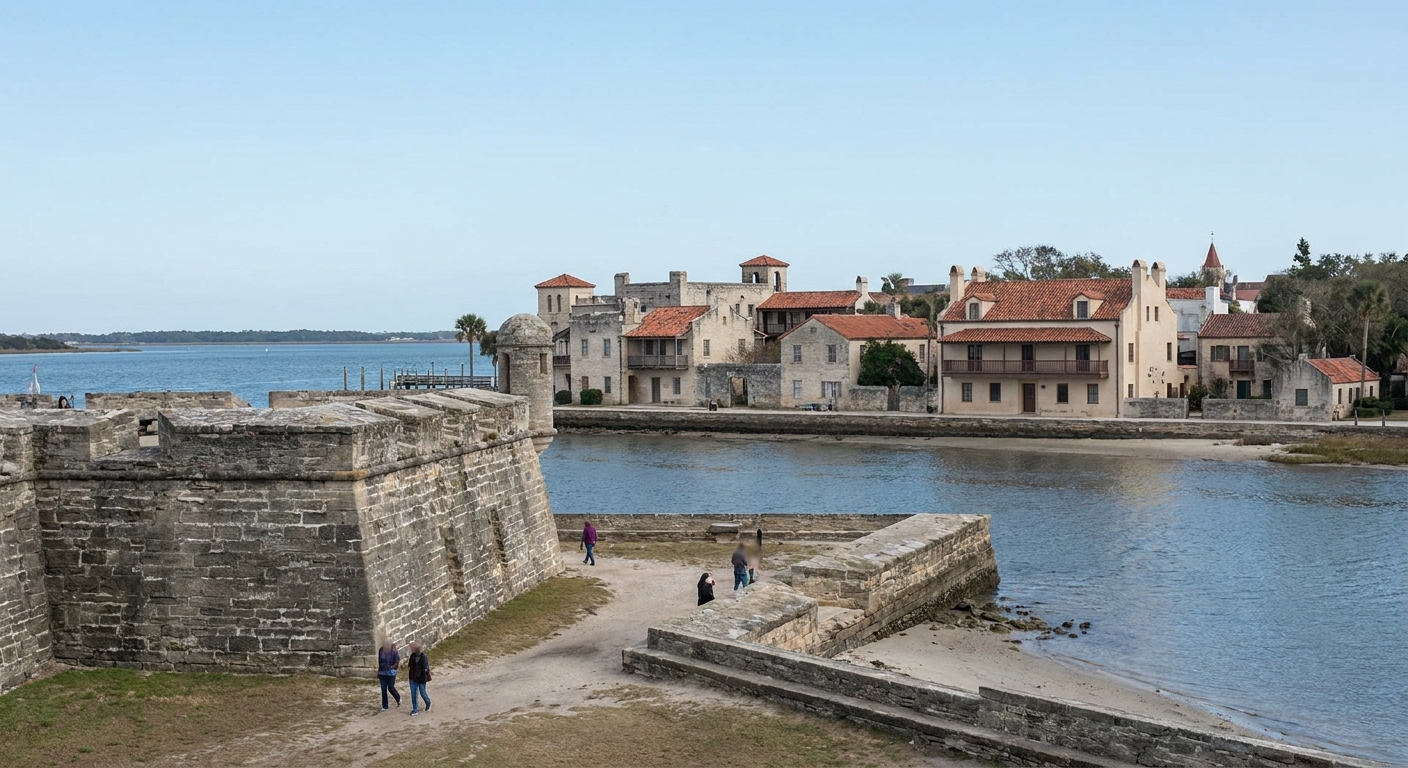
THE MONTH AT A GLANCE · ST. AUGUSTINE · JANUARY
January gives the two coquina forts a 65.5°F afternoon and takes the ocean away at 62.6°F: come for walls, walking and a 5:48 p.m. sunset, not for a swim.
DRY SEASON NOV TO APR · OUTSIDE HURRICANE SEASON · SUNSET 5:48 P.M. ON JAN 15
Go for: two National Park Service units at winter temperatures, a $15 fort ticket good for seven straight days, a ferry that costs nothing, and afternoons at 65.5°F.
Think twice before: building the trip around the beach: the sea averages 62.6°F, and 6.2 nights in an average January drop to 32°F or below.
Climate: NOAA NCEI 1991-2020, station USW00013889 · Sea: Open-Meteo Marine · Forts: National Park Service · full sources at the end
On this page
- St. Augustine weather in January65.5°F days, 42.9°F nights, 5.2 rain days
- Can you swim in St. Augustine in January?The sea at 62.6°F
- January prices and the St. Johns County lodging tax5% county tax plus 6% state
- Things to do in St. Augustine in JanuaryCastillo, Fort Matanzas, the lighthouse
- A two-day January planTwo days built around a 5:48 p.m. sunset
- January vs December and FebruaryHow the three months compare
- Is January a good time to visit St. Augustine?Yes, with a coat
St. Augustine holds two of the eleven National Park Service units in Florida, Castillo de San Marcos and Fort Matanzas, and neither carries the National Park title, which in this state belongs only to Biscayne, Dry Tortugas and the Everglades. That distinction is worth a January weekend’s planning: a fort is a morning inside a town you are already walking, while a national park is a day with a drive at each end. The eleven units, sorted by what they cost you in time.
St. Augustine weather in January: average highs, lows and rain days
| January measure | Normal |
|---|---|
| Average high | 65.5°F |
| Average low | 42.9°F |
| Precipitation | 3.28 in |
| Days with 0.10 in or more | 5.2 |
| Days with 1 in or more | 1.2 |
| Nights at 32°F or below | 6.2 |
| Daylight on Jan 15 | 10h 29m |
| Sea surface | 62.6°F |
Every figure here comes from a real thermometer rather than a model grid cell, and it is worth knowing where that thermometer stands: NOAA’s 1991-2020 monthly normals for this stretch of coast are read at station USW00013889, Jacksonville International Airport, up the coast and inland from the water. Those normals give January an average high of 65.5°F, an average low of 42.9°F and 3.28 inches of precipitation for the month.
Rain falls on 5.2 days of an average January if you count only days that collect a tenth of an inch or more, so roughly one day in six. Of those, 1.2 bring an inch or more. The practical shape of the month is four short wet spells you can wait out under an arcade and one afternoon that is simply lost to weather.
Between the average night and the average afternoon lies 22.6°F, and 6.2 nights in a typical January fall to 32°F or below at that station. Pack for both ends of the day: a real coat for the walk out at breakfast, and the expectation of carrying it by late morning. Anyone planning to stand on an unshaded stone rampart in a river wind wants a hat and gloves in the bag.
January 15 gives 10 hours 29 minutes of daylight, from a 7:20 a.m. sunrise to a 5:48 p.m. sunset in Eastern time, the same clock Orlando and Miami keep. Castillo de San Marcos takes its last admission at 5:00 p.m. and clears everyone out at 5:15, which puts you back on the street with half an hour of light. Dinner happens after dark, whatever you plan.
Can you swim in St. Augustine in January? Sea temperature and what it feels like
The sea surface off St. Augustine averages 62.6°F in January, measured across 2015-2024 in the Open-Meteo Marine record. One nuance travels with that number: it is a mean of daily maxima, so it runs a shade warmer than a flat 24-hour average would. The warmest moment of the average January day, at the surface, is 62.6°F.
At that temperature the water stops being a question of mood and becomes a decision. A 65.5°F afternoon over 62.6°F water gives you a quick dip and a long shiver, and most people will go in to the knees, call it a walk and dry off in the sun. Swimmers who want laps need rubber. Children want the sand, and in January they will get it without sunburn.
We could not verify a wind or wave series for this coast in January, so we give no figure for either. What is worth carrying instead is the flag code Florida’s beaches use: double red means the water is closed, red high hazard, yellow medium, green low hazard, and purple, flown alongside another flag, dangerous marine life. No law obliges a beach to fly any of them, so read the water as well as the pole.
How busy is St. Augustine in January? Crowds, prices and the lodging tax
January sits inside Florida’s dry season, November through April, and it follows the holiday weeks on the calendar. That is a calendar fact, and it is the only one we can stand on: we found no occupancy series and no monthly room-rate series for St. Johns County, so we crown no month cheap and no month expensive. What can be priced here is what carries a published number.
Little in town takes a booking at all. The Castillo’s $15 ticket covers seven consecutive days for anyone 16 and up, children 15 and under enter free with an adult, and the fort opens seven days a week except Thanksgiving Day and Christmas Day, so January has no dark day. Fort Matanzas cannot be reserved: its boarding pass is free, collected in person at the Fort Matanzas Visitor Center, and every member of a family needs one. Beds are the exception, and we verified no hotel and no rate, so we name none. What a Florida trip costs has the wider budget.
On the room line, St. Johns County levies a 5.0% transient rental tax on short stays, filed and paid alongside Florida’s 6% state sales tax. That is 11% before anything a property adds on its own, and the figure comes from the Florida Department of Revenue’s own form DR-15TDT. It does not move with the season, in January or in July.
The one place where paying more genuinely changes the month is where you sleep. The fort empties you onto the street at 5:15 p.m., the sun goes at 5:48, and a bed within walking distance of the old town turns those dark hours into an evening rather than a drive and a cold parking lot. Flights are the second lever: JAX is the nearer airport, MCO the bigger one, and our flights guide weighs that trade for the northeast coast.
Things to do in St. Augustine in January
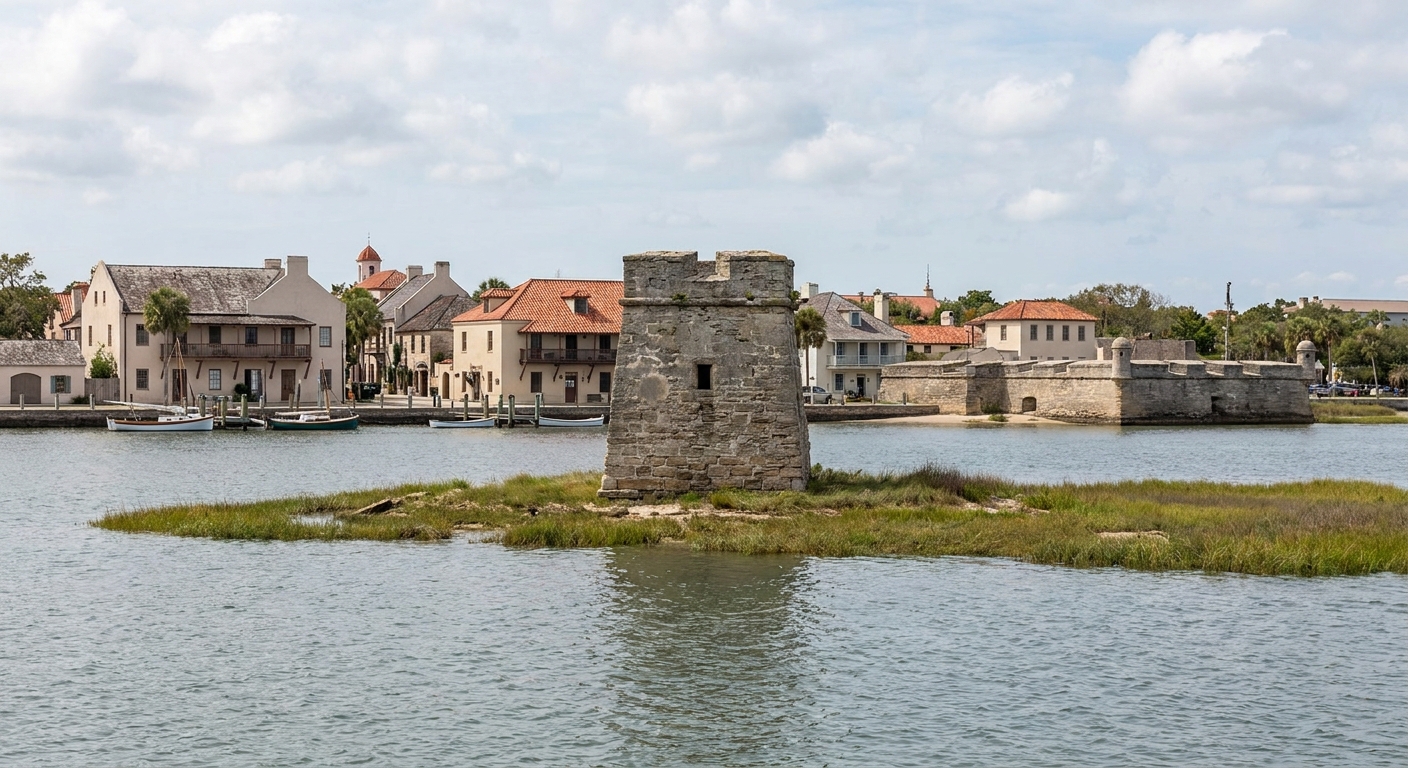
January falls entirely outside the Atlantic hurricane season, which opens June 1 and closes November 30 with its peak on September 10, so no plan made in this month needs a tropical forecast attached to it. The month also hands you 65.5°F for the kind of day that flattens people in July: two stone forts, a tower to climb, and several miles on foot between them.
Castillo de San Marcos is, in the Park Service’s careful wording, the oldest masonry fortification in the continental United States, a qualifier that leaves Puerto Rico’s Spanish forts out of the comparison. Adults 16 and up pay $15 and the ticket stands for seven consecutive days. First admission is 9:00 a.m., last admission 5:00 p.m., exit at 5:15. Down the coast, Fort Matanzas preserves a coquina watchtower completed in 1742, and everything there, ferry included, is free. Both forts are built of coquina, which the Spanish used because it was the only local stone.
The stone does not change with the season, but the opening hours do. The St. Augustine Lighthouse runs 9:00 a.m. to 6:00 p.m. from October 1 to February 28, with the last ticket sold at 5:30 p.m., against 6:30 p.m. and a 6:00 p.m. last ticket from March. The 1874 tower is included in general admission, though we could not read that admission price at the source and will not invent one. Children under 44 inches stay at the bottom, and those above it climb under their own power.
Free in January, and free all year: Fort Matanzas in its entirety, boat crossing included, provided each person collects a pass at that monument’s own visitor center rather than the city one downtown. The beach is the other free hour. Wet sand below the mean high-water line is public under Florida law, while dry sand above it can be private, so keep the walk on the firm part.
St. Augustine in January: a two-day itinerary
Day one opens at the Castillo’s 9:00 a.m. admission, when the sun has been up under two hours and the coquina is still cold to the hand: $15, seven days of validity, an hour on the gun deck over the river. Give the middle of the day to the waterfront, because that is when 65.5°F arrives. Drive south after lunch for Fort Matanzas and its free pass. The river’s name records a killing, matanzas being the Spanish for slaughters, tied by the Park Service to the massacre of French Huguenots. Be back in town by the 5:48 p.m. sunset.
Day two starts at the lighthouse when it unlocks at 9:00, tower included, anyone under 44 inches staying on the ground. Spend the afternoon on the beach on foot, on the public wet sand, with the 62.6°F water for company rather than recreation. If the sky delivers the one inch-plus day the month usually holds, yesterday’s Castillo ticket is still good, the lighthouse holds its last ticket until 5:30 p.m. through February 28, and the drive south waits a day without penalty.
St. Augustine in January vs December and February
| Measure | December | January | February |
|---|---|---|---|
| Average high | 67.5°F | 65.5°F | 68.9°F |
| Average low | 45.8°F | 42.9°F | 46.1°F |
| Precipitation | 2.78 in | 3.28 in | 2.86 in |
| Days with 0.10 in or more | 4.4 | 5.2 | 4.8 |
| Sea surface | 66.0°F | 63.8°F | 63.8°F |
December runs the warmest water of the three at 66.0°F, February the warmest air at a 68.9°F average high, and January sits under both: 65.5°F by day, 42.9°F at night, 62.6°F at the surface. January is also the wettest of the three, at 3.28 inches spread over 5.2 measurable days, against December’s 2.78 inches over 4.4 days and February’s 2.86 inches over 4.8.
Shift four weeks forward and you buy 3.4°F of afternoon and 1.2°F of ocean, and you give up nothing in rain. Shift four weeks back and the sea is 3.4°F warmer again and the month is drier, but you land in the holiday weeks, and the Castillo shuts for Christmas Day, one of only two closures it takes all year.
Is January a good time to visit St. Augustine?
Yes, if your St. Augustine is a walking one. Two forts, a tower, a waterfront, 65.5°F in the afternoon and no tropical forecast to watch between June and November. No, if the trip was built around the beach: 62.6°F at the surface and 6.2 nights at 32°F or below are not the makings of a swimming holiday, whatever the Florida postcards promise.
If the water is the point, December reads 66.0°F and February only 63.8°F, so December is the shift that actually buys warmth, with the Christmas closure accepted as the price. If daytime comfort is the point, February’s 68.9°F average high costs you four weeks of patience and nothing else that we can measure.
Among the three, only January puts the sea below 63°F, and that settles the itinerary instead of spoiling it: the coast becomes a walk, and the two coquina forts get the whole weekend.
The last word
Two nights, one $15 ticket good for seven days, one free boarding pass collected in person, and a coat you will be carrying by eleven. The Park Service dates the founding of St. Augustine to 1565. The line about the oldest continuously occupied city that travels everywhere with that date appears on none of the Park Service pages we read, so we serve the date and leave the superlative where we found it. One last clock: on January 15 the lighthouse sells its final ticket at 5:30 p.m., eighteen minutes before the sun sets.
Sources & data for this guide
- January normals, rain days and freezing nights · NOAA NCEI monthly normals 1991-2020, station USW00013889, Jacksonville International Airport · checked Sep 23, 2026
- December and February normals, same station and same period · NOAA NCEI · checked Sep 23, 2026
- Sea surface 62.6°F, mean of daily maxima 2015-2024 · Open-Meteo Marine API · checked Sep 23, 2026
- Daylight, sunrise and sunset on January 15, converted to Eastern time · sunrise-sunset.org · checked Sep 23, 2026
- Castillo de San Marcos fees, hours and coquina construction · National Park Service · checked Sep 7 and Sep 8, 2026
- Fort Matanzas free entry, boarding passes, ferry season and the 1742 watchtower · National Park Service · checked Sep 23, 2026. Daily departure times could not be read at the source, so we give none.
- 5.0% St. Johns County transient rental tax with the 6% state sales tax · Florida Department of Revenue, form DR-15TDT · checked Sep 23, 2026
- Lighthouse seasonal hours, the 1874 tower and the 44-inch rule · St. Augustine Lighthouse & Maritime Museum · checked Sep 23, 2026. We could not read a general admission price, so we quote none.
- Hurricane season dates and the September 10 peak · NOAA National Hurricane Center · checked Sep 23, 2026
- Beach warning flags and public wet sand · Florida Statutes s. 380.276 and s. 163.035 · checked Sep 23, 2026
- JAX and MCO passenger boardings, CY2024 · Federal Aviation Administration · checked Sep 23, 2026
- We found no occupancy series and no monthly room-rate series for St. Johns County, and we verified no hotel, rate or restaurant. Hours and fees change: check the Park Service before you drive.
To plan your stay
- Things to Do in St. Augustine: Castillo Tickets, Fort Matanzas Ferry and Lighthouse Hours
- Where to Stay in St. Augustine: Historic District, the Beach and the 5% Lodging Tax
- Airport to St. Augustine: JAX, MCO, Rental Cars and Eastern Time
- St. Augustine Know Before You Go: Castillo Fees, the Fort Matanzas Ferry Pass and Beach Rules