
ST. AUGUSTINE · KNOW BEFORE YOU GO · 29.9° N
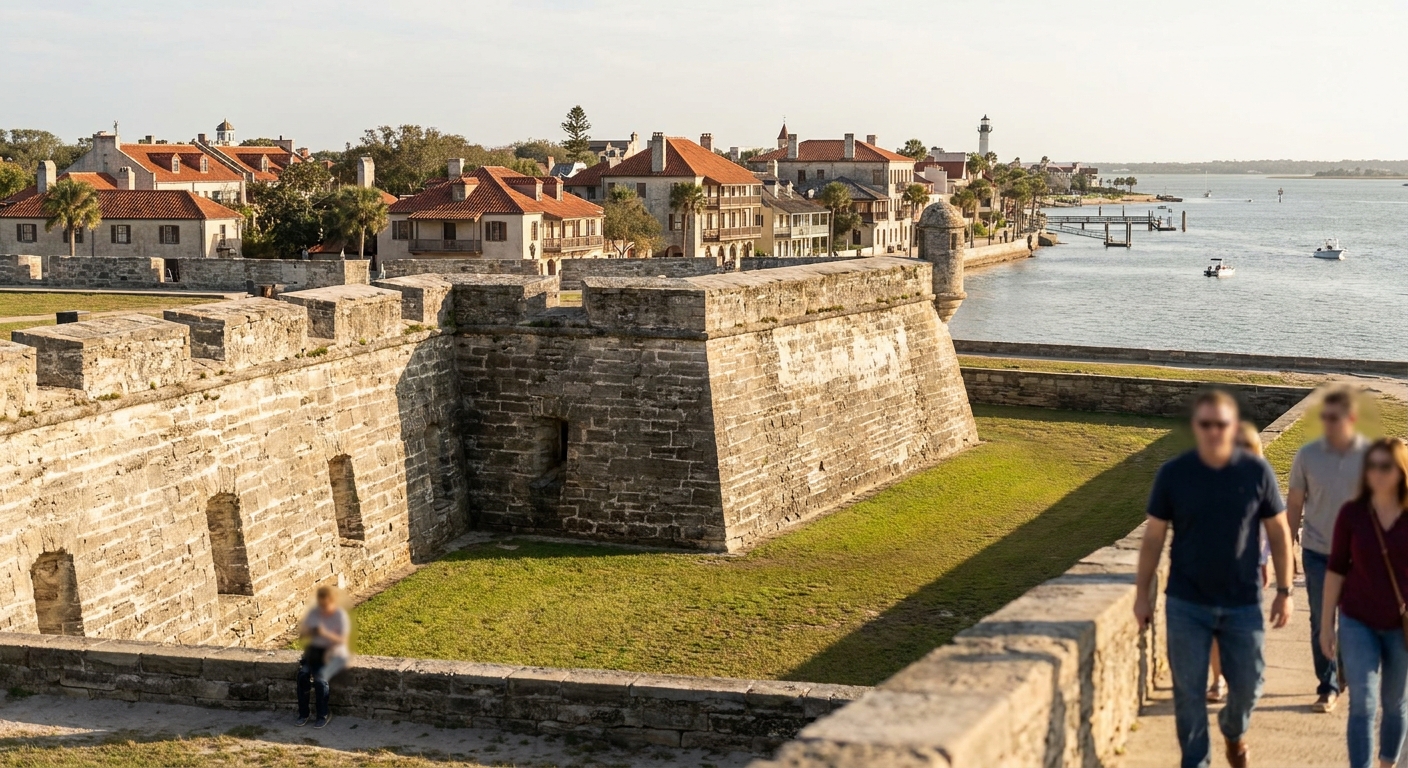
The Spanish were here in 1565, and the coquina fort they eventually built still anchors the north end of town. Age is the selling point, and it holds up. What trips up a first visit is smaller than history: a free boarding pass you cannot collect downtown, a national monument that stops letting anyone in at 5:00 p.m. sharp, and a strip of dry sand above the tide line that may belong to the house behind it.
Winter is the draw, with a caveat that catches northern visitors off guard. January averages a high of 65.5°F, a low of 42.9°F, and 6.2 nights at or below freezing. Every climate figure here comes from NOAA’s 1991–2020 normals at station USW00013889, Jacksonville International Airport, the nearest station with a full record, so read them as regional rather than street-level. Bring a real jacket for evenings on the water.
KNOW BEFORE YOU GO · ST. AUGUSTINE
Two federal sites carry the visit: one costs $15 and closes early, the other is free but hands out its ferry passes only at its own front desk.
TWO NPS UNITS · $15 CASTILLO TICKET, 7 DAYS · FREE MATANZAS PASS AT THE FORT
Go for: a masonry fort you can walk the top of, a free boat to a 1742 watchtower, and Atlantic beaches a short drive from both.
Think twice before: saving the Castillo for late afternoon, or looking for the Matanzas ferry pass anywhere other than the Fort Matanzas Visitor Center.
Tickets and hours: National Park Service · Lodging tax: Florida Dept. of Revenue · Normals: NOAA · full sources at the end
On this page
- Is St. Augustine the oldest city in the US?The 1565 date, and the superlative we could not source
- Castillo de San Marcos ticket price and hours$15 for seven days, last entry 5:00 p.m.
- Fort Matanzas ferry boarding passFree, and issued at the fort only
- Time zone in St. AugustineEastern, and the river that sets the line
- Beach access, warning flags and lodging taxWet sand, five flag colors, 11% on the room
Arrival sorts itself quickly. Jacksonville’s JAX is the nearest large airport, a medium hub that boarded 3,749,791 passengers in 2024 against 27,859,783 at Orlando MCO (Federal Aviation Administration, CY2024). Hubs and fares are compared in the Florida flights guide, and drive times in getting around Florida. For what fills the days, things to do and the three-day plan carry the itineraries.
Is St. Augustine the oldest city in the United States?
The claim is on half the signs in town: oldest continuously occupied city in the United States. It does not appear on any National Park Service page we read, and we could not tie it to a primary source we had in hand. That is not a denial. It’s a gap in our own checking, and naming it beats repeating a line lifted off a brochure.
What the Park Service does state, with no hedging, is the date. Writing about the events that gave the Matanzas river its name, it places the first conflict in 1565, “the year of the founding of St. Augustine.” A federal source, a year, no superlative attached to it.
So the version you can repeat at dinner without being corrected: Spanish St. Augustine dates to 1565, and the Castillo de San Marcos is the oldest masonry fortification in the continental United States. The NPS picks that word deliberately, since older Spanish fortifications stand in Puerto Rico. The town’s own superlative belongs to the tour guides. The 1565 date belongs to the record.
Castillo de San Marcos tickets: admission and hours
Admission is $15.00 for anyone aged 16 and above, and the ticket stays valid for seven consecutive days. That second half rarely registers at the window. It means a rushed first walk on the gundeck can be repeated at 9:00 the next morning for nothing extra, when the courtyard is cooler and emptier. Keep the stub in the same pocket as the car key.
Children aged 15 and under are admitted free, with one condition the fee page states outright: they must be accompanied by an adult. A kid who turns 16 during the trip pays the full $15 from that birthday on. The Castillo is one of two NPS units in town, and how it sits against Florida’s park passes is laid out in the Florida national parks guide.
First admission is 9:00 a.m., last admission 5:00 p.m., and everyone is out by 5:15 p.m. That quarter hour is the lesson. This is not an after-the-beach stop: turn up at 4:50 and you have paid $15 for twenty-five minutes inside. Doors open seven days a week, closing only for Thanksgiving Day and Christmas Day, so the fix is another morning rather than a sprint.
The walls explain themselves once you put a hand on them. The Park Service says it in one line on its Stories page: “The Castillo is constructed from a unique stone called coquina. The Spanish built with it because it was the only local stone.” Shell and sand pressed into rock, quarried nearby because nothing else was at hand. Fort Matanzas downriver is built of the same stuff, and comparing the two takes about ten seconds.
Fort Matanzas boarding pass
Everything at Fort Matanzas National Monument is free of charge, the ferry to the fort included. The tower it carries you to is coquina, completed in 1742, built to watch the southern approach to Spanish St. Augustine. The river carries a grim name: matanzas is the Spanish word for slaughters, after the killing of French Huguenots here. The Park Service sets the stakes simply, noting that whoever controlled Florida controlled the rich shipping lanes out of the Spanish Caribbean.
The pass is the catch. Boarding passes are free but issued at the Fort Matanzas Visitor Center, at the monument itself, and not at the St. Augustine city visitor center downtown. Every person in the party needs one, at every age, infants on a hip included.
Getting that wrong costs a drive rather than a dollar. The monument sits south of town on the coast, so a family that queues downtown for a pass nobody hands out there ends up driving south anyway, collecting passes, then waiting for a boat. Departure times we could not read at the source. The ferry service year runs Oct 1 to Sep 30, and the daily schedule is worth asking for at the visitor center desk when the passes are handed over.
Is St. Augustine on Eastern time?
St. Augustine keeps Eastern time, on the same clock as Orlando, Tampa and Miami. The boundary that decides it is the Apalachicola River, written into federal regulation at 49 CFR 71.5(f): east of that river the state runs Eastern; the western Panhandle runs Central.
The question comes up here because plenty of visitors arrive across the state rather than down it. Drive in from the western Panhandle and the hour disappears somewhere near the Apalachicola, usually while nobody is looking at a phone. Anyone holding a 9:00 a.m. plan after a Panhandle start should check which clock the phone picked up en route. Road timings across Florida sit in getting around, and the seasonal picture in the month-by-month page.
Beach access in St. Augustine
Florida draws its beach line at the mean high-water mark. Wet sand below it is public. Dry sand above it can be private, and Florida Statutes s. 163.035(2) bars a local government from adopting or keeping a rule based on customary use above that line without a judicial declaration first. A stretch of coast can therefore be entirely walkable at the waterline and off limits at the dune.
The warning flags are a statewide vocabulary worth learning before the first swim. Double red: the water is closed. Single red: high hazard. Yellow: medium hazard. Green: low hazard, still swim with care. Purple is not a surf color at all, it signals dangerous marine life and flies alongside one of the others.
No law compels a beach to fly any of them. An empty pole tells you nothing about the rip current underneath, and a beach without lifeguards has nobody to raise a color in the first place. The same caution applies behind you on the sand: keep to the wet strip when you pass private frontage, and read chairs, cabanas and posted signs above the tide line as somebody’s property.
Then the bill. St. Johns County, the county around St. Augustine, levies a 5.0% transient rental tax, filed and paid with the 6% state sales tax. Eleven percent lands on top of the nightly rate a booking site quotes, and across a week that is a line item rather than a rounding error. Budget it with the Florida cost guide, then pick the area in where to stay.
Some figures we will not print. The lighthouse posts its hours, 9 a.m. to 6 p.m. from Oct 1 to Feb 28 with the last ticket sold at 5:30 p.m., and 9 a.m. to 6:30 p.m. from Mar 1 to Sep 30 with the last ticket at 6 p.m. It restricts the tower to children over 44 inches, who must climb under their own power. Its general admission price we could not read at the source: the only figure there was a $500 Lens Room Tour, a specialty visit rather than the door rate. Ask at the ticket window.
Sources & data for this guide
- Castillo admission, $15 for ages 16+, valid 7 consecutive days, under 15 free with an adult · NPS Castillo de San Marcos, Fees · checked Sep 11, 2026
- Castillo hours, first admission 9:00 a.m., last admission 5:00 p.m., exit 5:15 p.m., closed Thanksgiving and Christmas · NPS Castillo de San Marcos, Hours · checked Sep 11, 2026
- Coquina as the only local stone · NPS Castillo de San Marcos, Stories page · checked Sep 11, 2026 · editorial note: the line is absent from the index, learn and FAQ pages, so a missing fact on three pages is not a missing fact at the source
- Fort Matanzas free of charge including the ferry, boarding passes issued at the Fort Matanzas Visitor Center, one per person at every age · NPS Fort Matanzas, Fees · checked Sep 11, 2026
- Ferry service year Oct 1 to Sep 30 · NPS Fort Matanzas · checked Sep 11, 2026 · daily departure times could not be read at the source and are deliberately not given here
- Founding date of 1565 and the naming of the Matanzas river · NPS Fort Matanzas, History & Culture · checked Sep 11, 2026
- 1742 completion of the coquina watchtower · NPS Fort Matanzas · checked Sep 11, 2026
- Eastern time east of the Apalachicola River · 49 CFR 71.5(f) · checked Sep 11, 2026
- Beach warning flags, five colors, none legally compulsory · Florida Statutes s. 380.276 and Volusia County Beach Safety · checked Sep 11, 2026
- Customary use above the mean high-water line · Florida Statutes s. 163.035 · checked Sep 11, 2026
- St. Johns County 5.0% transient rental tax with the 6% state sales tax · Florida Department of Revenue, form DR-15TDT · checked Sep 11, 2026
- Airport boardings, JAX 3,749,791 and MCO 27,859,783 · Federal Aviation Administration, CY2024 · checked Sep 11, 2026
- January normals and freezing nights · NOAA NCEI 1991–2020, station USW00013889, Jacksonville International Airport · checked Sep 11, 2026
- Lighthouse hours and the 44-inch tower rule · St. Augustine Lighthouse & Maritime Museum · checked Sep 11, 2026
- Open admission: we have no verified hotel, room rate or restaurant for St. Augustine, no verified lighthouse general admission price, and no primary source for the oldest-city title · verification incomplete as of Sep 8, 2026