
ST. AUGUSTINE · THE THREE-DAY PLAN · EASTERN TIME
St. Augustine hands a visitor two federally run Spanish forts, a working lighthouse tower from 1874 and a stretch of Atlantic beach, all inside a short driving radius. The National Park Service dates the town’s founding to 1565 and calls the Castillo de San Marcos the oldest masonry fortification in the continental United States, a wording that deliberately leaves Puerto Rico’s older walls out of the comparison.
Three days fits comfortably, and the ticket structure is part of why: $15.00 buys seven consecutive days at the Castillo, and everything at Fort Matanzas, the ferry included, costs nothing. What eats a day is the light and the cutoffs. Last admission at the fort is 5:00 p.m. On January 15 the sun sets at 5:48 p.m.
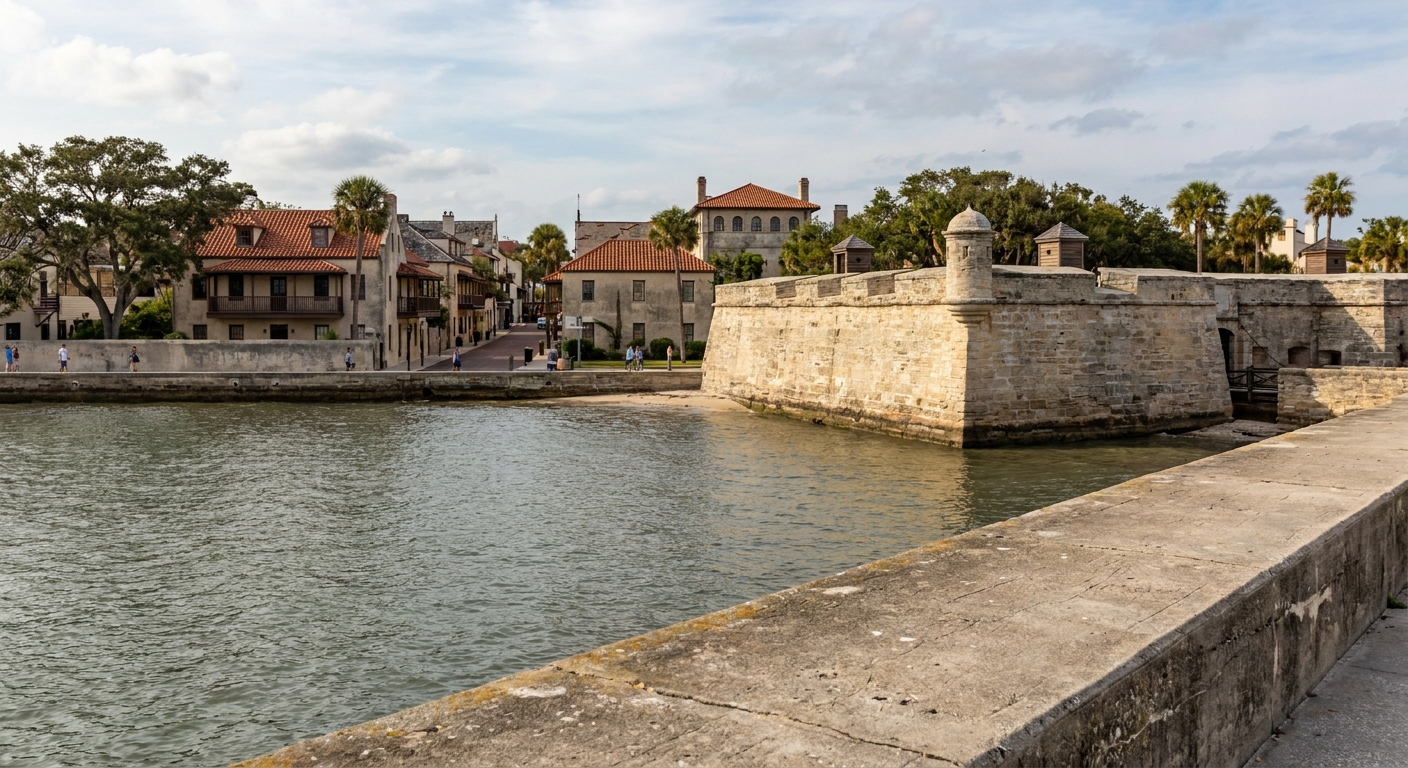
THREE DAYS AT A GLANCE · ST. AUGUSTINE
Three days covers both federal forts, the 1874 lighthouse tower and one beach afternoon, if the mornings are built around a 9:00 a.m. opening, a 5:00 p.m. cutoff and a boarding pass you can only collect at Fort Matanzas.
CASTILLO $15, GOOD 7 DAYS · FORT MATANZAS FREE, FERRY INCLUDED · LAST ADMISSION 5:00 P.M.
Go for: Spanish coquina masonry at two federal sites, a tower from 1874 you climb under your own power, and one admission that keeps working for a week.
Think twice before: booking September nonrefundable. Atlantic hurricane season runs June 1 to November 30 and peaks on September 10.
Fees and hours: National Park Service · Tower hours: St. Augustine Lighthouse & Maritime Museum · Normals: NOAA NCEI station USW00013889 · full sources at the end
On this page
- Is three days enough in St. Augustine?What three days covers, and what it drops
- Day 1: Castillo de San Marcos and the historic district$15, good for 7 days, out at 5:15 p.m.
- Day 2: St. Augustine Lighthouse and the beachSeasonal tower hours and the 44-inch rule
- Day 3: Fort Matanzas and the coast southFree fort, free ferry, pass in person
- Mistakes to avoid on a St. Augustine itineraryThe boarding-pass desk and the 5:00 p.m. cutoff
- Is one day enough for St. Augustine?One day against a seven-day ticket
- What three days costs in tickets and fees$30 in federal admissions for two adults
- St. Augustine itinerary in winter or in summer10h29m of light in January, 13h55m in July
- What to skip with only three daysThe drives that do not fit
- Best month to visit St. AugustineSt. Augustine month by month
- Where St. Augustine fits in a Florida tripThe town guide
Two of Florida’s eleven National Park Service units sit in this one town. Neither asks much at the gate: one wants $15.00 for a week of entries, the other wants a free boarding pass collected in person, at the fort. Hours, not prices, are what a three-day visit has to be arranged around.
Is three days enough in St. Augustine?
Yes, with slack left over. Three days holds the Castillo, the lighthouse tower, Fort Matanzas with its ferry crossing and one long beach afternoon, without a single dawn alarm. What it will not hold is a day trip with a drive at each end: the Everglades and Key West belong to a longer route, and Orlando’s parks want a trip of their own.
The format suits travelers who like one fixed anchor each morning and open time after lunch. History-minded couples, families with children tall enough for the tower stairs, anyone driving up from Orlando or down from Jacksonville for a long weekend. It suits a beach-only trip less well, since two of the three mornings here are spent inside masonry, and the Gulf side does sand better.
The figure that settles the question is the seven-day validity on the Castillo ticket. One $15.00 adult admission covers entries on seven consecutive days, so the fort does not have to be finished in one push. Walk in on the first morning, leave when the heat arrives, come back on the third afternoon at no extra charge. Children 15 and under enter free, accompanied by an adult.
Castillo de San Marcos and the historic district: day 1 of a St. Augustine itinerary
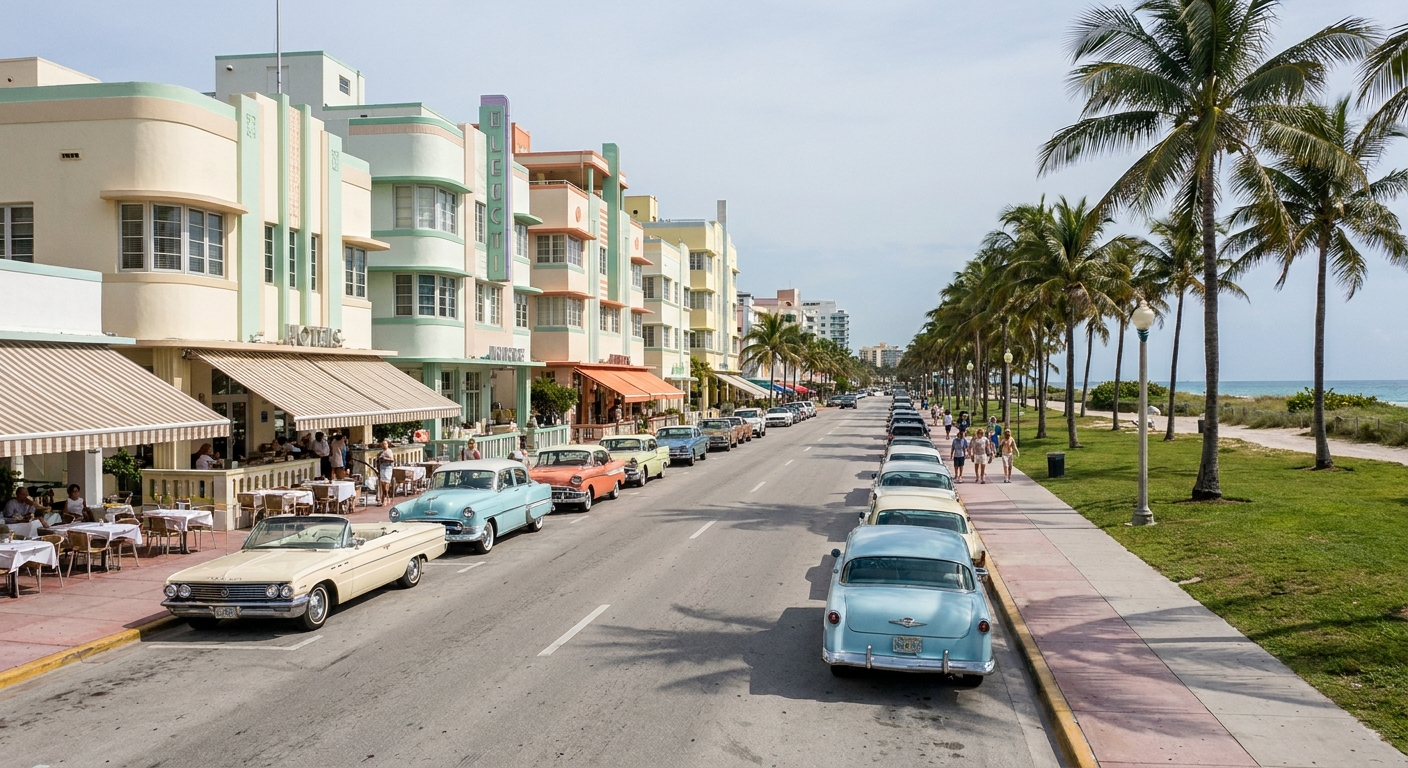
Adults aged 16 and above pay $15.00, valid for seven consecutive days, and anyone 15 or under gets in free with an adult. The Park Service is careful about what the building is: the oldest masonry fortification in the continental United States, raised by the Spanish to defend Florida and the Atlantic trade route. The stone is coquina, and the NPS explains that choice without romance. It was the only local stone.
First admission is 9:00 a.m., last admission 5:00 p.m., and everyone is outside by 5:15 p.m. The fort opens seven days a week and closes only on Thanksgiving Day and Christmas Day. In July, when the average high runs 91.9°F, that 9:00 a.m. slot is the humane one. In January, with a 65.5°F high, midday on the gun deck is the pleasant hour.
Around the fort, day one is a walking day, and the seven-day window keeps it loose: step out at noon, come back at four on the same ticket. St. Augustine keeps Eastern time, like Orlando, Tampa and Miami, so nobody flying in loses an hour to the clock. Jacksonville is the nearer airport and the smaller one, with 3,749,791 passengers boarded in 2024 against 27,859,783 at Orlando (the airport comparison goes further).
One claim you will not read here: that this is the oldest continuously occupied city in the country. It is repeated everywhere and it appeared on none of the Park Service pages we opened, so the 1565 founding date stands and the superlative waits for a source. The same discipline applies to beds and dinners. No room rate, no restaurant, no named property has passed verification, so none is named.
St. Augustine Lighthouse: day 2 of a St. Augustine itinerary
The tower dates from 1874, and general admission includes climbing it. Hours split by season: 9:00 a.m. to 6:00 p.m. daily from October 1 to February 28, last ticket sold at 5:30 p.m., then 9:00 a.m. to 6:30 p.m. from March 1 to September 30, last ticket at 6:00 p.m. Children under 44 inches are restricted from the stairs, animals too, and children over 44 inches must climb under their own power. Plan for no carrying.
The Atlantic fills the back half of the day. Read the flags before the water: double red means the water is closed, red high hazard, yellow medium, green low hazard with caution, and purple, flown alongside another flag, dangerous marine life. No Florida law compels a beach to fly any of them, which matters on an unstaffed stretch (our safety notes take that further). Sea surface off town averages 62.6°F in January and 84.5°F in July.
A gap to plan around: we could not read the lighthouse’s general admission price at the source. The only figure the site showed was $500 per person for a Lens Room Tour, which is a special visit rather than the gate price, and passing it off as one would be dishonest. Expect a paid ticket, confirm the amount when you buy it, and treat day two as the day with an open number on it.
Fort Matanzas and the coast south: day 3 of a St. Augustine itinerary
Fort Matanzas National Monument charges nothing. Not the grounds, not the fort, not the ferry that carries you across the river to reach it. Among the sites in Florida’s federal roster, it is the rare one where the only currency is patience.
The free boarding pass is issued at the Fort Matanzas Visitor Center, and only there. The city visitor center in downtown St. Augustine does not hand them out. Every family member of any age needs a pass of their own, so a party of five collects five. Drive south first, get the passes, then build the morning around the crossing you were given.
What you cross to is a fortified coquina watchtower completed in 1742, built to guard the southern approach to the Spanish military settlement upriver. The river’s name records what happened here in 1565: matanzas is Spanish for slaughters, after the massacre of the French Huguenots. The Park Service is blunt about the stake behind all of it, that whoever controlled Florida controlled the rich shipping lanes coming out of the Spanish Caribbean.
Departure times are the missing piece. The Fort Ferry Service runs on an October 1 to September 30 cycle, and we could not read the daily timetable at the source, so no hour for it appears here. Ask at the visitor center desk when you pick up the pass, and ask before you commit to a lunch plan, because the crossing sets the shape of the morning.
That leaves the afternoon south of town free. Wet sand below the mean high-water line is public everywhere in Florida, while above the line statute 163.035(2) means dry sand can be private unless a court has ruled otherwise, so read the signs at unfamiliar access points. Day three is also where the Castillo’s seven-day ticket pays off a second time, if the first morning at the fort ran short.
St. Augustine itinerary mistakes to avoid
The costly error at Fort Matanzas costs no money, only the morning. The boarding pass cannot be collected in town, because it is issued at the Fort Matanzas Visitor Center, next to the ferry it belongs to. Families meet the all-ages rule at the counter, usually with a surprise: a toddler asleep in the stroller still needs a pass with her own name on it.
The second one has a clock attached. Last admission at the Castillo is 5:00 p.m. and the building empties at 5:15 p.m., so a 4:50 p.m. arrival buys 25 minutes inside and a 5:05 p.m. arrival buys the view from the lawn. In mid-January that cutoff falls 48 minutes before a 5:48 p.m. sunset, which makes the late afternoon feel emptier than the day really is.
Is one day enough for St. Augustine?
One day covers the Castillo and the streets around it, and little else. The fort takes a morning. The lighthouse takes a half-day once the drive and the tower queue are counted. Fort Matanzas is a separate run south with a pass to collect and a boat to wait for, and when all three get stacked into a single day, the ferry is what gets cut.
Seven-day validity changes the arithmetic for anyone within return distance. A single $15.00 adult admission covers any of seven consecutive days, so a Saturday visit plus a Wednesday return costs the same $15.00 as one long Saturday. Two short fort visits inside one week beat one exhausting one, which is an argument for a nearby base rather than a second ticket (the regional lodging guide covers the geography).
A night in town earns its place when the day is short or the drive is long. Mid-January gives 10 hours 29 minutes of daylight, sunrise at 7:20 a.m. and sunset at 5:48 p.m., which does not stretch over a fort, a tower and a ferry. St. Johns County adds a 5.0% transient rental tax to the room rate, filed with the state’s 6% sales tax, and that is the only lodging number we can hand you.
What three days in St. Augustine costs in tickets and fees
| What you pay for | Price | Detail |
|---|---|---|
| Castillo de San Marcos, ages 16+ | $15.00 | Valid 7 consecutive days |
| Castillo de San Marcos, ages 15 and under | Free | Must be with an adult |
| Fort Matanzas, all areas | Free | Boarding pass required, issued at the fort |
| Fort Matanzas ferry | Free | Included in the monument’s no-fee status |
| St. Augustine Lighthouse, general admission | Not verified | We could not read the gate price at the source |
| Lodging tax, St. Johns County | 5.0% + 6% state | Transient rental tax filed with state sales tax |
The named fees are few, and federal admission is nearly all of it: $15.00 a head at the Castillo for anyone 16 or older, nothing at Fort Matanzas, nothing for the boat. Children 15 and under walk into the Castillo free as long as an adult is with them, which makes day one and day three unusually cheap for a family of four (the family guide has more of that arithmetic).
Two adults running all three days as written pay $30.00 total in federal admissions, once, and the Castillo half of that keeps working for four more days. On top sit the lighthouse ticket, whose amount we could not confirm, and the room tax at 5.0% county plus 6% state. Everything else on the trip bill is fuel, food and parking.
What we cannot put a number on: hotel rooms, restaurant meals, a rental car, downtown parking and that lighthouse gate. None of those came from a source we would stand behind, so none is estimated. For statewide averages on cars, gas and rooms, the Florida cost guide is the place, and the driving guide handles the toll transponders.
St. Augustine itinerary by season
Daylight rearranges the order more than temperature does. On January 15 the sun rises at 7:20 a.m. and sets at 5:48 p.m., 10 hours 29 minutes in all, which puts the Castillo’s 5:00 p.m. last admission nearly at dusk and argues for the fort first thing. On July 15 sunrise is 6:33 a.m. and sunset 8:28 p.m., 13 hours 55 minutes, so the fort can wait for the 9:00 a.m. opening and the beach gets the long evening.
Seasonal hours move one of these visits and not the other. The lighthouse sells its last ticket at 5:30 p.m. from October 1 to February 28 and at 6:00 p.m. from March 1 to September 30, so a winter climb is a mid-afternoon decision. The Castillo keeps its 5:00 p.m. cutoff year-round. On weather, July’s 6.77 inches of rain and 91.9°F highs against January’s 3.28 inches and 65.5°F make the winter case, and the normals here are NOAA 1991-2020, station USW00013889 at Jacksonville International Airport.
What to skip if you only have three days in St. Augustine
The casualties are the outings with a drive at each end. The Everglades and Key West sit at the far southern end of the state, and Orlando’s theme parks want their own week rather than a borrowed Tuesday. The town’s private museums are a different sort of omission: their hours and prices did not pass our verification, so they stay out of the sequence, which is no judgment on them (the statewide roundup is looser about that).
Cramming costs the two hours that matter most. Miss the 9:00 a.m. opening at the Castillo in July, with an average high of 91.9°F, and the gun deck becomes a griddle by eleven. Reach the Fort Matanzas desk late and the crossing you wanted may already be full. In January the entire budget is 10 hours 29 minutes of light, and windshield time is the most expensive way to spend it.
The last word
Neither of these forts carries the National Park designation, and the distinction is not pedantry: in Florida that title belongs to Biscayne, Dry Tortugas and the Everglades alone, each of them a day with a boat or a long drive attached. Castillo de San Marcos asks $15.00 and a morning, in a town you can walk into from breakfast, and Fort Matanzas asks nothing at all beyond a pass and a boat ride. Book the three days, collect those passes before anything else on day three, and let 5:00 p.m. be the only alarm on the trip.
Sources & data for this guide
- Castillo fees, $15.00 for ages 16+, valid 7 consecutive days, ages 15 and under free with an adult · NPS Castillo de San Marcos, Fees · checked Sep 10, 2026
- Castillo hours, first admission 9:00 a.m., last admission 5:00 p.m., exit 5:15 p.m., closed Thanksgiving and Christmas · NPS Castillo de San Marcos, Hours · checked Sep 10, 2026
- Oldest masonry fortification in the continental United States, and coquina as the only local stone · NPS Castillo de San Marcos, Stories page (the coquina line is not on the index, learn or FAQ pages) · checked Sep 10, 2026
- Fort Matanzas free of charge including the ferry, boarding pass at the Fort Matanzas Visitor Center, one pass per person of any age · NPS Fort Matanzas, Fees · checked Sep 10, 2026
- Fort Ferry Service October 1 to September 30 · NPS Fort Matanzas · checked Sep 10, 2026 · daily departure times could not be read at the source and are not stated here
- Coquina watchtower completed 1742, the 1565 founding date, the naming of the Matanzas river and the Caribbean shipping lanes · NPS Fort Matanzas, History & Culture · checked Sep 10, 2026 · the oldest-continuously-occupied-city superlative appears on none of the NPS pages we read
- Lighthouse hours by season, last ticket times, the 44-inch rule and the 1874 tower · St. Augustine Lighthouse & Maritime Museum · checked Sep 10, 2026 · general admission price not readable, the only figure shown was a $500 Lens Room Tour, which is not the gate price
- Beach warning flags · Florida Statutes s. 380.276 and Volusia County Beach Safety · checked Sep 10, 2026
- Dry sand above the mean high-water line · Florida Statutes s. 163.035(2) · checked Sep 10, 2026
- St. Johns County transient rental tax 5.0%, filed with the 6% state sales tax · Florida Department of Revenue, form DR-15TDT · checked Sep 10, 2026
- Temperature and rainfall normals, 1991-2020 · NOAA NCEI station USW00013889, Jacksonville International Airport · checked Sep 10, 2026
- Sea surface 62.6°F in January and 84.5°F in July, means of daily maxima 2015-2024 · Open-Meteo Marine API · checked Sep 10, 2026
- Sunrise, sunset and daylight length on the 15th, converted to America/New_York · sunrise-sunset.org · checked Sep 10, 2026
- Passenger boardings, 3,749,791 at Jacksonville and 27,859,783 at Orlando · Federal Aviation Administration, CY2024 · checked Sep 10, 2026
- Hurricane season dates and the September 10 peak · NOAA · checked Sep 10, 2026
- Editorial admission: no hotel, restaurant, rental car or parking price in this guide has been verified, so none is quoted · hours and fees change, confirm with the operator before you travel.