
ST. AUGUSTINE · SEPTEMBER · THE MONTH-BY-MONTH FILE
September hands St. Augustine an afternoon that averages 87.2°F and an ocean sitting at 83.7°F, then bills you in rain: 7.56 inches, more than either August or October. The town is still in short sleeves at 9 in the morning, the water needs no coaxing, and the light holds past 7 p.m.
The catch has a date on it. The Atlantic hurricane season runs June 1 to November 30 and peaks on September 10, with most activity falling between mid-August and mid-October. That single line decides how you book rather than whether you come, and the statewide picture lives in our Florida season guide.
THE MONTH AT A GLANCE · ST. AUGUSTINE · SEPTEMBER
September keeps August’s ocean at 83.7°F, knocks 3.6°F off the afternoon, and asks you to accept 8.4 rain days and the September 10 hurricane peak in exchange.
HIGH 87.2°F · SEA 83.7°F · 7.56 IN OF RAIN · HURRICANE PEAK SEP 10
Go for: swimming at 83.7°F, sunset at 7:31 p.m., a lighthouse that stays open to 6:30 p.m. through the 30th, and a $15 Castillo ticket good for 7 consecutive days.
Think twice before: booking non-refundable, or planning a long outdoor afternoon on an unshaded gun deck when the normal high is 87.2°F.
Normals: NOAA NCEI station USW00013889 · Sea: Open-Meteo Marine · Forts: NPS · full sources at the end
On this page
- St. Augustine weather in SeptemberHighs of 87.2°F and 8.4 rain days
- Sea temperature for swimming83.7°F, and what the flags mean
- Crowds, booking and the rental tax5% county plus 6% state
- Things to do in SeptemberCastillo de San Marcos and Fort Matanzas
- A two-day plan, hour by hourThe September itinerary
- September, August or October?How the three months compare
- Is September worth it?The verdict, for and against
Two of Florida’s eleven National Park Service units stand in this one town, Castillo de San Marcos and Fort Matanzas, and neither carries the National Park designation (in Florida that belongs to Biscayne, Dry Tortugas and the Everglades). The Park Service dates the founding to 1565. The familiar title of oldest continuously occupied city in the country appears on none of the NPS pages we read, so we serve the date and leave the superlative alone.
St. Augustine weather in September: average highs, lows and rain days
| Measure | September |
|---|---|
| Average high | 87.2°F |
| Average low | 70.5°F |
| Precipitation | 7.56 in |
| Days with 0.10 in or more | 8.4 |
| Days with 1 in or more | 2.3 |
| Sea surface (mean of daily maxima) | 83.7°F |
| Daylight on September 15 | 12 h 22 min |
Every figure here comes from NOAA NCEI’s 1991-2020 monthly normals for station USW00013889, a real thermometer at Jacksonville International Airport, rather than from a reanalysis grid cell hovering over the beach. It reads 87.2°F for the average high, 70.5°F for the average low and 7.56 inches of precipitation across the month. The station sits inland at an airport, not on the dunes, so an oceanfront afternoon with a sea breeze can run a degree or two milder (est.).
Those 7.56 inches do not fall as drizzle. An average September records measurable rain on 8.4 days, about one day in three and a half, and dumps an inch or more on 2.3 of them. In practice that means most days stay dry until the afternoon builds, one or two days go properly grey, and the rest of the month is sun with a loud interruption. Pack for the interruption, not against it.
The gap between day and night runs 16.7°F, which is narrow by continental standards and explains why nothing here cools down properly. A 70.5°F dawn with September humidity still feels warm, so the bag wants quick-dry shirts rather than layers, a light rain shell that packs small, and a second pair of shoes for the day the first pair gets soaked. Sunscreen matters more in the morning than you expect: the sun is high by 10.
On September 15 the town gets 12 hours 22 minutes of daylight, sunrise at 7:09 a.m. and sunset at 7:31 p.m. Eastern (St. Augustine sits east of the Apalachicola River, so Eastern time it is). That leaves real usable light after the monuments close: the Castillo pushes everyone out at 5:15 p.m., more than two hours before the sun goes, and the lighthouse shuts at 6:30 p.m. through the 30th. The evening belongs to the water and the waterfront.
Can you swim in St. Augustine in September? Sea temperature and the beach flags
Yes, and comfortably. The sea surface off St. Augustine averages 83.7°F in September, taken from the Open-Meteo Marine API as the mean of daily maxima over 2015-2024. That last detail matters: a mean of daily peaks reads a shade warmer than a flat 24-hour average, so an early swim before the sun has worked on the top layer will feel a touch cooler than the number promises.
At that temperature nobody stands at the edge negotiating. You walk in, you stay in, and an hour later the only thing that ends the swim is hunger. Children last as long as you do. It is also the warmest water of the three-month window by a wide margin over October, which drops to 77.9°F, the temperature at which a long float starts to feel like a decision rather than a default.
We could not verify a wave or wind series for September off this stretch of coast, so we give no numbers for surf. What we can give is the signal system: Florida’s beach warning flags run double red for closed water, red for high hazard, yellow for medium, green for low hazard and purple flown alongside another flag for dangerous marine life. No law obliges a beach to fly any of them, so absence of a flag is not a green flag. More on coastal risk in our Florida safety guide.
How busy is St. Augustine in September? Crowds, booking and the county rental tax
September sits inside Florida’s wet season, which runs May through October, and inside the hurricane season that peaks on the 10th. Those are calendar facts, and they are the honest frame for the month. What they are not is a price. We found no occupancy series and no monthly room-rate series for St. Johns County, so we crown no month the cheapest and none the most expensive.
Booking behavior follows the same logic. We could not verify lead-time data either, so instead of a number of weeks we give a rule: take the refundable rate, and watch National Hurricane Center advisories in the ten days before you fly. Air is the other constraint worth knowing. Jacksonville JAX, the nearest large airport, is a medium hub that boarded 3,749,791 passengers in 2024 against Orlando MCO’s 27,859,783, so the seat map is thinner and the fare swings harder. Our flights guide has the airport-by-airport picture.
The tax line is verified and easy to forget in a budget. St. Johns County levies a 5.0% transient rental tax, filed and paid alongside the 6% state sales tax, so a short-term stay carries 11% before any resort fee or parking charge a property adds on top. We verified no hotel, no room rate and no restaurant in town, so no property gets named here. Statewide cost tiers sit in the trip-cost guide.
One upgrade genuinely changes this month, and it is location rather than square footage. A base you can walk from in the morning turns an 87.2°F afternoon into a short stroll back to air conditioning instead of a hunt for a parking space and a hot walk at each end. Everything else, bigger room, ocean view, second bathroom, buys comfort in any month. Driving and parking logic for the state sits in getting around Florida.
Things to do in St. Augustine in September: Castillo de San Marcos, Fort Matanzas and the lighthouse
The month’s real gift is a long evening attached to a warm sea. Sunset at 7:31 p.m. on the 15th gives you a swim at 83.7°F after the forts close, and the St. Augustine Lighthouse keeps its long hours, 9:00 a.m. to 6:30 p.m. with the last ticket at 6:00, only through September 30. On October 1 those hours shorten to a 6:00 p.m. close and a 5:30 last ticket, and the water has dropped to 77.9°F by then.
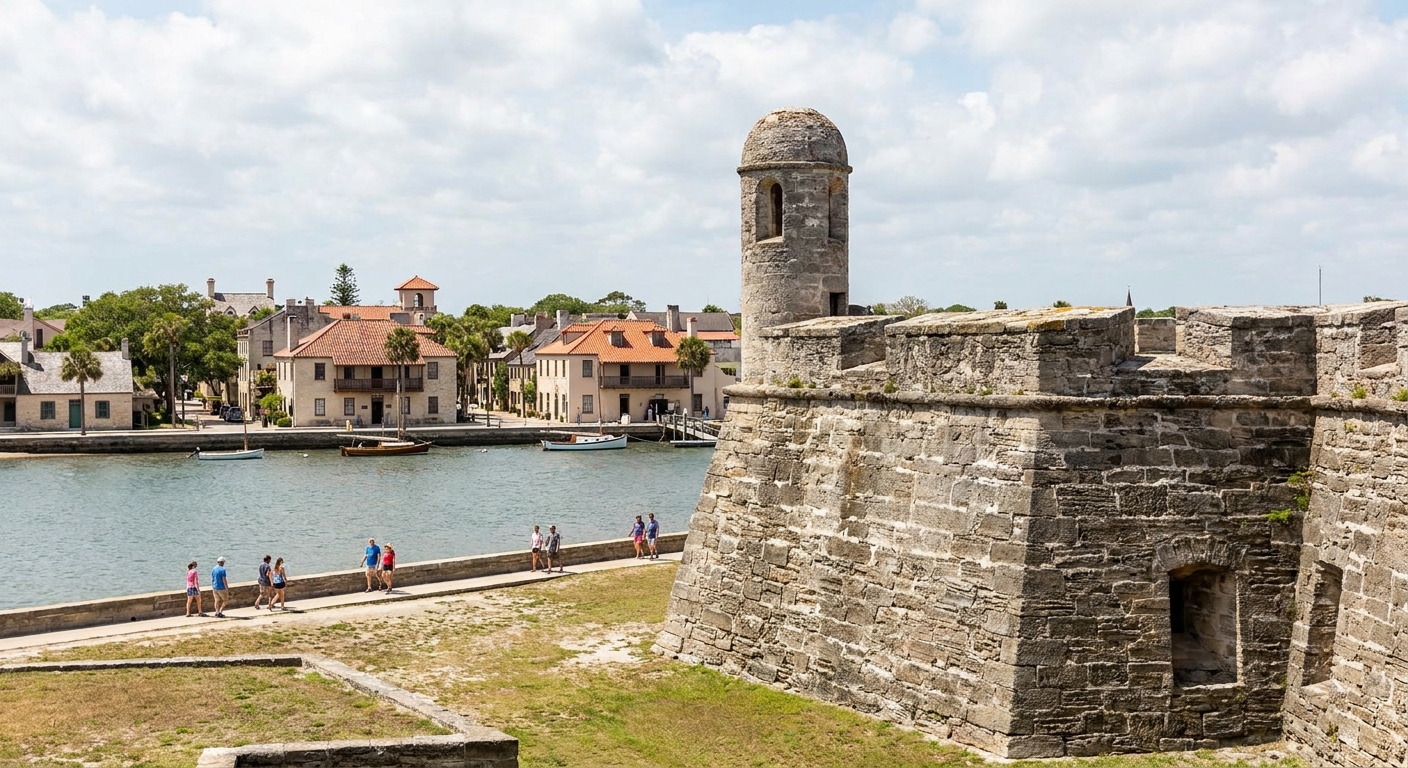
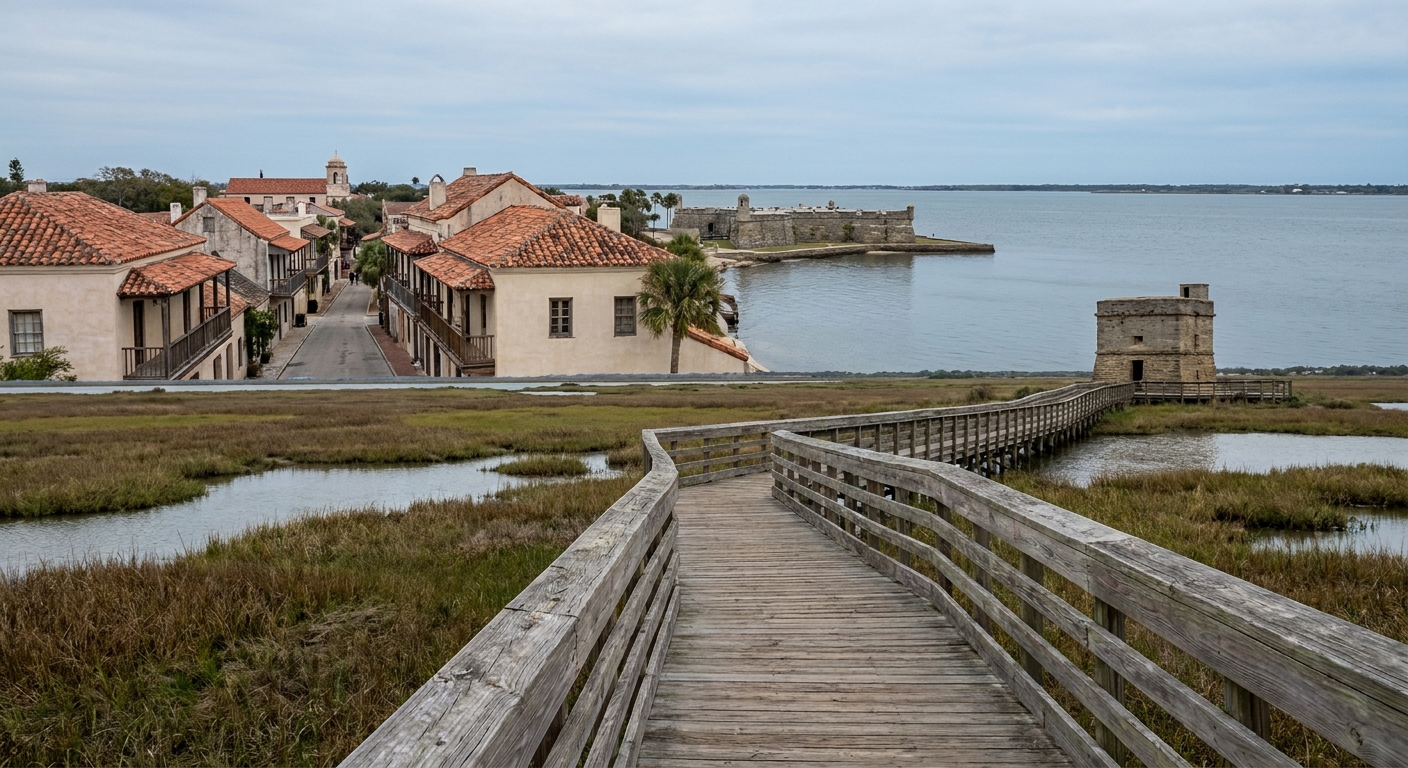
Castillo de San Marcos, which the Park Service calls the oldest masonry fortification in the continental United States, charges $15.00 for anyone 16 and up, valid for 7 consecutive days. Children 15 and under enter free with an adult. First admission is 9:00 a.m., last admission 5:00 p.m., and everyone exits at 5:15; it opens seven days a week except Thanksgiving and Christmas. Fort Matanzas, downriver, costs nothing at all, ferry included, and preserves a coquina watchtower completed in 1742.
The stone does not care what month it is. The Castillo and the Matanzas tower are both built of coquina, which the Spanish used because it was the only local stone, and that shell rock holds the same shape in February. The air is what moves: 87.2°F on an unshaded gun deck in September against 80.9°F in October, a 6.3°F difference you feel within ten minutes. Take the 9:00 a.m. opening and you walk the ramparts before the heat arrives.
Free in September, as in every month: all areas of Fort Matanzas, including the boat ride to the fort, on a boarding pass you collect at the Fort Matanzas Visitor Center rather than the city visitor center downtown, one pass per person of any age. Free too: every child under 16 at the Castillo, and the wet sand below the mean high-water line on any beach, which is public under Florida law even where the dry sand above it is private. Families should also read Florida with kids.
St. Augustine in September: a two-day itinerary
Be at the Castillo gate for the 9:00 a.m. first admission, when the coquina is still in shade and the day has not reached 87°F. Two hours covers the walls and the gun deck at a human pace. Eat indoors through the hottest stretch, 1 to 3 p.m., then take the afternoon to the beach while the water sits at 83.7°F. Dry off around 6:30, because sunset on the 15th is 7:31 p.m. and the waterfront gets its best light in the half hour before.
Day two goes south early: collect boarding passes at the Fort Matanzas Visitor Center, one for every member of the family, then cross to the 1742 tower. Ask at the desk for ferry departure times when you pick up the passes. Keep 4 to 6 p.m. for the lighthouse, buying tickets before the 6:00 p.m. cutoff, remembering that children under 44 inches cannot go up the 1874 tower and taller ones must climb it themselves. If rain settles in, your Castillo ticket runs 7 consecutive days, so tomorrow is free.
St. Augustine in September vs August and October
| Measure | August | September | October |
|---|---|---|---|
| Average high | 90.8°F | 87.2°F | 80.9°F |
| Average low | 73.4°F | 70.5°F | 61.5°F |
| Precipitation | 6.88 in | 7.56 in | 4.03 in |
| Days with 0.10 in or more | 10.3 | 8.4 | 5.1 |
| Sea surface | 84.0°F | 83.7°F | 77.9°F |
Against August, September is 3.6°F cooler by day and drops nearly two wet days, yet it takes on 0.68 inch more total rain: fewer soakings, heavier ones. The ocean barely notices the change of month, 84.0°F then 83.7°F, a difference of three tenths of a degree that no swimmer will ever detect. October is where the year turns: the high falls 6.3°F, the low falls a full 9.0°F to 61.5, rain drops by 3.53 inches, and the sea gives up 5.8°F.
Shift four weeks later and you buy dry evenings, a cool night for sleeping and 3.3 fewer wet days, and you move past the September 10 peak (though the season itself still runs to November 30). You pay for it with the water: 77.9°F is swimmable, not luxurious, and the lighthouse has already pulled its closing time back to 6:00 p.m. Going four weeks earlier buys almost nothing except 0.3°F of sea, and costs 3.6°F of afternoon heat. Our August guide makes that case in full.
Is September a good time to visit St. Augustine?
For swimmers, for anyone who wants an evening outdoors in shirtsleeves, and for travelers who can book refundable and move dates on 48 hours’ notice, yes: an 83.7°F sea and a 7:31 p.m. sunset are not small things. For anyone locked to fixed non-refundable dates, or who wilts at 87.2°F with Florida humidity, or who wants the forts at midday without hunting shade, no. The peak of the hurricane season lands on the 10th, and pretending otherwise helps nobody.
If the answer is no, take October. The same two forts, the same coquina, the same $15 ticket good for a week, but 80.9°F afternoons, 61.5°F nights and 4.03 inches of rain across 5.1 wet days rather than 8.4. You give up the warm ocean and the long lighthouse hours. Most visitors who are not there to swim make that trade happily.
September closes out the lighthouse’s long-hours season, which runs March 1 to September 30, with the ocean still at 83.7°F, a full 5.8°F above what October delivers.
The last word
Take the refundable rate, aim your best morning at the 9:00 a.m. Castillo opening, and save the water for four in the afternoon. One thing to carry down the coast road with you: Matanzas is the Spanish word for slaughters, and the Park Service names the river for the massacre of French Huguenots that gave it the title. Whoever held Florida held the rich shipping lanes coming up from the Spanish Caribbean, which is why a coquina watchtower was still worth finishing there in 1742, and why it costs nothing to see today.
Sources & data for this guide
- September, August and October normals (highs, lows, precipitation, rain days) · NOAA NCEI monthly normals 1991-2020, station USW00013889, Jacksonville International Airport · checked Sep 23, 2026
- Sea surface 83.7°F, mean of daily maxima 2015-2024 · Open-Meteo Marine API · checked Sep 23, 2026
- Daylight 12 h 22 min, sunrise 7:09 a.m. and sunset 7:31 p.m. Eastern on September 15 · sunrise-sunset.org · checked Sep 23, 2026
- Hurricane season dates and the September 10 peak · NOAA National Hurricane Center · checked Sep 23, 2026
- Castillo de San Marcos fees ($15, 7 consecutive days), hours (9:00 a.m. first admission, 5:15 p.m. exit), coquina construction and the continental-US wording · National Park Service · checked Sep 7 and 8, 2026
- Fort Matanzas free admission, boarding passes at the Fort Matanzas Visitor Center, 1742 coquina watchtower, 1565 founding date and the naming of the river · National Park Service · checked Sep 23, 2026
- Lighthouse hours (9:00 a.m. to 6:30 p.m., last ticket 6:00 p.m., March 1 to September 30), 44-inch tower rule, 1874 tower · St. Augustine Lighthouse & Maritime Museum · checked Sep 23, 2026
- St. Johns County 5.0% transient rental tax with the 6% state sales tax · Florida Department of Revenue, form DR-15TDT · checked Sep 23, 2026
- JAX 3,749,791 and MCO 27,859,783 enplanements · Federal Aviation Administration, CY2024 · checked Sep 23, 2026
- Beach warning flags and public wet sand below the mean high-water line · Florida Statutes s. 380.276 and s. 163.035, Volusia County Beach Safety · checked Sep 23, 2026
- What we could not verify: Fort Matanzas ferry departure times, lighthouse general admission price, any occupancy or room-rate series for St. Johns County, and the claim that St. Augustine is the oldest continuously occupied city in the country, which appears on none of the NPS pages we read. We verified no hotel and no restaurant in town.
To plan your stay
- Things to Do in St. Augustine: Castillo Tickets, Fort Matanzas Ferry and Lighthouse Hours
- Where to Stay in St. Augustine: Historic District, the Beach and the 5% Lodging Tax
- Airport to St. Augustine: JAX, MCO, Rental Cars and Eastern Time
- St. Augustine Know Before You Go: Castillo Fees, the Fort Matanzas Ferry Pass and Beach Rules