
SOUTH WALTON · MARCH · THE MONTH IN NUMBERS
South Walton sells itself on white sand and sixteen beach neighborhoods, from Miramar Beach at the western end to Inlet Beach at the eastern one. March is the month that trip stops being a winter idea and turns into a booking: the airport gauge at Destin-Fort Walton Beach averages a 70.7°F high, the dawn sits at 53.6°F, and the Gulf has climbed to 67.5°F.
The water is the catch. At 67.5°F it is warm enough to stand in and cold enough to end a swim early, so a March vacation here gets built around the sand, the coastal dune lakes and the 30A corridor rather than around long afternoons in the Gulf. April changes that arithmetic, and the cost of the change is four weeks of waiting.
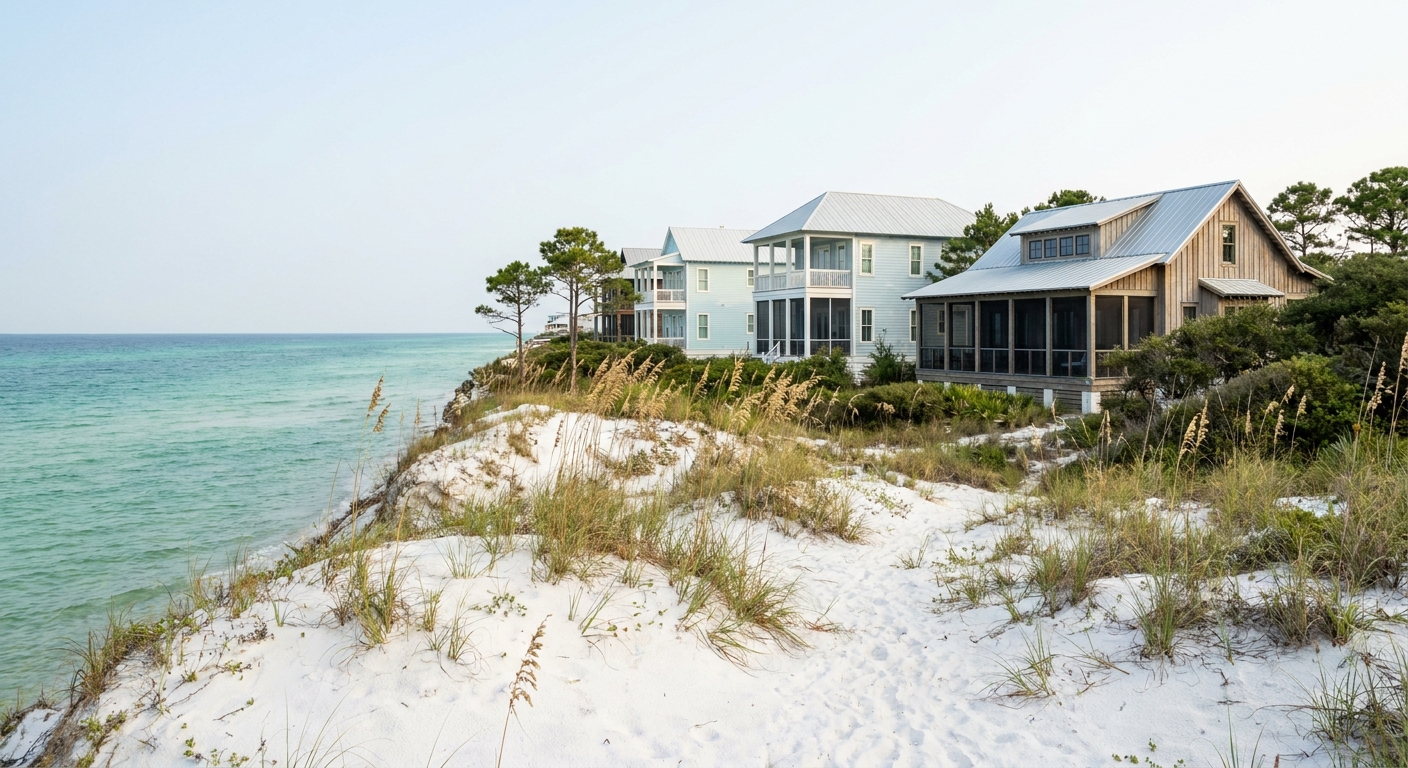
THE MONTH AT A GLANCE · SOUTH WALTON · MARCH
March gives South Walton 70.7°F afternoons, twelve hours of daylight and a calendar clear of hurricane season, at the price of a Gulf still sitting at 67.5°F.
NOAA 1991-2020 NORMALS · DESTIN-FORT WALTON BEACH AIRPORT · SEA FROM OPEN-METEO MARINE, 2015-2024
Go for: beach walking on 26 miles of sand, the 15 coastal dune lakes, the 30A corridor by bike or car, and a month that sits well outside the June 1 to November 30 hurricane season.
Think twice before: booking March as a swimming week. The Gulf averages 67.5°F, about three degrees under the average afternoon air temperature.
Air: NOAA NCEI 1991-2020 · Water: Open-Meteo Marine · Tax: Florida Department of Revenue · full sources at the end
On this page
- South Walton weather in MarchHighs of 70.7°F, lows of 53.6°F, 5.2 wet days
- Sea temperature in MarchA 67.5°F Gulf, and what that feels like
- Crowds, booking and the lodging taxThe 11% on the room, and what we could not price
- Things to do in MarchGrayton Beach, Eden Gardens and the dune lakes
- A two-day plan for South WaltonTwo days set to a 6:52 a.m. sunrise
- March, February or April?How the three months compare
- Is March worth it?Our verdict for walkers and for swimmers
Every figure here comes from a real thermometer rather than a grid cell: NOAA’s 1991-2020 monthly normals for station USW00053853 at Destin-Fort Walton Beach Airport. The water is a different animal, a marine reanalysis averaged over 2015-2024, and we flag it each time it turns up.
South Walton weather in March: average highs, lows and rain days
| March normal | Value |
|---|---|
| Average high | 70.7°F |
| Average low | 53.6°F |
| Total precipitation | 4.70 in |
| Days with 0.10 in or more | 5.2 |
| Days with 1 in or more | 1.3 |
| Nights at 32°F or below | 0.2 |
| Daylight on March 15 | 12h 02m |
NOAA’s 1991-2020 normals for the Destin-Fort Walton Beach Airport station put March at a 70.7°F average high and a 53.6°F average low, with 4.70 inches of rain across the month. That is a station measurement rather than a modeled grid cell, so what you are reading is an airfield thermometer, not a smoothed average of the coastline. It matters most overnight, where the two methods disagree the most.
Measurable rain falls on 5.2 days in an average March, counting days at 0.10 inch or more, roughly one day in six. Of those, 1.3 days deliver an inch or more. On a seven-night stay that points to one damp day, sometimes two, and about one stay in three catching a genuine soaking rather than a ten-minute shower. The other five or six days of a week are dry, and the total of 4.70 inches arrives in bursts, not drizzle.
The spread between a 70.7°F afternoon and a 53.6°F dawn is 17.1°F. That number decides the bag. A fleece or a light jacket for the morning walk, shorts by two, and something with sleeves again after sunset covers almost every day of the month. Freezing nights are rare without being extinct: the station logs 0.2 nights at or below 32°F in an average March, which works out to one March in five.
On March 15 the sun is up for 12 hours and 2 minutes, rising at 6:52 a.m. and setting at 6:54 p.m. Central time. Light that generous does two things to an itinerary. An early start costs you nothing, since the sand is lit and empty at seven, and the afternoon still holds five usable hours after a one o’clock lunch. Dinner and sunset compete for the same slot all month.
Can you swim in South Walton in March? Sea temperature and what it feels like
The Gulf off South Walton averages 67.5°F in March in the Open-Meteo marine series, taken as the mean of daily maxima over 2015-2024. That last detail changes how you read it: the figure is the warm end of each day’s range, so a full 24-hour average sits a shade below, and an eight o’clock swim will be colder than the headline number suggests.
In practice 67.5°F runs about three degrees under the average afternoon air, so climbing out is no shock. Getting in is the work. Without neoprene most adults last a few minutes before the cold wins the argument, children wade to the knees and go back to digging, and the surfers and paddlers you see out there are wearing wetsuits. Plan on standing in the Gulf rather than swimming in it, and on a heated pool doing the real swimming.
We found no monthly wind or wave series for this stretch of the Panhandle, so we put no figures on the surf. What we can flag is what a ten-year average hides: individual Marches land either side of 67.5°F by a real margin, and a run of south wind moves the water more than the calendar does. Read the flags flying at your access point on the morning you go and treat our number as a planning figure.
How busy is South Walton in March? Crowds, booking and the 11% lodging tax
March sits inside Florida’s dry season and nowhere near its storm season: NOAA dates the Atlantic hurricane season June 1 to November 30, so a March booking carries none of it. On demand we have to put our cards down. We found no occupancy series and no monthly room-rate data for Walton County, so we crown no month expensive and no month cheap. What is true by the calendar is that American school districts scatter their spring breaks through March, with dates that differ from district to district.
That leaves the booking decision to geography rather than to a price curve. We could not verify a booking window for rentals here, so we will not tell you it is nine weeks or twelve. What we can hand you is the shape of the place: sixteen beach neighborhoods along 26 miles of sand, with 63 public access points spread among them. A stay two minutes from an access point and a stay that needs the car every morning are two different vacations. Settle that first, using our Florida where-to-stay guide.
The one number we can put on the bill is the tax. Walton County levies a 5.0% transient rental tax on short stays, filed and paid alongside Florida’s 6% state sales tax, for 11% on the room rate before anything else lands. Cleaning charges, resort fees and parking are set property by property, and we could not verify what any of them add. The county rate is published by Florida’s Department of Revenue on form DR-15TDT.
If one line of the budget deserves to go up, it is the pool. With the Gulf at 67.5°F, a rental with a heated pool is the difference between a week that swims and a week that only walks, and it is the upgrade this particular month repays. Everything else, from the car to the groceries, behaves the way it does in any other Florida beach month. Our Florida trip cost guide handles the rest of the arithmetic.
Things to do in South Walton in March: Grayton Beach, Eden Gardens and the coastal dune lakes
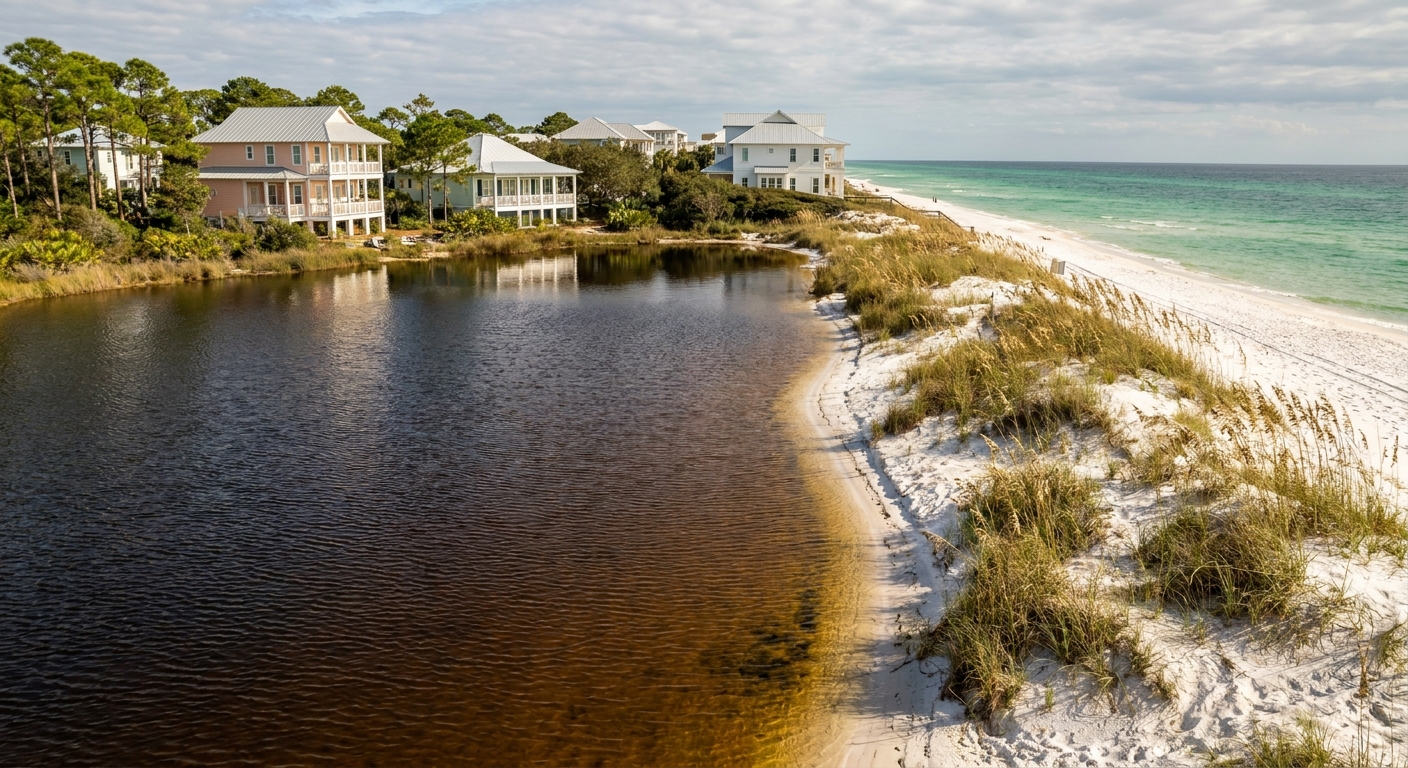
March hands you the whole coast at walking temperature. At 70.7°F an afternoon on the sand needs no shade strategy, a bike ride along 30A does not end in a change of shirt, and nothing you book for this month needs a named-storm contingency. The trade is obvious and it runs the other way in July, when the Gulf is the only comfortable place to be at two in the afternoon.
Five state parks sit in Walton County: Topsail Hill Preserve, Grayton Beach, Deer Lake, Eden Gardens and Ponce de Leon Springs. The county also holds all 15 of Florida’s coastal dune lakes, a landform the state’s environmental department says occurs in only four other places on earth, namely Australia, New Zealand, Madagascar and Oregon. The spine linking most of it is Scenic Highway 30A, designated a Florida Scenic Highway on April 9, 2008. Official state documents give the corridor as 24 miles in one place and 28 in another, so we quote neither as settled. We could not verify 2026 park entrance fees.
What March changes at those parks is the air, not the water. The Gulf’s 67.5°F becomes 71.0°F in April while the average high climbs 5.5°F over the same four weeks, so the gap between comfortable air and swimmable water closes as spring runs on. In March the parks are for boardwalks, birds, picnic tables and long stretches of empty shoreline. Come back in late spring and the same parking lot leads to a completely different day.
The free part is the access itself. Florida’s environmental department counts 63 public beach access points along the county’s 26 miles of sand, and walking through one costs nothing in March or in any other month. Parking is the variable we could not verify, priced lot by lot, so keep a line in the budget for it and arrive early on a clear Saturday.
South Walton in March: a two-day itinerary
Day one runs on the light. Sunrise at 6:52 a.m. gets you onto Grayton Beach with the sand to yourself and a jacket on, and by ten the jacket is in the car. Give mid-morning to Eden Gardens, lunch to somewhere inland, then hand the warmest stretch, roughly one to four, to the shoreline at Topsail Hill Preserve. Drive or cycle 30A east through Seaside, WaterColor and Alys Beach in the late afternoon, and be back on sand before the 6:54 p.m. sunset.
Day two belongs to the dune lakes and the inland detour: Deer Lake first thing, Ponce de Leon Springs if you want the drive, then the coast again at Rosemary Beach or Inlet Beach. If the day turns out to be one of March’s 1.3 inch-days, flip the order. Drive the corridor between neighborhoods while it falls, keep the beach for the clearing behind the rain, and count on usable light until nearly seven.
South Walton in March vs February and April
| Normal | February | March | April |
|---|---|---|---|
| Average high | 65.8°F | 70.7°F | 76.2°F |
| Average low | 47.9°F | 53.6°F | 60.1°F |
| Precipitation | 4.96 in | 4.70 in | 4.55 in |
| Days with 0.10 in or more | 5.3 | 5.2 | 4.0 |
| Sea surface (daily maxima) | 62.1°F | 67.5°F | 71.0°F |
Across the three months the air moves faster than the rain. March runs 4.9°F warmer by day than February and 5.5°F cooler than April, with the overnight lows climbing the same ladder from 47.9°F to 53.6°F to 60.1°F. Rainfall barely budges: 4.96 inches, then 4.70, then 4.55. April separates itself on wet days, at 4.0 against 5.2 in March. The water gains 5.4°F from February into March and another 3.5°F into April, all on the same marine series and the same daily-maxima basis.
Shift the trip four weeks later and you buy a 76.2°F afternoon, a 71.0°F Gulf and one fewer wet day, at whatever April does to demand on a coast with 26 miles of beach. Shift four weeks earlier and February hands back a 62.1°F sea that ends the swimming conversation, plus a 47.9°F dawn that wants a real coat, which is the trade our February page runs through in full.
Is March a good time to visit South Walton?
Yes, if the week is built on walking, cycling, birding and eating within sight of the water. A 70.7°F afternoon with twelve hours of daylight is close to ideal for that, and 5.2 wet days across 31 leave most of a stay dry. No, if the picture in your head is children in the Gulf from lunch until dinner. A 67.5°F sea does not produce that afternoon, and no amount of sunshine talks anyone into it.
If swimming is the whole point of the trip, book April instead. Four extra weeks buy 71.0°F water, a 76.2°F afternoon and one fewer wet day, and the rest of the coast behaves exactly the same. That is the entire trade, and the table above is the receipt for it.
What March offers that later months cannot is a coast at full walking temperature with no storm season anywhere on the calendar, weeks before the Gulf is warm enough to keep you in it.
The last word
Book for the sand first and the pool second, and let the water be a bonus rather than the plan. The other date worth holding in view sits at the far end of the year: NOAA puts the peak of the Atlantic hurricane season on September 10, so a March stay on this coast is one of the few Florida bookings that never needs a weather clause. Walk out at 6:52 a.m. at least once, jacket on, through one of the 63 public access points, and see how much of the 26 miles you get to yourself before breakfast.
Sources & data for this guide
- March, February and April air normals (highs, lows, precipitation, wet days, freezing nights) · NOAA NCEI monthly normals 1991-2020, station USW00053853, Destin-Fort Walton Beach Airport · checked Sep 23, 2026
- Sea surface 67.5°F in March, 62.1°F in February, 71.0°F in April, all as means of daily maxima 2015-2024 · Open-Meteo Marine API · checked Sep 23, 2026
- Daylight of 12h 02m on March 15, sunrise 6:52 a.m. and sunset 6:54 p.m. converted to America/Chicago · sunrise-sunset.org · checked Sep 23, 2026
- Hurricane season June 1 to November 30 with a September 10 peak · NOAA National Hurricane Center · checked Sep 23, 2026
- Walton County 5.0% transient rental tax and the 6% state sales tax · Florida Department of Revenue, form DR-15TDT · checked Sep 23, 2026
- 26 miles of beach, 63 public access points, five state parks and Florida’s 15 coastal dune lakes · Florida DEP Coastal Access Guide, Walton County · checked Sep 23, 2026
- Scenic Highway 30A designated April 9, 2008, with official documents giving 24 miles in one place and 28 in another · Florida Scenic Highways Program · checked Sep 23, 2026
- Sixteen beach neighborhoods · Visit South Walton, the county destination marketing organization · checked Sep 23, 2026
- Our gaps, stated plainly: we found no occupancy or monthly room-rate series for Walton County, no booking-window data, no 2026 state park entrance fees and no monthly wind or wave series, so no price ranking, gate price or surf figure appears above.