
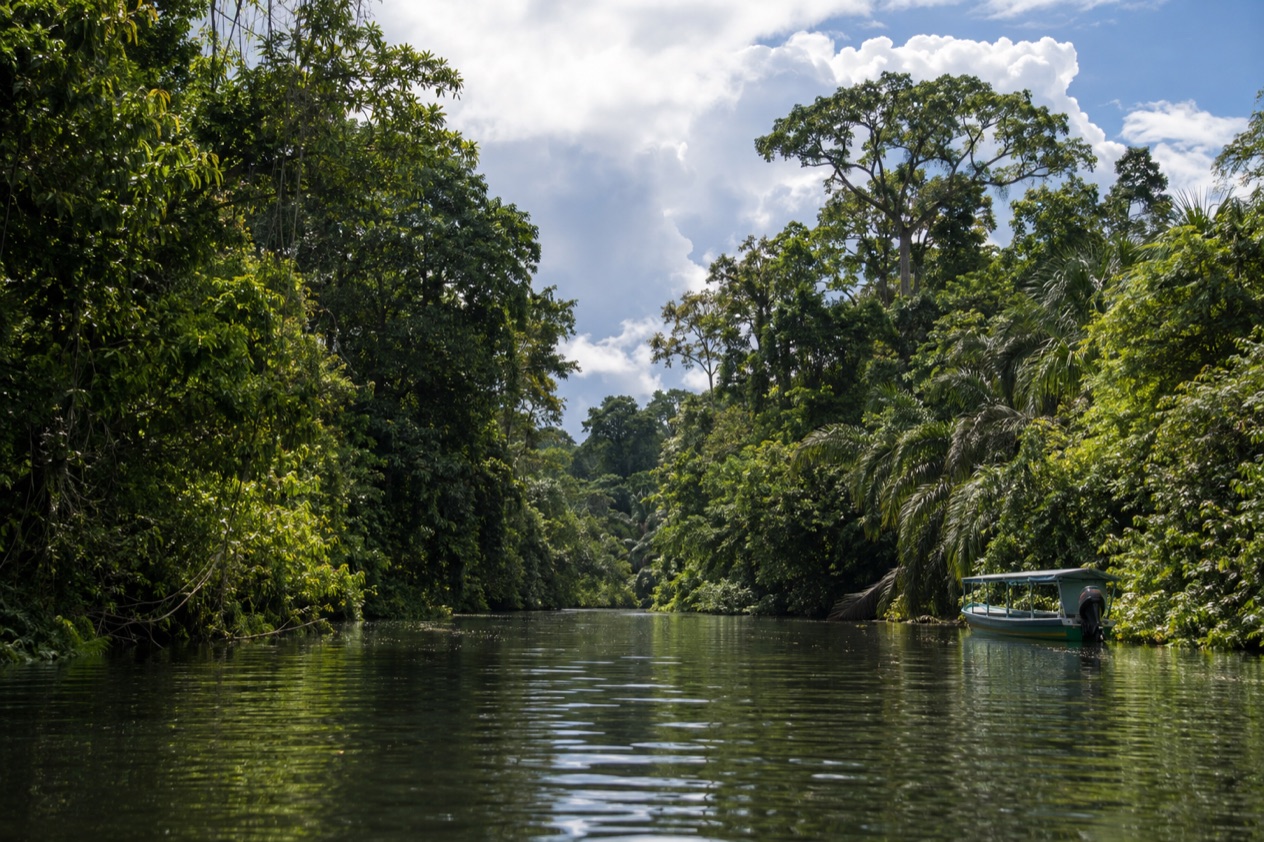
In July the canals of Tortuguero run dark and glassy at dawn, and the first sound is often a howler monkey roar rolling over the treetops while a boat engine idles somewhere down the water. By night, flashlights with red filters move quietly along the black-sand beach, where green sea turtles are beginning to come ashore. This is a wet, green, wildlife-heavy month in a village with no roads, made for travelers who want rainforest and turtles more than a dry beach day.
What is the weather like in Tortuguero in July?
July in Tortuguero is warm, humid and wet, with rain on nearly every day of the month, though not always for long. Plan on a rainforest climate where a downpour is part of the day and the sun appears between the clouds.
| Month | Average high (°F) | Average low (°F) | Rain days | Sea (°F) |
|---|---|---|---|---|
| June | 83.1 | 74.4 | 26.8 | 86.5 |
| July | 82.1 | 73.8 | 28.6 | 85.0 |
| August | 83.0 | 73.8 | 27.6 | 85.6 |
Mornings are often the best window. The air is soft, the canals are quiet, and birds are active along the banks, so boat trips that leave early tend to be the most rewarding. Rain can come at any hour on this Caribbean side, sometimes as a brief shower, sometimes as a steady gray soak that lasts through the afternoon. Heavy bursts do happen, but only a few days in the month bring really big totals.
Evenings stay warm, though the humidity makes clothes dry slowly. Daylight lasts about twelve hours and forty minutes in mid-July, so the sky darkens early evening and the night turtle walks begin after dark. Think quick-drying fabrics, a real rain jacket and shoes you do not mind getting muddy.
The light is often soft and diffused, which flatters the greens of the forest but can make photos in the canals dim under thick cloud. A dry bag for your camera is more useful here than sunglasses, although the sun can break through hard between showers.
Can you swim in Tortuguero in July?
By July, the temperature of the water allows for a long swim, but the Tortuguero coast is not a place for relaxed bathing. The Caribbean water here is bathwater warm, yet the beach faces open surf and the currents are the issue, not the temperature.
Rip currents are a real danger in Costa Rica, killing several American travelers every year, and on most beaches you will find no lifeguards and no signs warning that the water is unsafe. The beach at Tortuguero is long, dark-sanded and often rough, with waves that can arrive steeply and pull hard. Most visitors simply walk it, watch the surf and keep their feet at the edge of the foam, and that is the sensible way to treat it.
If your lodge has a pool, families and nervous swimmers will find it a better choice than the sea. Surfers rarely come here for the break. If you do wade in, stay shallow, go with others, and never swim at night when turtles are nesting. Bring a rash guard or a light cover-up and a towel that dries fast, since the air stays damp.
What to do in Tortuguero in July
The headline of the month is the beginning of green turtle nesting. These beaches see green sea turtles crawl up onto the sand mostly between about July and October, and those nights on the sand are what draw so many travelers to this month. Leatherbacks nest earlier in the year, so July belongs to the greens.
A licensed guide leads night walks in small groups, and everyone follows rules that keep noise and lights to a minimum. As with any wildlife, a sighting is a chance and not a promise, though July is a good time to try.
Beyond the beach, the village is a quiet one. A narrow dirt-and-concrete path is edged by colorful wooden houses, while small restaurants dish up rice and beans cooked in coconut milk, grilled fish and fresh fruit juices, and carved wood and painted souvenirs are sold at handicraft stands. Because there are no cars, the sound is of rain on tin roofs, frogs at dusk and now and then a boat passing.
Canal boat trips through the rainforest
Boats glide through the narrow canals that thread the forest behind the village. You may see howler and spider monkeys, sloths, caimans, basilisk lizards, kingfishers, herons and green macaws. The water mirrors the trees, and when rain taps the surface the whole scene turns silver.
Go early. Animals are busiest in the morning, and the light is softer then. In July the wet weather makes wildlife less predictable, but animals often shelter and then reappear as rain eases, so a patient guide is worth it. Wear a poncho, keep binoculars in a bag, and expect to share the canal with other boats at popular hours.
Night turtle walks
After dark, guides lead small groups along the beach with dim red light to look for nesting green turtles. You walk slowly on dark sand, sometimes for a while without seeing anything, then a guide waves you toward a shape hauling up from the surf. Watching a turtle dig a nest with her back flippers is quiet and moving.
Go with a licensed guide. Expect mud and drizzle, so wear closed shoes and dark clothing. The walk suits patient adults and older children who can stay quiet, and it is not ideal for toddlers.
The village, the beach and a rainy-day rhythm
Between outings, walk the village path from end to end, stopping at a bakery or a soda (a small family restaurant) for a plate of the day. The beach beyond is long and wild, with driftwood stacked above the tide line and clouds that move quickly. Expect to dodge showers rather than avoid them.
A local museum devoted to sea turtles is a good indoor choice on a gray afternoon, and lodges often have a covered porch and hammocks that are the real pleasure of a rainy hour.
July also carries the national holiday of July 25, the Annexation of the Partido de Nicoya, which marks Guanacaste joining Costa Rica. It is far from here, but it can mean a busier travel day for Costa Rican families.
A two-day itinerary for Tortuguero in July
Day 1 begins when you get there by boat or small plane, as the village has no road access. Settle in at your lodge, then take an early lunch of rice, beans and fish at a village soda. In the afternoon, walk the village path and the beach while the light is flat and soft, keeping to the sand and away from the surf. Sunset comes early evening, so be back at your lodge before dark.
After dinner, join a night turtle walk with a licensed guide. It is the evening’s main event in July, so keep the rest of the night light. Bring a rain jacket and closed shoes, and expect to be back late and happy to sleep.
Late in the day, climb the lookout hill if the trail is not too slick, or visit the turtle museum and browse the craft stands. If rain sets in, linger over a long dinner of coconut-milk fish and fresh juice and listen to the frogs.
Is Tortuguero busy in July?
Tortuguero is moderately busy in July, helped by the Costa Rican school break, which keeps families traveling for two weeks mid-year, and by the start of turtle season.
Since the village is tiny and you can get there only by boat or small plane, plan your stay before you leave. The canals feel busiest in the early morning, when most boats go out together. Restaurant tables are rarely a problem in a village this small, though dinner times cluster after the turtle walks.
Book your lodge and your transport early if your trip overlaps the school break, and a little later for the quieter weeks around it. Night turtle walks must be done with a licensed guide, so arrange yours when you book the room or as soon as you arrive. The weather rarely empties the village, since rain is normal here and travelers come prepared for it.
Rental cars do not matter in Tortuguero, because there are no roads in. If you drive part of the way, the transfer point is where the planning matters, so confirm your boat connection before you set out.
What to pack for Tortuguero in July
Think wet, warm and muddy, and pack light, since your bags go by boat or small plane.
- A real rain jacket or poncho, because showers come almost daily.
- Quick-drying shirts and pants, since the humidity keeps clothes damp.
- Closed shoes with grip for muddy trails and the turtle walk.
- Insect repellent and sunscreen for canals and beach.
- A dry bag for camera, phone and passport.
- Binoculars to spot monkeys and birds at a distance.
Good to know before you go
The U.S. State Department rates Costa Rica Level 2, ‘Exercise increased caution,’ due to crime; it says petty crime is common throughout Costa Rica and that violent crime also affects tourists, including armed robbery, homicide and sexual assault.
July falls inside the Atlantic hurricane season, which runs from June 1 to November 30 and covers the Caribbean coast, though its peak comes later, around September 10. Expect rain more than anything, and let your lodge help you adjust plans if weather delays a boat or flight. Since the only ways into Tortuguero are a boat or a small plane, you should leave some slack on the days you arrive and leave. Book your lodge and turtle guide first.
Tortuguero in July vs June and August
Moving a month earlier, to June, brings a slightly warmer sea and a little less rain overall, but green turtle nesting is only just getting started and the school break has not begun. It is a quieter month for travelers who care more about the forest and canals than the turtles.
Moving a month later, to August, the air is a touch warmer and the rain eases a little, while nesting is well underway. The school break is over, so rooms are often easier to find, and the wildlife and canal trips feel much the same. The Atlantic hurricane season is still running, with its busiest stretch approaching from mid-August.
Choose July if you want turtles and do not mind the family crowds of the school break. Shift to August for a calmer village with turtles still coming ashore, and to June if you want forest first and fewer visitors.
Is July a good time to visit Tortuguero?
Absolutely, July suits visitors eager for the rainforest, the canals and the season’s first green turtles, and who understand that rain comes with the experience. Wildlife lovers, photographers with patience and families with older children will do best.
It is a poorer choice for anyone hoping for a sunny beach vacation with swimming, since the surf and currents are not for casual swimmers. Travelers who dislike humidity or constant damp should pick a drier part of the country.
On arrival, sort out your turtle walk and morning canal trip first, then settle in and let the rhythm of the village take over. What makes July special here is the beginning of nesting: after dark, on a rain-washed beach, a green turtle slowly hauls herself out of the surf.
Sources
- Open-Meteo / ECMWF ERA5, normals 1991-2020 computed for the grid cell at 10.543N 83.502W, checked October 8, 2026
- Open-Meteo Marine API, average 2015-2024, checked October 8, 2026
- sunrise-sunset.org, sunrise and sunset calculated for the 15th of the month, checked October 8, 2026
- U.S. Department of State, Costa Rica Travel Information, Safety and security (https://travel.state.gov/content/travel/en/international-travel/International-Travel-Country-Information-Pages/CostaRica.html), checked October 8, 2026
- NOAA National Hurricane Center, Climatology (https://www.nhc.noaa.gov/climo/), checked October 8, 2026
- U.S. Department of State, Costa Rica Travel Advisory, issued April 1, 2026 (https://travel.state.gov/content/travel/en/traveladvisories/traveladvisories/costa-rica-travel-advisory.html), read via the State Department open data API on October 8, 2026
To plan your stay
- Things to Do in Tortuguero: Canal Boats, Turtle Nesting, Rainforest Walks and Caribbean Food
- Where to Stay in Tortuguero: Village, Beachfront and Canal Lodges
- Tortuguero National Park: Turtle Nesting, Canal Boat Tours, Hours and How to Get There
- Best Time to Visit Tortuguero: Turtle Season, Weather by Month and Canal Tours