
Early on Caye Caulker, the sand lanes of the village smell of fry jacks and strong coffee, and the first bicycles roll past hand-painted signs while pelicans settle on the dock posts. By evening the scene has moved to the Split, where people carry cold drinks to the edge of the channel to watch the sky change color. The island is small, but where you sleep still shapes your days, from the sounds at night to what you see when you step outside.
What is the best area to stay in Caye Caulker?
For a first visit, the village center is the natural choice, because the restaurants, the tour offices, the grocery shops and the waterfront all sit within a few sandy lanes of each other. Travelers who want a stretch of shoreline and a sunset drink in hand do better around the Split, while those who want a slower, more spread-out feel look to the north side. Budget travelers usually find guesthouses and simple rooms in the village, and families often like apartments or cabanas where a kitchen and some outdoor space come with the room.
Nightlife on Caye Caulker is a modest affair of beach bars, live music on a few evenings and late dinners, and it clusters around the village waterfront and the Split. If you want to hear music until bedtime, sleep close to it. If you want to hear the wind in the palms, sleep farther away from the main strip.
The areas differ in a few simple ways. The village is the island’s living room, where residents run errands and visitors line up for lunch. The Split is the social heart of the island’s shoreline, with a channel running between the east and west sides.
The north side is more open and more residential, with more space between buildings, and the south end around the airstrip is where small planes arrive. Across all of them, the water is never far, since Caye Caulker is a long, thin island with a reef about a mile off its eastern edge.
The kind of room you book matters as much as the area. Caye Caulker’s lodging runs from simple guesthouses and cabanas to small hotels and rental apartments, and the island’s pace suits all of them.
Because everything is close, a choice that looks wrong on a map often turns out fine in practice. What changes is the soundtrack of your evenings, the view from your porch and how far you walk with a beach bag.
Think about how you will spend the days. If your plan is to head out on reef and snorkeling trips, your lodging is mostly a base for sleeping and breakfast, and the village center keeps things simple.
If you want to linger with a book, a hammock and a view of the water, a spot on the shoreline pays you back every morning. The island is about five miles long, so you can always change scenery for a meal without changing hotels.
One more point: the island sits about twenty miles from Belize City and is reached by high-speed water taxi or by small plane to Caye Caulker Airport. Neither arrival puts you far from the village, so you can choose your area on atmosphere rather than on a worry about transfers.
The best areas to stay in Caye Caulker
The village center
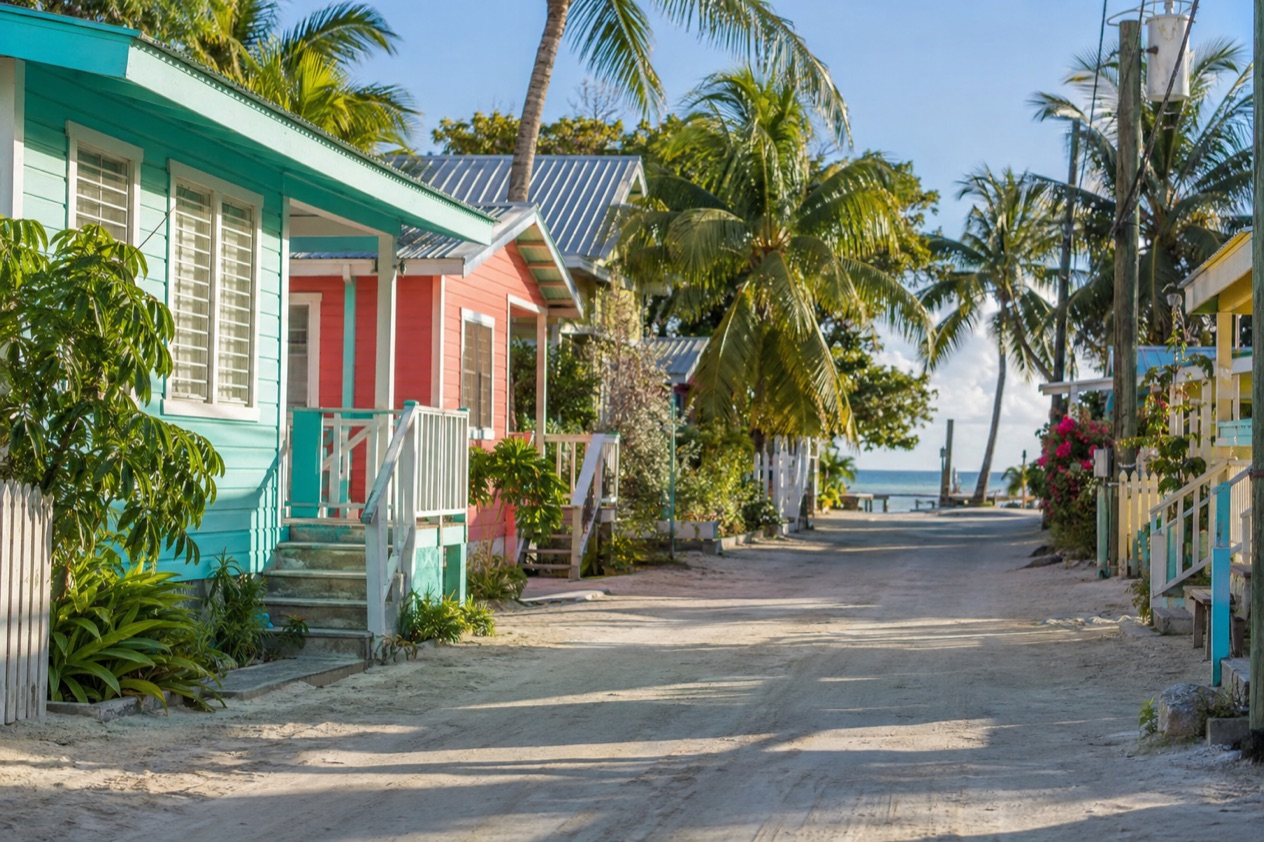
The village is where Caye Caulker lives. Front Street runs along the eastern waterfront, Middle Street and Back Street lie behind it, and between them you find bakeries, barbecue grills smoking at dusk, small grocery stores, dive and snorkel shops and the colorful wooden houses that give the island its look. Mornings begin early here, with coffee, johnnycakes and the first boats heading out.
Lodging in the village tends toward guesthouses, small hotels, cabanas and apartments, many of them in wooden buildings with porches. It suits first-time visitors, solo travelers and anyone who likes to step out of the room and be in the middle of things. Some rooms face the sea, others face the lanes, and a room on a lane may hear roosters, bicycles and conversation from early hours.
You get around the village on foot or by bicycle along the sandy lanes. A useful tip: ask whether a room faces the waterfront or the back, because that decides what you hear at night and what you see from the porch.
The Split and the shoreline around it
The Split is the narrow channel that cuts through the island, a result of a hurricane in the past, and it is where visitors gather in the late afternoon. Around it, the shoreline has lodging with direct access to the water’s edge, and sunset is the daily event.
This area suits couples, friends traveling together and anyone who wants a seat with a sea view, plus music within reach after dinner. Expect small hotels, cabanas and apartments with decks, and expect a little more evening activity than in the residential lanes.
A tip: if you like falling asleep to the waves rather than to a bar, ask where in relation to the Split a room sits. A few buildings of distance can change the evening, and a room on the quieter side of the channel keeps the view without the crowd.
The north side
North of the Split the island opens out. Buildings are farther apart, palms and low scrub fill the gaps, and the shoreline feels wider. The northern end of the island belongs to the Caye Caulker Marine and Forest Reserve, established in April 1998, and the reserve’s presence gives the area its calmer character.
Lodging here leans toward small, spread-out properties such as cabanas, private cottages and a few larger holiday rentals. It suits couples, travelers on a longer stay and families who want some space around them. The trade-off is that restaurants and shops are farther away, so a rental that includes a kitchen or a porch becomes more useful.
As a tip, plan your meals before you settle in. A late dinner in the village is part of a stay on the north side, and knowing where you will have breakfast saves time on the first morning.
The south end and the lagoon shore
The south end is where Caye Caulker Airport sits, and where small planes bring travelers in from the mainland. On the western side of the island lies the protected bay called La Ensenada, where, according to one theory, boats were caulked long ago and gave the island its name. The mood here is residential, with local homes, small guesthouses and open views across the water.
This is a place for travelers who want a quiet base with a view of sunsets over the water, and for those arriving by air who like to be near the airstrip. Rooms and apartments here sit at some distance from the busiest part of Front Street, so you walk or cycle for dinner.
A useful tip: the western shore faces the mainland rather than the reef, so the outlook is a different one from the village’s eastern waterfront.
Caye Caulker areas compared
| Area | Best for | Feel | Getting around |
|---|---|---|---|
| Village center | First visit, budget stays, solo travelers | Busy lanes, restaurants and shops at the door | Sandy village lanes, on foot or by bicycle |
| The Split | Sunsets, couples, friends | Social, with music and a crowd in the evening | Along the shoreline from the village |
| North side | Space, longer stays, families | Open and residential, near the marine and forest reserve | Farther from the village, along the island’s lanes |
| South end and lagoon shore | Arrivals by air, a calm base | Residential, with views toward the mainland | Near the airstrip, with the village farther along the island |
The main trade-off on Caye Caulker is between convenience and calm. The village puts everything within reach, but it asks you to accept the sounds of daily life, from early roosters to late conversations. The north side and the south end give you room to breathe, though you give up spontaneous strolls to dinner or a quick coffee.
The second trade-off is between the eastern, reef-facing shoreline and the western side. The eastern side gives you the morning light and the boat traffic toward the reef, the western side gives you the evening glow. Nightlife follows the same line: the Split and the waterfront hold it, and the farther you move from them, the more it fades into the sound of the sea.
Because the island is small, none of these choices is permanent. A traveler who sleeps near the Split can have breakfast in the village and dinner on the north side without trouble, and the island’s lanes make each part feel close to the others. What the area really decides is the first and last hour of each day.
How to choose your hotel in Caye Caulker
All-inclusive stays are not the island’s model. Caye Caulker is a village, and the experience is built around eating at local restaurants, walking the lanes and joining boat trips that leave from the waterfront, so most rooms are booked on their own. The Belize Hotel Association lists resorts, hotels and lodges in beach, jungle, island and mountain settings among its members, which gives you a sense of the range across the country, but on Caye Caulker you will mostly compare guesthouses, cabanas, small hotels and apartments.
Think first about beachfront against lagoon side. A room on the eastern shoreline looks toward the reef and the sunrise, while a room on the western side looks toward the mainland and the sunset.
Neither is better, they simply give you a different light, and you can ask any property which way its porch faces. Ask also which shore the building sits on if you care about what washes up on the sand, since conditions can differ from side to side and from week to week.
Noise deserves a question before you book. A room near the Split or a waterfront bar may hear music in the evening, and a room along the village lanes may hear roosters at dawn. If sleep is a priority, ask for a room set back from the main strip or on an upper floor. If you love the buzz, ask the opposite.
Timing matters too. The Atlantic hurricane season runs from June 1 to November 30, and a stay in those months deserves a look at the property’s own terms and at your travel arrangements. For festivals and busy holiday weeks, the village fills with visitors and locals, so decide early and keep dates in mind when you pick a room, especially if your group is large or you need a particular kind of lodging.
Families should think about kitchens, porches and the layout of a unit. An apartment or a cottage with a living area gives children somewhere to spread out, and a ground-floor room avoids stairs with a stroller. Travelers with limited mobility should ask about steps, thresholds and the sandy lanes leading to the door, since the island’s surfaces are not paved everywhere and wooden buildings often stand on raised foundations.
A few checks round out the decision. Every hotel in Belize must display its Hotel Registration and Accommodation License in a conspicuous place, preferably at the reception counter, so you can see it when you arrive. Ask about the transfer from the water taxi dock or the airstrip, and ask how far the room sits from the places you plan to visit most, whether that is the dock where tours leave or the restaurants you have your eye on.
Finally, match the room to the rhythm of your trip. If you plan to be out on the water each day, a simple room in the village is all you need. If you plan to slow down for several days, a porch, a hammock and a view will do more for the trip than any amenity list.
Good to know before you go
The U.S. State Department rates Belize Level 2, “Exercise increased caution”, because of crime, and says the south side of Belize City has historically had the highest concentration of violent crime.
Caye Caulker is reached by high-speed water taxi or by small plane to Caye Caulker Airport, and the island sits about twenty miles from Belize City. The currency is the Belize dollar. The village is run day to day by the Caye Caulker Village Council, which looks after public property in the village.
Sources
- Caye Caulker Village Council, About (https://www.cayecaulkervillagecouncil.org/about), checked October 11, 2026
- Wikipedia, Caye Caulker (https://en.wikipedia.org/wiki/Caye_Caulker), checked October 11, 2026
- Wikivoyage, Caye Caulker (https://en.wikivoyage.org/wiki/Caye_Caulker), checked October 11, 2026
- Belize Fisheries Department, Caye Caulker Marine Reserve (https://fisheries.gov.bz/ccmr/), checked October 11, 2026
- Caye Caulker Village Council, Traffic (https://www.cayecaulkervillagecouncil.org/traffic), checked October 11, 2026
- Belize Tourism Board, Hotels (https://www.belizetourismboard.org/hotels/), checked October 11, 2026
- Belize Hotel Association (https://www.belizehotels.org/), checked October 11, 2026
- U.S. Department of State, Belize Travel Advisory, Level 2, March 11, 2026 (https://travel.state.gov/), checked October 11, 2026
- NOAA National Hurricane Center, Climatology (https://www.nhc.noaa.gov/climo/), checked October 11, 2026
To plan your stay
- Best Time to Visit Caye Caulker: Dry Season, Sea Temperatures, Hurricane Months and Festivals
- Things to Do in Caye Caulker: The Split, Reef Snorkeling, Manatees and Fresh Lobster
- Caye Caulker from Belize City: Water Taxi, Small Plane and What to Do on Arrival
- Know Before You Go to Caye Caulker: Entry Rules, Money, Water Taxis and Health