
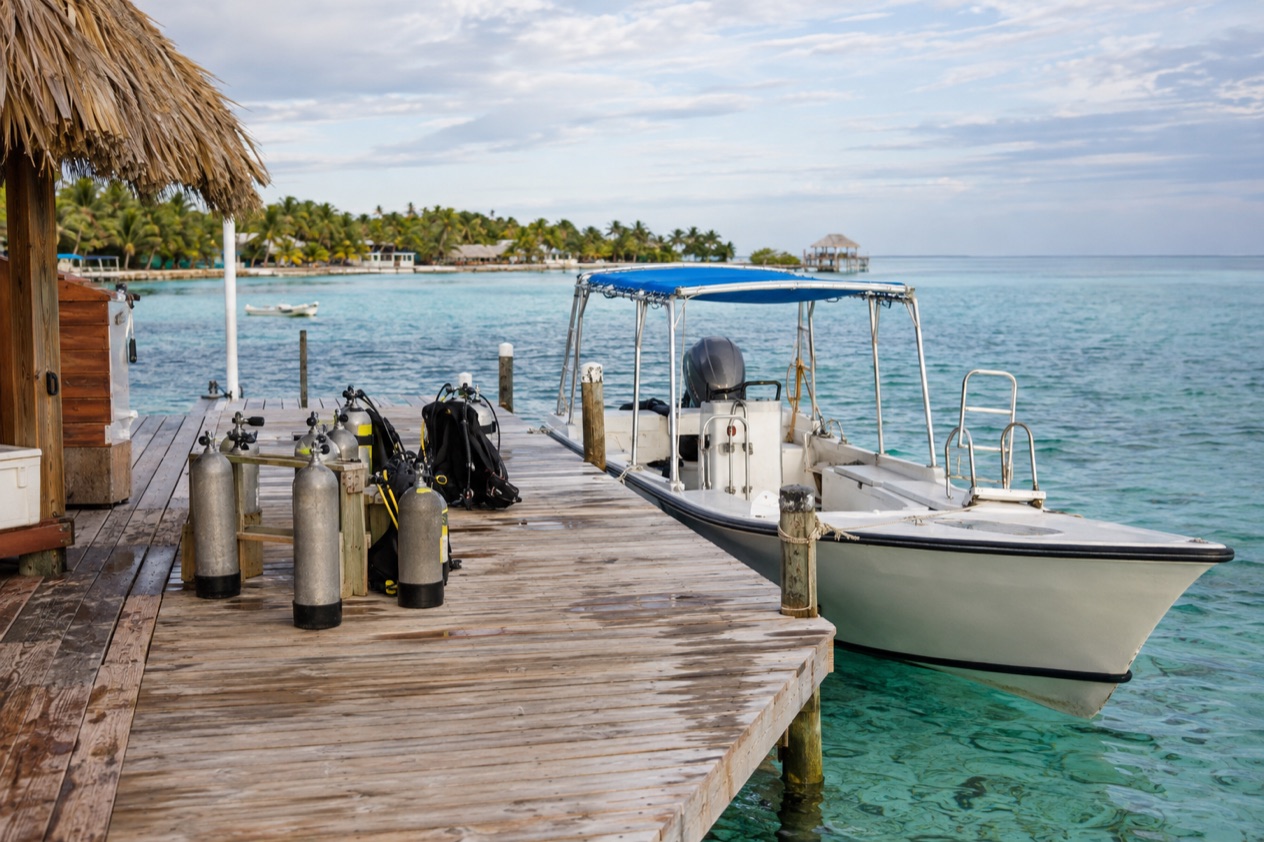
Early in the morning at a dive dock, tanks clink against the boat rail, someone rinses a mask in a bucket, and the water beyond the pilings turns from gray to turquoise as the light rises. Here is where the resorts are, what they offer and which reefs they take you to.
What dive resorts are there in Belize?
Two resorts stand out in our reporting, Hamanasi Adventure and Dive Resort on the mainland coast and Thatch Caye Resort on a private island, and both run their own PADI 5-Star dive operations. They suit different moods. One pairs reef days with the rainforest, the other puts you on a small island with the sea under your bungalow.
Hamanasi Adventure and Dive Resort
Hamanasi sits in Hopkins Village and is a PADI 5-Star Resort. Its dive shop is described as a PADI 5 star operation with modern equipment and a wide range of dive education courses, so it works for certified divers and for people who arrive wanting to learn. Reservation staff are at the resort every day of the year.
The most popular Barrier Reef tours run daily, weather permitting, and they are part of the Reef & Rainforest Package. Barrier Reef snorkeling is among those daily adventures, which gives non-divers in a group something to do on the same mornings. The longer outings are built around interest, and we cover them under the reefs below.
The dive trip menu is long: Barrier Reef Diving, Lighthouse Reef Atoll and the Great Blue Hole, Glover’s Reef Atoll, The Ultimate Reef Adventure, Turneffe Islands Atoll, a Barrier Reef Night Dive and a Lionfish Spearfishing Adventure. The night dive and the lionfish outing are the unusual ones, a different side of the reef after dark and a hands-on conservation outing.
Thatch Caye Resort
Thatch Caye is a private island resort with an on-site 5-Star PADI Dive Operation. It accommodates only 30 guests at any given time, so the island feels more like a house party than a hotel. Rooms are overwater bungalows with Caribbean ocean views.
Meals are farm-to-table and shared, which means evenings are spent around the table swapping the day’s sightings. The Coco Lounge has a TV, gourmet coffee and high-speed WiFi for the hours between dives. The resort received TripAdvisor’s Travelers’ Choice Best of Best Award in 2025.
Gear and extras at Hamanasi
If you would rather not pack a regulator, Hamanasi rents equipment by the day. Nitrox fills are offered too, at a lower price for those who take the Enriched Air Diver Certification there, which makes the course a sensible add-on for a week of repeated dives.
| Hamanasi rental or fill | Price (US$) |
|---|---|
| Mask, snorkel and fins, per day | 15 |
| Regulator with dive computer, per day | 20 |
| 3mm wetsuit, short or long, per day | 15 |
| Nitrox fill, prior Enriched Air certification, per tank | 15 |
| Nitrox fill, certified through Hamanasi, per tank | 10 |
Where are they?
Hamanasi is on the mainland, in Hopkins Village, while Thatch Caye is a private island, and the two give you very different surroundings between dives. One has a village and rainforest behind it, the other has water on every side.
Hopkins Village on the mainland
Staying at Hamanasi means your base is a village on the coast rather than a caye. Dive days start with a boat out to the reef, and the other days can go to the rainforest, which is why the resort sells its Reef & Rainforest Package. For a group where one person dives and another would rather hike, that mix is the appeal.
Hopkins is where the Garifuna culture of the coast is most felt, with drumming and cooking traditions that give an evening outside the resort a flavor of its own. It is a place to pair a week of diving with something on land.
A private island at Thatch Caye
Thatch Caye Resort is a private island in Belize, with room for just 30 guests. There is no town to wander into, so the days run on the dive boat, the dining table and the lounge. The overwater bungalows put the ocean right outside, and that setting is the whole point of staying.
It fits divers who want to step from bungalow to boat with nothing else on the schedule, and couples or small groups who like shared meals. If you want restaurants, shops and nightlife around you, an island this small is not that.
Near Ambergris Caye
Hol Chan Marine Reserve lies about four miles south of San Pedro on Ambergris Caye, and it is the closest marine protected area to the island’s town. Dive and snorkel operators in San Pedro take visitors there, but the two resorts above are the ones with their own operations in our reporting, so this is a place to know about rather than a resort base.
It was established in July 1987 as the first marine protected area in the country. Inside it, no one may remove or disturb flora or fauna, including rocks, dead corals, shells or sand, unless authorized by the fisheries administrator. Spear fishing and fishing gear such as long lines, fish traps and nets are prohibited, and fishing of any kind needs a valid license.
Which reefs do they serve?
Hamanasi’s list reaches the Southern Barrier Reef, Glover’s Reef Atoll, Turneffe Islands Atoll, the Elbow, Lighthouse Reef Atoll, the Blue Hole, Half Moon Caye and more. Thatch Caye runs its own dive operation as well. Together they open all three of the Belize Barrier Reef’s atolls.
The Barrier Reef close to Hopkins
The daily outings stay on the Southern Barrier Reef, which is the routine of a week at Hamanasi. Snorkelers and divers both go, and the night dive gives a second look at the same reef when different animals are out. These trips are scheduled daily, weather permitting.
The farther reefs work differently. Glover’s Reef and Lighthouse Reef trips are scheduled based on interest and need a minimum number of guests. If one is not in your package, it can be added for an additional charge.
Glover’s Reef
Glover’s Reef is a partially submerged atoll about 28 miles off the southern coast. Its lagoon is dotted with around 850 reef patches and pinnacles that rise to the surface, and it holds one of the greatest diversity of reef types in the western Caribbean. Major cays include Long Cay, Middle Cay, Northeast Cay and Southwest Cay.
At its northeastern end is a large spawning site for the endangered Nassau grouper, one of only two viable sites left for the species. The marine reserve was established in 1993 and became part of the World Heritage-listed Belize Barrier Reef Reserve System in 1996.
Lighthouse Reef and the Great Blue Hole
Lighthouse Reef is an atoll about 50 miles southeast of Belize City, and it is considered one of the best developed and healthiest reefs in the Caribbean. Named dive sites include Half Moon Caye Wall, Long Caye Aquarium, Silver Caves, Tres Cocos and West Point, and the atoll is home to the Great Blue Hole.
Half Moon Caye is worth a look above water too. It hosts a rookery of magnificent frigatebirds and a nesting colony of about 4000 red-footed boobies, and its western half holds a rare atoll siricote forest. The Great Blue Hole and Half Moon Caye are Natural Monuments and World Heritage Sites.
Turneffe Atoll
Turneffe is the largest coral atoll in Belize, about 30 miles long and 10 miles wide, and it lies southeast of Ambergris Caye and Caye Caulker, 20 miles from Belize City. Its flats, creeks and lagoons are dotted with more than 150 mangrove islands.
Under the surface are more than 500 species of fish and 65 species of stony coral, with sea turtles, manatees and dolphins among the wildlife. At least three important fish spawning aggregation sites are known here. It became a marine reserve in November 2012, and the Turneffe Atoll Sustainability Association co-manages it. Mauger Caye, with its lighthouse, marks the northern end.
Good to know before you go
The U.S. State Department rates Belize Level 2, “Exercise increased caution”, because of crime, and says the south side of Belize City has historically had the highest concentration of violent crime.
The Atlantic hurricane season runs from June 1 to November 30, which matters for boat schedules that already depend on the weather. Lighthouse Reef suffers from uncontrolled fishing and tourism despite its protection, so following each reserve’s rules is part of diving it well.
Sources
- Hamanasi Adventure and Dive Resort, diving (https://www.hamanasi.com/belize-diving/), checked October 11, 2026
- Hamanasi Adventure and Dive Resort, reef adventures (https://www.hamanasi.com/belize-reef-adventures/), checked October 11, 2026
- Wikipedia, Turneffe Atoll (https://en.wikipedia.org/wiki/Turneffe_Atoll), checked October 11, 2026
- Wikipedia, Glover's Reef (https://en.wikipedia.org/wiki/Glover's_Reef), checked October 11, 2026
- Wikipedia, Lighthouse Reef (https://en.wikipedia.org/wiki/Lighthouse_Reef), checked October 11, 2026
- Belize Fisheries Department, Hol Chan Marine Reserve (https://fisheries.gov.bz/hcmr/), checked October 11, 2026
- Thatch Caye Resort, about (https://www.thatchcaye.com/about-thatch-caye), checked October 11, 2026
- U.S. Department of State, Belize Travel Advisory, Level 2, March 11, 2026 (https://travel.state.gov/), checked October 11, 2026
- NOAA National Hurricane Center, Climatology (https://www.nhc.noaa.gov/climo/), checked October 11, 2026
To plan your stay
- Cayo Espanto: Private Island Villas, Getting There and What Is on Site
- Chaa Creek Belize: The Lodge, the Macal River, Rainforest Trails and Day Trips
- Hamanasi Resort Hopkins: Rooms, Reef and Rainforest Tours, and Where It Sits on the Coast
- Belize Overwater Bungalows: Thatch Caye, Where to Stay and How to Get There