
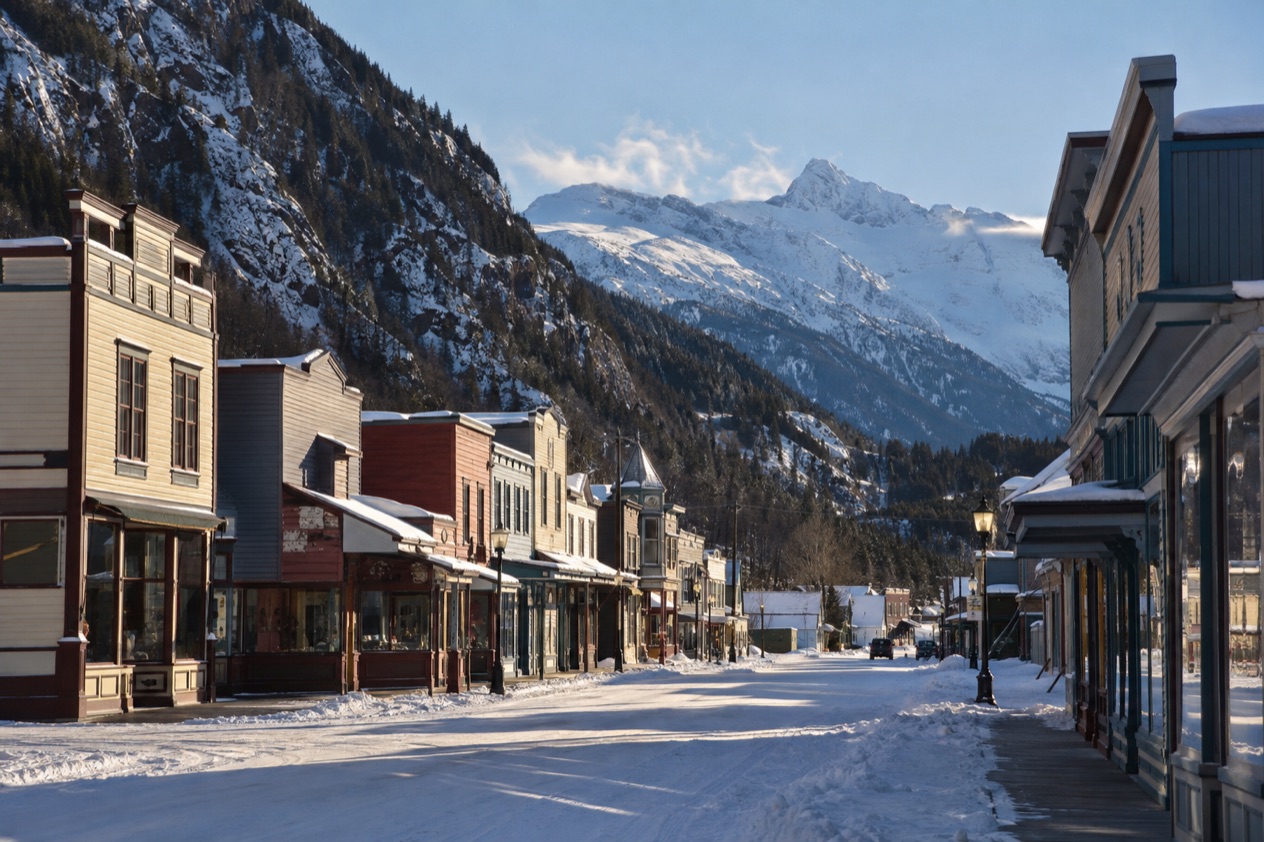
In February, Skagway is a town of boardwalks with hardly a soul on them, where the old false-front buildings of Broadway stand quiet and the mountains close in on both sides of the valley. The cruise crowds that fill the streets in summer are gone, and the place belongs to the people who live there. It is a month for travelers who want a gold rush town in its winter state, with short days that are already getting longer.
What is the weather like in Skagway in February?
February in Skagway is cold but not extreme, with afternoons that hover just above freezing and nights that dip well below it. Precipitation is light, and the month is a little drier and a little brighter than January.
| Month | Average high (°F) | Average low (°F) | Precipitation (in) | Days with precipitation | Daylight on the 15th |
|---|---|---|---|---|---|
| January | 30.7 | 22.2 | 2.17 | 5.8 | 6 h 48 min |
| February | 34.7 | 25.1 | 1.47 | 3.7 | 9 h 11 min |
| March | 39.0 | 27.9 | 1.52 | 4.7 | 11 h 40 min |
The afternoons are the best part of the day. When the temperature climbs a few degrees above freezing, a walk along the boardwalks is comfortable in a warm coat, and the snow on the streets turns soft. Mornings and evenings are properly cold, so hats and gloves matter from the moment you leave your room.
Precipitation in February is rain and melted snow together, and it falls on only a handful of days. That means most days are dry, though a gray, damp one can come along, and a waterproof outer layer is worth having over your insulation. Footwear with a good grip helps on packed snow and wet boards.
The light is the real change this month. Daylight now stretches past nine hours, much more than in January, so you can plan a full outdoor morning and still be back before dark. The evenings arrive earlier than in summer, and that suits a slow dinner and an early night.
What to do in Skagway in February
February is about walking a quiet historic town, learning its gold rush story and enjoying the stillness. Many visitor services in Skagway are tied to the summer season, so the month rewards a flexible plan built around the streets, the park and the scenery rather than a long list of tours.
Start on Broadway, the main street, where the wooden storefronts and plank sidewalks recall the years when thousands of prospectors passed through. Without summer crowds, you can stop and look at the details: the painted signs, the old facades and the mountains rising straight behind the buildings.
Klondike Gold Rush National Historical Park
The park has three units in the Skagway area, and its visitor center sits in the old railroad depot building at Second and Broadway. This is the natural first stop, because it is the starting point for ranger-led or self-guided tours and puts the whole story in order: the ports of Skagway and Dyea, and the route most prospectors took toward the Yukon.
The story is a striking one. Canadian authorities required each person entering Yukon Territory to bring a year’s supply of food, typically around 1,150 pounds, which explains why the old photographs show mountains of crates and long lines of people hauling loads. Standing in town in the cold, you get a small sense of what that effort meant.
The park is a good fit for a quiet February afternoon, when you can take your time over the displays and the historic buildings without any rush. Pair it with a slow walk along the boardwalks afterward.
The railroad and the Chilkoot Trail in winter
The railroad is a narrow-gauge line linking the port of Skagway with Whitehorse, the capital of Yukon, and its currently active track runs from Skagway to Carcross. Its original line was longer, reaching all the way to Whitehorse.
The Chilkoot Trail runs from Dyea, a ghost town and campground close to Skagway, to Bennett in British Columbia. Its official hiking season usually begins in late May and ends in early September, so February is not a hiking month. Still, Dyea and the story of the trail make good reading and conversation while you sit over coffee in town, and the railroad’s history is part of the Skagway story you can absorb on foot.
The railroad is currently accepting 2026 excursion bookings for its Summit excursion, which is a reminder that its main operating season belongs to the warmer months rather than February. Evenings are for lingering rather than rushing.
If the weather turns damp, the visitor center and the town’s indoor spaces give you an easy way to spend a gray hour. When it clears, return to the boardwalks, because the low winter light on the mountains is the real reward of the month.
A two-day itinerary for Skagway in February
Day 1 is for the town and the story. Start mid-morning, once the air has lost its sharpest chill, and walk Broadway from end to end, looking at the old storefronts and the mountains behind them. Head to the Klondike Gold Rush National Historical Park visitor center in the railroad depot for the gold rush background and the ranger-led or self-guided tour options.
Have a warm lunch in a café on or near Broadway, then use the early afternoon, the mildest part of the day, to explore the side streets and historic buildings on foot. As the light fades, settle into an unhurried dinner at a local restaurant.
Day 2 turns to the surroundings. With more than nine hours of daylight, you can spend the morning walking quietly through the town’s outskirts and looking at the rail line that links Skagway to Carcross and Whitehorse, then think about the Dyea story and the Chilkoot Trail as part of the larger picture.
If rain or wet snow arrives, go back indoors: a slow second pass through the park displays, a long coffee and an early evening suit the weather. Finish with a simple dinner and an early night, ready for the cold morning.
Is Skagway busy in February?
No, February is a quiet month in Skagway, far from the summer rhythm when the park drew nearly one and a half million visitors in 2025. The town slows down, the boardwalks empty out, and what you notice most is space.
Many of the services that define the busy season, such as the railroad’s excursions, are tied to the warmer months, and the Chilkoot Trail’s official season does not begin until late May. For a visitor this means a calm, small-town pace and a chance to see the historic streets with almost no one else around.
What to pack for Skagway in February
Pack for cold mornings, mild-ish afternoons and the occasional damp day, with layers you can add or remove as the light and temperature change.
- A warm insulated coat, because nights fall well below freezing.
- A waterproof shell, for the days with rain or wet snow.
- Warm hat and gloves for the cold mornings and evenings.
- Boots with good grip for packed snow and wet boardwalks.
- Warm base layers for long hours outdoors on Broadway.
- Sunglasses, since low winter sun can reflect off snow.
Good to know before you go
What matters most in February is the daylight, which is longer than in January but still modest, so plan your outdoor time around the middle of the day. The Chilkoot Trail’s hiking season has not started, and the railroad’s excursion season belongs to the warmer months, so build your days around the town and the park visitor center in the railroad depot at Second and Broadway.
Skagway in February vs January and March
Moving the trip earlier, to January, means colder days and much less light, with daylight under seven hours in mid-month and more days with precipitation. The town is just as quiet, but the short days limit how much time you have outside.
Moving later, to March, brings milder afternoons, more than eleven hours of daylight and a little more rain or wet snow than February. The town is still in its quiet season, though the lengthening days start to feel like spring approaching.
Travelers who want the most light should lean toward March, while those who want the deepest winter stillness might pick January.
Is February a good time to visit Skagway?
Yes, February suits travelers who like quiet towns, history and cold, clear days, and who are happy to walk rather than join organized outings. It is a poor fit for anyone hoping to hike the Chilkoot Trail or ride the railroad’s summer excursions, which belong to other months.
On arrival, head first to the visitor center in the railroad depot at Second and Broadway to get oriented in the gold rush story, then take a walk along Broadway while the afternoon is at its mildest.
Sources
- NOAA NCEI, U.S. Climate Normals 1991-2020, monthly (https://www.ncei.noaa.gov/access/services/data/v1?dataset=normals-monthly-1991-2020&stations=USW00025335), station Skagway Ap, elevation 20 feet, checked October 11, 2026
- Computed from the date and the latitude of the place (sunrise equation, solar elevation -0.833 degrees), October 11, 2026
- White Pass and Yukon Route Railway, Skagway (https://www.wpyr.com/), checked October 11, 2026
- Wikipedia, White Pass and Yukon Route (https://en.wikipedia.org/wiki/White_Pass_and_Yukon_Route), checked October 11, 2026
- Wikipedia, Chilkoot Trail (https://en.wikipedia.org/wiki/Chilkoot_Trail), checked October 11, 2026
- Wikipedia, Klondike Gold Rush (https://en.wikipedia.org/wiki/Klondike_Gold_Rush), checked October 11, 2026
- Wikipedia, Climate of Alaska (https://en.wikipedia.org/wiki/Climate_of_Alaska), checked October 11, 2026
To plan your stay
- Things to Do in Skagway: Gold Rush History, the White Pass Railway and Dyea
- Where to Stay in Skagway: Broadway, the Port and Rail Depot, and the Highway 98 Side
- Skagway from Juneau: The Ferry Route, Highway 98 and a Day in Town
- Know Before You Go to Skagway: Ferry and Highway Access, Klondike Park, Weather and Bears