
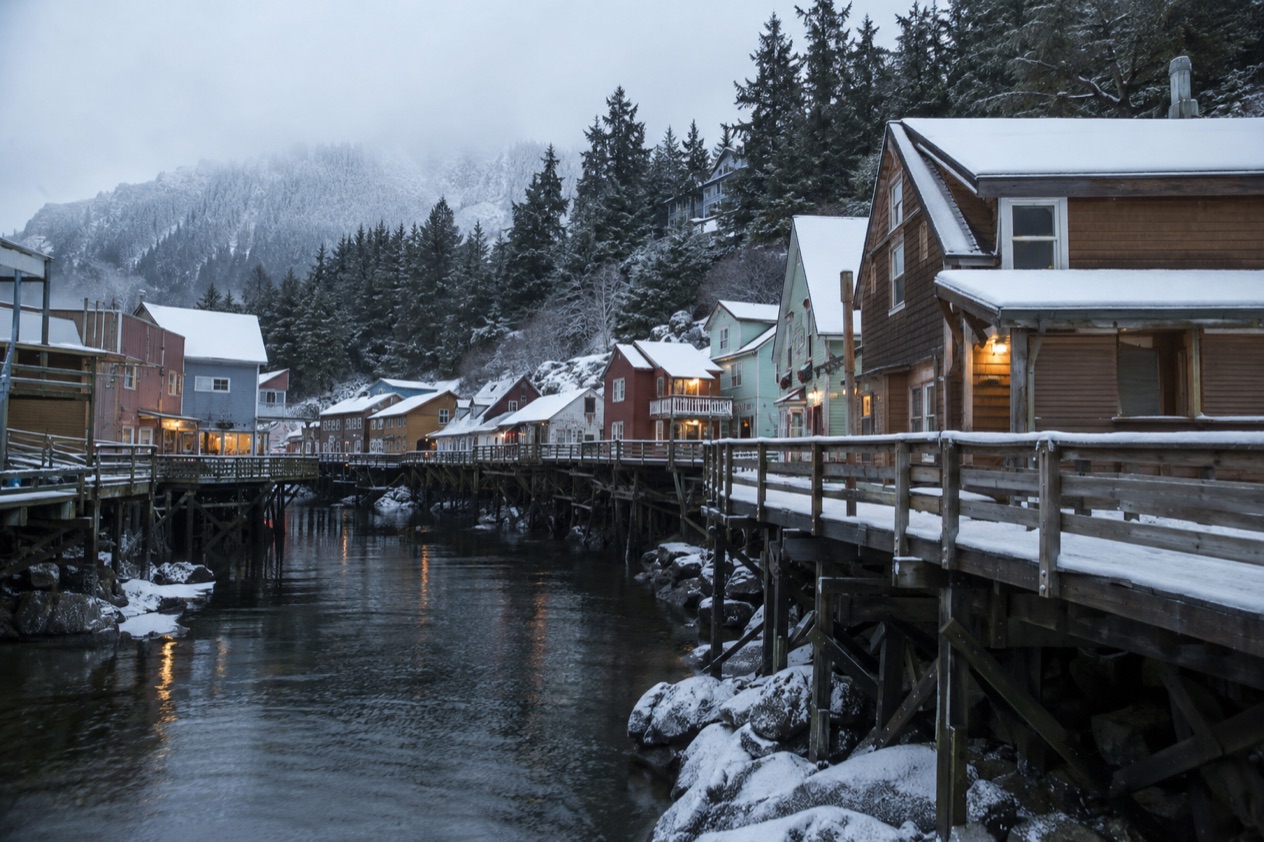
In January, Ketchikan’s waterfront belongs to the people who live there. Rain taps on the roofs of the buildings that cling to the hillside, the harbor lights glow on wet pavement, and fishing boats sit quietly at their moorings.
The cruise docks are idle, the town is slow, and what remains is a working Southeast Alaska community in the middle of the Inside Passage. For a traveler, it is a month for museums, long coffees and the pleasure of a damp, green place at its most private.
What is the weather like in Ketchikan in January?
January in Ketchikan is cool, wet and short on daylight, with temperatures that hover just above freezing in the afternoon and a steady supply of rain.
| Month | Average high (°F) | Average low (°F) | Precipitation (in) | Days with precipitation | Daylight on the 15th |
|---|---|---|---|---|---|
| December | 40.2 | 32.6 | 16.27 | 17.7 | 7 h 09 min |
| January | 39.7 | 31.5 | 16.17 | 17.1 | 7 h 41 min |
| February | 40.9 | 31.5 | 11.80 | 12.9 | 9 h 37 min |
Mornings start cold, close to the freezing mark, and the afternoons only climb a few degrees. That is cold enough to see your breath on the waterfront but rarely the deep freeze of Interior Alaska. The rain is the real feature.
It falls on most days of the month, sometimes as a fine drizzle that hangs in the air, sometimes as a steady soaking that lasts for hours.
Daylight is brief but already lengthening. The sun is up for a little under eight hours in mid-month, so the useful part of the day for walking outside is the middle of it. Under cloud, the light stays soft and gray, and the mountains behind town often wear low cloud. When the sky does lift, the contrast with the dark water and evergreen slopes can be striking.
Dress for wet more than for cold: a waterproof shell, warm layers underneath, and shoes that handle puddles and slick sidewalks. Evenings are chilly and damp, so a hat and gloves earn their place in the pocket.
What to do in Ketchikan in January
January is not a month of big festivals in the town’s visitor calendar, and that is part of its character. What you do here is slow and local: you walk the historic waterfront, step into galleries and shops when the rain picks up, learn how the town was built, and let the weather set the pace.
Downtown Ketchikan is easy to walk, with historic buildings, galleries, shops and locally made goods packed into a compact stretch along the water. In winter you see it without the summer crowds, which makes it easier to linger in a doorway and look at the details of the old storefronts. Between showers, the harbor itself is worth the walk, with working boats and the steep, forested hillside rising behind.
History and museums on a rainy day
Rain is the reason to go indoors, and Ketchikan has a good story to go indoors for. The town began as a seasonal Tlingit fish camp before becoming a border town that has welcomed pioneers since the late 1800s. Its economy and identity were shaped by commercial fishing, canneries, logging and maritime industries, with salmon and timber playing the largest roles. It became known as the Canned Salmon Capital of the World.
The Tongass Historical Museum is the place to follow that thread, with exhibits about the town’s people, businesses and events from the late 19th and early 20th centuries. Expect old photographs, tools and stories of the pioneers who came to find their fortunes, start a new life, or, as the local telling goes, misbehave. A winter visit leaves you room to read every label without jostling.
The Ketchikan story project, an Emmy Award-winning series, tells the story of the town from the beginning of time to the recent past. It is a natural companion to a museum visit when you want the wider picture before you go back out into the drizzle.
Native cultures, galleries and local goods
Ketchikan is home to the cultures of the Tlingit, Haida and Tsimshian people, and their presence shows in the art and design you meet around town. Galleries and shops downtown carry locally made goods, and browsing them is one of the best uses of a wet January afternoon. You can look closely at carving, prints and handwork without a line behind you.
Go in with curiosity rather than a shopping list. Shop owners in the off-season often have time to talk about what they sell, and a conversation can tell you as much about the town as any exhibit. Afterward, a warm drink in a downtown café gives the damp day a proper rhythm.
The waterfront and the Inside Passage setting
Ketchikan sits in Southeast Alaska, in the Inside Passage, and the water is always part of the picture. The docks that fill in the cruise season are quiet in January, so the harbor reads as a working place again. Walking the shoreline in a rain jacket, with mist on the channel and the hills disappearing into cloud, is the kind of simple outing this month does best.
Treat the weather as part of the experience rather than an obstacle. Short walks punctuated by a museum, a gallery and a hot meal make a satisfying winter day in a place like this.
A two-day itinerary for Ketchikan in January
Day 1. Start late and slow, since daylight is short and mornings are cold. Walk the downtown waterfront in the middle of the day, when the light is at its fullest, and look at the historic buildings, galleries and shops along the way. Stop for a long lunch in a downtown café or small restaurant, then use the early afternoon for the Tongass Historical Museum and the story of the fish camp, the canneries and the pioneers.
As the light fades, head back toward the harbor for a look at the boats and the lit-up shoreline. Dinner is a warm, unhurried affair somewhere downtown.
Day 2. Keep the same gentle pace and spend the morning on the Native art and craft side of town: galleries and shops with locally made goods, where Tlingit, Haida and Tsimshian cultures show in the work on display. This is a good plan for wet weather, since most of it happens under a roof.
Around midday, take a break for soup or a sandwich, then use the brightest part of the afternoon to wander streets you have not yet seen, going up the hillside side streets to look back at the harbor. If the weather turns heavy, retreat to a café with a book and let the rain do its work. Finish with a relaxed dinner and an early night.
Is Ketchikan busy in January?
No, January is a quiet month in Ketchikan, and the town feels like a small community rather than a port of call.
The cruise docks, with their downtown piers, Doyon Landing and the single pier at Ward Cove, are where the town’s busy season plays out, and nothing in the January picture suggests that bustle. What you find instead is a calmer waterfront, easier walking and more room in the shops and museums.
That pace is the appeal. You are seeing Ketchikan as the people who live there do, in a damp, dark and unhurried month.
What to pack for Ketchikan in January
Pack for rain on most days and temperatures hovering near freezing, with a plan for wet streets and short daylight.
- A waterproof jacket with a hood, because rain falls on most days of the month.
- Warm layers such as fleece or wool, for cold mornings and damp evenings.
- Waterproof shoes with good grip, for wet sidewalks and hillside streets.
- A hat and gloves, since afternoons stay barely above freezing.
- A small daypack with a dry bag, to keep a camera and phone safe in the drizzle.
Good to know before you go
Daylight is the thing to plan around: the sun is up for less than eight hours in mid-January, so schedule outdoor walks for the middle of the day and keep mornings and evenings for indoor stops. Downtown Ketchikan is easy to walk, which suits a month when you will want to duck in and out of shops, galleries and museums. Cruise ships dock at downtown piers and at Ward Cove, about 5.5 miles from downtown, but January’s pace is that of a small town rather than a port.
Ketchikan in January vs December and February
Moving a month earlier, to December, gives you almost the same weather, slightly milder in the mornings, with the shortest days of the year. Daylight is a half hour shorter than in mid-January, so the useful part of the day is tighter still. Rain falls on a similar number of days, and the town keeps the same quiet feel.
Moving a month later, to February, brings noticeably more light, with nearly two more hours of daylight than in mid-January, and less rain overall, with several fewer wet days. Walks outdoors are easier to fit in, and the afternoons stretch longer for gallery browsing and harbor strolls. Choose December if the deep-winter mood is the point, January if you want the quiet and are happy with the damp, and February if you want a bit more light and drier weather for the same low-key town.
Is January a good time to visit Ketchikan?
Yes, if you like quiet, damp, atmospheric places and are happy to spend your days on museums, galleries and short harbor walks.
It suits travelers who enjoy history and local culture, who do not mind rain, and who like seeing a town without crowds. It is a poor fit for anyone hoping for long outdoor days, big scenery in clear light or a packed calendar of events. If that describes you, another month will serve better.
On arrival, start with a walk along the downtown waterfront in the brightest part of the day, then spend the wet hours at the Tongass Historical Museum, where the story of the Tlingit fish camp, the canneries and the pioneers sets up everything else you will see. January in Ketchikan is a month of rain on the harbor, a town doing its own business and a story told slowly.
Sources
- NOAA NCEI, U.S. Climate Normals 1991-2020, monthly (https://www.ncei.noaa.gov/access/services/data/v1?dataset=normals-monthly-1991-2020&stations=USW00025325), station Ketchikan Intl Ap, elevation 76 feet, checked October 11, 2026
- Computed from the date and the latitude of the place (sunrise equation, solar elevation -0.833 degrees), October 11, 2026
- Visit Ketchikan, cruise travelers (https://www.visit-ketchikan.com/cruise-travelers/), checked October 11, 2026
- Visit Ketchikan, maps (https://www.visit-ketchikan.com/about-ketchikan/ketchikan-maps/), checked October 11, 2026
- Visit Ketchikan, museums and attractions (https://www.visit-ketchikan.com/things-to-do/art-and-culture/museums-attractions/), checked October 11, 2026
- Visit Ketchikan, overview (https://www.visit-ketchikan.com/about-ketchikan/ketchikan-stories/ketchikan-overview/), checked October 11, 2026
- Visit Ketchikan, things to do (https://www.visit-ketchikan.com/things-to-do/), checked October 11, 2026
- Wikipedia, Climate of Alaska (https://en.wikipedia.org/wiki/Climate_of_Alaska), checked October 11, 2026
To plan your stay
- Things to Do in Ketchikan: Totem Poles, Creek Street, Misty Fjords and Fresh Seafood
- Where to Stay in Ketchikan: Downtown, Ward Cove and How to Choose Your Base
- Ketchikan from Seattle: Ferry from Bellingham, Flights, Cruise Docks and What to Do on Arrival
- Know Before You Go to Ketchikan: Rain, Cruise Docks, Bears and Local Customs