
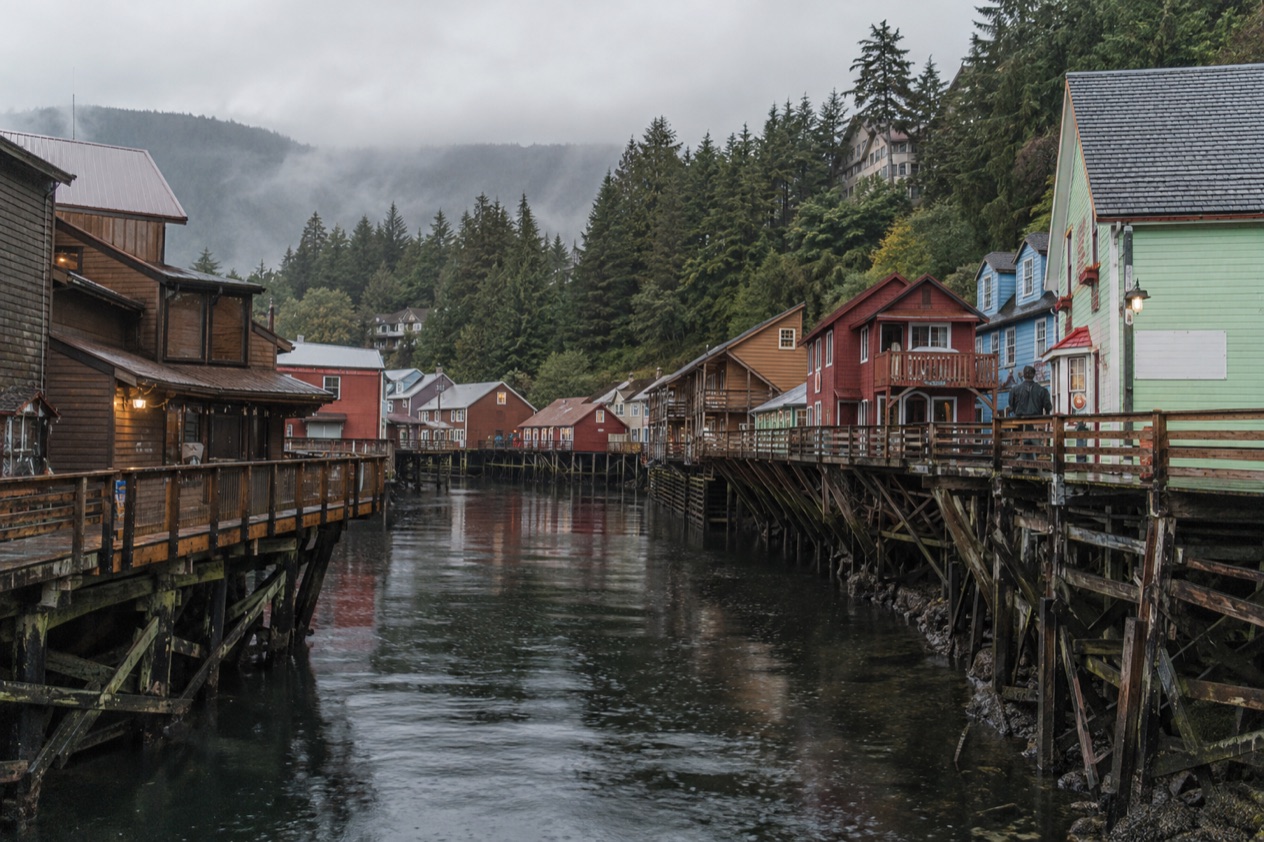
Ketchikan is a town of boardwalk streets and houses on stilts, where fishing boats slip through the Tongass Narrows and the rain is part of the scenery rather than an interruption. Ravens call from the spruce on the slope of Deer Mountain, and the smell of cedar and salt water follows you along the waterfront. The year here swings between bright, very long summer days and soft, dark, wet winters, and each has its own way of getting to know this island town.
When is the best time to visit Ketchikan?
Highs reach the low to mid 60s in July and August, which is comfortable for walking the town and the forest paths in a light waterproof layer. Even then, this is the town nicknamed the Rain Capital of Alaska, so a dry day is a bonus rather than a promise.
For sightseeing and totem poles, early summer is a pleasure. Light lasts deep into the evening in June, so you can see the town in the morning, spend the afternoon at a totem park, and still have hours of daylight left for a walk along Creek Street or the waterfront.
Ketchikan holds the world’s largest collection of standing totem poles, spread among Saxman Totem Park, Totem Bight State Historical Park, Potlatch Park and the Totem Heritage Center, and the poles look their best in soft, clear light. Wet weather suits them too, since cedar darkens and the carved colors deepen in the rain.
For the forest and the water around town, the long-day months give you the widest window. Ketchikan sits at the edge of the Tongass National Forest, and the coast and the islands beyond reward anyone who has time to leave the pier.
Misty Fjords National Monument lies about 40 miles east of town, and the airport keeps a water runway for seaplanes, a reminder of how much of this region is reached by air and water. Wildlife is always a chance, never a promise, so go for the landscape and treat any animal as a gift.
If you prefer a quiet town and do not mind rain, the shoulder months are worth a look. Late spring brings long days with a bit more cool in the air, while fall brings the heaviest rain of the year and a moody, gray beauty on the water.
Winter belongs to the residents, with short days, lights in the windows and a slower pace. Families with children who like puddles and boardwalks will do best in summer, when the days give them time to be outside.
Ketchikan weather by month
Ketchikan never gets truly hot or truly cold, but it is wet in every month, and the daylight changes the most from one season to the next.
| Month | Average high (°F) | Average low (°F) | Precipitation (in) | Days with precipitation | Daylight on the 15th |
|---|---|---|---|---|---|
| January | 39.7 | 31.5 | 16.17 | 17.1 | 7 h 41 min |
| February | 40.9 | 31.5 | 11.80 | 12.9 | 9 h 37 min |
| March | 43.6 | 32.4 | 10.98 | 16.0 | 11 h 43 min |
| April | 49.8 | 37.2 | 10.25 | 14.2 | 14 h 04 min |
| May | 56.9 | 43.3 | 8.68 | 11.6 | 16 h 09 min |
| June | 61.3 | 49.3 | 7.02 | 10.6 | 17 h 25 min |
| July | 64.5 | 53.2 | 7.33 | 10.8 | 16 h 56 min |
| August | 64.7 | 53.3 | 11.30 | 12.1 | 15 h 06 min |
| September | 58.9 | 48.3 | 14.30 | 15.8 | 12 h 51 min |
| October | 51.1 | 41.3 | 18.37 | 18.7 | 10 h 36 min |
| November | 43.7 | 35.6 | 17.07 | 19.5 | 8 h 25 min |
| December | 40.2 | 32.6 | 16.27 | 17.7 | 7 h 09 min |
The shape of the year is simple. Early summer is the drier stretch, with the fewest days of rain, and the wet season builds through late summer into a rainy fall.
October and November bring rain on most days, and the winter months stay damp, with cool temperatures hovering around freezing at night and rain falling as often as in the shoulder seasons.
What this means for a suitcase is layers: a waterproof jacket in every month, a warm middle layer even in July, and boots with grip for wet boardwalks. The light matters as much as the temperature. In June you can wander well into the evening, while in December the day is over by mid-afternoon and the town glows indoors.
What is there to do in Ketchikan in each season?
Summer: long days for totem parks and the waterfront
Summer is the season to see Ketchikan on foot. Downtown is easy to walk, with historic buildings, galleries, shops and locally made goods, and the Tongass Historical Museum fills in the story of the town’s people, businesses and events in the late 19th and early 20th centuries. The old canned salmon days explain the waterfront, which grew around fishing, canneries, logging and the maritime trades.
Beyond downtown, the totem parks give the day a shape. Totem Bight State Historical Park sits north of town on the North Tongass Highway, and Saxman, home to a totem park of its own, lies just southeast of the city.
Seeing the poles, the clan house and the carvers’ tradition of the Tlingit, Haida and Tsimshian people is the cultural heart of a visit. Misty Fjords and the Tongass forest are the big outdoor draws, with more daylight to enjoy them.
Fall and winter: rain, quiet streets and local life
Fall is the wettest season, and it asks for a different attitude. The forest turns dark and glossy, the water of the Narrows goes pewter, and the light is soft for photographs of totem poles and old storefronts. Museums, galleries and cafés become the day’s anchors, and a walk under a good hood feels like part of the place rather than a trial.
Winter is for people who like a small town at its own pace. Days are short, so plan the outdoor hours around the middle of the day and leave the evenings for a warm room and a long meal. Because Ketchikan is a working fishing community of about 14,000 people, you see life as residents live it, with boats at the docks and families at the grocery store.
Spring: the thaw and the return of the light
Spring arrives gradually. Days stretch fast from March into May, the air warms from the low 40s to the mid 50s, and the forest turns bright green after the winter rain. Rain still falls on many days, but showers are broken up by lighter skies and long evenings.
It is a good time for slower travelers who want daylight without summer’s full tempo. Museums, shops and the totem parks all make good plans, and a day trip by ferry to Metlakatla, about 16 miles south of Ketchikan and usually reached by the Alaska Marine Highway, shows another side of the region. Services vary by season, so match any outing to the month you are traveling.
When is Ketchikan cheapest and least crowded?
Ketchikan is least crowded when the cruise ships are not in port, and the busiest days are the ones when several ships tie up at once. More than 800,000 visitors come through each year by cruise ship, so on a big day downtown fills with people, the shops along the waterfront hum, and the sidewalks near the piers move slowly. The Ketchikan Visitors Bureau publishes a cruise ship calendar showing which ships are in town on which days, which makes it easy to see the busy days ahead of time.
Ships dock in one of two main places, downtown or Ward Cove, which is about 5.5 miles from downtown. That means crowds are concentrated near the piers on ship days, while quieter corners of town, like the residential streets and the forest trails, stay calm. Totem parks away from the center, such as Totem Bight, can feel quite different from the waterfront.
In the months of short days and heavy rain, the rhythm of the town belongs to its residents. You may find the streets calmer, and the pace slower, with fewer visitors to share the museums and the waterfront. Hotel and tour rates are not part of what we can quote here, so the clearest sign of a quiet stretch is simply the calendar of ship days and the season’s daylight.
Which months should you avoid in Ketchikan?
No month is wrong for everyone, but October and November are the hardest for a traveler who wants dry weather and long days. Those are the months with the most rain, falling on most days, and daylight drops to roughly ten and then eight hours. The gray can be handsome, yet a trip built around views of the mountains and the water is likely to be a wet one.
December and January are the darkest, with only about seven hours of daylight in the middle of winter. Highs stay near 40 degrees, nights hover around freezing, and rain falls on many days. If you are coming for the forest and the long evening light, these months will feel limiting, though they suit someone who wants a quiet, moody town and does not mind a short day.
The long-daylight months are the other end of the year. May through August give the most light, with the longest days in June, and are the months to pick if you want to fit a lot into one day. Which services run in a given month, from ferries to museum hours to boat trips, depends on each operator, so build the trip around the season you choose and the places you most want to see, not around a single month on a calendar.
Festivals and events in Ketchikan through the year
Summer: the Fourth of July and the working waterfront
Independence Day is the one fixed summer date that shapes the town. Alaskan communities mark the Fourth with parades, community gatherings and fireworks where the light allows, and a small island town like Ketchikan turns the day into a neighborhood event. The long evenings of high summer give plenty of time outdoors before dark.
Ketchikan’s identity as the Canned Salmon Capital of the World gives its summer a working rhythm. Fishing, canneries and the maritime trades built the town, and you still see boats coming and going along the Narrows. Local arts, carving and totem traditions of the Tlingit, Haida and Tsimshian people are part of everyday life here, so a visit to a totem park or a gallery is a good way to meet the culture at any time of year.
Fall: Alaska Day and the rain season
Alaska Day, on October 18, marks the formal transfer of Alaska from Russia to the United States and is a state holiday. In a rainy month like October it is a good reason to be among neighbors and in the town’s museums, where the stories of pioneers and fortune seekers fill the displays. The Tongass Historical Museum and the Ketchikan story project, an Emmy Award-winning series, carry the long history of the place from the beginning of time to the recent past.
Fall is also a good time to listen to local voices. The town grew from a seasonal Tlingit fish camp into a border town that has welcomed pioneers since the late 1800s, and the stories of those who came to find fortune, start over or simply misbehave are part of what makes it feel lived in.
Winter: Christmas lights and New Year
Christmas and New Year’s are the fixed winter dates, and in a town with so little daylight, lights matter. Windows glow along the hillside streets, and decorations on the boardwalks and houses brighten the dark afternoons. Rain is as likely as snow, so the festive mood is warm and damp rather than frosty.
It is a season for community gatherings, church services and holiday meals rather than large festivals, and visitors who join in find a small town that knows how to make the dark months cozy. The same is true of the long, quiet spring, when the town moves back toward daylight and the first hints of the summer season.
Sources
- NOAA NCEI, U.S. Climate Normals 1991-2020, monthly (https://www.ncei.noaa.gov/access/services/data/v1?dataset=normals-monthly-1991-2020&stations=USW00025325), station Ketchikan Intl Ap, elevation 76 feet, checked October 11, 2026
- Computed from the date and the latitude of the place (sunrise equation, solar elevation -0.833 degrees), October 11, 2026
- Visit Ketchikan (https://www.visit-ketchikan.com/), checked October 11, 2026
- Wikivoyage, Ketchikan (https://en.wikivoyage.org/wiki/Ketchikan), checked October 11, 2026
- Wikipedia, Ketchikan, Alaska (https://en.wikipedia.org/wiki/Ketchikan,_Alaska), checked October 11, 2026
- Wikipedia, Ketchikan International Airport (https://en.wikipedia.org/wiki/Ketchikan_International_Airport), checked October 11, 2026
- Wikipedia, Misty Fjords National Monument (https://en.wikipedia.org/wiki/Misty_Fjords_National_Monument), checked October 11, 2026
- Wikipedia, Saxman, Alaska (https://en.wikipedia.org/wiki/Saxman,_Alaska), checked October 11, 2026
- Wikipedia, Totem Bight State Historical Park (https://en.wikipedia.org/wiki/Totem_Bight_State_Historical_Park), checked October 11, 2026
- Wikipedia, Prince of Wales Island (Alaska) (https://en.wikipedia.org/wiki/Prince_of_Wales_Island_(Alaska)), checked October 11, 2026
- Wikipedia, Metlakatla, Alaska (https://en.wikipedia.org/wiki/Metlakatla,_Alaska), checked October 11, 2026
- Wikipedia, Tongass National Forest (https://en.wikipedia.org/wiki/Tongass_National_Forest), checked October 11, 2026
- Wikipedia, Southeast Alaska (https://en.wikipedia.org/wiki/Southeast_Alaska), checked October 11, 2026
- Wikipedia, Climate of Alaska (https://en.wikipedia.org/wiki/Climate_of_Alaska), checked October 11, 2026
To plan your stay
- Things to Do in Ketchikan: Totem Poles, Creek Street, Misty Fjords and Fresh Seafood
- Where to Stay in Ketchikan: Downtown, Ward Cove and How to Choose Your Base
- Ketchikan from Seattle: Ferry from Bellingham, Flights, Cruise Docks and What to Do on Arrival
- Know Before You Go to Ketchikan: Rain, Cruise Docks, Bears and Local Customs