
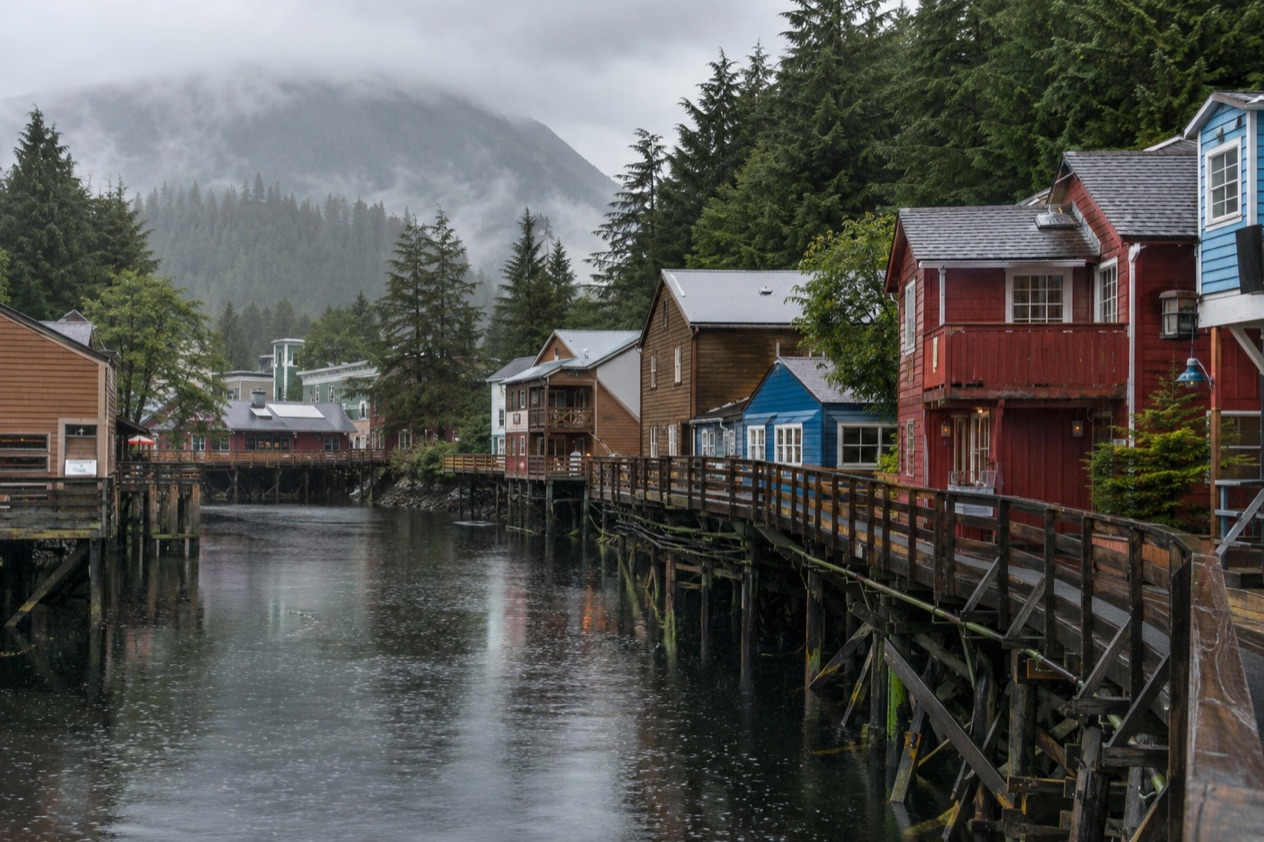
Early in the morning in downtown Ketchikan, the fishing boats are already moving, gulls argue over the docks, and the smell of rain on wet planks drifts along the boardwalks of Creek Street. A few miles out, Ward Cove looks like a different town, wider and quieter, with the rainforest right down to the water. Ketchikan is an island community, and where you sleep decides whether your days start on foot among the shops and museums or somewhere set apart.
What is the best area to stay in Ketchikan?
For a first visit, downtown Ketchikan is the natural base, since the museums, the waterfront and the cruise piers all sit in the same part of town. Travelers who want a quieter night, or who are arriving with a ship that docks away from the center, will look at Ward Cove instead. For glaciers and parks, the choice matters less than you might think, because the trips that leave from Ketchikan start from town and the water, not from your bed.
Budget travelers and families face the same basic question as everyone else: do you want to walk out of your door into the middle of things, or trade that for space and calm? Downtown puts the Tongass Historical Museum, the Totem Heritage Center and the Southeast Alaska Discovery Center within the conversation of a single stay. Ward Cove, on its own pier, feels like its own small harbor, a place to arrive and settle rather than wander.
The two areas differ most in rhythm. Downtown is where Ketchikan tells its story: a seasonal Tlingit fish camp that became a border town, then the self-styled Canned Salmon Capital of the World, with canneries, logging and maritime work leaving their mark on the waterfront. Ward Cove carries some of that industrial past too, but it is a place you stay near for the water and the trees, not the shop windows.
Think about how you like to spend a rainy afternoon, because Ketchikan sits in rainforest and that is a real part of the picture. If your answer is browsing a museum and ducking into a café, stay where those things are close. If it is watching weather move over the cove from a quiet window, the outer areas have their own appeal.
A last way to decide is to ask what you will do after dark. Downtown, a stroll to a restaurant or a walk along the water is part of the evening. Out of town, the evening is more likely to be spent where you sleep, which suits some trips perfectly and others not at all.
The best areas to stay in Ketchikan
Downtown Ketchikan and the piers
Downtown is the part of Ketchikan travelers picture: a working waterfront where cruise ships tie up at Piers 1 through 4 and where Doyon Landing, which typically takes smaller overnight ships, adds a fifth berth. Streets climb steeply from the water, houses cling to the hillside, and the mix of old storefronts and totem poles gives the town its look. Mornings can be busy when ships are in and calm when they are not.
This is the area for a first visit, for couples who want to wander, and for anyone planning to see the Tongass Historical Museum, with its exhibits on the people, businesses and events of the late 19th and early 20th centuries, and the Totem Heritage Center. The Southeast Alaska Discovery Center is also part of the town’s cultural line-up. Lodging here tends toward traditional hotels, small inns and guesthouses, the sort of places that fit a town built along a shoreline.
Getting around is mostly a matter of walking and looking up. A good tip is to plan your first hour without a destination: follow the boardwalks, read the plaques, and let the town’s mix of Alaska Native heritage, fishing history and pioneer stories show you where to go next.
Ward Cove
Ward Cove is the other main place ships come in, with a single pier that allows docking on both sides. It is set apart from downtown, which gives the area a different personality: more open water, more forest, less crowd. If you like to arrive somewhere and feel the landscape before the town, this is the area that gives you that.
It suits travelers who value quiet over convenience, and those who want their evenings to feel like the edge of the rainforest rather than a main street. Lodging out this way is more likely to be a place with some space around it, a guesthouse or an apartment-style stay, than a row of downtown storefront hotels, so think of it as a base you drive or ride from.
The tradeoff is simple. You give up walking out to museums and restaurants at a moment’s notice, and you gain a calmer stay. Plan the days you want in town as outings, and keep the evenings at the cove for the water and the trees.
Elsewhere on the island
Beyond downtown and Ward Cove, Ketchikan spreads along Revillagigedo Island, and the maps of the island and the city show how much of it is forest and shoreline. Totem Bight State Historical Park is among the places worth building a day around, and staying in the neighborhoods that lead toward it puts you in a greener, more residential corner of the island.
This kind of base suits travelers who already know Ketchikan, or who want a stay that feels less like a port call and more like a visit to a community. Lodging tends to be small and personal, such as a room in a house or a rented apartment. A good tip is to look at the city and island maps first and choose a stay by how you plan to move around.
Ketchikan areas compared
| Area | Best for | Feel | Getting around |
|---|---|---|---|
| Downtown Ketchikan | First visit, museums, waterfront | Busy waterfront, steep streets, old storefronts | On foot from Piers 1 through 4 and Doyon Landing |
| Ward Cove | Quiet stays, arrival by ship at the single pier | Open water and forest, set apart from town | About 5.5 miles from downtown |
| Elsewhere on Revillagigedo Island | Return visitors, a local feel | Green, residential, close to the rainforest | Plan outings into town and to sites such as Totem Bight |
The main trade-off is in town against out of town. Downtown puts the museums, the Creek Street boardwalks and the harbor on your doorstep, and it hums on days when ships are docked. Ward Cove and the quieter parts of the island trade that energy for calm, and they ask you to treat each trip into town as part of your plan.
Near the dock against the quiet side is the other way to put it. Close to the piers, you hear the boats and see the town working. On the quiet side, you hear rain on the roof and see the trees. Neither is better, and travelers who stay in one end for a night or two wish they had tried the other.
Ketchikan’s story is the thread that ties the areas together. Salmon and timber built the town, canneries filled the waterfront, and the Tlingit fish camp that came first gave the place its name and its older story. Wherever you sleep, that history is only a short outing away.
How to choose your hotel in Ketchikan
Start with the kind of stay you want. A hotel downtown gives you the shortest line between your door and the town. A guesthouse or apartment gives you a kitchen and a quieter street. Ketchikan is an island community surrounded by rainforest and sea, and a room with a view of either is part of the experience, whichever kind of lodging you pick.
Think next about how you are arriving. Cruise passengers dock either downtown or at Ward Cove, and if you are spending a night or more before or after a sailing, staying near the same dock keeps your departure simple. Doyon Landing typically takes smaller overnight ships, so a stay near the downtown piers can also fit a trip built around one of those.
Families and travelers who prefer to keep moving to a minimum will lean downtown, where museums, the waterfront and meals are close together. The Tongass Historical Museum and the Southeast Alaska Discovery Center give a rainy day somewhere to go, and the Totem Heritage Center adds a quieter indoor hour. Those who like a slower, greener setting will find Ward Cove and the island’s outer neighborhoods more to their liking.
Weather should shape the choice too. Rain is part of life in the rainforest, and a base with a comfortable place to sit and watch it makes a gray day feel like part of the trip. If you plan to spend most daylight hours out on the water or at Totem Bight State Historical Park, a simple room may be all you need.
Finally, consider how much of Ketchikan’s culture you want within reach. The Arts Humanities Council is part of the town’s creative life, and the Ketchikan story project, an Emmy Award-winning series, tells the town’s story from the beginning of time to the recent past. A stay close to downtown makes it easy to follow those threads at your own pace.
If you want a simple rule, pick downtown for a first visit and a short stay, pick Ward Cove or the island’s outer areas for a slower trip, and pick the lodging type by how much space and quiet you want at the end of the day.
Good to know before you go
The Ketchikan Visitors Bureau runs visitktn.com, where the cruise ship calendar and the town’s maps are kept, including the Downtown Ketchikan and City of Ketchikan maps.
Sources
- Visit Ketchikan (https://www.visit-ketchikan.com/), checked October 11, 2026
To plan your stay
- Best Time to Visit Ketchikan: Weather by Month, Long Summer Days, Totem Parks and Quiet Seasons
- Things to Do in Ketchikan: Totem Poles, Creek Street, Misty Fjords and Fresh Seafood
- Ketchikan from Seattle: Ferry from Bellingham, Flights, Cruise Docks and What to Do on Arrival
- Know Before You Go to Ketchikan: Rain, Cruise Docks, Bears and Local Customs