
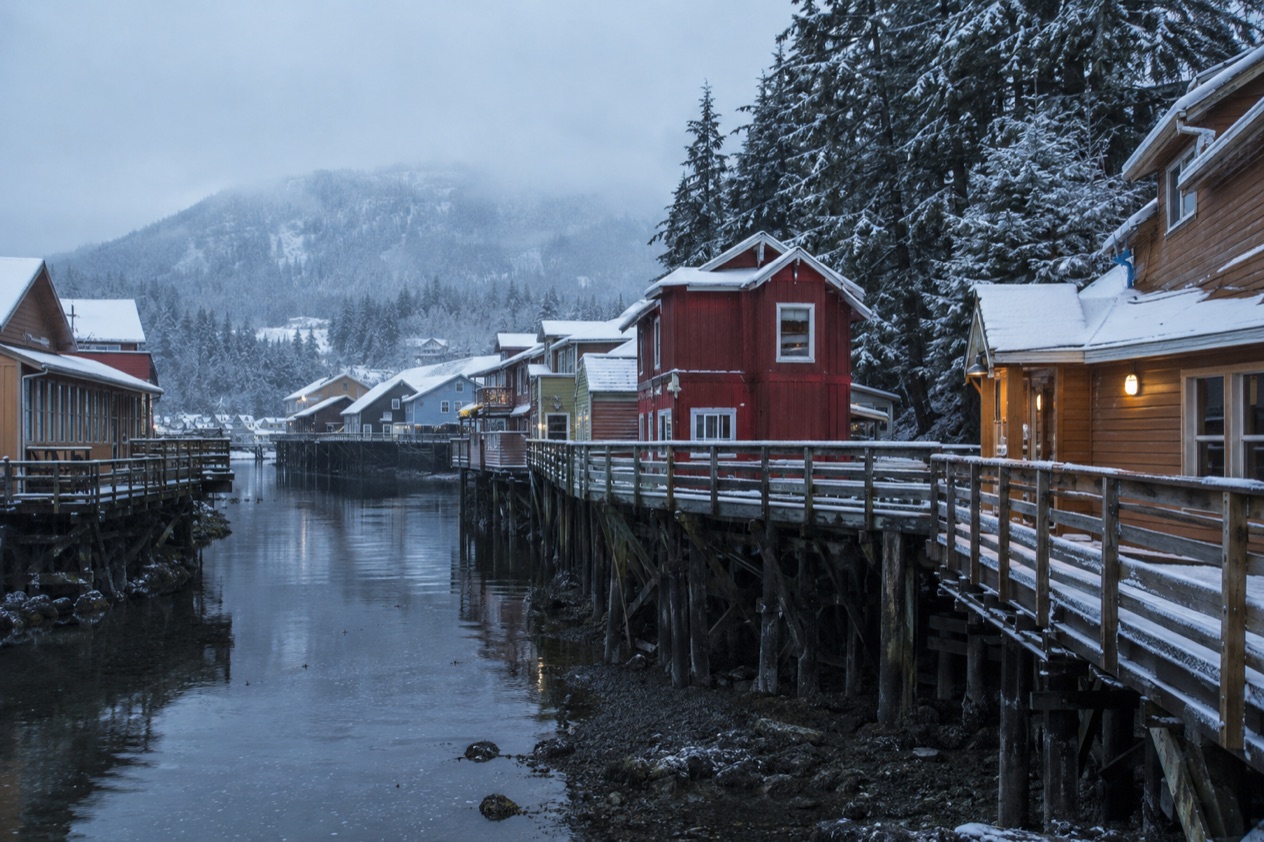
In February, Ketchikan’s waterfront is wet and quiet. Fishing boats rock in the harbor, gulls wheel over the Tongass Narrows, and Creek Street’s wooden boardwalk shines with rain. The summer crowds are long gone, and the town belongs to the people who live here. It is a month for walking slow, ducking into warm cafés and looking at totem poles in soft gray light.
What is the weather like in Ketchikan in February?
February in Ketchikan is cold, damp and gray, but not bitterly cold: afternoons stay just above freezing and rain falls on a little more than every other day.
| Month | Average high (°F) | Average low (°F) | Precipitation (in) | Days with precipitation | Daylight on the 15th |
|---|---|---|---|---|---|
| January | 39.7 | 31.5 | 16.17 | 17.1 | 7 h 41 min |
| February | 40.9 | 31.5 | 11.80 | 12.9 | 9 h 37 min |
| March | 43.6 | 32.4 | 10.98 | 16.0 | 11 h 43 min |
Mornings start near freezing, so the damp air feels sharper than the thermometer says, and puddles may have a skin of ice before the day warms a little. Afternoons climb into the low 40s, enough to walk the town without feeling pinched, as long as you are dressed in layers and something waterproof.
Rain is the usual companion. It tends to come as steady drizzle or passing showers, and some days the precipitation may fall as wet snow.
The light is the real change from January. Evenings are cold and dark early enough for a hot meal and a pub or a movie, and the harbor lights reflect on the wet streets.
A rain jacket with a hood matters more than an umbrella, since wind off the water can turn one inside out. Boots with grip help on the boardwalks and the steep streets, which can be slick when the cold meets the wet. The sea is for looking at, not swimming: it is cold and gray, and the pleasure is watching it from the shore or the window.
What to do in Ketchikan in February
February is the month to see Ketchikan as a working town rather than a port of call. The things that make it worth a trip, the totem poles, the creek-side boardwalk, the harbor and the forested mountain behind the town, are all here in a quieter mood, and the rain is part of the picture. This is the town nicknamed the Rain Capital of Alaska, and a visitor in winter understands why.
Walking is the heart of the month. The town stretches along the Tongass Narrows with Deer Mountain rising right behind it, and the waterfront is easy to follow on foot, with fishing boats, floatplanes and the occasional eagle on a piling. Stop for coffee and chowder in a café, and let a shower pass before heading out again.
Totem poles in the winter light
Ketchikan is known for holding the world’s largest collection of standing totem poles, spread across Saxman Totem Park, Totem Bight State Park, Potlatch Park and the Totem Heritage Center. Saxman lies just to the southeast of the city, and the others are reached from town as well. Rain darkens the carved cedar and brings out the reds, blacks and blue-greens of the paint, so a gray day is a good day to look.
The poles tell family histories and crests of the Tlingit, Haida and Tsimshian peoples, and standing in front of one in a quiet forest clearing without a tour group around you is a different experience from a summer visit. Take your time reading the figures from base to top: bears, eagles, ravens, whales and human faces stacked together. The Totem Heritage Center is the natural choice when the weather turns, because the old poles are kept indoors.
Pair a pole visit with a slow lunch in town and you have a full day without driving far. Keep a camera cloth in your pocket, since lenses fog and spot quickly in the damp.
Creek Street and the downtown waterfront
Creek Street is the old boardwalk of wooden buildings on stilts above the creek, and in February it is a good place to wander with few others around. The buildings, once part of the town’s rowdier past, now hold small shops and galleries, and some may keep shorter hours in winter. The creek runs fast with rain, and the sound of water under the planks follows you along.
From there, the downtown streets run along the water, with murals, small museums, fish-and-chips counters and bakeries. Look up at the mountainside, where low cloud often hangs in the trees and hides the summit of Deer Mountain. On a clear break the mountain appears suddenly, dark with spruce and hemlock, and the whole town seems to lift.
A walk in the late afternoon works best, as the lights come on and the harbor settles. Finish with a hot drink or a bowl of seafood soup, the sort of dish that suits a cold, wet day by the water.
Misty Fjords from a distance
Misty Fjords National Monument lies about 40 miles east of Ketchikan, along the Inside Passage coast, and covers more than two million acres of the Tongass National Forest. It is administered by the U.S. Forest Service. Its cliffs and fjords are the landscape people picture when they think of Southeast Alaska, and from town you can look toward that wild coast and imagine it under cloud.
If you want to feel the country, the forest around town and the shoreline paths give a taste of the same wet, green, mossy landscape.
Winter here is for rainforest atmosphere: moss thick on every trunk, creeks swollen, mist in the trees. That, rather than a long excursion, is what February offers.
A two-day itinerary for Ketchikan in February
Day 1 begins with a slow breakfast downtown, since mornings are cold and the light is late. Once the day has warmed a little, walk the waterfront and the streets behind it, stopping at the small museums and shops for shelter when a shower passes. Eat lunch at a harbor café, with something hot, then spend the afternoon on Creek Street, when the boardwalk is at its calmest.
As the light fades, return along the water for the lamps and the reflections on the wet pavement. Dinner at a seafood restaurant or a pub suits the early dark.
Day 2 is for the totem poles. Head out to Saxman Totem Park in the morning, when the light is soft and the carved figures stand clear against the trees, and walk slowly among them. Then move on to Totem Bight State Park, where the poles stand near the shore in a forest clearing.
Come back for lunch in town and spend the afternoon at the Totem Heritage Center, which gives shelter if rain returns and lets you see old poles up close. In the evening, a warm meal and an early night suit the season. With days of nearly ten hours of light, there is room to do all of this without rushing.
Is Ketchikan busy in February?
No, February is one of the quietest times in Ketchikan, a town better known for the cruise ships that bring more than 800,000 visitors a year in the warmer months.
In winter that rush is absent, and the town of about 14,000 people goes back to its own rhythms. Streets are calm, the waterfront is quiet, and you are likely to find yourself sharing a totem park with few others. Some seasonal shops and tour operators may be closed, so expect a town that feels more like home than a stage.
The pace suits travelers who like conversation at the counter and room to look around. It is a town of fishing, work and weather in February, and visitors are welcomed as part of that.
What to pack for Ketchikan in February
Pack for cold, wet days that rarely get far above freezing, with layers you can add or shed as you move between the street and indoor stops.
- A waterproof jacket with a hood, because rain falls on many days and wind off the water makes umbrellas unreliable.
- Waterproof boots with good grip for wet boardwalks and sloping streets.
- Warm layers such as fleece or wool, since mornings sit near freezing.
- A hat and gloves for damp, cold air on the waterfront.
- A small cloth for your camera lens in the mist and drizzle.
Good to know before you go
February is a quiet month, so plan around the short winter days and the possibility that seasonal businesses are closed. Ketchikan sits on Revillagigedo Island, about 700 miles northwest of Seattle, and the airport has a runway for planes plus a water runway for seaplanes. The town itself is compact along the Tongass Narrows, so the main sights cluster close together. Daylight is a useful guide: nearly ten hours in mid-month means the best outdoor time is the middle of the day, with the evening for indoor plans.
Ketchikan in February vs January and March
Moving the trip a month earlier brings a wetter, darker Ketchikan. February already feels lighter and a little drier, which makes walking easier.
A month later, March brings milder afternoons and much longer days, with light stretching well into the evening. Rain is still common, and the quiet is much the same, but the extra daylight gives more room for a long walk among the totem poles and along the water.
Travelers who want the deepest winter mood, with the town at its most hushed, can choose January. Those who want a balance of quiet and usable daylight will find February a sensible middle. If you prefer longer afternoons and a bit more warmth, March is the better pick.
Is February a good time to visit Ketchikan?
Yes, for travelers who like quiet towns, moody weather and cultural sights, and no for anyone who wants sunshine, long days or a busy summer waterfront.
You will enjoy February if you are happy in a rain jacket, like to wander slowly and care more about totem poles, wooden boardwalks and harbor views than about crowds and excursions. Those who want big outings into the wilderness or reliably clear skies should choose another month.
On arrival, start with a walk along the waterfront to get your bearings, then plan your totem pole visits for the brightest part of the day. What is special about February here is the feeling of seeing a town in its own season: rain on the carved cedar, creeks running loud under Creek Street, and a harbor that belongs to the people who work on it.
Sources
- NOAA NCEI, U.S. Climate Normals 1991-2020, monthly (https://www.ncei.noaa.gov/access/services/data/v1?dataset=normals-monthly-1991-2020&stations=USW00025325), station Ketchikan Intl Ap, elevation 76 feet, checked October 11, 2026
- Computed from the date and the latitude of the place (sunrise equation, solar elevation -0.833 degrees), October 11, 2026
- Wikivoyage, Ketchikan (https://en.wikivoyage.org/wiki/Ketchikan), checked October 11, 2026
- Wikipedia, Ketchikan, Alaska (https://en.wikipedia.org/wiki/Ketchikan,_Alaska), checked October 11, 2026
- Wikipedia, Ketchikan International Airport (https://en.wikipedia.org/wiki/Ketchikan_International_Airport), checked October 11, 2026
- Wikipedia, Misty Fjords National Monument (https://en.wikipedia.org/wiki/Misty_Fjords_National_Monument), checked October 11, 2026
- Wikipedia, Saxman, Alaska (https://en.wikipedia.org/wiki/Saxman,_Alaska), checked October 11, 2026
- Wikipedia, Climate of Alaska (https://en.wikipedia.org/wiki/Climate_of_Alaska), checked October 11, 2026
To plan your stay
- Things to Do in Ketchikan: Totem Poles, Creek Street, Misty Fjords and Fresh Seafood
- Where to Stay in Ketchikan: Downtown, Ward Cove and How to Choose Your Base
- Ketchikan from Seattle: Ferry from Bellingham, Flights, Cruise Docks and What to Do on Arrival
- Know Before You Go to Ketchikan: Rain, Cruise Docks, Bears and Local Customs